Many people spend a surprising amount of money on supplements while overlooking something much more basic.
Movement.
After hours of sitting at a desk, driving or looking down at a phone, the shoulders may begin to feel rounded.
The head may drift forward.
The upper back can feel stiff.
And muscles around the shoulder blades may feel as though they have barely worked all day.
These changes do not mean your internal organs are failing or your meridians are blocked.
Posture is influenced by many factors, including habits, strength, mobility, fatigue, pain, body proportions and the positions you spend the most time in.
The good news is that you do not need an expensive machine to start moving your upper back again.
The following three exercises combine upper body movement with simple lower body actions.
They can help train the shoulders, upper back, calves, hips, legs and balance at the same time.
Why the Upper Back Matters
The upper back includes the thoracic spine and a network of muscles surrounding the shoulder blades.
These muscles help position and move the scapulae when you reach, lift, pull and rotate your arms.
They also contribute to comfortable posture.
When people spend much of the day with the arms in front of the body, they may notice stiffness across the chest and upper back.
This does not necessarily mean the body has developed a structural problem.
But changing positions and regularly moving the shoulders through different ranges can feel very helpful.
Strengthening the back, shoulders, legs and other major muscle groups also becomes increasingly important as we age.
Regular strength training can help preserve physical function and independence.
Can Exercise Fix Rounded Shoulders?
Exercise can improve strength, mobility and awareness of posture.
But there is no single perfect posture that everyone must maintain all day.
Your body is designed to change position.
Rather than trying to hold the shoulders rigidly backward for hours, a better strategy is to move regularly.
Stand up.
Reach overhead.
Move the shoulder blades.
Walk.
Strengthen the upper back.
Change positions.
The best posture is often the next comfortable posture.
Exercise 1: Overhead Arm Raise With Heel Raise
This first movement combines shoulder mobility with calf strengthening and balance.
How to Do It
Stand with your feet approximately shoulder width apart.
Keep your knees relaxed.
Bring your arms out to the sides at approximately shoulder height.
Keep your hands open and your shoulders comfortable.
Slowly raise your arms upward.
At the same time, lift your heels and rise gently onto the balls of your feet.
Lower your heels as your arms return toward shoulder level.
Continue slowly.
Try 8 to 12 controlled repetitions.
What This Exercise Trains
The arm movement takes the shoulders through a larger range of motion.
Muscles around the shoulder blades must coordinate as the arms rise.
The heel raise activates the calf muscles.
Standing on the balls of the feet also creates a mild balance challenge.
This makes the exercise useful for people who want a simple whole body movement rather than an isolated shoulder stretch.
Do Not Force Your Arms Straight Overhead
Some people have excellent overhead mobility.
Others do not.
Your arms do not need to reach perfectly vertical.
Stop where your shoulders feel comfortable.
Do not force through pinching or sharp pain.
Modification for Older Adults
Stand beside a wall or sturdy chair.
Use one hand for support if necessary.
You can also perform the arm movement without the heel raise.
Once balance improves, gradually add the lower body component.
Exercise 2: Arm Open and Close With a Shallow Squat
The second movement emphasizes the muscles around the shoulder blades while adding lower body strength.
How to Do It
Stand with your feet comfortably apart.
Bring your hands together in front of your chest.
Open both arms out to the sides.
As the arms open, gently bend your hips and knees into a shallow squat.
Imagine sitting back toward a chair.
Return to standing while bringing the hands together again.
Repeat slowly.
Try 8 to 12 repetitions.
Focus on the Shoulder Blades
As your arms open, allow the shoulder blades to move naturally toward each other.
Do not aggressively pinch them together.
The goal is controlled movement rather than maximum force.
Keep your shoulders away from your ears.
You may feel muscles between and below the shoulder blades working.
Squat Depth Is Individual
You do not need a deep squat.
A small bend through the hips and knees is enough for beginners.
If you are older or have limited strength, place a chair behind you.
You can perform a controlled sit to stand instead.
Your Knees Can Move Forward
The idea that your knees must never move past your toes is too rigid.
Some forward knee movement is normal during squatting.
Individual anatomy, ankle mobility and squat depth all influence where the knees travel.
Focus instead on keeping the movement comfortable and controlled.
Your knees should generally track in a direction compatible with your feet rather than collapsing dramatically inward.
Why Combine the Squat With the Arm Movement?
The upper body works while the legs produce force.
This creates a simple coordination challenge.
The thighs and hips help you lower and rise.
The upper back and shoulders control the arm movement.
Your trunk stabilizes the two.
You are therefore training several physical abilities in one exercise.
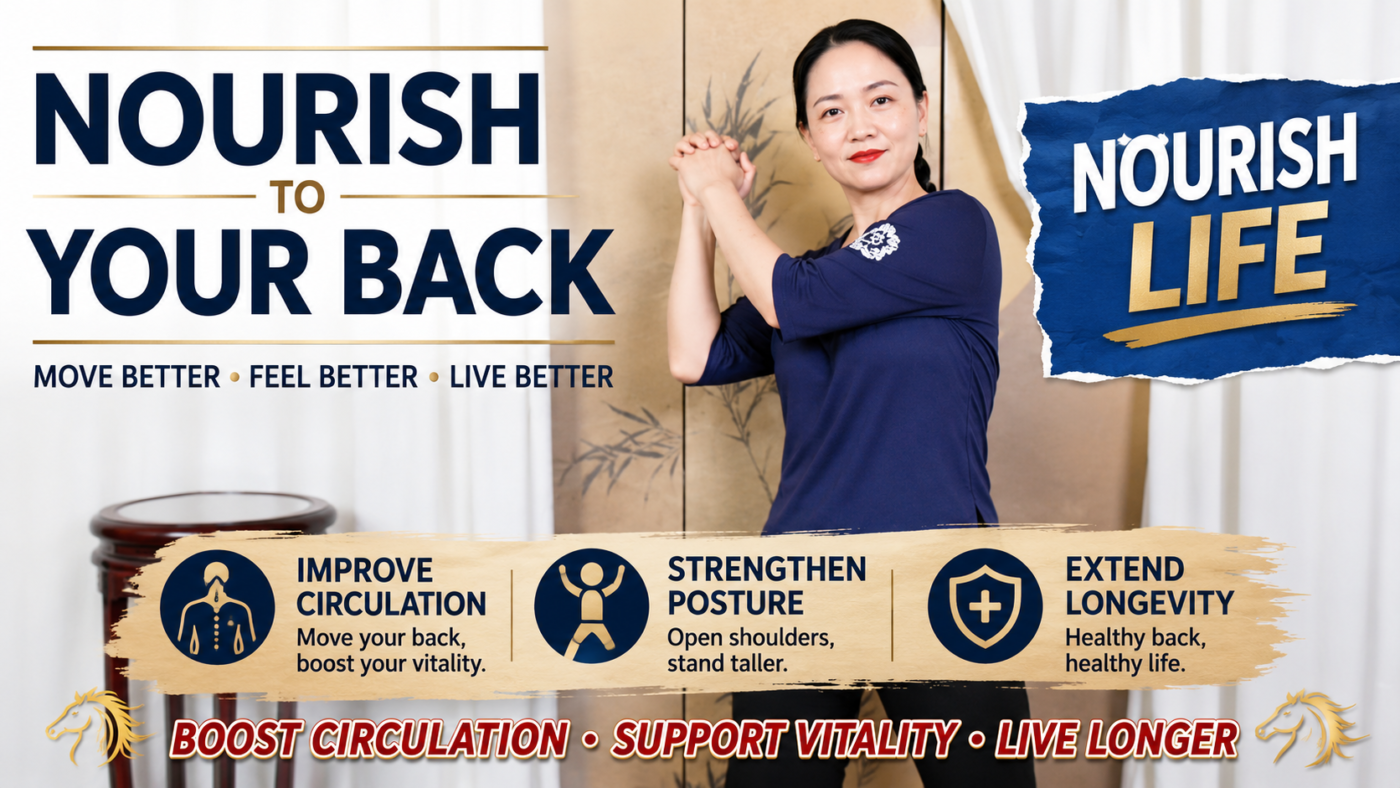
Exercise 3: Bent Elbow Back Opening With a Step Back
This third exercise combines shoulder blade movement with a controlled backward step.
How to Do It
Stand upright.
Bend both elbows approximately 90 degrees.
Keep the upper arms close to your sides.
Point your thumbs upward.
Gently move the forearms outward while allowing the shoulders to open.
At the same time, step your right foot backward.
If comfortable, allow the foot to move slightly behind the opposite side.
Return to the starting position.
Repeat with the left leg.
Continue alternating sides.
Try 5 to 10 repetitions on each side.
Keep the Step Small
You do not need a dramatic crossover step.
A simple straight backward step is safer for many people.
Older adults or anyone with balance problems should use a chair or countertop for support.
The exercise should challenge coordination without putting you at risk of falling.
What This Movement Trains
The arm action engages muscles around the upper and middle back.
The backward step requires hip control.
Your ankles and feet contribute to balance.
The trunk stabilizes as your weight shifts.
The result is a useful combination of upper back movement and whole body coordination.
What Should the Back Feel Like?
You may feel mild muscular effort around the shoulder blades and upper back.
A warm feeling after several repetitions is also normal.
Working muscles generate heat and receive increased blood flow.
That does not prove that a specific meridian or energy channel has opened.
It simply means your muscles are active.
What About Traditional Chinese Medicine?
Traditional Chinese movement practices sometimes describe the back as an important pathway for Yang energy and refer to the Du Mai, or Governing Vessel, running along the midline of the back.
This is part of the traditional Chinese medicine framework.
Modern anatomy does not identify a physical Du Mai that can be measured as an energy channel.
However, many traditional exercises emphasizing upright posture, spinal movement, breathing and shoulder opening can still be useful forms of physical activity.
Traditional interpretation and modern exercise physiology can therefore be discussed side by side without treating them as the same system.
Does a Thick Layer of Back Fat Mean Poor Organ Function?
No.
The amount of fat around the upper back does not provide a diagnostic test for the health of the internal organs.
Body fat distribution is influenced by genetics, age, sex hormones, overall body composition and energy balance.
You also cannot determine organ function by whether you can easily feel someone’s shoulder blades or spine.
Medical evaluation of organs requires appropriate history, examination and testing.
Can These Exercises Reduce Back Fat?
Not specifically.
You cannot choose where your body burns fat by exercising the muscles underneath that area.
This is known as the limitation of spot reduction.
Upper back exercises can strengthen and develop muscles in the area.
Regular physical activity can also contribute to overall energy expenditure.
But loss of body fat depends on overall energy balance and other individual factors.
Can These Exercises Make You Feel More Alert?
Possibly.
Getting up after prolonged sitting, moving the arms and legs and increasing physical activity can make some people feel more awake.
Movement increases muscular activity and changes breathing and circulation.
But feeling mentally refreshed after exercise should not be interpreted as proof that previously blocked energy has suddenly reached the brain.
What About Shoulder Cracking or Popping?
Some people hear clicking, cracking or popping sounds when moving the shoulders.
A painless sound does not automatically mean something is damaged.
Joints, tendons and surrounding tissues can create noises during movement.
However, shoulder sounds accompanied by persistent pain, swelling, weakness, instability or loss of motion deserve professional evaluation.
Do not repeatedly force a painful movement simply because you have been told that a joint needs to be opened.
Do These Exercises Prevent Colds?
No specific back exercise has been shown to guarantee that you will avoid colds during winter.
Regular physical activity supports overall health and is an important part of a healthy lifestyle.
But respiratory infections are caused by viruses.
Exercise does not create a protective barrier that prevents exposure or infection simply because your back becomes warm.
Sleep, vaccination when appropriate, hand hygiene, nutrition and reducing exposure to infectious illness all play roles in respiratory health.
A Simple 5 Minute Routine
Perform the overhead arm raise with heel raise for approximately one minute.
Rest briefly.
Perform arm opening with shallow squats for approximately one minute.
Rest.
Perform the bent elbow back opening with alternating step backs for approximately two minutes.
Finish with relaxed shoulder rolls and easy breathing.
You do not need to perform the movements quickly.
Quality and comfort matter more than speed.
How Often Should You Practice?
You can use these movements as a short mobility break during the day.
They may be especially useful after long periods of sitting.
For long term strength, however, a few minutes of mobility work should be combined with more complete exercise.
Healthy adults generally benefit from regular aerobic activity and muscle strengthening.
Older adults also benefit from balance training.
Your overall program might include walking, resistance exercises, squats, rows, calf raises and balance work.
One Important Limitation
These three movements are not a complete back strengthening program.
They use body weight and relatively light resistance.
If your goal is substantially stronger upper back muscles, progressive resistance training is more effective.
Examples include resistance band rows, cable rows, dumbbell rows and other pulling exercises appropriate for your ability.
The three movements in this article work best as mobility, coordination and light strengthening exercises.
When to Be Cautious
Use a smaller range if you have significant shoulder arthritis.
Use support if you have poor balance.
Modify or avoid overhead movement after recent shoulder surgery unless your rehabilitation professional has approved it.
Stop if you develop sharp shoulder pain, chest pain, severe dizziness or sudden weakness.
Persistent neck or back pain accompanied by numbness, weakness or pain traveling into an arm or leg deserves medical evaluation.
Frequently Asked Questions
What Are Good Upper Back Exercises for Posture?
Exercises that strengthen the muscles around the shoulder blades and move the shoulders through comfortable ranges can be useful.
Rows, controlled arm opening and resistance band pulling exercises are common examples.
Can Upper Back Exercises Fix Forward Head Posture?
They may improve strength and body awareness, but forward head posture has many influences.
Regularly changing position and reducing prolonged static posture are also important.
How Often Should I Exercise My Upper Back?
Light mobility movements can often be performed regularly.
More challenging strength training usually requires recovery between sessions.
Can Older Adults Perform These Exercises?
Many older adults can perform modified versions.
Use a wall, countertop or sturdy chair for balance and keep squats and steps shallow.
Should My Shoulder Blades Hurt During Exercise?
No.
Muscular effort is normal.
Sharp pain or persistent pain is not a goal.
Is Shoulder Cracking During Exercise Dangerous?
Painless clicking can occur normally.
Painful clicking, swelling, weakness or loss of motion should be evaluated.
Will These Exercises Remove Back Fat?
No exercise can selectively remove fat from one body area.
The movements can strengthen the muscles underneath the area but cannot guarantee localized fat loss.
Can Back Exercises Improve Immunity?
Regular physical activity supports overall health and normal immune function.
However, no specific back routine has been proven to prevent colds or other infections.
Bottom Line
You do not need expensive supplements to give your body one of the most important things it needs.
Regular movement.
Three simple exercises can help move the shoulders, activate the upper back, strengthen the legs and calves and challenge balance.
Start with an overhead arm raise combined with heel raises.
Add arm opening with shallow squats.
Finish with bent elbow shoulder opening and controlled step backs.
Keep the movements comfortable.
Use support when necessary.
Do not force painful ranges.
And do not worry about making every repetition look perfect.
These exercises do not unblock internal organs, melt back fat or guarantee protection from winter illness.
Their real benefits are more practical.
More movement.
Better shoulder mobility.
Stronger muscles.
Improved coordination.
Balance practice.
Less time spent sitting still.
Those are powerful reasons to include them in your daily routine.
Affiliate Disclosure
This article may contain affiliate links. If you purchase through one of these links, we may earn a commission at no additional cost to you. Affiliate relationships do not influence our editorial standards or health recommendations.
Medical Disclaimer
This article is for educational and informational purposes only and is not medical advice. Exercise should be adapted to individual health, mobility and medical conditions. Consult a qualified healthcare professional or physical therapist if you have persistent shoulder, neck or back pain, significant balance problems, recent surgery or other medical concerns before beginning a new exercise routine.
This article is for general education and does not replace individualized care from a qualified health professional. Seek appropriate advice for persistent, severe, or concerning symptoms.
Read the full medical disclaimer