A quiet room should feel peaceful. For someone living with tinnitus, however, silence may reveal ringing, buzzing, humming, hissing, clicking, or roaring sounds that no one else can hear.
Tinnitus is the perception of sound without an external source. It may affect one ear, both ears, or seem to come from inside the head. Surveys suggest that approximately 10% to 25% of adults experience tinnitus, although its duration and severity vary greatly from person to person.
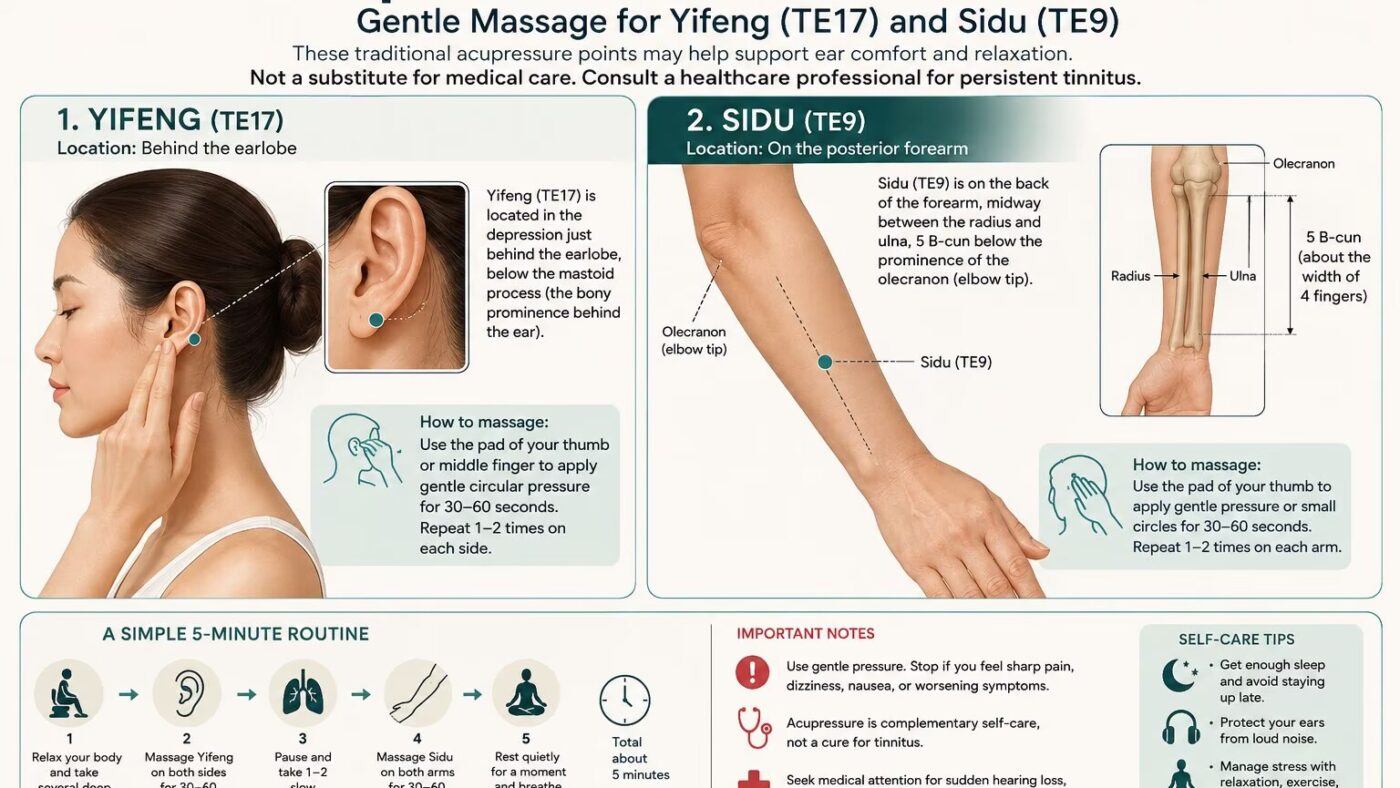
Traditional Chinese wellness practices often include gentle massage of points around the ears and along the Sanjiao, or Triple Energizer, meridian. Two points commonly discussed in relation to ear discomfort are Yifeng, or TE17, behind the ear and Sidu, or TE9, on the forearm.
Gently massaging these areas may provide a relaxing self-care ritual. However, acupressure should not be presented as a guaranteed treatment or cure for tinnitus. Current clinical guidance concludes that there is not enough evidence to recommend either for or against acupuncture for persistent, bothersome tinnitus, while research specifically examining self-administered acupressure remains even more limited.
Why Does Tinnitus Happen?
Tinnitus is a symptom rather than one single disease.
It is commonly associated with hearing loss and exposure to loud sound. Other possible contributors include earwax blockage, ear infections, certain medications, head or neck injuries, jaw-joint problems, Ménière’s disease and some blood-vessel conditions. In many people, no single cause can be identified.
The original wellness teaching connects irregular sleep with imbalance in the Sanjiao meridian. Within traditional Chinese medicine, this is a traditional explanatory framework rather than an established biomedical cause of tinnitus.
Poor sleep, fatigue and emotional stress may make tinnitus feel more noticeable or difficult to tolerate. Maintaining a regular sleep schedule may therefore support general well-being, but going to bed earlier cannot guarantee that tinnitus will disappear.
1. Yifeng Acupoint: TE17
Yifeng, sometimes translated as “Wind Screen,” is located immediately behind the earlobe.
According to standardized acupuncture-point descriptions, Yifeng lies behind the earlobe in a small depression near the lower end of the mastoid process—the firm bony prominence behind the ear. The World Health Organization’s acupuncture-point standard provides internationally recognized anatomical references for locating points such as TE17.
How to Find Yifeng
Place the pad of your middle finger behind the earlobe.
Move the finger slightly forward and downward until it rests in the soft depression between the jaw area and the bony prominence behind the ear.
Opening the mouth gently may make this depression easier to feel.
Do not use a fingernail, pointed massage tool or excessive pressure. The area behind the ear contains sensitive nerves and other anatomical structures.
How to Massage Yifeng
Use the soft pad of your thumb or middle finger.
Apply light pressure and make small, slow circles for approximately 30 to 60 seconds. Release the pressure, rest briefly and repeat once or twice if the area remains comfortable.
Massage both sides unless a health professional has advised otherwise.
A mild sensation of warmth, dull pressure or slight tenderness may occur. The point does not need to hurt for the massage to be effective as a relaxation technique.
Stop immediately if you experience:
* Sharp or electric-like pain
* Strong dizziness or nausea
* Facial weakness or numbness
* Sudden hearing changes
* Worsening ear pressure or tinnitus
2. Sidu Acupoint: TE9
Sidu is located on the posterior side of the forearm along the traditional Sanjiao meridian.
The correct standardized location is on the back of the forearm, midway between the radius and ulna, approximately 5 bone-proportional cun below the prominence of the elbow, or olecranon.
This is important because Sidu is sometimes incorrectly described online as simply “three finger-widths below the elbow crease.” That description does not accurately represent the standardized location.
What Does “Cun” Mean?
A cun is a proportional body measurement used in acupuncture-point location. It is not a fixed measurement in centimetres or inches, and it should not automatically be converted into three ordinary finger-widths.
Because individual arm proportions differ, a licensed acupuncturist or trained traditional medicine practitioner is best qualified to identify the exact point.
For home acupressure, it is safer to massage the general soft-tissue region gently rather than pressing forcefully in an attempt to locate one precise spot.
How to Find the General Sidu Region
Turn the palm downward so the back of the hand faces upward.
Bend the elbow slightly and locate the pointed bone at the back of the elbow. Imagine a line extending from the elbow point toward the centre of the back of the wrist.
The Sidu region lies along this line, between the two forearm bones and closer to the elbow than to the wrist.
Do not press deeply into the gap between the bones.
How to Massage Sidu
Support one forearm with the opposite hand.
Place the broad pad of the thumb over the general Sidu region. Apply gentle, steady pressure or make small circular movements for 30 to 60 seconds.
Release the pressure and allow the arm to relax. Repeat once or twice before changing sides.
A comfortable session should not leave bruising, numbness or lingering soreness.
A Gentle Five-Minute Acupressure Routine
This simple routine can be used as a brief relaxation practice.
Step 1: Relax Your Posture
Sit comfortably with your shoulders lowered.
Unclench the jaw, let the tongue rest naturally and take three slow breaths.
Step 2: Massage Yifeng
Use the middle fingers to massage the Yifeng region behind both ears.
Continue for 30 to 60 seconds using gentle circular movements.
Step 3: Pause and Breathe
Remove your hands and take one or two slow breaths.
Notice whether the jaw, neck and shoulders feel more relaxed.
Step 4: Massage Sidu
Massage the general Sidu region on one forearm for 30 to 60 seconds.
Change arms and repeat.
Step 5: Finish Without Forcing a Result
Rest quietly for one minute.
Do not repeatedly check whether the tinnitus has disappeared. The goal of the routine is comfortable relaxation rather than forcing an immediate change in symptoms.
The original video recommends pressing each point for three to five minutes and continuing until the tenderness disappears. For unsupervised home massage, shorter and gentler sessions are more cautious. More pressure and longer massage do not necessarily produce better results.
Can Acupressure Cure Tinnitus?
There is currently no reliable evidence that pressing Yifeng, Sidu or any other individual acupoint can permanently cure tinnitus.
Some people may feel temporarily calmer after massage. Others may notice that touching the head, jaw or neck briefly changes the pitch or intensity of their tinnitus. This type of change may occur in somatosensory tinnitus, in which movement or touch alters the perceived sound.
A temporary change does not prove that the underlying cause has been treated.
Professional tinnitus guidance states that the available evidence is insufficient to make a recommendation for or against acupuncture in persistent, bothersome tinnitus. Acupressure should therefore be described as an optional complementary wellness practice rather than a proven medical treatment.
Common Acupressure Mistakes to Avoid
Pressing Until the Area Stops Hurting
Pain is not proof that the correct point has been found.
Repeatedly pressing a tender area until it becomes numb or no longer hurts may irritate the skin, muscles or nerves. Pressure should remain mild and comfortable.
Assuming Tenderness Means a Meridian Is Blocked
Tenderness alone cannot diagnose a blocked meridian or reveal the cause of tinnitus.
It may be related to muscle tension, repeated touching, local irritation or normal anatomical sensitivity.
Massaging Directly Over Irritated Skin
Avoid massage over:
* Cuts or open wounds
* Swelling or infection
* Recent surgical sites
* Unexplained lumps
* Severe skin irritation
* Fresh bruising
Using Acupuncture Needles at Home
Acupressure uses fingers or blunt surface pressure. Acupuncture involves needle insertion and should only be performed by an appropriately trained and licensed practitioner.
Improperly delivered acupuncture can cause infections, organ injury, collapsed lung and injury to the nervous system. Traditional Chinese medicine should not be used to replace or delay necessary conventional care.
When Tinnitus Needs Medical Evaluation
Brief tinnitus after loud sound exposure may improve, but persistent, new or worsening symptoms should not be ignored.
Arrange an evaluation with a doctor, audiologist or ear, nose and throat specialist when tinnitus:
* Persists or becomes progressively worse
* Occurs mainly in one ear
* Interferes with sleep, concentration or daily life
* Is accompanied by noticeable hearing difficulty
* Sounds as though it is pulsing with the heartbeat
* Begins after a head or ear injury
* Occurs with ear pain, drainage or bleeding
* Is associated with dizziness or balance problems
Clinical guidance recommends prompt hearing evaluation for people with one-sided tinnitus, persistent bilateral tinnitus or reported hearing difficulty. Imaging may be considered when tinnitus is pulsatile, one-sided, associated with asymmetric hearing loss or accompanied by focal neurological abnormalities.
Sudden Hearing Loss Is an Emergency
Seek urgent medical attention when tinnitus appears together with sudden or rapidly worsening hearing loss, especially if one ear suddenly feels blocked or muffled.
Sudden sensorineural hearing loss may also cause ear fullness, dizziness and tinnitus. The National Institute on Deafness and Other Communication Disorders advises treating sudden hearing loss as a medical emergency because delayed assessment and treatment can reduce the likelihood of hearing recovery.
Do not spend several days trying pressure-point massage before seeking help for sudden hearing loss.
Evidence-Based Ways to Manage Persistent Tinnitus
Treatment depends on the underlying cause, hearing ability and the effect tinnitus has on everyday life.
A healthcare professional may first check for earwax, infection, medication effects or another identifiable condition. Hearing tests can reveal hearing loss that may otherwise go unnoticed.
Depending on individual needs, management may include:
Hearing Aids
For people who have both tinnitus and hearing loss, hearing aids may make surrounding sounds easier to hear and make tinnitus less noticeable.
Sound Therapy
Low-level background sound may reduce the contrast between tinnitus and a quiet room.
Fans, sound generators, soft nature recordings or suitable smartphone applications are sometimes used for relaxation and sleep.
Cognitive Behavioral Therapy
Cognitive behavioral therapy does not remove the sound itself, but it can help reduce distress and change the way a person responds to tinnitus.
Clinical guidance recommends cognitive behavioral therapy for persistent, bothersome tinnitus.
Hearing Protection
Repeated or intense noise exposure can damage hearing and trigger or worsen tinnitus.
Use suitable hearing protection around concerts, machinery, power tools, firearms and other hazardous sound environments. Avoid complete overprotection during ordinary daily activities, as excessive silence may make tinnitus more noticeable.
Healthy Sleep Habits
A regular bedtime, reduced late-night stimulation, moderate daytime activity and quiet background sound may make nighttime tinnitus easier to tolerate.
These habits support symptom management but should not be advertised as a cure.
Frequently Asked Questions
Can Yifeng and Sidu Make Tinnitus Disappear?
There is no guarantee that these points will reduce or eliminate tinnitus. Some people may feel more relaxed or notice a temporary change, while others may notice no effect.
How Long Should I Massage Each Point?
For home self-care, begin with 30 to 60 seconds per area. Repeat once or twice only when the pressure remains comfortable.
Long sessions are not automatically more effective.
Should the Points Feel Painful?
No. Mild pressure or tenderness may occur, but sharp, burning, electrical or increasing pain is a reason to stop.
Can I Perform This Routine Several Times a Day?
A brief session once or twice daily may be reasonable for most healthy adults when it causes no irritation. Reduce the frequency if the skin or underlying tissues become sore.
Can Acupressure Replace a Hearing Test?
No. Tinnitus is frequently associated with hearing loss, and a hearing evaluation can help identify problems that massage cannot diagnose.
Who Should Avoid This Routine?
Consult a healthcare professional before using acupressure around the ear or forearm if you have recently undergone surgery, have a serious neurological condition, take blood-thinning medication, have an active infection or have unexplained swelling or pain.
Final Takeaway
Yifeng and Sidu are traditional acupoints used in Chinese wellness practices for ear-related discomfort.
A gentle massage routine may help release tension around the jaw, neck and forearms and may offer a brief sense of relaxation. It should not be described as a guaranteed method for preventing, treating or curing tinnitus.
Use comfortable pressure, keep sessions brief and stop when symptoms worsen. Most importantly, seek professional evaluation for persistent, one-sided or pulsatile tinnitus and obtain urgent medical care when ringing is accompanied by sudden hearing loss.
This article is provided for general education and wellness information only. It does not provide medical diagnosis or treatment and should not replace advice from a qualified healthcare professional. Acupressure is not a proven cure for tinnitus. Seek urgent medical attention for sudden hearing loss, rapidly worsening hearing, severe dizziness, neurological symptoms, ear injury, drainage or bleeding.
This article is for general education and does not replace individualized care from a qualified health professional. Seek appropriate advice for persistent, severe, or concerning symptoms.
Read the full medical disclaimer