Tight hamstrings can make everyday movement surprisingly uncomfortable. Sitting with your legs straight may feel difficult. Your knees may refuse to fully straighten. A forward bend may stop long before your hands reach your feet. You may also notice tension through the backs of your thighs, calves, hips, or lower back.
This has led to an increasingly popular claim online: loosen your hamstrings and your body will start burning fat more easily.
It sounds appealing—but the reality is more nuanced.
Stretching your hamstrings does not directly cause body fat to melt away, dramatically increase your metabolism, or replace aerobic exercise and strength training. However, improving flexibility can make movement more comfortable for some people. When walking, exercising, getting up from the floor, bending, and other daily activities feel easier, staying physically active may become easier too.
That indirect connection is far more realistic—and far more useful.
This guide explains why hamstrings become tight, how they interact with your hips, knees and lower back, what research actually says about stretching, and how to try a gentle floor-based mobility routine without forcing your body into painful positions.
What Are the Hamstrings?
The hamstrings are a group of muscles running along the back of the thigh.
They primarily include:
- Biceps femoris
- Semitendinosus
- Semimembranosus
These muscles help bend the knee and extend the hip. They are involved in walking, running, climbing stairs, standing from a chair and many other everyday movements.
The gluteal muscles, calf muscles and spinal muscles are not technically part of the hamstrings, although they all participate in the larger movement system sometimes informally called the posterior chain.
This distinction matters because stiffness experienced during a forward bend does not necessarily originate only in the hamstrings.
Hip mobility, calf flexibility, joint structure, neural tension, movement habits and spinal mobility can all influence how far you can comfortably bend forward.
Why Do Hamstrings Feel Tight?
There is no single explanation.
Long periods of sitting can contribute to a feeling of stiffness, particularly when daily activity is low. Limited movement variety, previous injury, exercise habits, individual anatomy and nervous-system sensitivity may also influence flexibility.
Some people simply have less natural range of motion than others.
And feeling “tight” does not always mean that a muscle has physically shortened.
What you experience as tightness can involve your nervous system’s tolerance for stretch as well as the mechanical properties of muscles and surrounding tissues.
That is one reason aggressive stretching is not necessarily more effective.
Gentle, repeated exposure to comfortable ranges of motion is usually a much better strategy.
Do Tight Hamstrings Cause Poor Posture?
Not automatically.
Posture is affected by many structures and behaviors, including the pelvis, spine, hips, muscles, habitual sitting positions and the task you are performing.
Hamstring tension can influence pelvic movement in certain positions, especially when the knees are straight and the hips are flexed.
For example, someone with limited hamstring flexibility may compensate during a seated forward bend by rounding the lower back rather than moving primarily from the hips.
But describing hamstring tightness as the single cause of “bad posture” oversimplifies how the body works.
There is also no single perfect posture that must be maintained all day.
Changing positions regularly and maintaining adequate movement capacity are generally more useful goals than trying to hold the body rigidly upright for hours.
Are Tight Hamstrings Connected With Lower Back Pain?
There may be a relationship, but it should not be exaggerated.
Some research has found an association between limited hamstring range of motion and lower-back problems, while other reviews have emphasized that the quality of evidence is limited and does not establish a simple cause-and-effect relationship.
Lower-back pain can arise from many factors.
Muscle strength, sleep, stress, previous injury, activity level, work demands, neurological conditions and other health issues can all play a role.
More recent research examining people who already have lower-back pain suggests that hamstring stretching may improve pain and function in some populations when incorporated into rehabilitation.
That does not mean every person with back pain needs to stretch their hamstrings.
It means flexibility training can be one useful tool within a broader movement program.
Will Loosening Your Hamstrings Burn More Fat?
This is where the viral claim goes too far.
Stretching itself uses relatively little energy compared with activities such as brisk walking, cycling, swimming, resistance training or running.
Looser hamstrings do not switch on a hidden fat-burning mechanism.
Body fat decreases over time when energy expenditure exceeds energy intake, producing a sustained calorie deficit.
Regular physical activity can increase energy expenditure, and dietary intake plays an especially important role in weight management. The CDC notes that physical activity combined with reducing calorie intake creates the calorie deficit responsible for weight loss. 疾病控制与预防中心
So where could flexibility matter?
Imagine that stiff legs, uncomfortable hips or limited mobility make walking and exercise unpleasant. If improved flexibility helps you move with greater comfort, you may become more willing to walk, exercise or remain active throughout the day.
That additional movement—not the stretch itself—is what could eventually contribute to weight management.
It is an indirect relationship.
What Stretching Can Actually Do
Stretching has a much stronger scientific basis for improving flexibility than for burning fat.
A large systematic review and meta-analysis involving thousands of adults found that static stretching improved flexibility both immediately and when practiced over time. The researchers also found particularly meaningful flexibility improvements in people who started with poor flexibility. PubMed
That means you do not have to force yourself into an extreme forward fold.
Consistency matters considerably more than turning every session into a flexibility contest.
A Gentle Hamstring and Posterior-Chain Mobility Routine
The following sequence is inspired by traditional floor-based mobility practice but has been modified to remove unsupported claims and unnecessarily aggressive techniques.
The goal is not pain.
The goal is gradually increasing comfortable movement.
1. Check Your Starting Position
Sit on the floor with both legs extended in front of you.
Point your toes toward the ceiling.
Notice three things:
Can your knees comfortably straighten?
Can you sit relatively upright?
Do you immediately feel strong tension behind your thighs?
Do not judge your flexibility.
This is simply your starting point.
You may find it useful to repeat the same position at the end of the routine.
2. Make Sitting Easier
If your pelvis rolls backward and your lower back rounds substantially, sit on a folded towel, cushion or yoga block.
Elevating the hips often makes the position much more comfortable.
There is no benefit in struggling to maintain a completely straight back while your entire body is fighting the position.
3. Gentle Lower-Back Movement
Instead of aggressively pinching or attempting to “release twisted fascia,” begin with gentle movement.
Sit comfortably or move onto your hands and knees.
Slowly tilt your pelvis forward and backward.
Allow your lower back to move naturally.
Breathe slowly.
Continue for approximately 30–60 seconds.
This can help you become more aware of pelvic movement before stretching the legs.
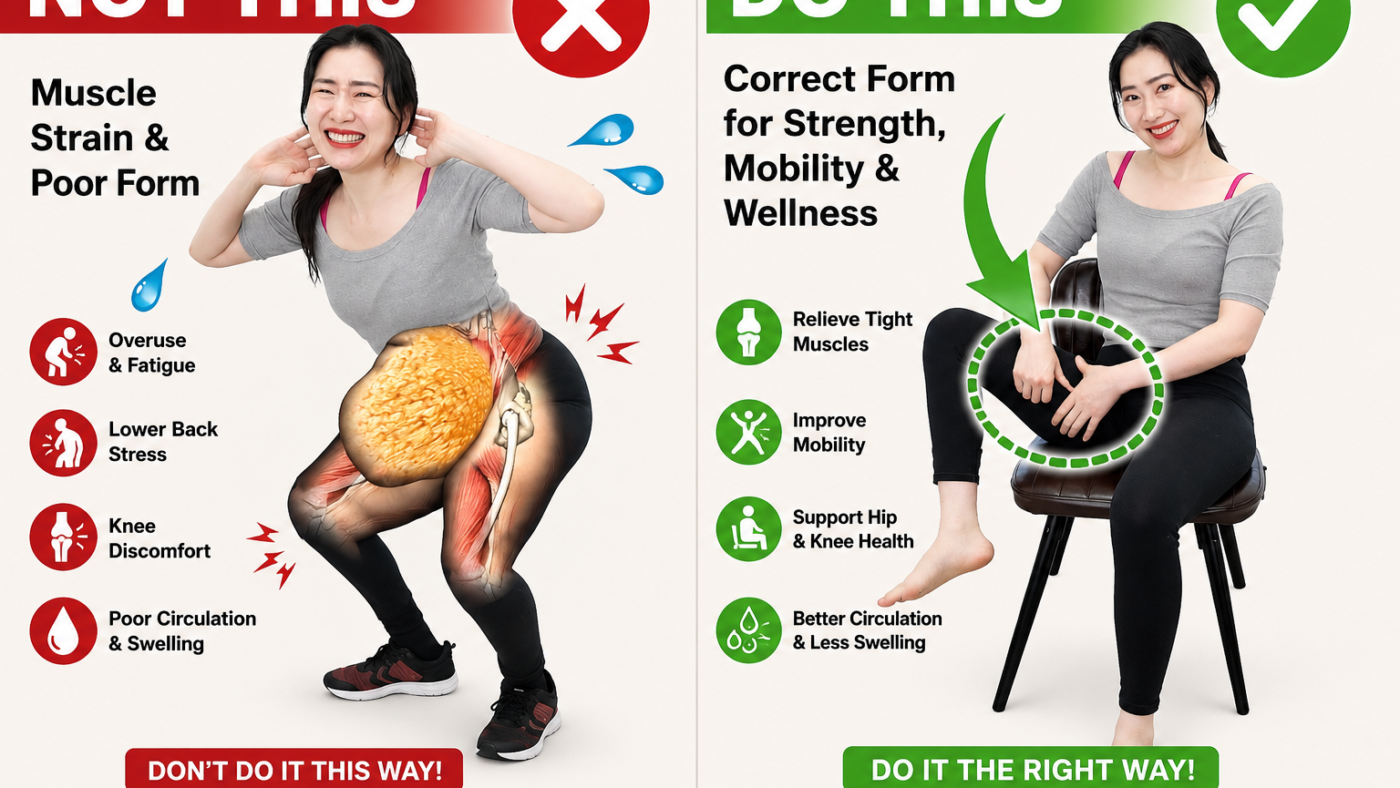
4. Gentle Hamstring Massage
Sit comfortably with one knee slightly bent.
Use your hands to gently massage the back of the thigh.
Work from higher on the thigh toward the area above the knee without applying hard pressure directly behind the knee joint.
The objective is relaxation, not breaking adhesions or forcing tissue to change position.
Repeat on the other leg.
Massage may temporarily change how the muscles feel, but it should not be painful.
5. Relax the Legs
Extend both legs loosely in front of you.
Gently shake the legs or alternate small movements at the hips and knees.
Keep the muscles relaxed.
This is less about “unlocking” tissue and more about reducing unnecessary muscular tension before the next movement.
6. Mobilize the Ankles
With one leg extended, slowly move the foot through a comfortable range.
Point the toes away.
Then bring them back toward you.
You can also make gentle circles in both directions.
Repeat with the other ankle.
Ankle mobility is important for walking, squatting and many other activities.
However, a stiff ankle should not automatically be blamed for knee pain, back pain or difficulty losing weight.
Human movement is rarely that simple.
7. Child’s Pose Relaxation
Kneel comfortably.
Bring your hips toward your heels and extend your arms forward.
Allow your forehead to move toward the floor or rest it on a cushion.
If your knees or ankles do not tolerate this position, skip it.
Take several slow breaths.
Think about relaxing the shoulders, hips and lower back instead of trying to stretch as deeply as possible.
Stay for approximately 30–60 seconds.
8. Pelvic Rocking
Return to a comfortable seated or hands-and-knees position.
Slowly alternate between a small forward pelvic tilt and a small backward pelvic tilt.
Avoid forcing the end range.
This gentle motion helps you practice separating pelvic movement from excessive spinal movement.
9. Single-Leg Hamstring Stretch
Extend one leg in front of you.
Bend the opposite knee into a comfortable position.
Sit tall without becoming rigid.
Slowly hinge forward from the hips until you feel a mild-to-moderate stretch along the back of the extended thigh.
You do not need to reach your foot.
Keep breathing.
Hold for approximately 20–30 seconds.
Come out of the position slowly.
Repeat on the opposite side.
10. Adjust the Knee When Necessary
The knee does not have to be completely locked.
A small bend is perfectly acceptable, especially for beginners.
As your tolerance improves, you can gradually straighten the leg while maintaining a comfortable stretch.
Sharp pain behind the knee is not a sign that the exercise is working better.
Back off if that occurs.
11. Supported Straight-Leg Stretch
Lie on your back if you find seated stretches difficult.
Raise one leg toward the ceiling and support the thigh with your hands or use a towel or stretching strap around the foot.
Keep the opposite leg bent if that feels better.
Slowly straighten the raised knee until you feel gentle tension.
This position often allows people to stretch the hamstrings without rounding the lower back.
Hold for 20–30 seconds.
Repeat on the other side.
12. Return to the Seated Position
Sit again with both legs extended.
Do not immediately try to touch your toes.
Instead, check whether sitting upright feels different from the beginning of the session.
You may notice:
- Less tension
- Easier knee extension
- A more comfortable hip hinge
- A slightly greater forward reach
- No noticeable change at all
All of these are acceptable outcomes.
One stretching session does not permanently remodel the body.
Progress comes from repetition.
How Hard Should a Stretch Feel?
Stretching should feel like controlled tension.
It should not feel like:
- Sharp pain
- Burning
- Electric sensations
- Sudden shooting pain
- Numbness
- Tingling
- Joint pain
Those sensations may indicate irritation of a nerve or another structure rather than a normal muscular stretch.
Stop and change position.
You never need to force yourself to achieve a specific shape.
How Long Should You Stretch?
There is no magic number.
Research consistently shows that several stretching approaches can improve hamstring range of motion.
A recent large meta-analysis found that flexibility benefits can be achieved without extremely long sessions; repeated modest stretching over time is effective. PubMed
For a simple home routine, try holding a comfortable stretch for roughly 20–30 seconds and repeating it two or three times.
A short routine practiced consistently is usually more realistic than an exhausting flexibility session performed occasionally.
Should You Stretch Every Day?
Gentle mobility can often be performed daily if it feels comfortable.
More intensive stretching does not necessarily need to be performed every day.
Start with three or four sessions each week and observe how your body responds.
People who sit for long periods may also benefit from simply standing up and moving more frequently.
Walking for a few minutes can sometimes be more useful than repeatedly stretching while continuing to remain sedentary for the rest of the day.
Don’t Forget Strength
Flexibility is only one component of healthy movement.
Strong hamstrings are important too.
Once basic mobility feels comfortable, consider combining stretching with exercises such as:
- Glute bridges
- Hip hinges
- Romanian deadlift variations
- Hamstring curls
- Step-ups
- Squats appropriate for your ability
- Walking
Strength training helps the muscles produce and tolerate force throughout available ranges of motion.
For long-term mobility, being both flexible and strong is generally more useful than maximizing flexibility alone.
What About Knee Pain?
If your knee hurts because it cannot fully straighten, do not assume that stretching will solve the problem.
Knee pain can come from many different structures and conditions.
Swelling, arthritis, meniscus problems, ligament injuries, tendinopathy, trauma and other causes can restrict knee motion.
If you have persistent knee pain, swelling, locking, instability or an inability to straighten the knee, seek professional evaluation rather than trying to force the joint flat against the floor.
What About Back Pain?
The same principle applies to the lower back.
A 2024 meta-analysis involving 14 randomized trials found that hamstring stretching was associated with improvements in pain and function among certain people with lower-back pain, although the studies showed substantial variation. PubMed
This makes stretching potentially useful—not universally curative.
Seek medical advice promptly if back pain occurs together with significant weakness, bowel or bladder changes, numbness around the groin, serious trauma, fever or other concerning symptoms.
Can You Become “20 Years Younger” by Stretching?
No exercise literally reverses chronological age by 20 years.
But maintaining mobility as you age can have a meaningful effect on how you function.
Being able to walk comfortably, reach the floor, rise from a chair, climb stairs and exercise with confidence can make everyday life feel very different.
That is a worthwhile goal without making anti-aging promises that science cannot support.
Flexibility and Healthy Aging
Mobility becomes especially important because physical activity supports health across adulthood.
Current public-health recommendations encourage adults to accumulate regular aerobic activity and muscle-strengthening exercise. WHO recommends approximately 150–300 minutes of moderate-intensity aerobic activity per week, or 75–150 minutes of vigorous activity, together with muscle-strengthening activity on at least two days. 世界卫生组织
Stretching cannot replace these forms of exercise.
Instead, think of flexibility work as something that may help you participate in them more comfortably.
A practical weekly program could contain:
Mobility + aerobic exercise + strength training + recovery
That combination has far more potential for healthy aging and weight management than hamstring stretching alone.
The Bottom Line
Tight hamstrings are common, and improving hamstring flexibility can make sitting, bending and certain forms of exercise feel easier.
Stretching has good evidence for improving range of motion.
It may also be helpful as part of rehabilitation for some people experiencing lower-back discomfort.
But loosening your hamstrings does not make fat “burn on its own,” dramatically increase metabolism or guarantee the disappearance of knee or back pain.
Instead of thinking:
“Stretch my hamstrings to lose weight.”
A better approach is:
“Improve mobility so I can move comfortably, exercise consistently and stay active.”
That small change in thinking turns an exaggerated internet promise into a realistic long-term health strategy.
And the best part is that you do not need to force yourself into extreme stretches.
Start gently.
Move regularly.
Build strength.
Walk more.
And allow flexibility to improve gradually.
Frequently Asked Questions
Can tight hamstrings make it harder to bend forward?
Yes. Limited hamstring flexibility can restrict hip flexion with the knees extended and may cause some people to compensate by rounding the lower back.
Does stretching hamstrings burn belly fat?
No. Hamstring stretching does not selectively burn belly fat or produce meaningful fat loss by itself. Fat loss requires a sustained energy deficit.
Can stretching increase metabolism?
Stretching requires some energy, but its calorie expenditure is relatively small. It should not be considered a metabolism-boosting weight-loss intervention.
Can tight hamstrings cause lower-back pain?
Limited hamstring flexibility has been associated with lower-back pain in some research, but the relationship is complex and does not prove that tight hamstrings are the cause of every case of back pain.
Can hamstring stretching help lower-back pain?
Some studies suggest it can improve pain and function for certain people with lower-back pain when used appropriately, but results vary and stretching should not replace proper evaluation when symptoms are persistent or severe.
Should my knees touch the floor when I sit with straight legs?
Not necessarily. Individual anatomy and flexibility vary. There is no requirement that the backs of everyone’s knees must lie completely flat.
Is it okay to bend my knees during a hamstring stretch?
Yes. A slight knee bend is often an excellent modification, especially for beginners.
How quickly can hamstring flexibility improve?
Some temporary increase in range of motion can occur after a single session, while longer-lasting improvements generally require repeated stretching over time.
Should stretching hurt?
No. Mild-to-moderate muscular tension is normal. Sharp, shooting, electrical or joint pain is a reason to stop.
Is stretching enough for healthy aging?
No. Stretching is useful for flexibility, but aerobic activity, strength training, balance, sleep and nutrition are also important components of healthy aging.
Medical Disclaimer: This article is for educational purposes only and is not medical advice. Stretching should not cause sharp or severe pain. People with persistent back or knee pain, recent injuries, neurological symptoms, significant mobility restrictions or other medical conditions should consult a qualified healthcare professional before beginning a new exercise program.
References
- Warneke K, et al. Optimising the Dose of Static Stretching to Improve Flexibility: A Systematic Review, Meta-analysis and Multivariate Meta-regression. Sports Medicine.
- Gou Y, Lei H, Chen X, Wang X. The Effects of Hamstring Stretching Exercises on Pain Intensity and Function in Low Back Pain Patients: A Systematic Review with Meta-analysis of Randomized Controlled Trials. SAGE Open Medicine. 2024.
- Sadler SG, Spink MJ, Ho A, Janse De Jonge X, Chuter VH. Restriction in Lateral Bending Range of Motion, Lumbar Lordosis, and Hamstring Flexibility Predicts the Development of Low Back Pain: A Systematic Review of Prospective Cohort Studies. BMC Musculoskeletal Disorders. 2017.
- Hori M, et al. Comparisons of Hamstring Flexibility Between Individuals With and Without Low Back Pain: Systematic Review With Meta-analysis. Physiotherapy Theory and Practice.
- World Health Organization. Physical Activity Recommendations for Adults.
- Centers for Disease Control and Prevention. Physical Activity and Your Weight and Health.
This article is for general education and does not replace individualized care from a qualified health professional. Seek appropriate advice for persistent, severe, or concerning symptoms.
Read the full medical disclaimer