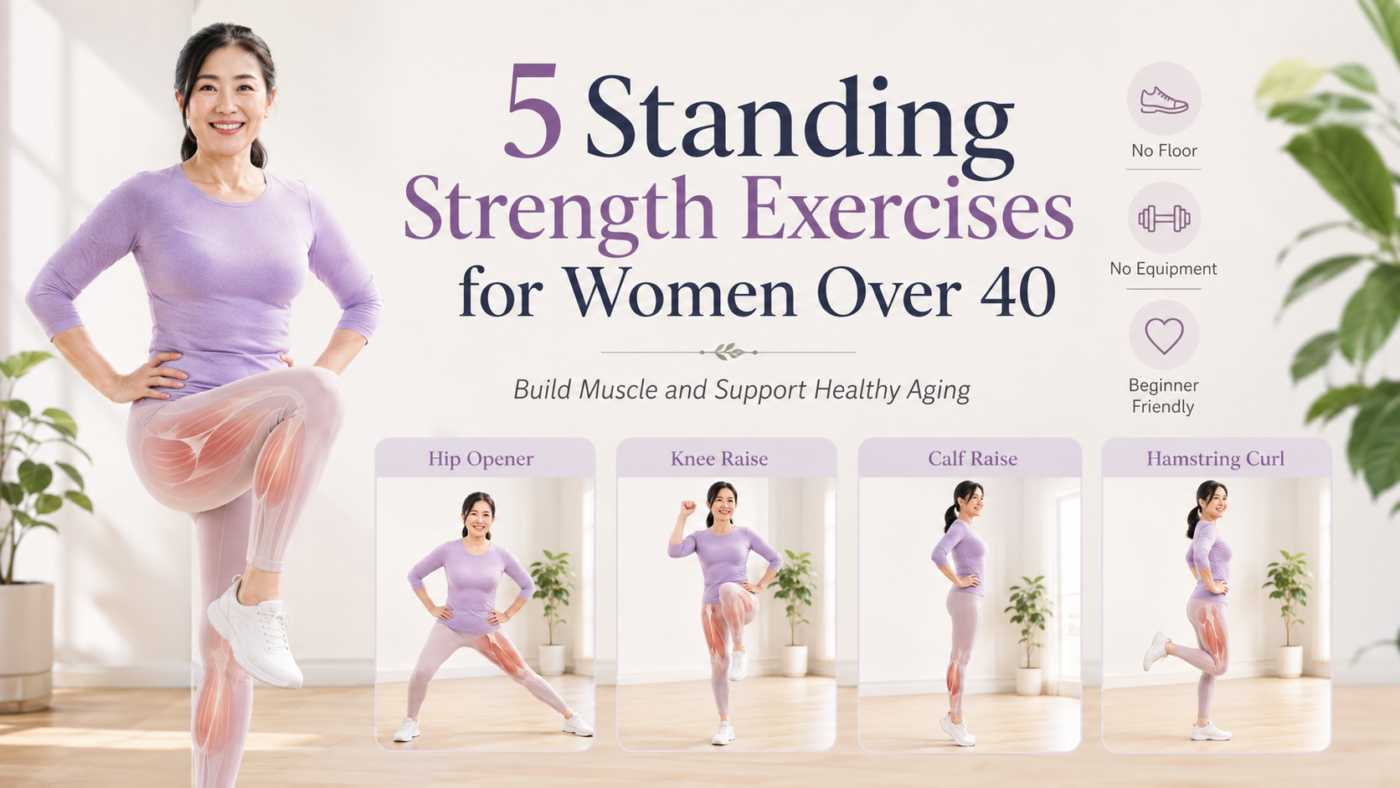
Standing strength exercises for women over 40 can help maintain muscle, improve mobility, and support healthy aging without requiring a floor workout.
Nutrition plays an important role in managing body weight, but focusing only on the number on the scale can overlook something that becomes increasingly important with age: muscle strength and muscle mass.
Skeletal muscle helps you stand, walk, climb stairs, maintain balance, support your joints and stay independent. As we get older, muscle mass, strength and power tend to decline. The National Institute on Aging notes that muscle performance generally peaks in early adulthood and gradually declines with age, with losses becoming more noticeable later in life. Regular strength training can help slow this decline and can improve strength even in older adults.
For women approaching or moving through menopause, paying attention to muscle becomes especially worthwhile. Hormonal changes may contribute to changes in muscle mass, strength and body composition, although menopause is only one factor among many, including activity level, nutrition and aging itself.
The encouraging part is that you do not necessarily need a gym or complicated equipment to start.
The following standing exercises target several major lower-body muscle groups and can be practiced at home with a sturdy chair or countertop for support.
Why Standing Strength Exercises for Women Over 40 Matter
Muscle is not literally a fountain of youth, and exercise cannot reverse biological aging.
But maintaining muscle can help preserve many abilities that people associate with healthy aging.
Age-related muscle loss, sometimes called sarcopenia when it becomes clinically significant, is associated with weakness, reduced mobility and greater difficulty performing everyday activities. Resistance exercise is one of the most important tools available for maintaining strength and limiting age-related muscle loss.
For women, the menopausal transition may add another layer.
Research suggests that postmenopausal women often have lower muscle mass and strength than premenopausal women, although scientists are still investigating exactly how much of this difference is caused directly by estrogen changes versus aging and lifestyle factors.
This is why strength training after 40 is not simply about looking toned.
It is an investment in mobility, balance and long-term physical independence.
Does Weight Loss Without Exercise Cause Muscle Loss?
Not necessarily—but it can.
Weight loss usually includes some combination of fat mass and lean tissue. In older adults especially, losing substantial weight without sufficient protein intake and resistance exercise may increase the amount of lean mass lost along with fat.
That does not mean dieting automatically leaves someone as “skin and bones,” as some fitness videos suggest.
Instead, the smarter strategy is often to combine appropriate nutrition with resistance exercise so that muscle is preserved as much as possible.
NIA-supported research has found resistance training particularly valuable when weight loss is part of the goal because it can help reduce loss of muscle mass.
Why Standing Exercises Are Useful
Many of the largest and most functionally important muscles are located in the hips and legs.
These include the:
- Gluteal muscles
- Quadriceps
- Hamstrings
- Calves
- Hip flexors
- Hip stabilizers
Training these muscles can make everyday movements such as walking, climbing stairs and rising from a chair easier.
Standing exercises also challenge balance and trunk control at the same time, making them particularly useful for functional fitness.
You do not need to perform them perfectly.
A chair, wall or countertop can provide extra stability.
Exercise 1: Supported Standing Hip Openers
Stand beside a sturdy chair or countertop and hold it lightly for support.
Shift your weight onto one leg.
Lift the opposite knee slightly and move it outward as comfortably as possible.
Then return the knee toward the center.
Continue slowly:
Open → return → open → return.
Aim for approximately 8 to 12 controlled repetitions before changing sides.
You should feel the muscles around the hip and gluteal region working.
Do not force the knee unusually high or rotate through pain.
Your comfortable range of motion is enough.
Why It Helps
The movement challenges muscles responsible for stabilizing and moving the hip.
Strong hip muscles contribute to balance, walking mechanics and control of the pelvis during everyday movement.
Exercise 2: Standing Knee Raises
Stand tall with your feet about hip-width apart.
You may place your hands behind your head, around your waist or on the back of a sturdy chair.
Slowly raise one knee toward your torso.
Lower it with control.
Alternate sides.
Try approximately 10 repetitions per side.
Keep your torso tall rather than leaning dramatically backward.
What About the Psoas?
Knee lifting involves the hip flexors, including the iliopsoas muscles.
These muscles are important for hip flexion and walking.
However, strengthening the psoas does not selectively burn lower-belly fat or automatically create a flat stomach.
A flatter abdomen depends on many factors, including body-fat distribution, nutrition, overall activity, posture, abdominal muscle development and genetics.
Standing knee raises are valuable because they strengthen movement patterns—not because they magically target belly fat.
Exercise 3: Standing Calf Raises
Stand behind a sturdy chair.
Place your hands lightly on the back for balance.
Slowly raise your heels until you are standing on the balls of your feet.
Pause briefly.
Then lower your heels slowly.
Repeat approximately 10 to 15 times.
Keep the movement controlled rather than bouncing.
Why Train Your Calves?
Calf muscles play an important role in walking, ankle stability and pushing your body forward during movement.
Strengthening them can also contribute to balance and lower-body function.
If balance is difficult, keep both hands firmly on the chair.
Exercise 4: Supported Single-Leg Calf Raise
Once the two-leg version feels comfortable, you can make the movement more challenging.
Hold the chair securely.
Shift more weight onto one leg.
Raise your heel slowly.
Lower it again with control.
Perform a small number of repetitions and then change sides.
You do not need to progress to this version immediately.
For many beginners, the two-leg calf raise provides plenty of challenge.
Progress only when you can maintain balance and good control.
Exercise 5: Standing Hamstring Curl
Stand behind your chair and hold it for support.
Shift your weight onto one leg.
Bend the opposite knee and bring your heel toward the back of your thigh.
Avoid swinging.
Slowly lower the foot.
Repeat approximately 8 to 12 times before switching legs.
Why Hamstrings Matter
Your hamstrings are involved in bending the knee and extending the hip.
They contribute to walking, running, climbing stairs and controlling the position of your pelvis and legs.
Strengthening them together with the glutes and quadriceps creates a more balanced lower-body program.
You Do Not Need to Feel a Burn for Exercise to Work
One of the most misleading fitness slogans is:
“If it burns, it’s working.”
A burning sensation during higher-repetition exercise can occur because of metabolic changes within working muscles.
But pain or intense burning is not required for muscle growth.
You can make progress without pushing every exercise to extreme discomfort.
Sharp pain, joint pain, dizziness, chest discomfort or sudden unusual weakness are reasons to stop.
Training should challenge you, not punish you.
Finish With a Gentle Hamstring Stretch
After the strength exercises, stand with one foot slightly forward.
Keep the front knee relatively straight but not forcefully locked.
Push your hips gently backward and lean forward slightly from the hips.
You should feel a comfortable stretch behind the thigh.
Breathe normally.
Hold for around 15 to 30 seconds.
Switch sides.
Avoid bouncing.
Standing Quadriceps Stretch
Hold the back of a sturdy chair.
Bend one knee and gently bring your heel toward your buttocks.
If comfortable, hold your ankle or pant leg.
Keep your knees relatively close together.
You should feel a stretch through the front of the thigh.
Hold approximately 15 to 30 seconds and change sides.
If grabbing your ankle is difficult, skip this stretch rather than forcing the position.
Will These Five Exercises Build Muscle?
They can contribute to improved muscular strength and endurance, particularly for beginners.
But significant muscle growth does not happen after one workout.
Muscle adaptation occurs gradually when muscles are challenged repeatedly and given sufficient recovery and nutrition.
As exercises become easy, continued improvement usually requires some form of progressive overload.
That might mean:
- Performing more repetitions
- Adding another set
- Slowing the movement
- Increasing range of motion
- Using resistance bands
- Eventually adding weights
The goal is gradual progression rather than extreme intensity.
Is Twice a Week Enough?
For many people, two strength-training sessions per week are an excellent starting point.
Current U.S. physical activity recommendations call for adults to perform muscle-strengthening activities involving the major muscle groups at least two days per week.
For adults 65 and older, recommendations also emphasize aerobic activity and exercises that improve balance.
That means a short standing routine can be useful, but it works best as part of a broader activity plan.
Walking, cycling, swimming, resistance exercise, mobility work and balance exercises can complement one another.
What About Menopause and Muscle?
The relationship deserves more nuance than the claim that “female hormones fall, so your muscles disappear.”
Estrogen levels decline substantially during menopause, and research suggests estrogen may influence skeletal muscle physiology.
Studies have found changes in lean mass, muscle mass and strength across the menopausal transition. At the same time, researchers caution that the precise contribution of estrogen remains difficult to separate from aging, activity levels, protein intake and other factors.
The practical lesson is much simpler:
Women do not need to wait until significant muscle loss occurs before thinking about strength.
Regular resistance exercise can begin in the 20s, 30s, 40s and beyond.
Does Muscle Make Your Skin Younger?
The relationship is not that simple.
Exercise affects many biological signaling systems and contracting skeletal muscle releases signaling molecules known as myokines.
Physical activity can also support circulation, metabolic health, sleep and psychological well-being.
But it would be misleading to promise that building leg muscle causes the brain to release special hormones that directly make the skin glow or reverse aging.
Exercise supports healthy aging through many interconnected mechanisms.
That is already impressive enough without exaggerating the science.
Can Strength Training Help Your Mood?
Physical activity can support mental as well as physical health.
Regular activity is associated with benefits for mood, sleep and overall quality of life.
This does not mean exercise replaces professional treatment for depression, anxiety or other mental-health conditions.
It simply means that movement is one valuable part of overall well-being.
Strength Is More Important Than Chasing Youth
Fitness marketing often promises to “turn back the clock.”
A better goal is to increase the number of years in which you can move comfortably and independently.
The National Institute on Aging emphasizes that strength training can help maintain muscle mass, improve mobility and support healthier years of life.
You cannot literally reverse your chronological age.
But you can improve strength.
You can improve balance.
You can improve physical capacity.
And you can continue gaining strength much later in life than many people assume.
That is a far more meaningful definition of healthy aging.
A Simple Weekly Plan
If you are new to strength training, try this routine twice a week on nonconsecutive days:
Standing hip openers: 8–12 per side
Standing knee raises: 8–12 per side
Calf raises: 10–15 repetitions
Supported single-leg calf raises: 5–10 per side if appropriate
Standing hamstring curls: 8–12 per side
Start with one set.
As your strength improves, gradually progress toward two or three sets.
You do not need to exhaust yourself.
Consistency matters much more than turning every session into a punishment.
The Bottom Line
Muscle cannot make you biologically younger, but maintaining muscle is one of the most valuable things you can do for healthy aging.
Strength naturally tends to decline with age, and women may experience additional changes around menopause. Resistance exercise can help maintain or improve strength, mobility and physical function.
Simple standing movements such as hip openers, knee raises, calf raises and hamstring curls can provide an accessible starting point—especially for people who prefer not to exercise on the floor.
Do not chase exaggerated promises of instant muscle growth, guaranteed flat abs or “reversing aging.”
Build strength gradually.
Keep moving.
And think of muscle not as a shortcut to youth, but as an investment in what your body will still be able to do years from now.
FAQ
Can women build muscle after 40?
Yes. Muscle-building capacity changes with age, but adults can still improve muscle strength and often muscle mass through progressive resistance training. NIA-supported research shows that older adults can increase strength with exercise.
Does menopause cause muscle loss?
Muscle mass and strength commonly change with age, and evidence suggests the menopausal transition may contribute. However, menopause is not the only factor; physical activity, nutrition and aging also influence muscle health.
How many days a week should women strength train?
Current guidelines recommend muscle-strengthening activity involving all major muscle groups on at least two days each week for adults.
Can standing knee raises flatten lower-belly fat?
No exercise can selectively remove fat from one body area. Knee raises train the hip flexors and challenge trunk control, but fat loss depends on overall energy balance and body composition.
Is muscle soreness necessary for muscle growth?
No. Mild soreness can happen when starting a new program, but severe soreness or pain is not required for strength gains.
Can you gain muscle after one workout?
A workout stimulates physiological responses that contribute to adaptation, but noticeable muscle growth requires repeated training over time.
Medical Disclaimer
This article is for educational and informational purposes only and is not medical advice. Exercise ability varies considerably between individuals. If you have osteoporosis, severe arthritis, balance problems, cardiovascular disease, recent surgery, significant hip, knee or back pain, or another medical condition, consult an appropriate healthcare professional before beginning a new exercise program. Use a sturdy support when needed and stop exercising if you experience sharp pain, dizziness, chest pain or unusual shortness of breath.
This article is for general education and does not replace individualized care from a qualified health professional. Seek appropriate advice for persistent, severe, or concerning symptoms.
Read the full medical disclaimer