Many parents notice that their children occasionally struggle to see distant objects clearly after long periods of reading, studying, or using digital devices. They may also complain of tired, dry, sore, or strained eyes.
One possible cause is pseudomyopia, sometimes associated with excessive accommodation or accommodative spasm. This happens when the eye’s focusing system remains overly engaged after prolonged near work, temporarily making distant vision appear blurry. However, blurred vision should never automatically be assumed to be pseudomyopia, because true myopia and other eye conditions can produce similar symptoms.
What Is Pseudomyopia?
Pseudomyopia is a temporary change in focusing rather than the structural elongation of the eye commonly associated with true myopia.
A child may experience:
Blurred distance vision
Fluctuating vision
Eye strain after reading
Headaches or discomfort around the eyes
Difficulty shifting focus from near objects to distant objects
An eye-care professional may use a comprehensive examination, sometimes including cycloplegic refraction with special eye drops, to determine whether the blurred vision is caused by pseudomyopia, true myopia, or another focusing problem.
Children do not always report vision problems clearly. Regular eye examinations are therefore important, particularly when a child squints, moves unusually close to screens, struggles to see the classroom board, or repeatedly complains of headaches or blurred vision.
Healthy Habits for Tired Eyes
The first step is not pressing an acupoint. It is reducing continuous visual strain and making sure the child receives an appropriate eye examination.
Follow the 20-20-20 rule
After approximately 20 minutes of close-up work, encourage the child to look at something about 20 feet away for at least 20 seconds.
Maintain a healthy viewing distance
Books, phones, and tablets should not be held directly in front of the eyes. The American Association for Pediatric Ophthalmology and Strabismus advises keeping reading materials and screens at least about 12 inches away.
Spend more time outdoors
Outdoor activity is one of the better-supported lifestyle measures associated with a lower risk of childhood myopia. Current pediatric ophthalmology guidance recommends at least one hour outdoors each day, with appropriate sun protection.
Improve the study environment
Children should read in a well-lit room, avoid studying while lying down, take regular breaks, and maintain a consistent sleep schedule.
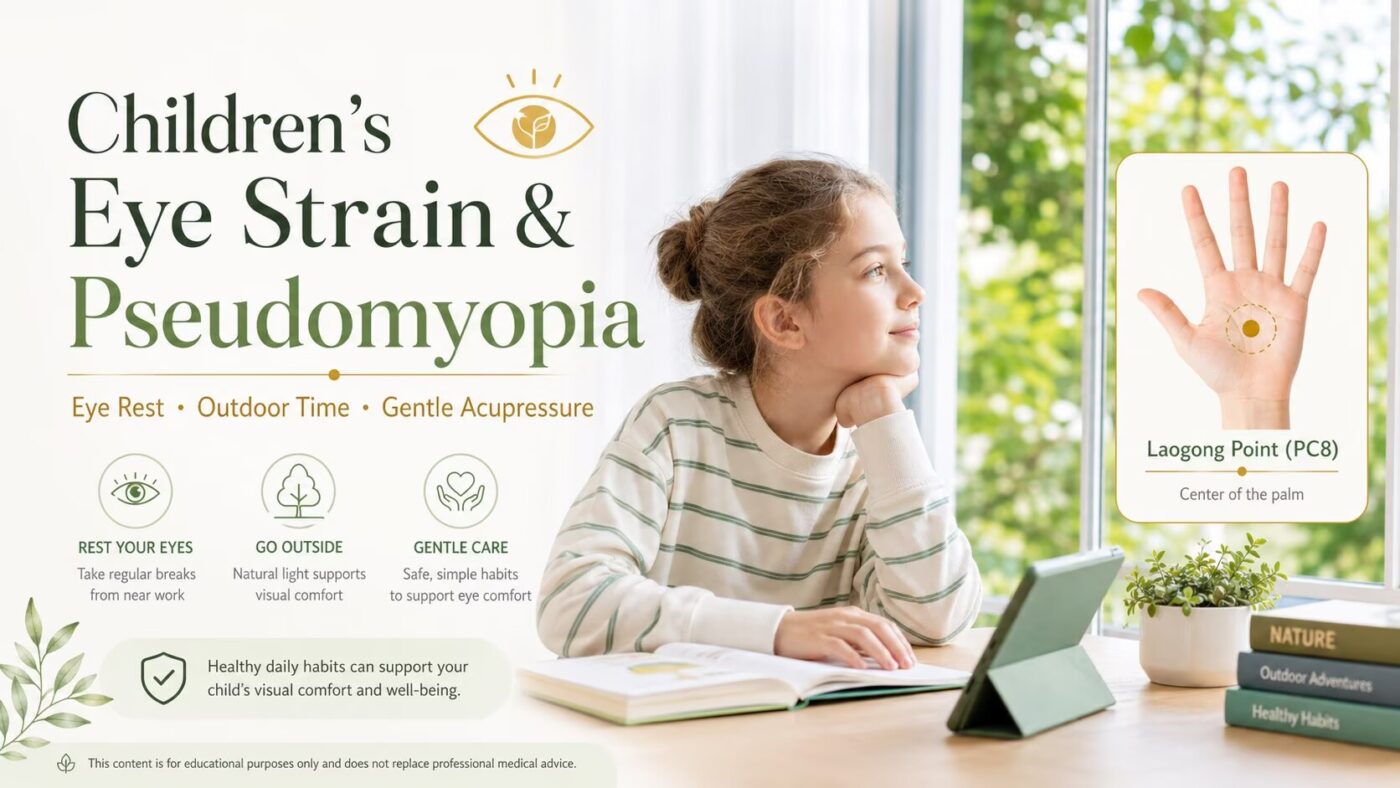
Where Is the Laogong Point?
In traditional Chinese medicine, Laogong, also known as Pericardium 8 or PC8, is located near the center of the palm.
To find it:
1. Relax the hand.
2. Gently make a loose fist.
3. Notice where the tip of the middle finger touches the palm.
4. The depression around this area corresponds approximately to Laogong.
The standardized location is described on the palm between the second and third metacarpal bones, closer to the third metacarpal bone.
A Gentle Laogong Acupressure Routine
Laogong massage may be used as a calming hand-relaxation practice during breaks from reading or screen use.
Use the thumb of the opposite hand to apply gentle circular pressure over the point for approximately 30 to 60 seconds. Repeat on the other hand and complete one or two rounds.
The pressure should feel comfortable. There is no need to press until the area becomes sharply painful. Stop if the child experiences persistent pain, numbness, swelling, or skin irritation.
From a traditional Chinese medicine perspective, Laogong is associated with clearing heat and calming the mind. However, it should not be presented as a proven treatment for pseudomyopia or structural myopia.
Current systematic-review evidence is insufficient to conclude that acupuncture or acupressure can prevent or slow childhood myopia. Laogong massage should therefore be treated only as a complementary relaxation practice, not as a replacement for eye examinations, prescribed glasses, or professional myopia-management treatments.
When Should a Child See an Eye Doctor?
Arrange an eye examination when a child has:
Persistent or worsening blurred vision
Frequent squinting or eye rubbing
Repeated headaches after schoolwork
One eye that appears weaker than the other
Eye pain, redness, double vision, or sudden visual changes
Difficulty seeing the classroom board
A strong family history of myopia
Early assessment helps distinguish temporary focusing strain from true refractive error and allows appropriate treatment to begin when needed.
Key Takeaway
Eye rest, regular outdoor activity, an appropriate viewing distance, and professional eye examinations are the most important parts of protecting a child’s vision.
Gentle Laogong acupressure can be included as a relaxing wellness ritual, but it should never be described as a cure for pseudomyopia or a method that can reverse true myopia.
Can pseudomyopia be reversed?
Pseudomyopia is generally associated with a temporary focusing problem, but only a professional eye examination can distinguish it from true myopia or another eye condition.
Can pressing the Laogong point cure myopia?
No reliable evidence shows that Laogong acupressure can cure or reverse myopia. It may be used as a gentle relaxation practice but should not replace professional eye care.
How much time should children spend outdoors?
Current pediatric ophthalmology guidance recommends at least one hour outdoors daily, together with suitable sun protection.
This article is for general education and does not replace individualized care from a qualified health professional. Seek appropriate advice for persistent, severe, or concerning symptoms.
Read the full medical disclaimer