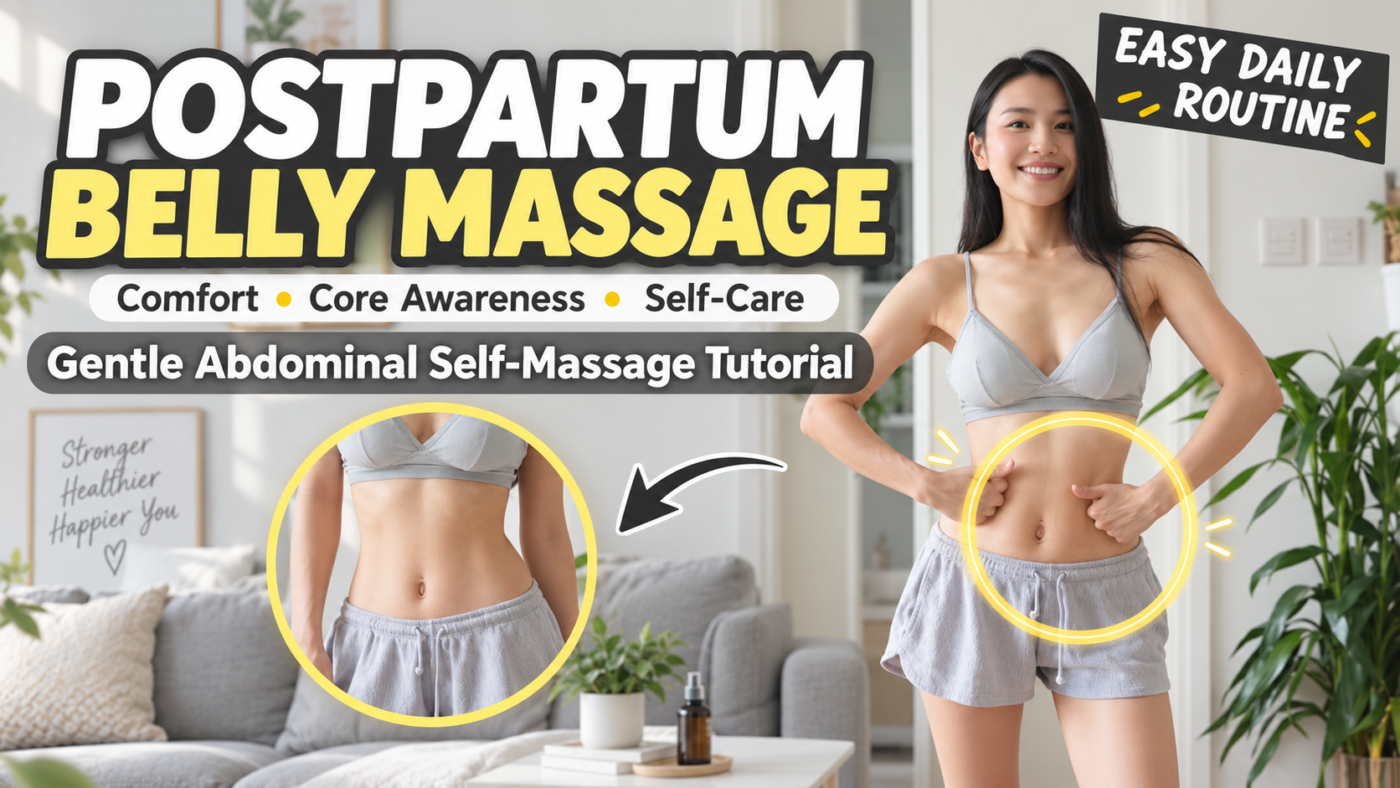
After pregnancy, it is completely normal for the abdomen to look and feel different.
The abdominal wall has stretched, the uterus needs time to return toward its pre-pregnancy size, connective tissues have adapted, and the muscles of the core and pelvic floor may feel weaker or less coordinated than before pregnancy.
Because of these changes, many women look for ways to help the abdomen “recover” more quickly.
One of the most popular methods is postpartum belly massage.
Gentle abdominal massage can be a relaxing form of self-care for some women, but it is important to understand what it can realistically do.
Massage may help you feel more comfortable, become more aware of your abdominal area, and temporarily reduce a sensation of tightness or puffiness.
It cannot directly remove abdominal fat, permanently shrink the waist, tighten weakened muscles, or physically “push internal organs back into place.”
Those claims go beyond what abdominal massage can reasonably achieve.
What Happens to the Abdomen After Pregnancy?
Pregnancy creates major but normal changes throughout the abdominal and pelvic region.
As the uterus expands, the abdominal wall stretches significantly.
The rectus abdominis muscles may separate to some degree along the midline, a condition known as diastasis recti.
The deep abdominal muscles adapt to the changing shape of the torso.
The pelvic floor experiences months of increased pressure.
Breathing mechanics can change.
Posture and movement patterns may change as the center of mass shifts.
After childbirth, these tissues do not immediately return to their previous state.
Recovery takes time.
Some women recover relatively quickly, while others experience weakness, discomfort, abdominal separation, pelvic floor symptoms, back pain, or reduced core control for much longer.
That is why postpartum recovery should be treated as a gradual process rather than something that needs to be forced.
Can Postpartum Belly Massage Reduce Belly Fat?
No.
Massage does not cause the body to selectively burn fat from the area being massaged.
Abdominal fat loss occurs through overall changes in energy balance and metabolism, not through rubbing, pushing, kneading, or compressing the stomach.
A massage may temporarily make the abdomen feel different because of changes in skin tension, tissue movement, relaxation, or fluid distribution.
But this should not be confused with fat loss.
If reducing body fat is a postpartum goal, the most useful long-term strategies usually include:
Regular physical activity
Progressive strength training
Appropriate nutrition
Adequate protein
Walking and aerobic activity
Sleep and recovery whenever possible
Gradual return to exercise
Sustainable energy balance
There is no need to aggressively massage the abdomen to lose fat.
Can Abdominal Massage Tighten Weak Muscles?
Massage cannot strengthen abdominal muscles in the same way exercise can.
Muscles become stronger when they are exposed to appropriate resistance and gradually challenged over time.
Massage may help you feel and identify an area of the body more clearly, but it does not replace core training.
For postpartum abdominal recovery, a more useful approach may include:
Breathing exercises
Pelvic floor coordination
Deep abdominal activation
Controlled trunk movements
Progressive resistance exercise
Walking
Full-body strength training
The appropriate starting point depends on the individual.
Can Massage Reposition the Internal Organs?
This is one of the biggest misconceptions in the original routine.
Normal abdominal massage cannot manually reposition the internal organs into a more desirable location.
The abdominal and pelvic organs are supported by complex anatomical structures including connective tissues, ligaments, fascia, muscles, and surrounding organs.
They do not simply fall out of position and need to be pushed back by hand after pregnancy.
If someone experiences pelvic pressure, vaginal heaviness, urinary problems, bowel symptoms, or concerns about pelvic organ prolapse, massage is not the appropriate solution.
Those symptoms deserve proper medical or pelvic floor assessment.
What About “Water Retention” and Lymphatic Drainage?
Massage can sometimes influence superficial fluid movement and may temporarily reduce the feeling of puffiness.
However, ordinary abdominal massage should not automatically be described as “lymphatic drainage.”
Clinical lymphatic drainage is a specialized technique used for particular medical conditions and should not be confused with aggressive rubbing or pushing.
The body’s lymphatic system already continuously transports fluid.
For most healthy people, normal movement, walking, breathing, hydration, and regular activity are more important for general circulation than forceful abdominal massage.
If swelling is persistent, severe, one-sided, painful, or accompanied by shortness of breath or other concerning symptoms, it should be medically evaluated.
When Can You Start Postpartum Abdominal Massage?
There is no single postpartum day that is appropriate for everyone.
The timing depends on:
How the baby was delivered
Whether there was a Cesarean section
Whether incisions or wounds have healed
Pain levels
Bleeding
Infection risk
Pregnancy or delivery complications
Individual medical advice
After a Cesarean birth, do not massage directly over a healing incision unless a qualified healthcare professional has confirmed that the area has healed sufficiently and that scar massage is appropriate.
Even after vaginal delivery, the abdomen may remain tender for some time.
The safest rule is simple:
Do not force massage onto tissues that are painful, inflamed, bruised, infected, or still healing.
A Gentle Postpartum Belly Massage Routine
If recovery is progressing normally and abdominal touch feels comfortable, a gentle self-massage can be used as a relaxation routine.
The goal should be comfort, not reshaping the body.
Step 1: Choose a Comfortable Position
Lie on your back with the knees bent or sit in a comfortable supported position.
Relax your shoulders.
Breathe normally.
You should never need to tense your abdomen aggressively during a gentle massage.
Step 2: Apply a Small Amount of Lotion or Oil
A fragrance-free moisturizer or simple massage oil can reduce friction.
You do not need a special “slimming” product.
Apply enough to allow your hands to glide comfortably across the skin.
Avoid products that irritate the skin.
Step 3: Begin With Gentle Side-to-Center Strokes
Place your hands gently on the side of the abdomen.
Slowly glide your hands toward the center.
Repeat several times with very light pressure.
This should feel relaxing.
There is no need to push deeply into the abdomen.
Step 4: Use Broad Palm Strokes
Use the broad surface of your hands rather than digging into the tissue with fingertips or knuckles.
Slowly move across the abdomen.
Maintain even, comfortable pressure.
The goal is simply tissue movement and relaxation.
Step 5: Add Gentle Circular Movements
Use one or both hands to create slow circles over the abdomen.
Keep the circles soft and controlled.
If you experience pain, stop immediately.
There is no benefit to painful pressure.
Step 6: Massage the Side of the Waist Gently
You can glide your hands along the sides of the torso.
Avoid the idea that you are “pushing fat away.”
The tissue does not need to be moved into a new location.
Think of the movement as a relaxing skin and soft-tissue massage.
Step 7: Finish With Slow Breathing
Place both hands gently over the abdomen.
Inhale slowly.
Allow the rib cage and abdomen to expand comfortably.
Exhale slowly.
Repeat for several breaths.
This simple breathing phase may be more valuable for postpartum core awareness than vigorous manual manipulation.
Avoid Aggressive Knuckle Massage
The original routine repeatedly uses fists and knuckles to push firmly across the abdomen.
That is not necessary.
Deep pressure can be uncomfortable and may irritate sensitive tissues.
In the postpartum period, the abdomen may still be recovering from significant physiological changes.
Force is not a sign that a massage is more effective.
Use your palms and fingers gently instead.
A massage should not cause:
Sharp pain
Bruising
Numbness
Persistent tenderness
Burning
Increasing abdominal pain
Dizziness
Bleeding
If it does, stop.
Can Massage Make the Waist Look Smaller?
Massage cannot permanently change your skeletal structure or selectively remove fat.
Some people may temporarily feel less bloated or notice a slightly different appearance immediately after massage.
That does not mean the waist has been structurally reshaped.
Long-term changes in waist circumference are more likely to come from a combination of:
Changes in body fat
Recovery of the uterus after pregnancy
Improved muscle strength
Changes in bloating
Posture and body position
Overall body composition
Time
The postpartum body changes gradually.
It does not need to be forced into a specific shape.
What About Postpartum Waist Trainers?
Waist trainers are another popular postpartum topic.
They are often marketed as a way to “set” the waist after massage or permanently create a smaller waist.
That is not how they work.
A tight waist trainer can temporarily compress the abdomen and change how the waist looks while it is being worn.
Once removed, that mechanical compression does not permanently reshape fat, muscle, or internal organs.
Postpartum Compression Garments Are Different
It is important to distinguish between fashionable waist trainers and medically appropriate postpartum compression garments.
Some postpartum garments are designed to provide gentle support and may make certain women feel more comfortable during recovery.
For example, some women appreciate mild abdominal support after Cesarean delivery.
However, support is different from permanent reshaping.
A compression garment should not be viewed as a substitute for:
Core rehabilitation
Pelvic floor recovery
Strength training
Movement
Medical care
Time
Tighter Is Not Better
A postpartum compression garment should never make it difficult to breathe comfortably.
It should not cause:
Pain
Numbness
Skin irritation
Reflux
Abdominal pressure
Pelvic heaviness
Difficulty taking a deep breath
Dizziness
If a garment creates these symptoms, it is too restrictive or inappropriate.
There is no health advantage to gradually tightening a waist trainer simply because you can tolerate a smaller size.
Should You Sleep in a Waist Trainer?
Wearing a tight waist trainer while sleeping is not necessary for postpartum recovery and is generally not a useful strategy for permanently reshaping the waist.
Sleep is an important period for recovery.
Your breathing and movement should not be unnecessarily restricted overnight.
If a medical compression garment has been specifically recommended after surgery or delivery, follow the instructions provided by the clinician involved in your care.
That is different from routinely sleeping in a cosmetic waist trainer.
What Actually Helps the Postpartum Abdomen Recover?
The most effective postpartum strategy is usually not one technique.
It is a combination of time, recovery, movement, strength, nutrition, and appropriate rehabilitation.
1. Give Your Body Time
Pregnancy took many months.
Recovery also takes time.
Do not judge your abdomen based on what it looks like a few weeks or months after delivery.
2. Rebuild Core Coordination
Begin with gentle exercises that help you coordinate breathing, abdominal tension, and pelvic floor function.
Then gradually progress toward more demanding movements.
3. Strengthen the Whole Body
Postpartum recovery should not become an endless series of abdominal exercises.
Strong legs, hips, back, shoulders, and arms matter too.
Full-body resistance training supports overall function and body composition.
4. Walk Regularly
Walking is one of the simplest ways to rebuild activity tolerance.
It also supports cardiovascular fitness without requiring complicated equipment.
5. Eat Enough Protein
Adequate protein supports muscle maintenance and recovery.
You do not need extreme dieting.
6. Address Pelvic Floor Symptoms
Urinary leakage, pelvic heaviness, pain, or pressure should not simply be accepted as normal.
Pelvic floor rehabilitation may be helpful.
7. Assess Diastasis Recti by Function, Not Appearance Alone
Some degree of abdominal separation is common during pregnancy.
The important question is not simply how many fingers fit between the muscles.
Consider function:
Can you generate tension through the abdominal wall?
Can you breathe comfortably?
Can you move without pain?
Can you progressively load the core?
If you have significant doming, discomfort, weakness, or concerns, professional assessment can help.
Massage Can Be Self-Care Without Being a “Slimming Treatment”
This is the most useful way to think about postpartum belly massage.
It does not need exaggerated claims to have value.
You can use it because:
It feels relaxing.
You enjoy the routine.
It helps you reconnect with your body.
It encourages a few minutes of quiet breathing.
It may make stiff or sensitive tissues feel more comfortable.
Those are reasonable benefits.
There is no need to claim that it melts fat, drains toxins, tightens muscles, or pushes internal organs into position.
Frequently Asked Questions
Does postpartum belly massage flatten the stomach?
Not permanently. Massage may temporarily change how the abdomen feels or appears, but it does not directly burn abdominal fat or strengthen weakened abdominal muscles.
Can massage help diastasis recti?
Massage does not close diastasis recti by itself. Progressive core rehabilitation and overall strength training are more important for improving abdominal function.
Can I massage my belly after a C-section?
Avoid massaging directly over a healing incision. Once the incision has healed sufficiently, scar massage may sometimes be appropriate, but timing and technique should be individualized.
Does abdominal massage remove water retention?
Gentle massage may temporarily influence superficial fluid movement, but persistent postpartum swelling should not simply be treated with massage, especially if it is severe or associated with other symptoms.
Do I need a waist trainer after postpartum massage?
No. A waist trainer is not required for abdominal recovery and cannot permanently “set” the waist.
Can waist trainers permanently make your waist smaller?
No. They can temporarily compress the torso while worn but do not permanently remove fat or reshape the abdominal wall.
Is postpartum abdominal massage supposed to hurt?
No. Gentle massage should feel comfortable. Strong pain, bruising, burning, or persistent tenderness is a reason to stop.
How often can I perform gentle belly massage?
If the tissues are fully healed and massage feels comfortable, short gentle sessions can be performed according to personal preference. There is no evidence that doing more aggressive or frequent massage produces faster abdominal recovery.
Final Thoughts
Postpartum belly massage can be a pleasant part of self-care, but it should not carry unrealistic expectations.
You do not need to push, squeeze, or force your abdomen into a different shape.
You do not need to “reposition” your organs.
And you do not need an increasingly tight waist trainer to lock your body into place.
A better postpartum recovery strategy focuses on healing first, then gradually rebuilding movement, core control, muscle strength, cardiovascular fitness, and confidence.
Massage can support comfort.
Exercise rebuilds physical capacity.
Nutrition supports recovery.
And time allows the body to adapt.
The goal should not simply be a smaller waist.
The goal should be a strong, comfortable, functional body that continues to serve you well for years to come.
Medical Disclaimer
This content is for general educational purposes only and is not medical advice. Postpartum recovery varies considerably between individuals. Avoid abdominal massage over unhealed incisions, areas of infection, significant pain, unexplained swelling, or other concerning symptoms. Seek medical evaluation for severe abdominal or pelvic pain, heavy or unusual bleeding, fever, worsening swelling, difficulty breathing, pelvic pressure, urinary or bowel problems, or other persistent postpartum symptoms.
This article is for general education and does not replace individualized care from a qualified health professional. Seek appropriate advice for persistent, severe, or concerning symptoms.
Read the full medical disclaimer

