As men move through middle age, prostate health, urinary changes, and sexual well-being often become more noticeable concerns.
Some men may begin experiencing nighttime urination, a weaker urine stream, urinary urgency or frequency, a feeling of incomplete bladder emptying, or changes in sexual performance.
It is important, however, not to assume that every urinary or sexual symptom is caused by the prostate.
Benign prostatic hyperplasia (BPH), or noncancerous enlargement of the prostate, becomes more common with age and may contribute to urinary symptoms. But similar problems can also be related to bladder function, urinary tract conditions, pelvic floor dysfunction, prostatitis, medications, metabolic health, or other medical issues.
One part of men’s health that is often overlooked is the pelvic floor.
These muscles play an important role in urinary control, bowel function, core stability, and certain aspects of sexual function.
When used correctly, pelvic floor exercises can become a valuable part of a broader strategy for maintaining strength, mobility, bladder control, and functional health as men age.
The following two chair-based exercises provide a practical starting point.
Why the Male Pelvic Floor Matters
The pelvic floor is a group of muscles located at the bottom of the pelvis.
You can think of it as a supportive muscular platform that helps support the pelvic organs while contributing to urinary and bowel control.
These muscles also work together with the abdominal muscles, diaphragm, back muscles, hips, and glutes to help stabilize the trunk.
For men, pelvic floor muscle training is commonly used to support urinary control, particularly in certain rehabilitation settings. Research also suggests that pelvic floor rehabilitation may support some aspects of male sexual function in selected individuals.
However, pelvic floor exercise should not be described as a direct treatment for every prostate condition.
A more accurate way to think about it is this:
Pelvic floor training can support muscular control and function, but it does not replace medical evaluation or treatment for prostate, urinary, or sexual health conditions.
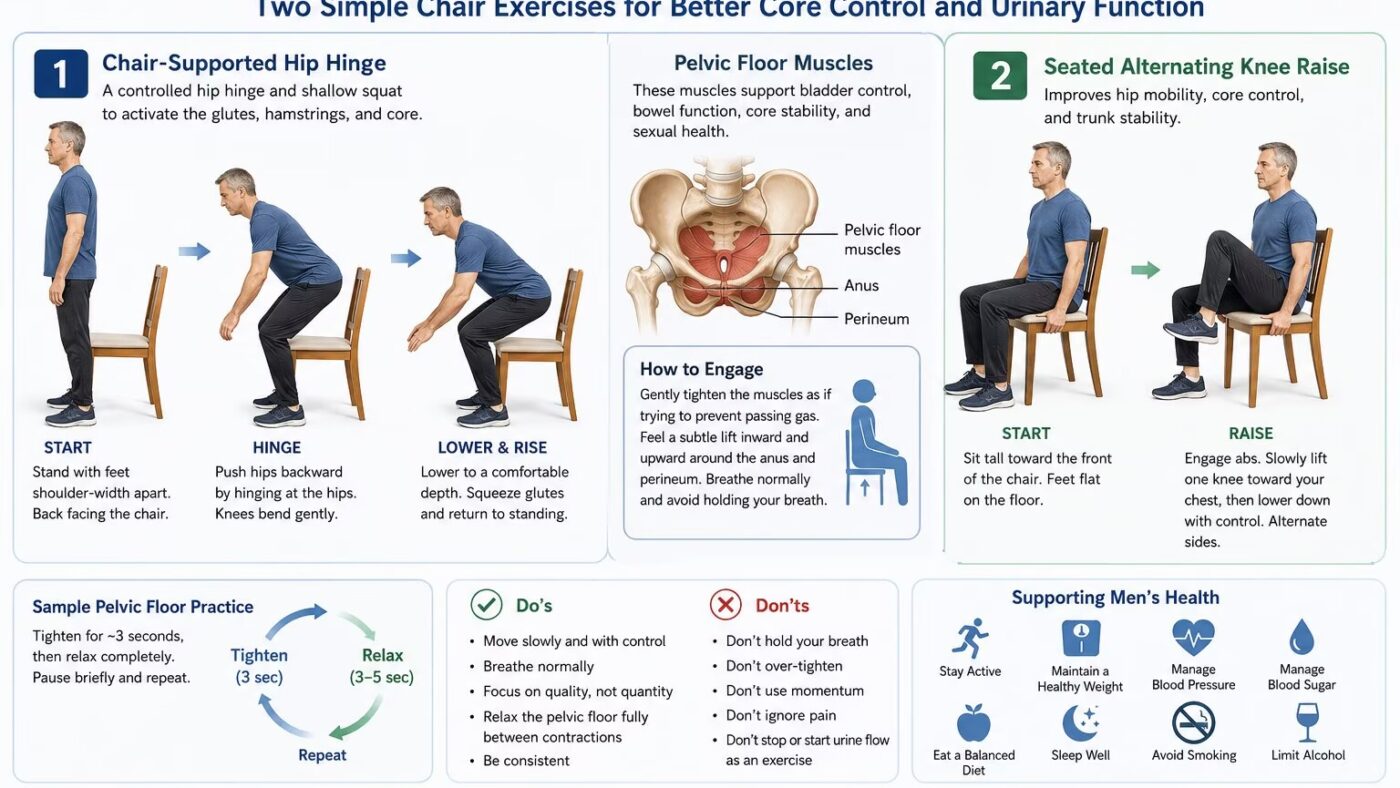
Exercise 1: Chair-Supported Hip Hinge
This first movement combines a controlled hip hinge with a shallow squat.
The goal is not to squat as deeply as possible. Instead, the focus is on learning to move from the hips while activating the glutes, hamstrings, and core.
Starting Position
Choose a stable chair without wheels.
Stand with your back facing the chair and your feet approximately shoulder-width apart.
Position yourself close enough that your hips would reach toward the chair if you were going to sit down.
Keep your chest relaxed, spine long, and feet firmly planted.
How to Perform the Movement
Begin by pushing your hips backward.
Imagine that you are trying to sit into the chair behind you.
Allow the movement to begin primarily from the hip joints rather than immediately driving the knees forward.
Once your hips have moved backward, gently bend your knees.
Keep your knees tracking roughly in the same direction as your second toes rather than allowing them to collapse inward.
Lower only as far as you can maintain control.
You do not need to actually sit on the chair.
At the bottom of the movement, you should feel your glutes and the muscles along the back of your thighs working.
Maintain a natural breathing pattern throughout the exercise.
Then gently squeeze your glutes and return to standing.
What You Should Feel
The movement should primarily involve the glutes, hamstrings, hips, and core.
If you feel intense fatigue only in the front of the thighs while barely feeling the glutes or hamstrings, you may be shifting too much of the movement into the knees.
Reduce the depth and practice pushing the hips backward first.
Depth is not the goal.
Control, alignment, and muscle coordination matter more than how low you can go.
Adding Gentle Pelvic Floor Engagement
Once the basic movement feels comfortable, some men may choose to add a light pelvic floor contraction.
As you hold the lowered position briefly, gently tighten the pelvic floor as though you were trying to prevent passing gas.
Think of the muscles around the anus and perineal area lifting slightly inward and upward.
Do not squeeze as hard as possible.
Do not hold your breath.
The contraction should feel controlled rather than forceful.
After a few seconds, fully relax the pelvic floor before repeating.
The ability to relax these muscles is just as important as the ability to contract them.
Exercise 2: Seated Alternating Knee Raise
The second exercise can also be performed using the same chair.
It focuses on hip movement, abdominal control, and trunk stability.
Starting Position
Sit toward the front half of the chair rather than leaning heavily against the backrest.
Keep both feet on the floor.
Sit tall without excessively arching your lower back.
Place your hands lightly on the sides of the chair for balance if needed.
How to Perform the Movement
Gently engage your abdominal muscles.
Slowly lift one knee toward your chest.
Only raise the leg as high as you can without leaning backward, rounding your spine, or losing balance.
Pause briefly.
Slowly return the foot to the floor.
Repeat with the opposite leg.
Continue alternating sides.
Move slowly and breathe normally.
Avoid using momentum.
If you already have good awareness of your pelvic floor, you may pair the knee lift with a gentle pelvic floor contraction.
Release the contraction as the leg returns to the floor.
How to Identify Your Pelvic Floor Muscles
Many men struggle at first to identify the correct muscles.
One simple cue is to imagine that you are trying to prevent yourself from passing gas.
You may feel a subtle tightening around the anus and the area between the anus and genitals.
The sensation should feel as though the muscles are drawing gently inward and upward.
Another useful cue is to imagine stopping urine flow.
However, repeatedly stopping urine while actually urinating should not be used as your regular exercise method.
Interrupting urine flow may occasionally help someone identify the correct muscles, but consistently practicing pelvic floor contractions while urinating can interfere with normal bladder emptying.
Pelvic floor exercises are better performed when the bladder is not actively emptying.
A Simple Pelvic Floor Practice
Beginners can start with gentle contractions.
Tighten the pelvic floor for approximately 3 seconds.
Then completely relax.
Pause briefly.
Repeat.
Over time, some people may gradually work toward longer contractions if they remain comfortable and can still relax fully between repetitions.
A common mistake is to focus only on tightening.
Healthy pelvic floor function requires both contraction and relaxation.
Constantly clenching the pelvic floor throughout the day is not necessarily beneficial and may be counterproductive for some individuals.
Pelvic Floor Exercise Is Not Prostate Massage
Many health videos make claims such as:
Pelvic floor contractions directly massage the prostate.
These exercises flush inflammation and toxins out of the prostate.
Seven days of training will restore prostate function.
These statements oversimplify the anatomy and exaggerate what exercise can realistically accomplish.
Pelvic floor exercises primarily train muscular coordination, strength, endurance, and control.
They should not be described as a way to mechanically clean the prostate or remove inflammation.
Actual prostate conditions may include benign prostatic hyperplasia, prostatitis, prostate cancer, and other urinary disorders.
These conditions require appropriate medical assessment when symptoms are persistent or concerning.
Exercise can support general health, but it should not be used as a substitute for diagnosis or evidence-based treatment.
Can Pelvic Floor Training Improve Sexual Function?
Possibly, for some men.
The pelvic floor participates in several aspects of male sexual function, including muscular control associated with erection and ejaculation.
Some studies suggest that pelvic floor rehabilitation may help selected men with erectile or ejaculatory difficulties.
However, erectile function is influenced by far more than the pelvic floor alone.
It may also be affected by cardiovascular health, blood flow, diabetes, hormone status, nerve function, medications, sleep, psychological stress, alcohol use, smoking, obesity, and other medical conditions.
For this reason, pelvic floor training should not be promoted as a guaranteed or rapid solution for erectile difficulties.
A more responsible description is:
Pelvic floor exercise may support sexual function as one component of a broader men’s health strategy.
Persistent erectile problems deserve proper medical evaluation, especially because they can sometimes be associated with underlying cardiovascular or metabolic conditions.
How Much Should You Do?
More is not always better.
Beginners do not need to perform dozens or hundreds of intense pelvic floor contractions.
A simple starting routine might include:
Chair-supported hip hinge: 5 to 10 controlled repetitions.
Seated alternating knee raise: 5 to 10 repetitions on each side.
Gentle pelvic floor contractions: a small number of short contractions with complete relaxation between repetitions.
Perform movements slowly and maintain normal breathing.
Avoid straining or holding your breath.
As your coordination improves, repetitions can gradually increase.
Consistency matters more than intensity.
When to Stop or Modify the Exercises
Mild muscular fatigue in the glutes, hips, or abdominal muscles can occur when beginning a new exercise.
However, stop the exercise and seek professional guidance if you experience significant pelvic or perineal pain, worsening urinary difficulty, burning during urination, increasing pelvic tightness, numbness, unusual genital pain, or symptoms that persist after exercise.
Some men have an overly tight or poorly coordinated pelvic floor rather than a weak one.
In those cases, repeatedly squeezing the muscles harder may worsen symptoms.
A pelvic health physical therapist can help determine whether strengthening, relaxation training, mobility work, or another approach is more appropriate.
Urinary Symptoms Men Should Not Ignore
Occasional changes in urinary habits do not always indicate disease.
Persistent changes, however, deserve attention.
Speak with a healthcare professional if you regularly experience frequent nighttime urination, increasing urinary urgency, frequent urination during the day, difficulty starting urination, a weak or interrupted urine stream, straining to urinate, persistent feelings of incomplete bladder emptying, pain during urination, pain during ejaculation, ongoing pelvic or perineal discomfort, or persistent erectile dysfunction.
Seek prompt medical care if you develop an inability to urinate, visible blood in the urine, severe urinary pain, or urinary symptoms accompanied by fever or chills.
These symptoms should not simply be managed with exercises at home.
Supporting Prostate and Men’s Health Beyond Exercise
Pelvic floor exercises are only one part of healthy aging.
Long-term men’s health is also strongly influenced by everyday habits.
Helpful strategies include maintaining regular physical activity, avoiding prolonged sitting, maintaining a healthy body weight, managing blood pressure, managing blood sugar, eating a balanced diet, getting adequate sleep, limiting excessive alcohol intake, avoiding smoking, maintaining cardiovascular fitness, and attending appropriate health screenings.
Sexual health, urinary health, metabolic health, and cardiovascular health are often closely connected.
Instead of looking for a single prostate exercise, it is more useful to view men’s health as a whole-body issue.
The Bottom Line
Middle age does not automatically mean losing strength, urinary control, or sexual function.
Simple exercises performed with a chair can help train the hips, glutes, core, and pelvic floor while improving overall body awareness and movement control.
The goal is not to promise a dramatic transformation in seven days.
The goal is to build better function over time.
Regular movement, pelvic floor awareness, cardiovascular health, healthy body composition, quality sleep, and appropriate medical care all contribute to long-term male health.
Exercise can support the body. It should never replace proper diagnosis when persistent symptoms are present.
Medical Disclaimer
This article is provided for general educational and wellness purposes only. It is not intended to diagnose, treat, cure, or prevent any disease and should not be considered a substitute for professional medical advice.
Urinary symptoms, pelvic pain, prostate conditions, or persistent sexual dysfunction can have many different causes. If symptoms are persistent, worsening, or affecting your quality of life, consult a qualified healthcare professional, urologist, or pelvic health physical therapist.
If you are unable to urinate, notice blood in your urine, develop severe urinary pain, or experience urinary symptoms together with fever or chills, seek prompt medical attention.
This article is for general education and does not replace individualized care from a qualified health professional. Seek appropriate advice for persistent, severe, or concerning symptoms.
Read the full medical disclaimer