Men often begin paying more attention to urinary and sexual health in middle age.
You may notice that urination feels different.
Perhaps the stream is weaker.
You may need to visit the bathroom more often at night.
You might experience occasional dribbling after urination.
Sexual function can also change with age.
Erections may take longer to develop or may not feel as reliable as they once did.
Some men also become concerned about ejaculation control.
These problems are common, but they are not all caused by the prostate.
The pelvic floor is another important part of the picture.
Pelvic floor muscles help support the bladder and bowel and contribute to urinary control and sexual function.
Learning to contract and relax these muscles properly can therefore be useful for many men.
But pelvic floor exercise is not a seven day cure for an enlarged prostate, prostatitis, erectile dysfunction or premature ejaculation.
It is better understood as one component of a broader men’s health program.
What Is the Male Pelvic Floor?
The pelvic floor is a group of muscles and connective tissues located at the bottom of the pelvis.
You can imagine it as a supportive muscular hammock.
In men, these muscles help support the bladder and bowel and work around structures involved in urination.
They also participate in sexual function.
Like other muscles, they can lose strength or coordination.
Aging, prostate surgery, excess body weight, chronic coughing, constipation and other factors can influence pelvic floor function.
Training can improve control in appropriate cases.
What Pelvic Floor Exercises Can Really Help With
Pelvic floor muscle training is best established for urinary control.
Men may use these exercises to help with urine leakage and post urination dribbling.
They are also frequently incorporated into rehabilitation surrounding prostate surgery.
Research has additionally explored pelvic floor training for erectile dysfunction and premature ejaculation.
Some studies have reported improvement, although research protocols vary substantially and there is no single ideal program proven for every man.
A systematic review found encouraging results for erectile dysfunction and premature ejaculation but also emphasized that studies were generally low to moderate in quality and used very different exercise programs.
That makes pelvic floor training promising rather than miraculous.
First Learn the Correct Pelvic Floor Contraction
Before adding squats or leg movements, learn the basic contraction.
Imagine that you are trying to prevent yourself from passing gas.
Gently squeeze the muscles around the anus and feel a subtle inward and upward lift.
Do not bear down.
Do not hold your breath.
Do not aggressively squeeze your buttocks.
Do not tighten your thighs as hard as possible.
The movement should be relatively subtle.
A beginner can gently contract for about three seconds and then completely relax for about three seconds.
The relaxation phase is just as important as the contraction.
NIDDK suggests gradually working toward approximately 10 to 15 repetitions per session, depending on individual needs.
Do Not Regularly Practice by Stopping Urine
You may sometimes hear that the easiest way to identify the pelvic floor is to stop urine midstream.
That can help you recognize the muscles once.
It should not become your normal exercise.
Repeatedly interrupting urine flow can prevent complete bladder emptying and may increase urinary problems.
Once you recognize the muscles, perform your training away from the toilet.
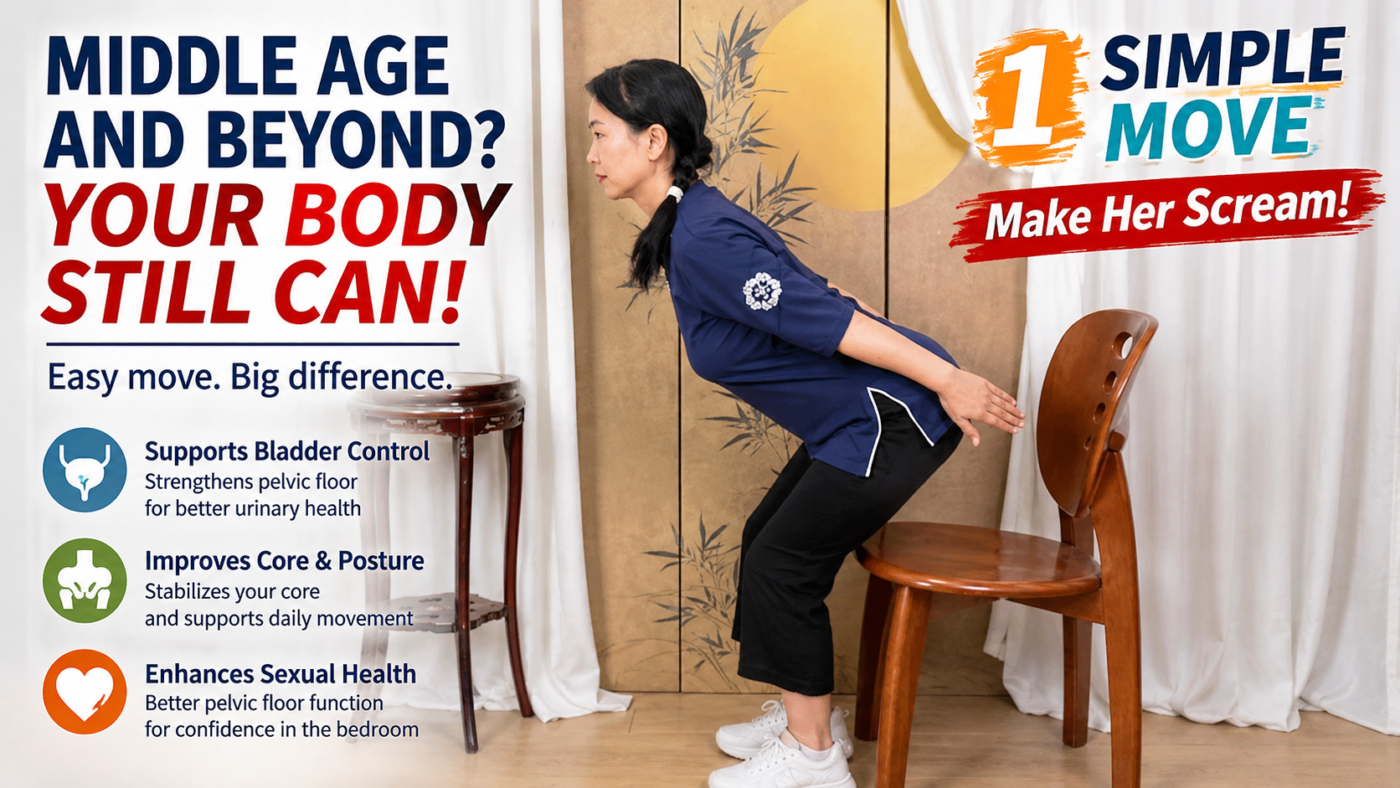
Exercise 1: Chair Supported Hip Hinge With Pelvic Floor Awareness
This movement combines a controlled hip hinge or shallow squat with pelvic floor awareness.
Place a sturdy chair behind you.
Stand approximately one comfortable step in front of it.
Keep your feet around hip to shoulder width apart.
Allow your toes to point in a natural direction.
Begin by moving your hips backward as though you are about to sit on the chair.
Allow your knees to bend naturally.
Keep your trunk controlled.
You do not need to actually sit down.
Lower only as far as you can comfortably control.
Before returning to standing, gently contract the pelvic floor.
Then stand up while breathing normally.
Once upright, allow the pelvic floor to relax again.
Start with approximately five to eight slow repetitions.
Do Not Keep the Pelvic Floor Maximally Contracted
The original routine recommends keeping the pelvic floor strongly contracted throughout a prolonged squat.
That is not necessary for beginners.
A muscle needs both contraction and relaxation.
Repeated maximal contractions without adequate relaxation can create unnecessary fatigue and may be inappropriate for people whose pelvic floor is already overactive.
Think gentle lift followed by complete release.
Your Quadriceps Will Work Too
The original routine also suggests that the front of the thighs should not work.
That is anatomically incorrect.
Squats and chair sitting movements normally involve the quadriceps.
Your glutes, hamstrings, quadriceps, calves and trunk may all contribute.
Feeling some effort in the front of the thighs does not automatically mean your technique is wrong.
The goal is balanced, comfortable movement rather than trying to completely eliminate quadriceps activity.
Why This Exercise Is Useful
The exercise trains much more than the pelvic floor.
Moving your hips backward and standing again activates important muscles used in daily activities.
You use similar movement when standing from a chair, getting out of a car and picking things up.
This makes it useful for healthy aging even if it has no special effect on the prostate.
Exercise 2: Seated March With Gentle Pelvic Floor Control
Sit near the middle of a sturdy chair rather than balancing on the extreme edge.
Place both feet on the floor.
Sit tall without becoming rigid.
Keep your hands on the sides of the chair if you need additional stability.
Gently contract your pelvic floor.
Lift one knee a small distance.
Lower it slowly.
Relax the pelvic floor.
Repeat with the other leg.
Continue alternating sides.
Begin with approximately five to ten repetitions per leg.
What Actually Lifts the Knee?
The knee is lifted primarily through muscles involved in hip flexion.
Your abdominal and trunk muscles help stabilize the body.
The pelvic floor can work as part of the wider core system, but it is not the main muscle lifting your leg.
That distinction matters.
The exercise combines coordination and core control rather than directly exercising the prostate.
Do You Need a Maximum Contraction?
No.
The original routine repeatedly recommends contracting the pelvic floor as strongly as possible.
For general training, maximal effort is not necessary.
A controlled contraction that you can perform while breathing comfortably is usually more appropriate.
If you find yourself holding your breath, clenching your jaw or turning red, reduce the effort.
Do These Exercises Massage the Prostate?
Not in the way the original claim suggests.
Pelvic floor muscles are located close to structures within the pelvis, and contractions change pressure and muscle activity in the region.
But Kegel exercises should not be described as directly massaging the prostate and flushing inflammation or waste out of it.
Prostatitis is not caused by waste collecting inside the prostate.
Different forms of prostatitis or chronic pelvic pain can involve infection, inflammation, nerves, muscles and other mechanisms.
Some men with chronic pelvic pain actually have pelvic floor muscles that are too tense.
For them, repeatedly performing stronger Kegels may make symptoms worse.
Pelvic floor relaxation and specialist physical therapy may be more appropriate.
Can Pelvic Floor Exercises Shrink an Enlarged Prostate?
No.
Benign prostatic hyperplasia is enlargement of the prostate gland.
Pelvic floor exercises do not shrink prostate tissue.
However, pelvic floor training may help certain urinary symptoms, particularly urgency or storage related symptoms.
Current urological guidance includes pelvic floor muscle training among behavioral approaches that may be useful for selected men with lower urinary tract symptoms.
That is very different from curing BPH.
Can They Improve Urination?
Possibly, depending on the problem.
Strong and coordinated pelvic floor muscles may help with urine leakage and post urination dribbling.
However, difficulty starting urination, a persistently weak stream or incomplete bladder emptying may have other causes.
An enlarged prostate is one possibility.
Other urinary tract problems are also possible.
Exercises should not delay proper evaluation of persistent symptoms.
What About Erectile Function?
Pelvic floor muscles participate in male sexual function, so researchers have studied strengthening programs for erectile dysfunction.
Some systematic reviews report improvement in certain groups.
Other more recent analyses have found less convincing results when pelvic floor training is examined separately from other exercise interventions.
For example, a 2024 meta analysis found clearer improvement in erectile function from aerobic exercise than from pelvic floor training alone in the included studies.
The sensible conclusion is that pelvic floor training may help some men but should not be presented as a guaranteed treatment.
What About Premature Ejaculation?
Pelvic floor control may be helpful for some men with premature ejaculation.
Mayo Clinic includes pelvic floor exercises among potential strategies because weak pelvic floor muscles may make delaying ejaculation more difficult.
However, premature ejaculation has multiple possible influences.
Anxiety, sensitivity, relationship factors and other biological factors may contribute.
Kegels are one possible tool rather than a universal cure.
Do Not Promise Results in Seven Days
Muscles do not transform overnight.
NIDDK notes that improvements in bladder control may take approximately three to six weeks, while Mayo Clinic describes improvement as taking several weeks to several months.
Some people improve faster.
Others take longer.
The cause of the original symptoms matters considerably.
Consistency is more important than trying to force rapid results.
More Exercise Is Not Always Better
Performing hundreds of maximum contractions is unnecessary.
NIDDK specifically warns against overdoing Kegel exercises because excessive training can contribute to straining during urination or bowel movements.
For most beginners, good technique matters more than large numbers.
Contract.
Breathe.
Relax.
Repeat.
Progress gradually.
Pelvic Floor Exercise Is Not a Replacement for Cardiovascular Exercise
The claim that men do not need walking, running or other exercise if they perform pelvic floor exercises is misleading.
Cardiovascular health and erectile function are closely connected.
Regular aerobic activity supports the heart and blood vessels.
Strength training helps preserve muscle.
Balance work supports healthy aging.
Pelvic floor exercise addresses a different part of physical function.
A comprehensive program is more useful than relying on one muscle group.
When Prostate or Urinary Symptoms Need Medical Attention
Seek medical evaluation rather than relying only on exercise if you develop inability to urinate, blood in the urine, fever with urinary symptoms, severe pelvic pain, repeated urinary infections, persistent weak urine flow, significant pain during urination, new persistent erectile dysfunction or urinary symptoms that continue to worsen.
Persistent erectile dysfunction is also worth discussing with a healthcare professional because it can sometimes accompany cardiovascular disease, diabetes or other underlying conditions.
Frequently Asked Questions
Are Pelvic Floor Exercises Good for Middle Aged Men?
They can be.
They may support urinary control and pelvic floor coordination and may benefit sexual function in some men.
Can Kegels Cure Prostate Problems?
No.
Pelvic floor strengthening does not cure prostate cancer, prostatitis or benign prostate enlargement.
Do Kegels Massage the Prostate?
They activate muscles in the pelvic region but should not be described as physically cleaning or massaging inflammation out of the prostate.
Can Pelvic Floor Exercises Improve Erections?
Some studies suggest benefit for certain men, but results vary and the exercise is not a guaranteed treatment.
Can They Help Premature Ejaculation?
They may help some men improve pelvic floor control, but premature ejaculation has multiple causes and may require additional treatment.
How Long Before Results Appear?
Several weeks is more realistic than seven days.
Some men may require several months.
Should I Squeeze My Glutes During Kegels?
For isolated Kegel training, try not to strongly contract your buttocks, thighs or abdominal muscles.
Should I Hold My Breath?
No.
Breathe normally throughout the exercise.
Is a Chair Squat a Kegel Exercise?
Not by itself.
It is primarily a lower body exercise.
You can coordinate a gentle pelvic floor contraction with the movement if appropriate.
Can Kegels Make Symptoms Worse?
They can be inappropriate for people with an excessively tight or painful pelvic floor.
Pelvic pain, difficulty relaxing during urination or worsening symptoms are reasons to seek professional evaluation.
Bottom Line
Pelvic floor training can be valuable for men.
These muscles contribute to bladder and bowel control and participate in sexual function.
A chair supported hip hinge and a seated marching exercise can be useful ways to combine pelvic floor awareness with general movement.
But their benefits should not be exaggerated.
Seven days cannot be guaranteed to restore prostate function.
Pelvic floor contractions do not flush toxins or inflammation from the prostate.
They do not shrink an enlarged prostate.
They cannot guarantee stronger erections.
And they do not replace aerobic exercise, strength training or medical evaluation.
Start by learning the correct pelvic floor contraction.
Use a gentle controlled squeeze.
Continue breathing.
Relax fully between contractions.
Progress gradually.
If urinary or sexual symptoms persist, treat them as health issues worth properly evaluating rather than simply exercising harder.
That approach gives pelvic floor training an appropriate place within long term men’s health.
Affiliate Disclosure
This article may contain affiliate links. If you purchase through one of these links, we may earn a commission at no additional cost to you. Affiliate relationships do not influence our editorial standards or health recommendations.
Medical Disclaimer
This article is for educational and informational purposes only and is not medical advice. Pelvic floor exercises are not a treatment for prostate cancer and do not replace evaluation or treatment for benign prostate enlargement, prostatitis, urinary retention, erectile dysfunction or other urological conditions. Consult a qualified healthcare professional or pelvic floor physical therapist if symptoms are persistent, painful or worsening.
This article is for general education and does not replace individualized care from a qualified health professional. Seek appropriate advice for persistent, severe, or concerning symptoms.
Read the full medical disclaimer