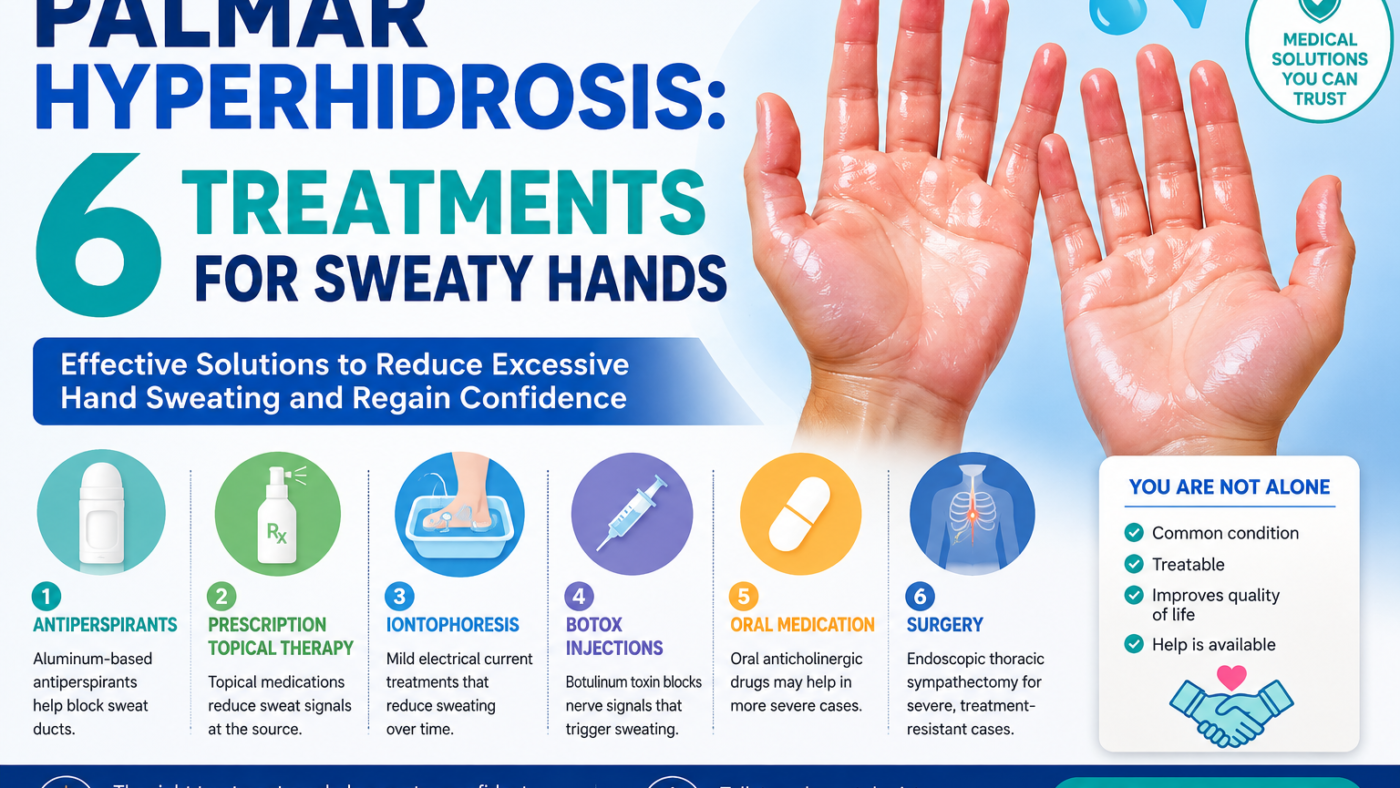
Sweaty palms can seem like a minor inconvenience until they begin interfering with everyday life.
For someone with palmar hyperhidrosis, shaking hands may become stressful. Writing on paper can leave pages damp. A computer mouse may become slippery. Playing the piano, holding gym equipment, handling tools, performing delicate work, or simply holding another person’s hand can become unexpectedly difficult.
The sweating may appear even when the weather is cool and the person is not exercising.
That is because palmar hyperhidrosis is different from ordinary sweating caused by heat.
Primary palmar hyperhidrosis is a recognized medical condition in which the palms produce excessive sweat beyond what is needed for normal temperature regulation. It can begin in childhood or adolescence and may continue for many years.
Although it is not usually dangerous, it can substantially affect confidence, work, school, relationships, sports, hobbies, and quality of life.
The encouraging news is that treatment options have expanded considerably.
From prescription-strength antiperspirants and iontophoresis to newer topical medications, botulinum toxin injections, oral medicines, and surgery for carefully selected severe cases, excessive hand sweating can often be reduced.
What Is Palmar Hyperhidrosis?
Hyperhidrosis means excessive sweating.
When excessive sweating mainly affects a specific area such as the palms, soles, underarms, or face without another identifiable medical cause, doctors often call it primary focal hyperhidrosis.
Palmar hyperhidrosis specifically affects the hands.
People with this condition may notice that both palms become unusually moist or even visibly wet. In severe cases, sweat may collect into droplets.
Unlike normal sweating during exercise or hot weather, episodes can occur while sitting quietly, studying, working, talking with another person, or anticipating a social situation.
Stress and emotional excitement can make the sweating worse, but they are not necessarily the underlying cause.
Why Do Our Hands Sweat?
The palms contain a high concentration of eccrine sweat glands.
These glands are controlled by the autonomic nervous system.
One unusual feature of sweat glands is that although they are controlled by sympathetic nerves, those nerves mainly use the neurotransmitter acetylcholine to stimulate sweating.
In people with primary hyperhidrosis, the sweat glands themselves are not necessarily larger or more numerous.
Instead, the signaling that activates sweating appears to be unusually responsive.
That is why someone can have soaking-wet palms even when the body does not need additional cooling.
Is Palmar Hyperhidrosis Just Anxiety?
No.
This is an important misconception.
Anxiety, nervousness, embarrassment, excitement, examinations, public speaking, job interviews, or meeting new people can trigger or intensify sweating.
But people with primary palmar hyperhidrosis can also sweat when they do not feel particularly anxious.
The relationship can also become a cycle.
A person worries that their hands will sweat.
The worry increases sympathetic nervous-system activity.
The palms become wetter.
The sweating then creates more embarrassment and stress.
Reducing stress may therefore help some people manage triggers, but telling someone simply to “relax” does not treat the underlying condition.
Primary Versus Secondary Hyperhidrosis
Not all excessive sweating is primary hyperhidrosis.
Doctors generally distinguish between primary and secondary hyperhidrosis.
Primary Focal Hyperhidrosis
Primary hyperhidrosis often:
Begins relatively early in life
Affects both sides of the body relatively symmetrically
Occurs repeatedly
Affects focal areas such as the palms, soles, underarms, or face
Interferes with daily activities
May run in families
Usually stops during sleep
There is often no underlying disease that explains the sweating.
Secondary Hyperhidrosis
Secondary hyperhidrosis occurs because of another medical condition, medication, hormonal change, substance, or other identifiable cause.
It is more likely to deserve investigation when sweating:
Begins suddenly later in life
Occurs over much of the body rather than one focal area
Occurs prominently during sleep
Is accompanied by fever, unexplained weight loss, palpitations, tremor, or other new symptoms
Begins after starting or changing a medication
Is noticeably one-sided or asymmetrical
Conditions that can contribute to secondary excessive sweating include endocrine and metabolic disorders, neurological conditions, infections, hormonal changes, and other illnesses.
Certain medications can also increase sweating.
For this reason, new or unexplained excessive sweating should not automatically be self-diagnosed as primary hyperhidrosis.
How Doctors Diagnose Primary Palmar Hyperhidrosis
There is no single blood test that confirms primary palmar hyperhidrosis.
Diagnosis is usually based on the medical history and examination while ruling out secondary causes when appropriate.
A commonly used clinical framework starts with visible, excessive focal sweating lasting at least six months without another apparent cause.
Supporting features include:
Bilateral and relatively symmetrical sweating
Episodes occurring at least weekly
Onset at a relatively young age
A family history of similar excessive sweating
Little or no excessive sweating during sleep
A meaningful effect on school, work, relationships, hobbies, or other daily activities
Not every person will match every feature perfectly.
A healthcare professional should interpret the overall pattern.
Why Sweaty Hands Can Affect More Than Handshakes
Palmar hyperhidrosis is sometimes dismissed as cosmetic.
For many people, it is much more than that.
Students may soak examination papers or have difficulty holding a pen.
Musicians may struggle with instrument grip or moisture on keys and strings.
Athletes may have difficulty gripping weights, rackets, bars, or climbing equipment.
Healthcare professionals and technicians may find gloves uncomfortable.
People working with electronics, tools, documents, or precision instruments may need to repeatedly dry their hands.
Social consequences can be equally significant.
Someone may avoid handshakes, dating, holding hands, networking events, or professional introductions because they fear another person’s reaction.
Over years, these small experiences can affect self-confidence.
Treatment therefore aims not merely to make the hands look dry, but to reduce the extent to which sweating interferes with life.
Treatment 1: Aluminum-Based Antiperspirants
Treatment often begins with a topical antiperspirant.
Many medical antiperspirants contain aluminum salts, commonly aluminum chloride.
These compounds interact with material within the sweat ducts and temporarily reduce sweat output.
They do not permanently destroy the sweat glands.
How They Are Usually Used
Antiperspirants tend to work best when applied to completely dry skin.
For this reason, clinicians often recommend nighttime application when sweating is relatively low.
The product is then washed off according to the instructions provided with that formulation.
Once sweating is controlled, applications may sometimes be reduced to a maintenance schedule.
The exact strength and frequency depend on the product and individual response.
The Main Limitation: Irritation
Aluminum chloride can irritate the skin.
Burning, itching, redness, and dermatitis may occur, particularly when the product is applied to wet or already irritated skin.
Someone with significant irritation should discuss the problem with a healthcare professional rather than simply continuing increasingly frequent applications.
For mild palmar hyperhidrosis, however, antiperspirants remain one of the least invasive treatment options.
Treatment 2: Prescription Topical Anticholinergic Therapy
A newer approach involves medications that reduce the chemical signal telling sweat glands to produce sweat.
These medications are called anticholinergics.
Unlike aluminum antiperspirants, which act mainly at the sweat duct, anticholinergic therapy interferes with acetylcholine signaling to the eccrine sweat gland.
One example developed in Japan is a topical 20% oxybutynin hydrochloride lotion for primary palmar hyperhidrosis.
Clinical trials in people aged 12 years and older found that the medication reduced palmar sweat production more effectively than placebo.
However, availability and regulatory approval vary substantially between countries.
A medicine approved for the palms in one country should not automatically be used on the feet, underarms, face, or other areas unless that use has been specifically recommended by an appropriate clinician.
Why Medical Supervision Matters
Although topical treatment generally limits systemic exposure compared with oral medication, anticholinergic effects are still possible.
The appropriate treatment can depend on age, pregnancy or breastfeeding status, eye conditions, urinary problems, other medications, and individual medical history.
This is why prescription topical anticholinergics should be used according to local prescribing information and professional guidance.
They are not simply stronger cosmetic antiperspirants.
Treatment 3: Iontophoresis
Iontophoresis has been used for excessive sweating of the hands and feet for decades.
During treatment, the hands are placed in shallow trays of tap water while a device delivers a mild electrical current through the water and skin.
The exact biological mechanism by which iontophoresis reduces sweating is still not completely understood.
Several mechanisms have been proposed, including temporary changes in sweat-gland function and neural signaling.
It is therefore more accurate to say that iontophoresis suppresses sweat production than to describe it simply as physically “blocking the sweat glands.”
How Long Does Treatment Take?
A typical session may last approximately 20 to 30 minutes, although protocols differ between devices.
Treatment is initially performed relatively frequently until sweating improves.
After that, maintenance sessions are usually needed because the effect is not permanent.
Some people eventually require treatment about once a week or every other week, while others need a different schedule.
Can Iontophoresis Be Done at Home?
Yes.
Home iontophoresis devices are available in some countries.
A dermatologist or other qualified professional can help determine whether a particular device is appropriate and teach correct technique.
Possible side effects include mild tingling, dryness, irritation, and, if the equipment is used incorrectly, minor burns.
Certain people, including some individuals with implanted electrical devices or specific medical conditions, may not be appropriate candidates, so device instructions and professional guidance are important.
For many people with moderate palmar hyperhidrosis, iontophoresis provides a useful balance between effectiveness and avoiding medication or injections.
Treatment 4: Botulinum Toxin Injections
Botulinum toxin is widely known for cosmetic wrinkle treatment, but it can also reduce sweating.
Sweat glands depend on acetylcholine signaling.
Botulinum toxin temporarily inhibits the release of acetylcholine from nerve endings, reducing sweat production in the treated area.
This can be highly effective for hyperhidrosis.
Why Hand Injections Are More Difficult
Treating the palms is different from treating the underarms.
The palms are densely supplied with sensory nerves, which means injections can be painful.
Multiple injection points are usually required across the hand.
Pain-control techniques may therefore be needed.
Can It Affect Hand Strength?
Temporary weakness of small hand muscles can occur after palmar botulinum toxin injections because the medication can affect nearby motor nerves or muscles.
This is particularly important for people whose occupation depends on extremely precise hand movements.
Musicians, surgeons, dentists, technicians, athletes, craftspeople, and others requiring fine manual control should discuss this issue carefully with their clinician.
The effect on sweating is temporary.
Many patients experience improvement for several months before treatment needs to be repeated.
Treatment 5: Oral Anticholinergic Medication
When topical therapies, iontophoresis, or other localized approaches are inadequate, doctors sometimes prescribe oral anticholinergic medications.
Examples include oxybutynin and glycopyrrolate or glycopyrronium, depending on the country.
Because oral medication circulates throughout the body, it can reduce sweating in several areas at the same time.
That can be useful for people with sweating affecting multiple regions.
The tradeoff is a greater risk of systemic side effects.
These may include:
Dry mouth
Constipation
Blurred vision
Difficulty urinating
Reduced ability to sweat normally during heat exposure
Other anticholinergic effects
Certain medical conditions may make these medications unsuitable.
Older adults may also be particularly susceptible to some anticholinergic effects.
Oral medication therefore requires individualized medical assessment.
Treatment 6: Endoscopic Thoracic Sympathectomy
For severe palmar hyperhidrosis that remains disabling despite appropriate non-surgical treatment, surgery may occasionally be considered.
The procedure is known as endoscopic thoracic sympathectomy, often abbreviated ETS.
During surgery, a thoracic surgeon interrupts selected sympathetic nerve pathways involved in excessive hand sweating.
The procedure can produce a dramatic reduction in palmar sweating.
But this effectiveness comes with an important tradeoff.
Compensatory Sweating After Surgery
The major long-term concern after thoracic sympathectomy is compensatory sweating.
The palms may become dry while sweating increases elsewhere, commonly on the trunk, back, abdomen, legs, or other areas.
For some people, compensatory sweating is mild and acceptable.
For others, it can become more troublesome than the original sweaty palms.
A 2025 systematic review and meta-analysis found compensatory hyperhidrosis to be common after endoscopic thoracic sympathectomy.
Because the operation changes sympathetic nerve pathways and its effects may be difficult or impossible to reverse completely, ETS should usually be considered only after the benefits, limitations, and possible complications have been discussed carefully.
It should not be treated as an easy shortcut to permanently dry hands.
Which Treatment Should You Try First?
There is no single treatment sequence that fits everyone.
A common conservative progression is:
Start with an appropriate topical antiperspirant.
Consider prescription topical therapy where available.
Try iontophoresis for persistent palmar sweating.
Discuss botulinum toxin when other localized treatments are inadequate.
Consider systemic medication in suitable patients.
Reserve surgery for carefully selected severe cases after less invasive treatments have been considered.
Actual treatment decisions depend on severity, age, occupation, lifestyle, medical history, previous treatments, cost, access, preferences, and side-effect tolerance.
Someone whose only concern is occasional damp palms before a presentation needs a very different plan from someone whose hands drip sweat throughout the school or work day.
Can Deep Breathing, Meditation, or Yoga Stop Sweaty Hands?
Stress-management techniques can be useful, but expectations should be realistic.
Slow breathing, mindfulness, yoga, adequate sleep, and other relaxation practices may help reduce emotional arousal.
For people whose sweating becomes dramatically worse when nervous, this can reduce one important trigger.
But primary palmar hyperhidrosis is not simply a failure to relax.
Breathing exercises do not switch off an underlying hyperhidrosis condition in the same way that antiperspirants, iontophoresis, medication, or other medical treatments can reduce sweat production.
Think of relaxation as a supportive strategy rather than a cure.
Practical Strategies for Everyday Life
Medical treatment takes time, and some people still experience intermittent sweating.
Simple adaptations may reduce frustration.
Keep a clean absorbent cloth available when necessary.
Allow hands to dry before handling delicate equipment.
Use appropriate grip aids for exercise when permitted and safe.
Protect paper or electronic devices when sweating is severe.
Discuss accommodations with schools or workplaces if the condition interferes with examinations or job tasks.
Avoid feeling pressured to hide the condition from healthcare professionals.
Hyperhidrosis is common enough that dermatologists routinely evaluate and treat it.
Does Palmar Hyperhidrosis Improve With Age?
Some people report that excessive hand sweating becomes less troublesome as they grow older.
That does not happen to everyone.
Symptoms can persist into middle age and beyond.
The apparent improvement experienced by some adults may reflect changes in autonomic responses, lifestyle, social circumstances, treatment, or the natural course of the condition.
It is therefore better not to tell a young person simply to wait until they “grow out of it.”
If sweating is significantly affecting school, confidence, relationships, work, or normal activities, effective treatment may be available now.
When Should You See a Doctor?
Consider seeking professional assessment when sweating:
Regularly interferes with daily activities
Causes significant emotional or social distress
Is severe enough to drip from the hands
Begins suddenly without a previous history
Starts later in adulthood
Occurs during sleep
Becomes generalized rather than limited to the palms
Occurs with unexplained weight loss, fever, palpitations, tremor, weakness, or other new symptoms
Begins after starting a new medication
Is markedly different between the two sides of the body
A dermatologist is often a good starting point for focal palmar hyperhidrosis.
If a secondary cause is suspected, other medical evaluation may be appropriate.
Final Thoughts
Palmar hyperhidrosis is much more than having slightly damp hands.
For a child, it can mean avoiding hand-holding activities or struggling with schoolwork.
For a teenager, it may create embarrassment during examinations or social interactions.
For an adult, it can affect professional handshakes, instruments, tools, sports, electronics, and confidence.
People often spend years adapting their lives around the sweating before realizing that it can be treated.
The best approach usually begins with the least invasive option that is likely to work.
Topical antiperspirants can be sufficient for mild cases. Newer topical medications may offer another choice where available. Iontophoresis is particularly useful for the hands and feet. Botulinum toxin can provide substantial temporary control. Oral medication is an option for selected patients, while sympathectomy remains a potential last-line treatment for severe cases because of the risk of compensatory sweating.
Most importantly, excessive sweating should not be dismissed as poor hygiene, nervousness, weakness, or something a person simply needs to tolerate.
When sweaty hands begin controlling everyday choices, it is reasonable to seek treatment.
Frequently Asked Questions
What causes palmar hyperhidrosis?
Primary palmar hyperhidrosis appears to involve excessive activation of eccrine sweat glands through autonomic sympathetic signaling. Genetics can contribute, and many patients report other affected family members. It is not simply caused by hot weather or anxiety.
Why do my hands sweat when I am not hot?
The sweating involved in primary palmar hyperhidrosis is not primarily driven by the body’s need to cool itself. Emotional and autonomic signals can activate the palms even in a cool environment.
Does anxiety cause sweaty hands?
Anxiety can trigger or worsen sweating, but primary palmar hyperhidrosis can occur without anxiety. Stress and sweating can reinforce one another.
Can palmar hyperhidrosis be cured permanently?
Many treatments control rather than permanently cure the condition. Thoracic sympathectomy can produce long-lasting dryness of the palms but carries a significant risk of compensatory sweating elsewhere, so it is generally reserved for severe selected cases.
What is the best first treatment for sweaty palms?
For many people, treatment begins with a topical aluminum-based antiperspirant. Iontophoresis is another common option for the hands. The best choice depends on severity and individual circumstances.
Does iontophoresis really work?
Yes. Iontophoresis has been used for decades and can substantially reduce palmar and plantar sweating in many patients. Ongoing maintenance treatment is usually required.
How long does Botox for sweaty hands last?
The effect is temporary and often lasts several months. Duration varies between individuals. Palmar injections may be painful and can occasionally cause temporary hand weakness.
Is sweating at night normal with primary hyperhidrosis?
Primary focal hyperhidrosis typically decreases or stops during sleep. New or significant night sweating deserves medical evaluation because other causes may need to be considered.
Can children and teenagers have palmar hyperhidrosis?
Yes. Primary palmar hyperhidrosis frequently begins during childhood or adolescence. Treatment should be selected according to age, severity, local medication approvals, and professional assessment.
A Note on Health Information
Excessive sweating can have many causes. The information in this article is intended to explain primary palmar hyperhidrosis and commonly used treatment approaches, not to diagnose an individual.
Sudden, generalized, nighttime, asymmetrical, or otherwise unexplained sweating may require evaluation for medication effects or underlying medical conditions.
Medical Disclaimer
The information provided by Health, Beauty & Longevity is for general educational purposes only and is not a substitute for professional medical advice, diagnosis, or treatment. Prescription medications, iontophoresis devices, botulinum toxin injections, and surgical procedures have specific indications, contraindications, risks, and regional regulatory requirements. Consult an appropriately qualified healthcare professional before beginning or changing treatment for hyperhidrosis.
This article is for general education and does not replace individualized care from a qualified health professional. Seek appropriate advice for persistent, severe, or concerning symptoms.
Read the full medical disclaimer

