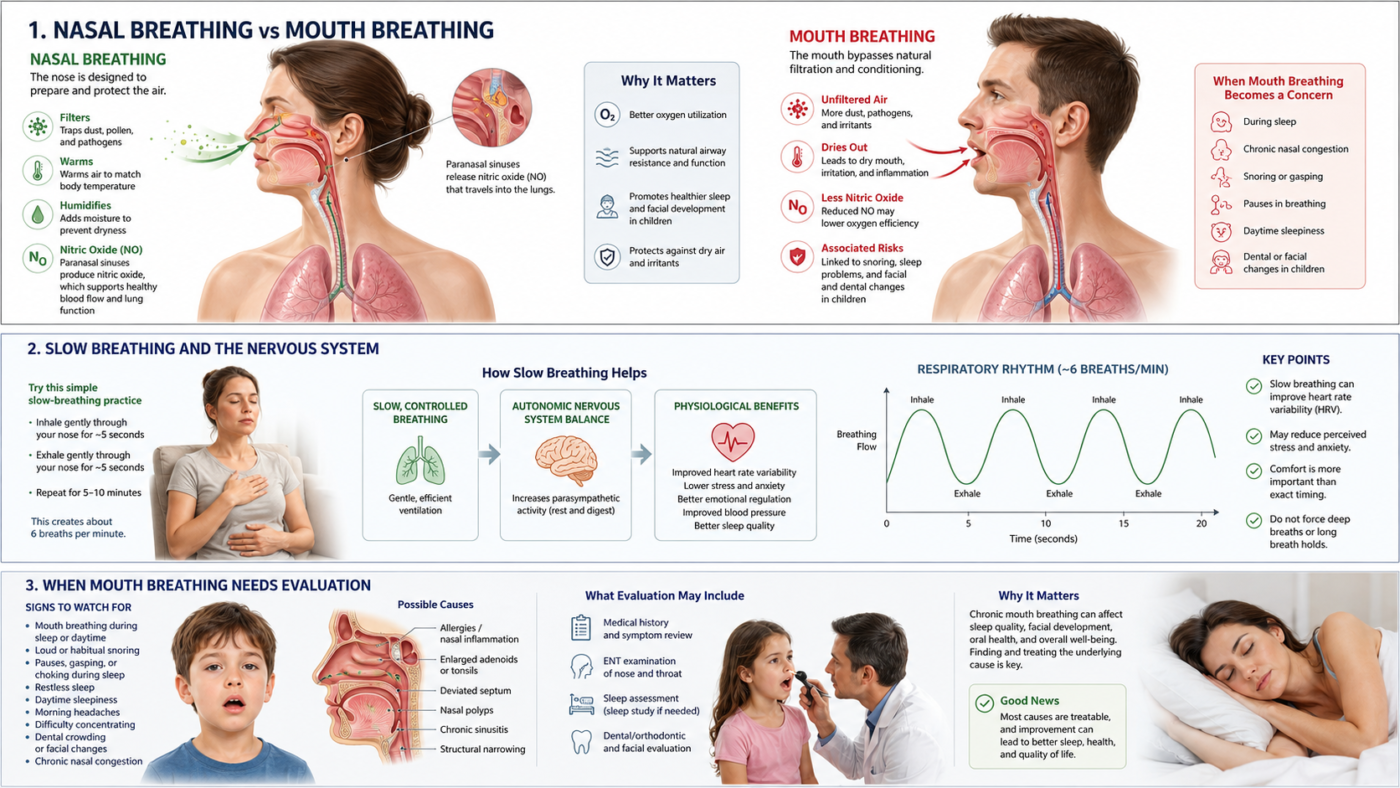
You breathe thousands of times every day without thinking about it.
Most of those breaths happen automatically.
But breathing is unusual because it is controlled both automatically and voluntarily. You cannot simply decide to slow your digestion or directly change your hormone levels, but you can deliberately change how quickly and deeply you breathe.
That makes breathing exercises interesting.
It does not mean that most people have been “breathing wrong” their entire lives, nor does it mean that correcting breathing can cure disease or reverse aging.
The evidence is much more useful when we avoid those exaggerated claims.
Nasal breathing plays important roles in filtering, warming and humidifying inhaled air. Slow, controlled breathing can also influence the autonomic nervous system and may help some people feel calmer.
At the same time, chronic mouth breathing, persistent nasal obstruction, loud snoring and sleep apnea deserve proper medical attention rather than simply being treated with breathing exercises.
Here is what the science actually tells us.
Why We Normally Breathe Through the Nose
The nose is designed to prepare air before it reaches the lungs.
As air passes through the nasal passages, it is warmed, humidified and filtered.
The nasal cavity also contributes resistance to airflow, which can influence breathing mechanics.
Another interesting feature is nitric oxide.
The nose and paranasal sinuses produce nitric oxide, a signaling molecule involved in blood-vessel regulation and respiratory physiology.
Some of this nitric oxide travels into the lungs during nasal breathing.
A small human study found higher measures of oxygenation during nasal breathing compared with oral breathing, possibly in part because of inhaled nasal nitric oxide.
This does not mean nasal breathing magically increases oxygen delivery by a guaranteed percentage in everyone.
But it does illustrate that the nose is much more than a simple air tube.
Nasal Nitric Oxide, Not Carbon Monoxide
This distinction is important.
The beneficial molecule associated with nasal breathing is nitric oxide.
Nitric oxide is abbreviated NO.
Carbon monoxide is CO.
They are completely different gases.
Nitric oxide produced in the nose and sinuses has biological signaling functions and may contribute to regulation of pulmonary blood flow and airway physiology.
So if you see health content claiming that nasal breathing works because your nose produces carbon monoxide, that claim is incorrect.
Is Mouth Breathing Always Bad?
No.
You naturally breathe through your mouth when intense exercise requires greater airflow.
Temporary mouth breathing can also occur during a cold or other short-lived nasal blockage.
The concern is habitual mouth breathing, particularly when it happens during sleep or throughout childhood.
Chronic mouth breathing may occur because of:
Allergic rhinitis
Enlarged tonsils or adenoids
A deviated nasal septum
Chronic nasal congestion
Structural narrowing
Sleep-disordered breathing
Other airway problems
In these situations, telling someone to simply “keep your mouth closed” may ignore the actual cause.
Mouth Breathing and Facial Development in Children
Research has found associations between chronic mouth breathing and differences in craniofacial and dental development in children.
Children who habitually breathe through their mouths are more likely in some studies to show features such as a narrower upper jaw, altered dental alignment and greater vertical facial growth.
However, this is a complex relationship.
Mouth breathing can influence facial development, but facial and airway anatomy can also make nasal breathing more difficult.
Allergies, enlarged adenoids, genetics, chewing patterns and other developmental factors may contribute.
Therefore, it is too simplistic to say that crooked teeth or narrow jaws are caused entirely by incorrect breathing.
The relationship appears to work in both directions.
What Parents Should Watch For
Persistent mouth breathing in a child deserves attention, especially when accompanied by:
Regular snoring
Sleeping with the mouth open
Chronic nasal congestion
Restless sleep
Pauses in breathing
Gasping during sleep
Daytime sleepiness
Morning headaches
Behavioral or attention problems
Difficulty breathing through the nose
Significant dental crowding
A pediatrician, ENT specialist, dentist, orthodontist or sleep specialist may need to evaluate the underlying cause.
The goal is not simply to train the child to close the mouth.
The first priority is making sure the nasal airway is actually open and healthy.
Snoring Is Not Always Harmless
Snoring occurs when tissues in the upper airway vibrate as air passes through a narrowed space during sleep.
Occasional mild snoring does not automatically mean someone has sleep apnea.
However, loud habitual snoring can be an important warning sign.
Obstructive sleep apnea occurs when the airway repeatedly becomes partially or completely blocked during sleep.
These interruptions can reduce sleep quality and repeatedly disturb normal breathing.
A widely cited global analysis estimated that hundreds of millions of adults may have some degree of obstructive sleep apnea.
Because many cases remain undiagnosed, persistent symptoms deserve evaluation.
Signs of Possible Sleep Apnea
Consider speaking with a healthcare professional if you experience:
Loud habitual snoring
Witnessed pauses in breathing
Waking up choking or gasping
Morning headaches
Dry mouth on waking
Severe daytime sleepiness
Difficulty concentrating despite adequate time in bed
Repeated nighttime awakenings
High blood pressure together with significant snoring
Breathing exercises are not a substitute for diagnosing or treating obstructive sleep apnea.
Does More Breathing Mean More Oxygen?
Not necessarily.
Healthy breathing depends on appropriate ventilation, not simply taking the largest possible breaths.
Hyperventilation means breathing more than your body’s metabolic needs require.
This can happen by breathing very quickly, very deeply, or both.
During significant hyperventilation, excessive carbon dioxide is exhaled.
Blood carbon dioxide levels fall, blood pH rises and blood vessels in the brain can constrict.
This is why acute hyperventilation may cause:
Lightheadedness
Tingling
Dizziness
Chest discomfort
A feeling of breathlessness
Visual changes
Anxiety
In healthy people breathing normally, however, there is no reason to deliberately try to “store” large amounts of carbon dioxide.
The Bohr Effect Explained Simply
Carbon dioxide is not merely useless waste.
It plays several important physiological roles.
One is related to the Bohr effect.
Hemoglobin carries oxygen through the bloodstream.
In metabolically active tissues, higher carbon dioxide concentrations and lower pH help hemoglobin release oxygen more readily.
During excessive hyperventilation, lower carbon dioxide changes this relationship.
But the popular claim that overbreathing leaves your blood “full of oxygen while your cells are starving” greatly exaggerates what normally happens.
The Bohr effect is real.
Using it to claim that everyday modern breathing causes widespread cellular oxygen starvation is not supported by evidence.
Can Slow Breathing Calm the Nervous System?
This is one of the strongest parts of the breathing story.
Controlled slow breathing can influence autonomic cardiovascular regulation.
Studies frequently examine breathing around five to seven breaths per minute.
At approximately six breaths per minute, breathing rhythms can interact with heart rate and blood pressure rhythms in ways that increase certain measures of heart rate variability.
Heart rate variability reflects changes in the time interval between heartbeats.
Slow breathing has also been associated with reductions in perceived stress and anxiety in some studies.
This makes slow breathing a reasonable relaxation technique.
It does not prove that six breaths per minute is a magic biological frequency or that everyone should breathe this slowly all day.
A Simple Slow-Breathing Exercise
If you are healthy and comfortable doing breathing exercises, try this:
Sit comfortably.
Relax your shoulders.
Breathe gently through your nose if it is comfortable.
Inhale slowly for about five seconds.
Exhale slowly for about five seconds.
Continue for five to ten minutes.
That produces roughly six breaths per minute.
Your breathing should remain gentle.
You should not be taking enormous breaths or forcing your lungs to fill completely.
The goal is slower, comfortable breathing, not maximal breathing.
You Do Not Need Exactly 5.5 Seconds
The internet often promotes 5.5 seconds in and 5.5 seconds out as though the number itself were medically special.
Research does not support that level of precision.
Different people have different resonance breathing frequencies.
For many adults, a comfortable range somewhere around five to seven breaths per minute can produce similar autonomic effects.
Some people will feel best slightly faster.
Others slightly slower.
Comfort matters more than hitting an exact stopwatch number.
What If Slow Breathing Makes You Dizzy?
Stop and return to normal breathing.
Dizziness can occur if you unintentionally take breaths that are too large and begin hyperventilating despite breathing slowly.
Slow breathing should also not involve prolonged forced breath holding.
Never practice extended breath holds:
Underwater
While driving
While standing somewhere you could fall
If you are feeling faint
During dangerous activities
People with significant heart or lung disease should discuss unfamiliar breathing practices with a healthcare professional before undertaking aggressive breath-holding exercises.
Does Slow Breathing Lower Cortisol and Slow Aging?
Claims in this area often go too far.
Relaxation and breathing exercises may reduce stress in some people and can influence measures of autonomic nervous system activity.
That does not establish a direct chain in which ordinary breathing habits continuously elevate cortisol, destroy muscle, suppress immunity, create systemic inflammation and accelerate biological aging.
Human physiology is much more complicated.
Breathing exercises are useful because they can be a simple stress-management tool.
They should not be marketed as an anti-aging treatment.
The Buteyko Breathing Method
The Buteyko method generally emphasizes nasal breathing, reduced breathing volume and greater awareness of breathing patterns.
It has been studied most extensively in asthma.
Some trials have reported improvements in asthma-related quality of life, symptoms and use of reliever medication.
However, improvements in objective lung-function measurements have been less consistent.
This means Buteyko-style breathing exercises may be helpful as an additional self-management technique for some people with asthma.
They are not a cure.
Do Not Stop Asthma Medication Because of Breathing Exercises
This is extremely important.
Someone with asthma should not discontinue an inhaled corticosteroid, bronchodilator or other prescribed treatment simply because a breathing technique makes them feel better.
Breathing exercises should complement evidence-based asthma treatment rather than replace it.
Medication changes should be discussed with the healthcare professional managing the condition.
What About the Famous Buteyko Story?
Many online accounts tell dramatic stories about Konstantin Buteyko curing serious disease by deliberately reducing his breathing.
Those historical stories are difficult to verify scientifically and should not be treated as clinical evidence.
Modern controlled trials are much more useful.
Those studies suggest that breathing retraining can improve certain asthma outcomes for some patients.
That is a meaningful finding without needing extraordinary historical claims.
What Is the BOLT Score?
BOLT stands for Body Oxygen Level Test.
It involves timing how long you can comfortably pause breathing after a normal exhalation before feeling the first definite urge to breathe.
It is popular in some breathing-training communities.
However, the name is misleading.
It does not directly measure your body’s oxygen level.
It does not replace pulse oximetry.
It does not diagnose carbon dioxide intolerance.
It does not diagnose asthma, sleep apnea, cardiovascular disease or poor health.
A 2024 study in highly trained individuals also found that BOLT performance was not associated with exercise performance.
So there is no scientifically established rule that:
Under 20 seconds means unhealthy.
40 seconds means ideal.
Most people should aim for a particular score.
Treat it as a breathing-training measurement if you use it, not as a medical test.
Do You Need to Train Yourself to Hold Your Breath Longer?
Usually not.
For general health, there is little reason for the average person to chase increasingly long breath holds.
If your goal is relaxation, gentle slow breathing has much more straightforward evidence and much less potential for misuse.
People who repeatedly experience breathlessness, difficulty breathing through the nose or unexplained exercise intolerance need medical evaluation rather than a higher breath-hold score.
Can Nasal Breathing Improve Exercise?
During light and moderate activity, many people can comfortably breathe through the nose.
Nasal breathing may encourage a slower breathing pattern and can be useful during gentle exercise.
But during vigorous exercise, ventilation requirements rise substantially.
Opening the mouth is normal.
There is no health prize for forcing yourself to keep your mouth closed while performing intense exercise if you feel air hungry.
Use nasal breathing when comfortable.
Let physiology take over when exercise becomes demanding.
What If Your Nose Is Always Blocked?
Do not simply force nasal breathing.
Persistent nasal obstruction may result from:
Allergic rhinitis
Chronic sinus disease
Nasal polyps
A deviated septum
Enlarged turbinates
Structural abnormalities
Other airway conditions
Treatment depends on the cause.
For some people that may involve allergy management, saline irrigation, medication or specialist evaluation.
Addressing the obstruction is more important than practicing increasingly difficult breathing exercises.
What About Mouth Taping at Night?
Mouth taping has become popular online.
Evidence supporting routine use in the general population remains limited.
It may also be inappropriate for people with nasal obstruction, significant congestion, suspected sleep apnea or other respiratory problems.
If someone cannot comfortably keep the mouth closed during sleep, the important question is why.
Do not simply tape over the symptom without understanding the airway.
A Practical Breathing Routine
You do not need an elaborate program.
During the Day
Use nasal breathing during quiet activities when comfortable.
Avoid repeatedly taking unnecessarily large breaths because you believe more air must always be healthier.
During Stress
Try five to ten minutes of gentle slow breathing.
A comfortable rate around five to seven breaths per minute is reasonable for many adults.
During Exercise
Use nasal breathing when comfortable.
Allow mouth breathing when exercise intensity demands more ventilation.
At Night
Pay attention to chronic snoring, mouth breathing, choking, gasping and poor sleep quality.
These symptoms deserve evaluation rather than simply breathing practice.
For Children
Persistent mouth breathing should prompt investigation of nasal obstruction and sleep-disordered breathing, particularly when dental or facial-development concerns are also present.
Frequently Asked Questions
Is Nasal Breathing Better Than Mouth Breathing?
For normal resting breathing, the nose provides filtration, humidification, warming and nasal nitric oxide.
Mouth breathing is nevertheless normal during strenuous exercise or temporary nasal obstruction.
The concern is persistent habitual mouth breathing rather than occasional use of the mouth.
Does Mouth Breathing Change Your Face?
Chronic mouth breathing in childhood is associated with certain craniofacial and dental patterns.
However, much of the evidence is observational, and cause and effect can run in both directions.
It is inaccurate to say that mouth breathing alone determines someone’s facial appearance.
Does Nose Breathing Give You 10 Percent More Oxygen?
A small older physiological study reported approximately 10 percent higher transcutaneous oxygen measures in most participants during nasal breathing.
That finding should not be turned into a universal promise that nasal breathing increases everyone’s oxygen absorption by exactly 10 percent.
Does Slow Breathing Improve Health?
Slow breathing can affect autonomic regulation and heart rate variability and may help reduce perceived stress.
Evidence does not show that slow breathing alone prevents disease, reverses aging or guarantees longer life.
Is Six Breaths Per Minute the Perfect Breathing Rate?
No.
Rates around five to seven breaths per minute are commonly studied.
Individual responses vary.
You do not need to maintain that rate throughout the day.
Can Buteyko Breathing Cure Asthma?
No.
Breathing retraining may improve symptoms and quality of life in some people with asthma, but it does not replace evidence-based asthma treatment or prescribed medication.
Is the BOLT Score a Medical Test?
No.
It does not directly measure blood oxygen and is not an established diagnostic test for respiratory or cardiovascular health.
Does Snoring Mean I Have Sleep Apnea?
Not necessarily.
But loud habitual snoring, especially when accompanied by gasping, witnessed breathing pauses or daytime sleepiness, warrants medical assessment.
Bottom Line
Breathing deserves more attention, but not because everyone has secretly been breathing incorrectly for decades.
Your nose is well designed for resting respiration.
Persistent mouth breathing can be a clue to nasal obstruction or sleep-disordered breathing.
Slow breathing can be a useful tool for relaxation and autonomic regulation.
And breathing retraining may complement treatment for certain conditions such as asthma.
But breathing exercises cannot replace diagnosis or medical treatment.
You do not need to chase extreme breath holds.
You do not need to hit an exact breathing frequency.
And you do not need to believe that every crooked tooth, sleep problem or chronic illness began with the way you breathe.
The most useful approach is simple:
Breathe comfortably through your nose when you can.
Slow your breathing gently when you want to relax.
And if you cannot breathe normally through your nose, snore heavily, wake up gasping or struggle with persistent breathlessness, find out why.
Medical Disclaimer
This article is for educational and informational purposes only and is not intended as medical advice, diagnosis or treatment. Persistent nasal obstruction, unexplained breathlessness, loud habitual snoring, witnessed pauses in breathing, asthma symptoms or suspected sleep apnea should be evaluated by a qualified healthcare professional. Do not discontinue prescribed respiratory medications because of breathing exercises.
This article is for general education and does not replace individualized care from a qualified health professional. Seek appropriate advice for persistent, severe, or concerning symptoms.
Read the full medical disclaimer