Morning wake-up yoga can be one of the simplest ways to gently transition your body from rest into movement. Some mornings, the body does not need an intense workout. It needs time to gradually wake up, breathe, and move.
This gentle 10-minute routine starts slowly, giving the ankles, spine, shoulders, and hips time to become mobile before the demands of the day begin.
Designed for stiff mornings, this morning wake-up yoga practice combines joint mobility, gentle stretching, mindful breathing, and easy full-body movement.
Some mornings, the body does not need an intense workout.
It needs time.
Time for the ankles to move again. Time for the spine to gradually become mobile. Time for the shoulders to drop away from the ears. Time for breathing and movement to reconnect before the demands of the day begin.
This gentle 10-minute wake-up yoga routine is designed for exactly those mornings.
Rather than jumping immediately into deep stretches or vigorous exercise, the sequence begins on the floor and slowly progresses from small joint movements to larger whole-body patterns. The practice includes ankle and wrist mobility, pelvic tilts, a gentle bridge, spinal movement, side-body stretching, Cat-Cow, Child’s Pose, neck mobility, shoulder releases, and slow breathing.
It can be used first thing in the morning, before a workout, or anytime you have been sitting for a long period and your body feels stiff.
Start With a Full-Body Stretch
Begin lying comfortably on your back.
Extend both legs long and reach the arms overhead.
Take a slow breath in and gently lengthen through the entire body, reaching in opposite directions through the fingertips and feet.
Avoid forcing the stretch.
Instead, imagine creating space.
As you exhale, bend the elbows and allow the arms to relax.
Take three slow breaths into the abdomen.
Let the belly rise naturally with the inhale and soften with the exhale.
This is not meant to be a dramatic breathing exercise. It is simply a transition between rest and movement.
Give your body a moment to realize that the day has begun.
Wake Up the Ankles and Feet
Keep the upper body relaxed and begin moving the toes and ankles.
Draw slow circles with the feet in one direction.
Move through the toes, the arches, and the ankles rather than making the movement only from the lower leg.
Then reverse direction.
Next, alternate between pointing and flexing the feet.
Point the toes away from you and notice the muscles of the legs becoming active.
Then flex the feet, pressing through the heels while drawing the toes toward you.
Spread the toes if that feels comfortable.
Repeat this pattern several times.
These small movements may seem simple, but they are an effective way to gradually introduce motion into joints that have remained relatively still overnight.
Activate the Legs and Center
With the legs extended, gently engage the thighs.
Imagine that you are standing in Mountain Pose, except that you are lying on your back.
Keep the feet flexed.
Draw the lower ribs inward slightly and notice the subtle engagement around the center of the body.
The goal is not to brace aggressively.
You are simply beginning to reconnect the feet, legs, abdomen, and torso.
Wake Up the Hands and Wrists
Reach both hands toward the ceiling.
Spread the fingers wide.
Notice the sensation of simultaneously spreading the fingers and toes.
Then begin making slow circles with the wrists.
Rotate in one direction and then the other.
If holding the arms up feels tiring, allow the elbows to rest on the mat while continuing the movement.
This practice is especially useful after sleep or before a day that involves prolonged typing, driving, or computer work.
Explore Gentle Pelvic Tilts
Bend both knees and place the feet on the floor.
Rest the arms comfortably beside you.
On an inhale, allow the pelvis to return toward a neutral position.
As you exhale, gently draw the lower abdomen inward and tilt the pelvis so that the lower back moves closer toward the floor.
Release.
Repeat several times.
Make the movement small.
Rather than lifting the entire body, focus on gradually articulating the pelvis and lower spine.
Pelvic tilts can be a simple way to introduce movement into the lumbar region before progressing into larger spinal movements.
Roll Slowly Into a Gentle Bridge
After several pelvic tilts, continue the movement upward.
Press gently through the feet.
Begin by lifting the tailbone.
Then slowly roll upward through the spine until the hips rise into a comfortable bridge.
The bridge does not need to be high.
Keep the neck relaxed and avoid turning the head.
Pause briefly.
Then soften through the chest and gradually lower the spine back to the mat, one section at a time.
Finish by returning the tailbone to the floor.
This slow rolling action encourages awareness of spinal movement rather than turning the bridge into a strength exercise.
Hug the Knees and Massage the Lower Back
Bring both knees toward the chest.
Hold behind the thighs or around the legs wherever it feels comfortable.
Rock gently from side to side.
Allow the movement to create a subtle massage across the lower back.
Then lift the feet and make another round of ankle circles.
After sleeping, the body often benefits from revisiting simple mobility rather than rushing ahead.
Rock Up to a Comfortable Seat
Place the hands behind the thighs and gently rock forward and backward along the spine.
If this feels comfortable, use the momentum to come gradually into a seated position.
Another option is to cross the ankles and hold the outer edges of the feet while rocking forward.
Avoid forcing the movement.
Once upright, cross the legs comfortably and sit tall.
Take a moment before moving on.
Stretch the Side Body
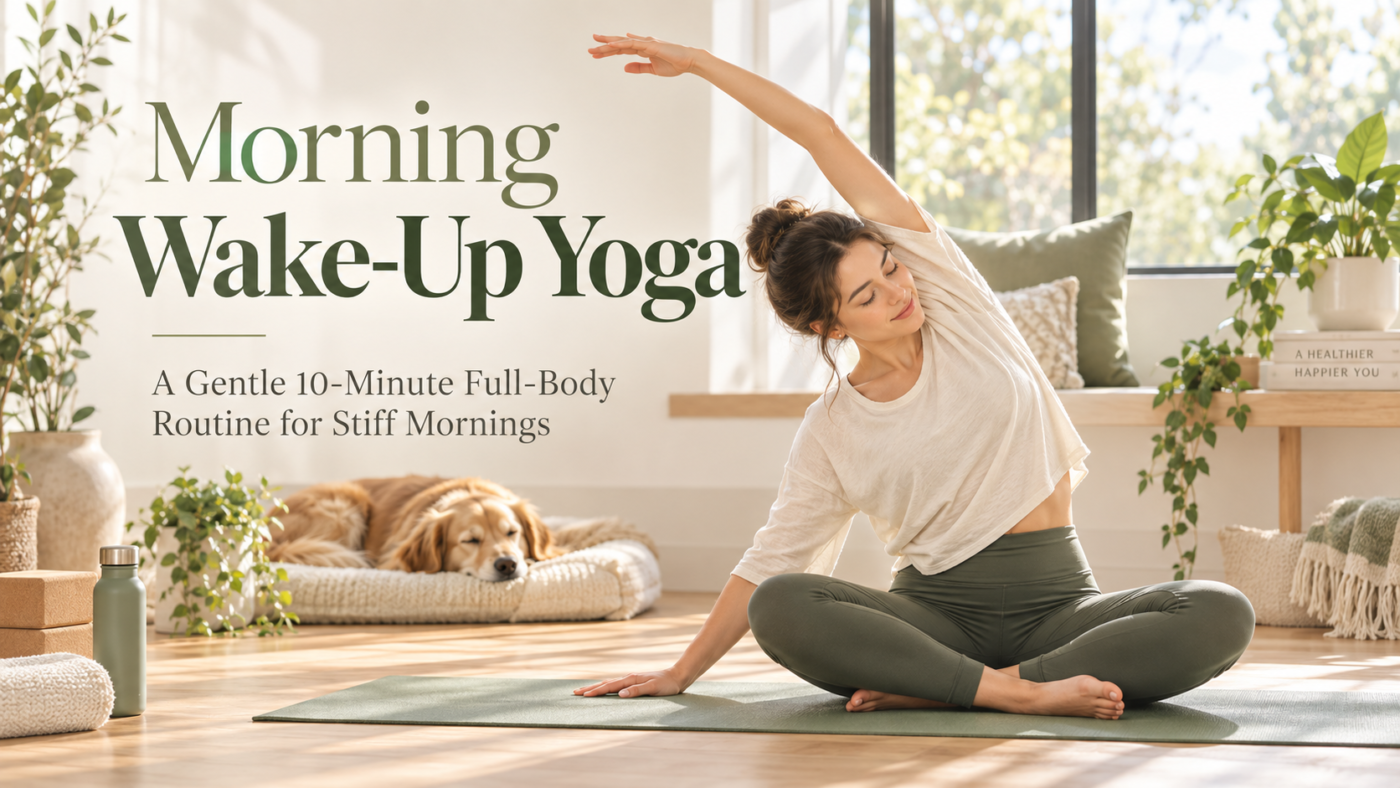
Place one hand beside you.
Reach the opposite arm overhead and lean gently to the side.
Rather than collapsing downward, think about creating length through both sides of the torso.
Take a deep breath.
Notice the expansion through the ribs, waist, chest, and back.
Return to center and repeat on the opposite side.
Keep both sitting bones as grounded as possible.
The intention is to lengthen rather than reach as far as possible.
Move Into Cat-Cow
Come onto your hands and knees.
Place the wrists approximately beneath the shoulders and the knees beneath the hips.
On an inhale, allow the belly to move gently downward as the chest opens and the gaze moves slightly forward.
On the exhale, round the spine, draw the abdomen inward, and allow the head to follow naturally.
Continue moving between these positions with the breath.
Do not rush.
Each repetition can be slightly different.
Some mornings the spine may feel mobile almost immediately. On other mornings, it may take several slow repetitions before the movement becomes comfortable.
Both experiences are normal.
Rest in Child’s Pose
From all fours, slowly send the hips backward.
Reach the fingertips forward.
Allow the forehead to move toward the mat or rest on a folded towel, cushion, or yoga block.
Take a slow breath in.
Remain for the exhale.
Take another deep breath and allow the back of the body to broaden.
You do not need to push the hips toward the heels.
Choose the version of Child’s Pose that allows you to breathe comfortably.
This is a useful moment of stillness before transitioning into seated neck and shoulder work.
Gently Mobilize the Neck
Return to a comfortable seated position.
Bring the chin gradually toward the chest.
Then slowly guide the nose toward one side.
Continue the movement upward and around without throwing the head backward.
Think about looking diagonally upward rather than collapsing the back of the neck.
Continue toward the other side and return the chin toward the chest.
Repeat slowly.
Then reverse direction.
These should be controlled, comfortable movements.
A neck circle does not need to be large to be useful.
Add Simple Side Neck Stretches
Return the head to center.
Bring the right ear gently toward the right shoulder.
Keep the chest lifted.
Avoid lifting the shoulder toward the ear.
Breathe.
Return to center and repeat on the left.
You may notice a stretch along the opposite side of the neck and upper shoulder.
Keep the sensation mild.
Neck stretching should never cause sharp pain, tingling, numbness, dizziness, or radiating symptoms.
Release the Shoulders
Take a deep breath in and lift both shoulders toward the ears.
As you breathe out, roll the shoulders backward and allow them to settle down.
Repeat several times.
Try to exaggerate the contrast between lifting and releasing.
Then extend both arms outward.
Bring the right arm across the chest and support it gently with the left hand.
Relax the shoulder away from the ear.
Breathe.
Release and repeat on the other side.
This simple stretch can feel especially welcome after sleeping in one position or spending long periods at a desk.
Finish With Breath and Reach
Return both arms beside you.
On an inhale, sweep the arms upward toward the ceiling.
Take a full, comfortable breath.
Exhale and slowly lower the arms.
Repeat.
For the final round, inhale and reach both arms overhead.
Bring the palms together.
Then exhale and guide the hands toward the center of the chest.
Remain here for a moment.
Notice how your body feels compared with the beginning of the practice.
You may feel more mobile.
You may feel warmer.
You may simply feel more aware of your body.
There is no required outcome.
Why Morning Wake-Up Yoga Can Be Useful
Morning wake-up yoga works best when the goal is not to force flexibility, but to gradually restore comfortable movement after sleep.The body naturally spends hours with relatively little movement during sleep.
That does not mean every joint needs aggressive stretching the moment you wake up.
A gradual routine allows movement to build progressively.
This sequence starts with the extremities—the feet, ankles, hands, and wrists—before adding the pelvis, spine, hips, neck, and shoulders.
That progression can make morning movement feel less abrupt.
It also provides an opportunity to notice stiffness before increasing intensity.
If you plan to exercise later, a gentle practice like this can serve as an initial movement session, although it should not automatically replace a sport-specific warm-up for demanding exercise.A short morning wake-up yoga routine can also be easier to maintain consistently than a long or demanding workout first thing in the day.
When to Practice This Morning Wake-Up Yoga Routine
Although it works particularly well in the morning, this sequence is not limited to mornings.
Try it:
After waking up.
Before a longer yoga session.
Before a moderate workout.
After prolonged sitting.
During a work-from-home break.
After travel.
Whenever your body feels stiff and you want to move without jumping directly into intense exercise.
Because the sequence is short, it can be easier to maintain consistently than a longer routine.
Make the Practice Comfortable
Gentle yoga should be adaptable.
Use a folded blanket beneath the hips if seated positions feel uncomfortable.
Support the forehead during Child’s Pose.
Reduce the depth of Cat-Cow if the spine feels sensitive.
Keep the bridge low.
Skip rocking movements if they feel uncomfortable.
Use a chair instead of sitting on the floor when necessary.
Most importantly, distinguish between mild stretching or muscular effort and pain.
A wake-up practice should leave the body feeling more prepared for the day, not irritated or exhausted.
A Better Morning Does Not Require a Complicated Routine
You do not need an hour-long workout immediately after waking.
Sometimes ten thoughtful minutes are enough to change the way you enter the day.
Move the feet.
Wake up the hands.
Mobilize the pelvis.
Let the spine move gradually.
Create space through the sides of the body.
Release the neck and shoulders.
Breathe.
Instead of demanding that your body be ready immediately, give it a few minutes to arrive.
That may be one of the simplest forms of morning self-care.
FAQ
Is 10 minutes of morning yoga enough?
Ten minutes can be enough for a short mobility and mindful-movement session. A brief routine can help you gradually introduce movement into the ankles, hips, spine, neck, and shoulders before beginning the rest of your day.
Is this morning yoga routine suitable for beginners?
Yes. The sequence uses gentle, relatively simple movements and can be modified. Reduce the range of motion, use cushions or blankets, or skip any position that does not feel comfortable.
Can I do this routine immediately after waking up?
Yes, provided the movements feel comfortable. The practice begins with slow floor-based movements rather than demanding stretches, allowing the body to transition gradually from rest into activity.
Can I use this routine before a workout?
It can be used as a gentle preliminary movement session. However, demanding exercise or sport may still require a more specific warm-up appropriate to that activity.
What should I do if my back feels stiff in the morning?
Keep pelvic tilts, bridges, and Cat-Cow small and controlled. Avoid forcing the spine into a large range of motion. Stop if movement causes sharp pain, numbness, tingling, or radiating symptoms.
Do I need yoga equipment?
A yoga mat or comfortable floor surface is helpful. A folded blanket, cushion, or yoga block can also make seated positions and Child’s Pose more comfortable.
Can I do this routine every morning?
If the routine feels comfortable and is appropriate for your health and mobility, it can be incorporated into a regular morning movement routine.
Medical Disclaimer
This article is for general educational and wellness purposes only and is not intended to provide medical advice, diagnosis, or treatment. Gentle yoga and mobility exercises may not be appropriate for everyone. Stop any movement that causes pain, dizziness, numbness, tingling, shortness of breath, or other unusual symptoms. People who are pregnant, recovering from surgery or injury, or living with significant musculoskeletal, neurological, cardiovascular, respiratory, or other medical conditions should seek individualized guidance from an appropriate healthcare professional before beginning a new exercise program.
This article is for general education and does not replace individualized care from a qualified health professional. Seek appropriate advice for persistent, severe, or concerning symptoms.
Read the full medical disclaimer