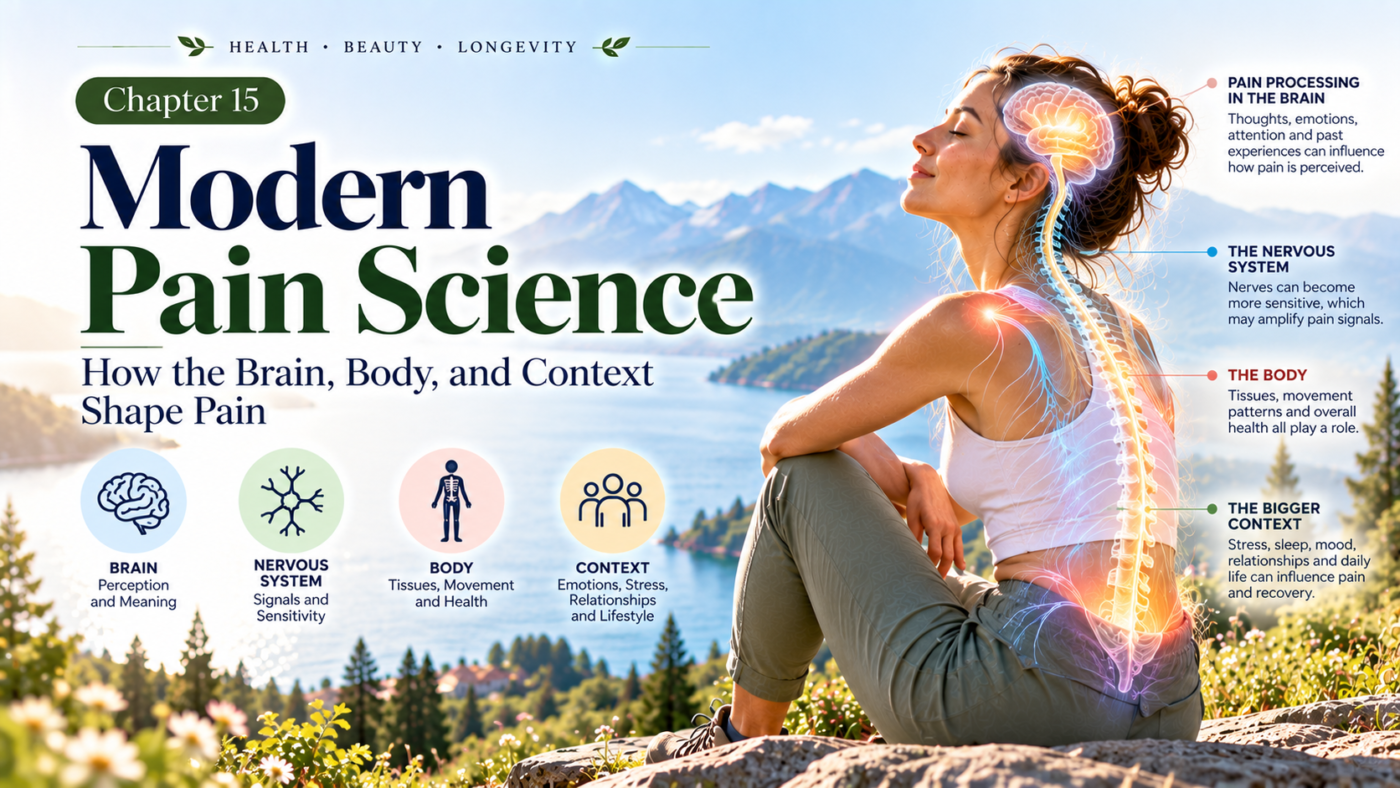
What Is Modern Pain Science?
Modern pain science understands pain as a personal sensory and emotional experience influenced by biological, psychological, and social factors. Pain and nociception are not identical: activity in sensory pathways alone does not determine the complete pain experience. This framework allows clinicians and patients to take tissue injury seriously while also considering nervous-system processing, sleep, stress, beliefs, behavior, relationships, and other relevant influences.
Modern pain science has changed the way we understand one of the body’s most powerful protective experiences. Pain can clearly arise from injury, inflammation, or nerve damage, but its intensity is not always a direct measurement of tissue damage. The brain, nervous system, body, past experience, sleep, stress, attention, expectations, and social context can all influence how pain is experienced.
Few experiences capture our attention as quickly as pain.
A sudden sharp sensation in the back, neck, shoulder, knee, or chest can instantly change the way we move and think. Pain makes us stop. It makes us protect the body. It raises an urgent question:
What has been damaged?
Sometimes the answer is straightforward.
A sprained ankle hurts because tissue has been injured.
A surgical incision hurts because the body has been cut.
Inflammation, infection, fracture, and other physical problems can clearly activate the nervous system and produce pain.
But pain is not always a direct measurement of tissue damage.
Two people can have similar injuries and report very different pain.
Pain may continue after an injury has healed.
Some people experience severe chronic pain even when imaging does not reveal a structural problem large enough to explain the intensity of their symptoms.
And in other situations, significant structural changes may exist without severe pain.
Modern pain science therefore asks a broader question:
How does the nervous system create and regulate the experience of pain?
That question does not make pain less physical.
It makes our understanding of pain more complete.
Pain Is Real
One of the most important principles in modern pain science is simple:
Pain is real whenever a person experiences it.
The International Association for the Study of Pain defines pain as an unpleasant sensory and emotional experience associated with, or resembling that associated with, actual or potential tissue damage. Modern pain science also recognizes that pain is influenced by biological, psychological, and social factors.
This means pain is not merely a signal traveling from an injured body part to the brain.
The nervous system receives information, interprets threat, considers context, and produces an experience designed to protect the person.
That experience can be influenced by:
injury,
inflammation,
nerve damage,
past experiences,
attention,
sleep,
stress,
fear,
expectations,
mood,
social circumstances,
and many other factors.
None of this means pain is “all in your head.”
The brain and nervous system are part of the body.
Pain is a biological experience influenced by the whole person.
Acute Pain and Chronic Pain Are Not Always the Same Problem
Acute pain is usually connected to a recent injury, illness, procedure, or other short-term threat.
It often serves a useful protective function.
If you sprain your ankle, pain encourages you to protect it.
If you burn your hand, pain makes you pull away.
As healing progresses, acute pain usually decreases.
Chronic pain is different.
IASP defines chronic pain as pain that persists or recurs for more than three months. At that point, pain may become a health problem in its own right rather than simply a temporary warning signal. Chronic pain is often multifactorial, with biological, psychological, and social factors interacting over time.
This does not mean the original injury was imaginary.
It means that the nervous system can change.
Pain can become persistent even after the original tissue injury is no longer the main driver.
Three Broad Pain Mechanisms
Modern pain science often distinguishes three broad mechanisms.
They can occur separately or overlap.
1. Nociceptive Pain
Nociceptive pain occurs when specialized sensory receptors respond to actual or threatened damage in non-neural tissue.
Examples can include:
a sprain,
a burn,
arthritis-related tissue irritation,
a surgical wound,
or some inflammatory conditions.
This is the kind of pain most people imagine when they think about injury.
There is a physical source of danger or tissue irritation activating pain pathways.
2. Neuropathic Pain
Neuropathic pain results from a lesion or disease affecting the somatosensory nervous system.
Examples may include:
diabetic neuropathy,
pain after certain nerve injuries,
postherpetic neuralgia,
or some forms of pain following stroke or spinal cord disease.
Neuropathic pain may feel:
burning,
electric,
shooting,
tingling,
or unusually sensitive to touch.
IASP emphasizes that neuropathic pain requires evidence or a clinically plausible history of disease or injury involving the somatosensory nervous system.
3. Nociplastic Pain
Nociplastic pain is a newer concept.
IASP defines it as pain arising from altered nociception when there is no clear evidence that ongoing tissue damage or a lesion of the somatosensory nervous system adequately explains the pain.
This category helps explain why some people experience genuine, persistent pain without a single damaged structure that fully accounts for the symptoms.
It does not mean the pain is psychological.
It means the nervous system itself may be processing pain-related information differently.
Fibromyalgia is one condition commonly discussed in relation to altered pain processing.
Some people may also have combinations of nociceptive, neuropathic, and nociplastic mechanisms at the same time.
Pain biology is not always either/or.
The Nervous System Can Become More Sensitive
The nervous system is adaptable.
That adaptability is essential for learning and survival.
But sometimes it can contribute to persistent pain.
After repeated or prolonged pain, the nervous system may become increasingly responsive.
A stimulus that once produced mild discomfort may feel much more painful.
A normally harmless touch may sometimes become painful.
IASP uses the term sensitization to describe increased responsiveness within nociceptive pathways, and central sensitization for increased responsiveness of pain-processing neurons within the central nervous system.
This helps explain an important point:
Pain intensity does not always correspond directly to the amount of tissue damage present at that moment.
The nervous system can amplify the experience.
Pain Is Protective, but Protection Can Become Overprotective
Pain is fundamentally protective.
Imagine an alarm system in a building.
If smoke appears, the alarm warns everyone to leave.
That is useful.
But imagine the alarm becomes so sensitive that it sounds when someone makes toast.
The alarm itself is functioning.
It is simply reacting too strongly.
Some chronic pain conditions can be understood in a similar way.
The nervous system may become increasingly protective, producing pain in response to movements, sensations, or activities that are not necessarily causing new tissue damage.
This analogy is imperfect, but it helps explain why treatment may sometimes involve teaching the nervous system that certain movements are safe again.
Stress Can Influence Pain Without Being the Sole Cause
Stress and emotion can influence pain.
That statement is scientifically reasonable.
But it can easily be misunderstood.
Stress does not mean:
“You caused your pain.”
“You are imagining it.”
“You are weak.”
“Your pain would disappear if you thought differently.”
Stress can influence:
muscle tension,
sleep,
attention,
inflammation-related processes,
coping behavior,
physical activity,
and nervous-system arousal.
When sleep is poor and stress is high, the nervous system may become more reactive.
A difficult day may therefore increase pain intensity even when the underlying physical condition has not suddenly become worse.
This is one reason chronic pain can fluctuate.
Why Fear Can Make Pain More Disabling
Pain naturally creates caution.
If bending caused severe pain yesterday, you may hesitate to bend today.
That makes sense.
But sometimes fear of pain grows larger than the actual physical danger.
A person may gradually stop:
walking,
lifting,
bending,
exercising,
traveling,
or participating in normal activities.
Reduced activity can lead to:
loss of strength,
lower confidence,
reduced fitness,
greater vigilance,
and more fear of movement.
A cycle can develop:
pain → fear → avoidance → reduced capacity → greater sensitivity and disability
This does not happen to everyone.
And avoiding movement may be appropriate in some acute injuries.
But in many chronic musculoskeletal pain conditions, long-term fear and avoidance can become part of the problem.
The solution is not simply:
“Push through the pain.”
The safer approach is often gradual, appropriate return to movement based on the individual condition.
Where John Sarno’s Ideas Fit Into Modern Pain Science
John Sarno became widely known for arguing that some chronic musculoskeletal pain could be strongly influenced by emotional stress and psychological processes.
His work helped popularize the idea that persistent pain could exist even when structural findings did not fully explain symptoms.
That broad insight overlaps with one important principle of modern pain science:
pain is influenced by more than tissue structure alone.
However, Sarno’s specific diagnosis of Tension Myositis Syndrome / Tension Myoneural Syndrome (TMS) and his theory that repressed emotions are the main cause of many musculoskeletal pain conditions are not equivalent to the current scientific classification of chronic pain.
Modern pain medicine uses a broader framework.
Biological factors matter.
Psychological factors matter.
Social conditions matter.
Nervous-system processing matters.
Sometimes structural disease is the major driver.
Sometimes nerve damage is involved.
Sometimes altered nociception is important.
Sometimes several mechanisms coexist.
A single emotional explanation cannot account for every case.
Pain Without Visible Damage Is Still Pain
People with chronic pain sometimes hear:
“Your scan looks normal, so nothing is wrong.”
That conclusion is too simplistic.
Medical imaging is designed to identify certain forms of structural change.
It does not directly measure the subjective experience of pain.
Likewise, a person may have a structural abnormality on imaging without that abnormality being the only reason they hurt.
Pain assessment therefore requires more than one data point.
History matters.
Physical examination matters.
Neurological findings matter.
Function matters.
Imaging and laboratory studies may matter.
And the person’s experience matters.
The goal is not to choose between:
“physical pain”
and
“psychological pain.”
The goal is to understand the entire pain mechanism as accurately as possible.
The Biopsychosocial Model
Modern interdisciplinary pain care often uses a biopsychosocial framework.
IASP describes integrative pain care as evidence-based management operating within this framework and potentially combining multiple treatment approaches.
Biological factors may include:
injury,
inflammation,
nerve damage,
genetics,
sleep disturbance,
physical conditioning,
medical disease,
and pain-system sensitization.
Psychological factors may include:
fear,
stress,
mood,
attention,
expectations,
coping strategies,
and beliefs about pain.
Social factors may include:
work demands,
family responsibilities,
financial pressure,
social support,
culture,
healthcare access,
and disability-related stress.
None of these factors makes the others less real.
They interact.
Why Sleep Matters in Chronic Pain
Pain can disturb sleep.
Poor sleep can also increase pain sensitivity.
This can create another cycle:
pain → poor sleep → greater sensitivity → more pain
Someone who wakes repeatedly during the night may have less resilience the following day.
Ordinary movement may feel harder.
Stress tolerance may fall.
Pain may feel more intense.
Improving sleep does not cure every pain condition.
But sleep is important enough that it should usually be considered in comprehensive chronic pain management.
Movement Can Be Treatment
When movement hurts, avoiding it feels logical.
Sometimes temporary protection is necessary.
But prolonged inactivity can create additional problems.
Appropriate movement can help maintain:
strength,
mobility,
balance,
confidence,
cardiovascular fitness,
and normal participation in life.
The key word is appropriate.
The correct activity depends on:
the diagnosis,
pain mechanism,
medical condition,
current fitness,
age,
and individual response.
A person recovering from surgery needs a different program from someone with fibromyalgia.
A person with nerve compression may need a different approach from someone with nonspecific chronic low-back pain.
Treatment should match the person rather than the slogan.
Cognitive Behavioral Therapy Does Not Mean the Pain Is Imaginary
Cognitive behavioral therapy, or CBT, is sometimes recommended for chronic pain.
Some patients understandably react:
“Why are you sending me to psychological treatment when my pain is physical?”
But CBT is not based on the idea that pain is fake.
It can help people work with:
fear of movement,
catastrophic thinking,
stress,
sleep problems,
activity patterns,
and coping strategies.
NCCIH notes that research supports CBT and mindfulness-based interventions as useful components of chronic pain management, including improvements in pain-related functioning for some people.
Psychological treatment can change the experience and impact of pain without denying its physical reality.
Mindfulness and Relaxation May Help Some People
Mindfulness, relaxation training, yoga, tai chi, qigong, massage, acupuncture, and related approaches are often discussed in chronic pain care.
The evidence varies considerably by condition.
NCCIH reports that some of these approaches may provide modest benefits for certain chronic pain conditions, but effectiveness is not universal and the quality of evidence differs across therapies and diagnoses.
This means they can sometimes be useful additions.
They should not be marketed as guaranteed cures.
Pain Education Can Reduce Fear
Understanding pain can itself be helpful.
A person who believes:
“Every time my back hurts, I am damaging my spine”
may become afraid of normal movement.
If appropriate medical evaluation shows that the activity is safe, learning that pain does not always equal new injury may make movement less frightening.
That change in understanding can support rehabilitation.
Pain education does not mean ignoring symptoms.
It means interpreting them more accurately.
Pain and Damage Are Related—but Not Identical
This distinction is one of the most important ideas in modern pain science.
Sometimes:
more damage = more pain
But not always.
Pain depends on the nervous system’s interpretation of threat.
That interpretation is influenced by context.
A painful stimulus may feel different depending on:
whether you expect danger,
whether you feel safe,
how much attention you give it,
whether you slept well,
whether you are frightened,
and whether the nervous system has become sensitized.
This does not make pain voluntary.
You cannot simply decide not to hurt.
It means pain is an active biological process rather than a simple damage meter.
Chronic Pain Treatment Is Often Multimodal
There is rarely one universal treatment for chronic pain.
A comprehensive plan may involve:
medical diagnosis and treatment,
physical therapy,
graded or appropriate exercise,
sleep improvement,
medications when indicated,
cognitive behavioral therapy,
stress-management approaches,
occupational rehabilitation,
and selected complementary therapies.
IASP describes interdisciplinary treatment as the coordinated use of different disciplines within a shared biopsychosocial framework.
This is often more realistic than expecting one pill, one exercise, one scan, or one psychological insight to solve everything.
What Chronic Pain Treatment Should Not Do
Good pain care should not tell people:
“It’s all psychological.”
Nor should it automatically assume:
“Every painful structure must be damaged.”
Both extremes are misleading.
A modern approach asks:
What type of pain is this?
What medical conditions need to be ruled out or treated?
What is the person able to do?
What increases or decreases symptoms?
How is sleep?
How much fear has developed around movement?
What stressors are present?
What treatment goals matter most?
The goal is not merely reducing a pain score.
It is improving life.
Function Is an Important Measure of Progress
Pain intensity matters.
But progress can also mean:
walking farther,
sleeping better,
returning to work,
playing with children,
driving comfortably,
lifting groceries,
exercising again,
or thinking about pain less often.
For chronic pain, improvement does not always mean reaching zero pain.
Sometimes it means pain has less control over life.
That can be an important clinical success.
When Pain Requires Prompt Medical Evaluation
A biopsychosocial understanding of pain should never become an excuse to ignore dangerous symptoms.
New or severe pain sometimes requires urgent assessment.
Seek prompt medical attention for concerning situations such as:
major trauma,
new or progressive weakness,
sudden neurological symptoms,
loss of bowel or bladder control with neurological symptoms,
severe chest pain,
significant breathing difficulty,
high fever with severe pain,
or rapidly worsening unexplained symptoms.
Persistent pain that does not improve also deserves appropriate evaluation.
Modern pain science expands medical thinking.
It does not replace medical diagnosis.
A Better Question About Pain
Instead of asking only:
“Where is the damage?”
modern pain science also asks:
“What is maintaining the pain experience?”
Sometimes the answer is ongoing tissue injury.
Sometimes it is nerve damage.
Sometimes altered pain processing has become important.
Sometimes poor sleep, fear, inactivity, stress, and sensitization amplify the problem.
Often several factors interact.
This broader understanding can lead to better treatment because it creates more than one path toward improvement.
Pain Is Personal, but It Is Not Imaginary
Two people with the same diagnosis can experience pain very differently.
That is not evidence that one person is exaggerating.
Pain is shaped by individual nervous systems, histories, bodies, environments, and experiences.
Respecting that individuality is one of the most important developments in modern pain medicine.
The person in pain is not merely carrying a damaged body part.
They are living with a complex sensory and emotional experience that affects movement, sleep, work, relationships, and confidence.
Effective care should address that whole reality.
The Newer View of Pain
The most useful modern insight is not that “pain is psychological.”
It is something more sophisticated:
Pain is an experience created by the nervous system to protect the person, and that experience is influenced by biological, psychological, and social information.
Sometimes the alarm accurately reflects tissue danger.
Sometimes nerves themselves are injured.
Sometimes the pain system becomes more sensitive.
Sometimes fear and stress amplify symptoms.
Sometimes structural disease remains the dominant cause.
And sometimes several mechanisms exist at once.
Understanding these possibilities does not make pain less real.
It gives us more ways to help.
John Sarno and the Historical Mind-Body Pain Debate
John Sarno helped popularize the idea that persistent musculoskeletal pain could be influenced by emotional and psychological processes even when structural findings did not fully explain symptoms. However, his specific Tension Myositis/Myoneural Syndrome theory should not be treated as equivalent to the current scientific classification of chronic pain. Modern pain science uses a broader biopsychosocial framework and distinguishes multiple pain mechanisms rather than attributing most persistent musculoskeletal pain to one emotional cause.
Pain Does Not Mean “It’s All in Your Head”
Psychological influences on pain do not make pain imaginary. The brain and nervous system are physical parts of the body, and pain is a genuine biological experience. A biopsychosocial approach expands the number of factors considered in pain care; it does not dismiss tissue injury, neurological disease, or other medical causes.
7 Key Facts About Modern Pain Science
1. Pain Is Real Even When Imaging Does Not Explain Everything
Pain cannot be reduced to what appears on an X-ray, MRI, or laboratory test. Imaging may reveal important structural disease, but the pain experience depends on the nervous system and the individual clinical context.
2. Pain and Tissue Damage Are Related but Not Identical
Tissue damage commonly causes pain, but pain intensity does not function as a precise damage meter. IASP explicitly distinguishes pain from nociception.
3. Chronic Pain Is Different From Short-Term Protective Pain
Pain is generally considered chronic when it persists or recurs for more than three months. Chronic pain may involve ongoing disease, but it can also persist after the initial injury or trigger has changed.
4. Pain Can Involve Different Mechanisms
Modern terminology distinguishes nociceptive pain, neuropathic pain, and nociplastic pain. These mechanisms are not always mutually exclusive and may coexist in the same person.
5. Stress and Emotion Can Influence Pain Without Making It Imaginary
Psychological factors can change attention, sleep, behavior, muscle tension, coping, and nervous-system arousal. Their involvement does not mean symptoms are invented or voluntarily produced.
6. Movement and Psychological Treatment Can Be Part of Physical Pain Care
Depending on the diagnosis, chronic pain management may include exercise, rehabilitation, CBT, mindfulness-based approaches, medication, sleep treatment, and other interventions. NCCIH reports that CBT and mindfulness-based interventions can improve pain and physical functioning for some people with chronic pain, while evidence varies by condition.
7. Good Chronic Pain Care Is Usually Individualized
IASP describes interdisciplinary and integrative pain care within a biopsychosocial framework, using different interventions according to the person’s pain mechanism, diagnosis, functioning, goals, and circumstances.
Three Broad Pain Mechanisms
| Pain Mechanism | Basic Meaning | Examples / Context |
|---|---|---|
| Nociceptive Pain | Pain related to actual or threatened damage to non-neural tissue with activation of nociceptors | Injury, burns, some inflammatory or musculoskeletal pain |
| Neuropathic Pain | Pain caused by a lesion or disease of the somatosensory nervous system | Diabetic neuropathy, postherpetic neuralgia, some nerve injuries |
| Nociplastic Pain | Pain associated with altered nociception when tissue damage or somatosensory nerve lesion does not adequately explain the pain | Can be relevant in some chronic pain presentations, including altered pain processing |
These mechanisms can overlap, and this simplified table is for education rather than self-diagnosis.
Modern pain science does not claim that all chronic pain is psychological.
One of the most useful lessons from modern pain science is that pain intensity and tissue damage are not always proportional.
Modern pain science also helps explain why sleep, fear, stress, movement, and rehabilitation can influence chronic pain.
From a modern pain science perspective, treatment should match the individual pain mechanism rather than rely on a single universal explanation.
FAQ
What is modern pain science?
Modern pain science studies pain as a sensory and emotional experience influenced by biological, psychological, and social factors rather than treating it as a simple direct measurement of tissue damage.
Does pain always mean something is damaged?
No. Tissue damage can produce pain, but pain may also continue after healing or occur when structural findings do not fully explain symptom intensity. Pain and nociception are related but distinct phenomena.
What is nociceptive pain?
Nociceptive pain arises from actual or threatened damage to non-neural tissue and activation of nociceptors.
What is neuropathic pain?
Neuropathic pain is pain caused by a lesion or disease of the somatosensory nervous system.
What is nociplastic pain?
Nociplastic pain involves altered nociception when there is no clear evidence that tissue damage or a lesion of the somatosensory system adequately explains the pain.
What is central sensitization?
IASP describes sensitization as increased responsiveness of nociceptive neurons to normal input and/or responses to normally subthreshold input. Central sensitization refers specifically to increased responsiveness within the central nervous system.
Can stress make chronic pain worse?
Stress may influence pain through sleep, attention, behavior, nervous-system arousal and other pathways. This does not mean stress is necessarily the original cause of the pain or that the symptoms are imaginary.
Can CBT help chronic pain?
For some chronic pain populations, cognitive behavioral therapy can improve pain-related functioning and may reduce pain intensity. It is usually one component of broader pain management rather than evidence that pain is “psychological.”
Can tai chi, yoga or mindfulness help with chronic pain?
They may help some people with some chronic pain conditions, but the evidence and effect size vary by diagnosis. NCCIH describes benefits from many complementary approaches as generally modest and condition-specific.
When should pain receive urgent medical attention?
New severe pain after major trauma, severe chest pain, difficulty breathing, sudden neurological symptoms, rapidly progressive weakness, or certain bowel/bladder changes with neurological symptoms warrant prompt medical assessment rather than self-treatment.
Medical Disclaimer: This article is for general educational and informational purposes only and is not intended as medical advice, diagnosis, or treatment. Pain can have many causes, including conditions that require prompt or urgent medical evaluation. Psychological or social influences on pain should never be used to dismiss symptoms or replace appropriate medical assessment. Seek qualified healthcare guidance for severe, persistent, unexplained, rapidly worsening, traumatic, neurological, or otherwise concerning pain.
This article is for general education and does not replace individualized care from a qualified health professional. Seek appropriate advice for persistent, severe, or concerning symptoms.
Read the full medical disclaimer

