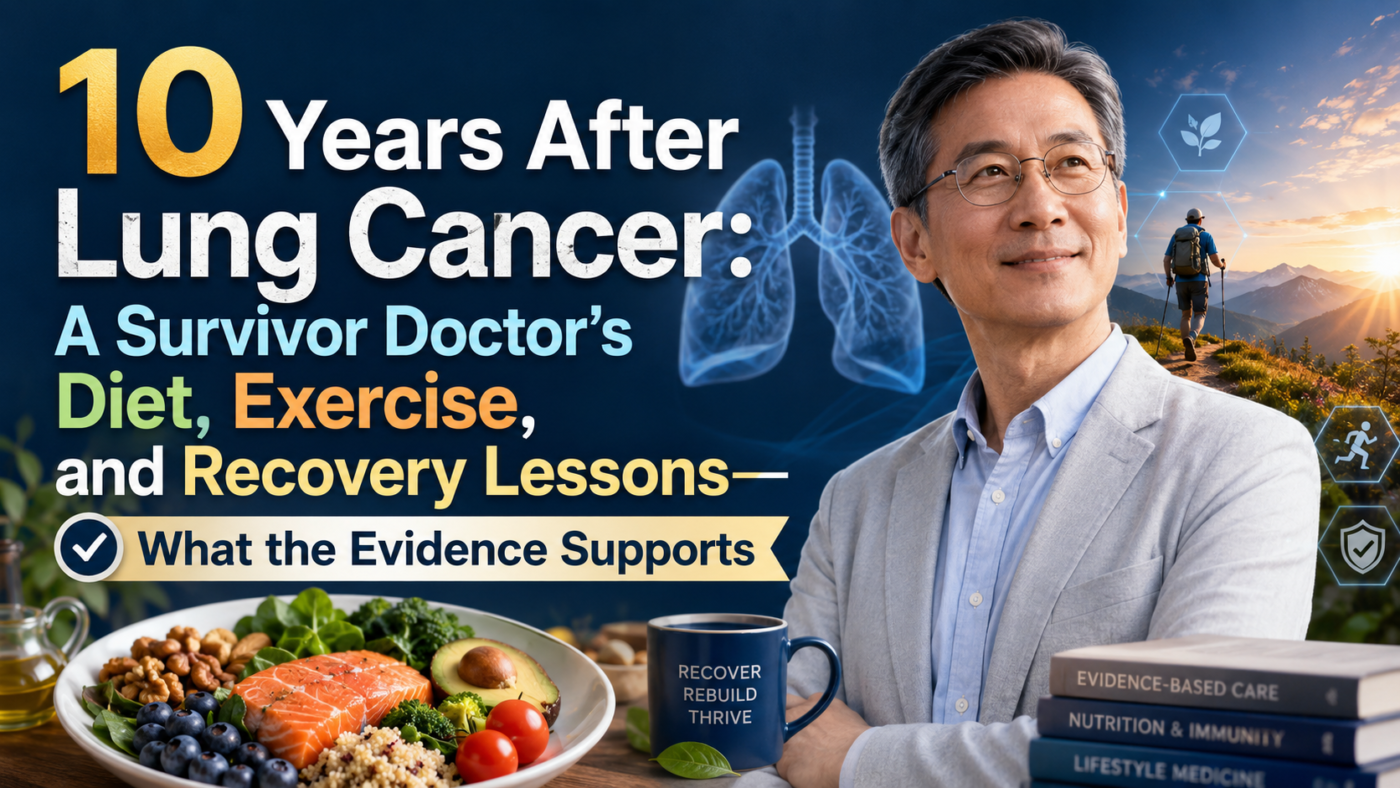
A lung cancer survivor diet is not a cure, but nutrition can become an important part of life after cancer. After experiencing lung cancer, treatment and recurrence, one physician rebuilt his daily routine around vegetables, healthy fats, protein, exercise, sleep and traditional wellness practices. More than 10 years later, his story offers valuable lessons—but it also raises an important question: which parts of his recovery routine are supported by evidence, and which should be viewed as personal experience rather than cancer treatment?A cancer diagnosis can divide life into two distinct periods: everything that came before it, and everything that comes after.
For one physician who had spent much of his career studying neurology, toxicology, and environmental medicine, lung cancer suddenly transformed cancer from an academic subject into a deeply personal experience.
He underwent conventional treatment, including surgery and chemotherapy. Months later, another tumor was detected in the same lung.
Faced with recurrence, he began reconsidering nearly every aspect of his daily life: what he ate, how much he exercised, when he slept, how he managed stress, how he viewed traditional Chinese health practices, and how much control a patient actually has after cancer treatment.
More than a decade later, his experience offers a powerful story of survivorship.
But there is an important distinction.
A survivor’s experience can teach us valuable lessons about living after cancer. It cannot prove that one particular diet, oil, vegetable, meridian practice, or emotional strategy prevented recurrence.
The most useful approach is therefore to separate the inspiring parts of the story from claims that go beyond the evidence.
That gives us something much more valuable than another “anti-cancer secret.”
It gives us a practical framework for healthier cancer survivorship.
Cancer Treatment and the Search for a “Root Cause”
When cancer returns after surgery or chemotherapy, it can be tempting to conclude that conventional medicine removed the tumor but failed to address the real cause of the disease.
Cancer biology is more complicated.
Surgery may successfully remove all cancer that can be identified, yet microscopic cancer cells may already exist elsewhere or remain below the limits of detection.
Some cancers also develop additional tumors because the surrounding tissue has been exposed to the same carcinogenic influences.
Tumor genetics, stage, treatment sensitivity, immune responses, age, smoking history, environmental exposure and simple biological chance can all influence recurrence.
This is why oncology often combines surgery with chemotherapy, radiation, targeted therapy or immunotherapy depending on the cancer.
Lifestyle still matters enormously.
But lifestyle should be viewed as part of survivorship and risk reduction—not as proof that cancer returned because the patient failed to correct an invisible “root cause.”
Can You Starve Cancer by Cutting Carbohydrates?
One of the ideas in the original cancer-survivor diet was to substantially reduce carbohydrate intake because cancer cells use glucose for energy.
There is a biological basis behind part of this idea.
Many tumors consume large amounts of glucose.
This phenomenon is related to the altered metabolism observed in many cancer cells and is one reason radioactive glucose can be used in PET imaging.
But the conclusion that follows is often wrong.
Simply removing carbohydrates from the diet does not starve a tumor.
Your healthy cells also require glucose, and when carbohydrate intake falls, the body can manufacture glucose from amino acids and other substrates.
Cancer metabolism is also far more flexible than “cancer eats sugar.”
Different tumors can use glucose, amino acids, fatty acids and other fuels.
Therefore, there is currently no universal anti-cancer carbohydrate percentage that every cancer survivor should follow.
For some people, replacing large quantities of refined carbohydrates with vegetables, legumes, intact whole grains, protein and healthy fats can improve metabolic health.
That is very different from declaring carbohydrates the fuel that must be removed to stop cancer.
Weight Maintenance Can Be More Important Than Carbohydrate Restriction
During active cancer treatment, losing too much weight or muscle can become dangerous.
Patients undergoing chemotherapy, radiation or major surgery may need substantially different nutrition from healthy adults trying to lose weight.
Adequate calories and protein can be essential for maintaining:
Muscle mass.
Strength.
Immune function.
Wound healing.
Treatment tolerance.
And quality of life.
For cancer survivors who are overweight after treatment, gradual movement toward a healthier body composition may be beneficial.
But aggressive dieting should never compromise nutrition during treatment.
The appropriate diet depends on the cancer, treatment phase, current weight, appetite, laboratory findings and medical condition.
A Better Version of the “Anti-Cancer Plate”
Rather than trying to design a plate that directly kills cancer cells, it is more useful to build a dietary pattern associated with long-term health.
A strong foundation includes abundant vegetables, fruit, legumes, whole grains when tolerated, nuts and seeds, adequate protein and predominantly unsaturated fats.
Processed meat should be minimized.
Red meat can be moderated.
Sugar-sweetened beverages and highly processed foods should not dominate the diet.
Alcohol is best minimized, and for cancer prevention, avoiding alcohol is the lowest-risk choice.
The goal is not to find one magical ingredient.
It is to create a dietary pattern that can be sustained for years.
Cruciferous Vegetables Deserve a Place on the Plate
The survivor highlighted cruciferous vegetables as one of his favorite food groups.
That is a reasonable choice.
The cruciferous family includes foods such as:
Broccoli, cauliflower, cabbage, kale, bok choy, Brussels sprouts and related vegetables.
They contain compounds called glucosinolates.
When these vegetables are chopped, chewed and digested, glucosinolates can form biologically active compounds such as isothiocyanates and indoles.
Scientists have studied these compounds for their effects on cellular signaling, detoxification enzymes, oxidative stress and carcinogenesis.
This makes cruciferous vegetables scientifically interesting.
It does not make broccoli chemotherapy.
Human cancer prevention involves much more than consuming one class of phytochemicals.
The practical conclusion is simple: cruciferous vegetables are nutritious foods worth eating regularly as part of a diverse plant-rich diet.
Garlic, Onions and the Allium Family
The second food group emphasized in the original discussion was the allium family.
This includes garlic, onions, scallions, leeks and chives.
These foods provide sulfur-containing compounds and numerous phytochemicals.
Research has explored possible relationships between allium vegetable consumption and cancer risk.
The results are interesting but not strong enough to claim that garlic or onions prevent cancer recurrence.
Still, they are inexpensive, flavorful and nutrient-rich foods that can easily become part of daily cooking.
The survivor’s habit of regularly combining cruciferous vegetables with onions and garlic is therefore a sensible dietary habit even without calling them “the two strongest anti-cancer vegetables.”
Mushrooms and Sea Vegetables
Mushrooms and sea vegetables also appeared prominently in the original recovery diet.
Mushrooms contain fiber, micronutrients and a variety of polysaccharides and other bioactive compounds.
Some purified mushroom-derived compounds have been investigated medically, particularly in parts of Asia.
But eating mushrooms should not be confused with receiving an established cancer drug.
Sea vegetables can provide minerals and other nutrients, but iodine levels can vary enormously.
Extremely high seaweed consumption may lead to excessive iodine intake in some people.
The most sensible approach is dietary variety rather than treating either food group as medicine.
Protein Is Especially Important During Cancer Recovery
Cancer survivors should not focus so intensely on vegetables that they forget protein.
Protein helps support muscle maintenance, physical recovery and tissue repair.
Suitable sources may include fish, eggs, dairy foods if tolerated, poultry, beans, lentils, soy foods and other protein-rich foods.
The physician in the original discussion favored oily fish such as sardines, mackerel and salmon.
That is a reasonable strategy.
These fish provide protein along with the long-chain omega-3 fatty acids EPA and DHA.
Not Every “Healthy Oil” Is an Omega-3 Oil
One important correction is needed here.
The original discussion grouped flaxseed oil, olive oil, camellia oil, perilla oil and other oils together as if they were all rich sources of omega-3.
They are not.
Flaxseed and perilla oils can be rich in alpha-linolenic acid, a plant omega-3 fatty acid.
Olive oil, by contrast, is valued mainly for monounsaturated fat and polyphenols.
Camellia oil is also predominantly monounsaturated.
They may all fit into a healthy diet, but for different nutritional reasons.
Likewise, walnuts contain meaningful plant omega-3, while macadamia nuts contain very little omega-3 and are mainly rich in monounsaturated fat.
Precision matters.
You Do Not Need to Drink Oil
The survivor described carrying his own cooking oil when eating outside and sometimes adding it directly to vegetables.
Bringing a trusted oil can certainly be an option.
But drinking oil or deliberately adding large quantities to replace carbohydrate calories is unnecessary for most people.
Oil is extremely calorie dense.
A better strategy for many people is to obtain healthy fats through whole foods such as nuts, seeds, fish and avocado, while using moderate amounts of olive or other unsaturated oils in cooking.
Five Vegetables and Two Fruits?
The original approach emphasized roughly five portions of vegetables and two portions of fruit.
The precise number does not need to become a rigid prescription.
The more important concept is to make plant foods a large and varied part of the diet.
Different vegetables contain different fibers, carotenoids, polyphenols, vitamins, minerals and phytochemicals.
Eating broccoli every day while ignoring the rest of the plant kingdom is less desirable than eating a diverse range of vegetables.
Colors can be useful as a simple guide.
Dark green vegetables, red and orange produce, berries, purple vegetables, legumes and different whole plant foods each contribute something different.
Fruit Is Not the Enemy
Some cancer survivors become unnecessarily frightened of fruit because it contains natural sugar.
Whole fruit is not equivalent to soda or candy.
Fruit provides water, fiber, vitamins and phytochemicals along with its naturally occurring sugars.
Unless a patient has a specific metabolic or digestive reason to restrict certain fruits, whole fruit can fit comfortably into a healthy cancer-survivorship diet.
Two servings a day may be perfectly reasonable, but an exact universal number is unnecessary.
What About Vegetable and Fruit Juice?
Juicing is popular in cancer communities.
There is nothing inherently wrong with occasionally drinking vegetable or fruit juice.
But juice should not replace most whole fruits and vegetables.
Juicing often removes much of the fiber.
Fruit-heavy juices can also deliver substantial amounts of sugar quickly.
The claim that chewing itself is an “anti-cancer mechanism” goes too far.
Chewing is unquestionably important for normal eating and digestion. It breaks food down mechanically, mixes it with saliva and helps initiate normal digestive processes.
But chewing should not be promoted as a cancer treatment.
Whole foods remain preferable mainly because they preserve the complete food matrix, including fiber.
A Daily Routine Can Be Powerful
One of the strongest parts of the survivor’s story was not a particular vegetable.
It was consistency.
He described waking early, exercising regularly, spending time in quiet reflection, eating regular meals and maintaining structured working hours.
Modern research strongly supports the importance of regular physical activity and adequate sleep for general health.
The exact clock time is far less important than maintaining a sustainable rhythm.
You do not need to wake at 4:30 a.m. to become healthy.
Someone who sleeps from 10 p.m. to 5 a.m. and someone who sleeps from midnight to 7 a.m. may both have healthy routines if they obtain sufficient restorative sleep and maintain appropriate circadian regularity.
Exercise May Be One of the Most Valuable Survivorship Tools
Physical activity is one of the strongest lifestyle interventions available to many cancer survivors.
Regular exercise can help maintain:
Muscle mass.
Cardiorespiratory fitness.
Bone health.
Balance.
Metabolic health.
Mood.
Sleep.
And independence.
Evidence also suggests that higher physical activity after diagnosis is associated with better outcomes for several cancers, although the strength of evidence varies by cancer type.
A survivor climbing mountains at age 60 is inspirational.
But mountain climbing is not necessary.
Walking, cycling, swimming, resistance training, tai chi and other activities can all be valuable.
For people recovering from lung surgery or cancer treatment, exercise intensity should be increased gradually.
The Traditional Chinese Medicine Body Clock
The original conversation connected waking and sleeping times with the traditional Chinese medicine concept of the organ clock, in which different meridians are associated with different two-hour periods.
This remains an important part of traditional Chinese medical theory.
It can be presented respectfully as a historical wellness framework.
But modern physiology has not demonstrated that the lung “cleans itself” specifically between 3 and 5 a.m., that the large intestine functions uniquely from 5 to 7 a.m., or that liver detoxification occurs only from 1 to 3 a.m.
Human metabolism and liver detoxification operate continuously.
Circadian biology is real, but it should not be treated as proof of the traditional meridian timetable.
What About Glutathione at 2 a.m.?
Glutathione is one of the body’s major antioxidant molecules and participates in cellular defense and metabolism.
The liver plays an important role in glutathione metabolism.
However, the claim that glutathione universally reaches a dramatic detoxification maximum at precisely 2 a.m. and therefore proves the Chinese meridian clock is not established.
Both traditions and modern circadian science recognize that timing matters in biology.
That does not mean the two systems have been scientifically shown to describe the same mechanism.
Meridian Practices Can Still Have a Place
Traditional meridian theory played a powerful psychological role in this physician’s recovery.
He found hope in the classical Chinese statement:
“Meridians determine life and death, treat many diseases, regulate deficiency and excess, and therefore must remain unobstructed.”
Historically, this idea belongs to a broader Chinese medical understanding of health.
A modern cancer patient can respect that tradition without interpreting it literally as proof that opening meridians cures cancer.
Practices associated with traditional medicine—such as tai chi, qigong, breathing exercises, gentle movement and meditation—may help with relaxation, mobility, stress management and quality of life.
Acupuncture may also help selected cancer patients manage certain treatment-related symptoms when used appropriately.
None of these approaches should replace oncology treatment.
Hope Matters—But Hope Is Not a Guarantee
Perhaps the most valuable thing the survivor found in traditional medicine was not a biochemical cancer cure.
It was hope.
After recurrence, he needed a reason to believe that survival remained possible.
That psychological shift mattered.
Cancer patients frequently experience fear of recurrence, anxiety, depression and uncertainty about the future.
Learning to live with uncertainty is an important part of survivorship.
Acceptance does not mean surrender.
It means recognizing the diagnosis, participating in treatment, making realistic lifestyle changes and continuing to build a meaningful life.
Stress Does Not Map Directly Onto Specific Cancers
The original discussion went much too far when it suggested that certain emotional conflicts correspond to specific cancers.
For example, breast cancer was linked to family relationships, colorectal cancer to suppressed anger, and lung cancer to sadness.
There is no reliable evidence that these emotional states directly determine where cancer develops.
This distinction is extremely important because otherwise patients may begin blaming themselves for their disease.
Cancer is caused by complex interactions among genetic changes, aging, environmental exposures, infections, tobacco, radiation, hormones, metabolic factors, inherited susceptibility and chance.
Chronic stress can still matter.
It may affect sleep, appetite, exercise, alcohol use, smoking, immune signaling and quality of life.
Managing stress therefore remains valuable.
But a person’s sadness did not “cause” lung cancer, and family problems did not “create” breast cancer.
Cancer Survivors Should Never Be Blamed
This principle deserves special emphasis.
Healthy living can lower certain risks.
It cannot eliminate risk.
A person can exercise, eat vegetables, sleep well and still develop cancer.
Another person can live less healthfully and never develop it.
Lifestyle medicine should empower patients rather than make them feel responsible for everything that happens inside their bodies.
Lung Cancer Outcomes Are Not a Single Percentage
The survivor described discovering that even cancers with very poor survival statistics still had a small percentage of long-term survivors.
That realization gave him hope.
The emotional lesson remains valuable.
But modern lung cancer survival should never be summarized with a single low percentage.
Outcomes vary dramatically according to:
Cancer stage.
Tumor subtype.
Molecular mutations.
Overall health.
Response to treatment.
Access to surgery.
Targeted therapies.
Immunotherapy.
And many other factors.
Some early-stage lung cancers can be treated with curative intent.
Modern targeted therapy and immunotherapy have also substantially changed outcomes for some patients with advanced disease.
Statistics describe populations.
They cannot predict exactly how long one individual will live.
Ten Years Without Recurrence Is Inspiring, Not Proof of a Cure Method
A physician living cancer-free for a decade after recurrence is a remarkable survivorship story.
But we cannot know which part of his outcome came from surgery, chemotherapy, tumor biology, immune response, lifestyle changes or other factors.
That uncertainty does not diminish his experience.
It simply means we should not turn an individual story into a universal prescription.
His vegetables may have supported health.
Exercise almost certainly supported fitness.
Better sleep may have improved well-being.
Mindfulness may have helped him live with uncertainty.
Traditional Chinese medical philosophy may have given him psychological strength.
And his conventional cancer treatment may have eliminated the malignant cells responsible for the disease.
All of these things can coexist.
Cooking Fumes and Lung Health
The original interview also discussed cooking fumes.
This is an important topic.
High-temperature cooking—particularly frying and cooking oils until they smoke—can generate particulate matter and volatile compounds.
Long-term exposure to poorly ventilated cooking environments has been associated with respiratory risks in observational research.
The most important intervention is ventilation.
Turn on the range hood before cooking.
Use adequate extraction.
Open windows when appropriate.
Keep filters clean.
Avoid repeatedly heating oils beyond their smoke point.
Reduce unnecessary high-temperature frying.
A mask may reduce inhalation of some particles depending on its design and fit, but there is not enough evidence to tell every home cook that wearing a mask will reduce lung cancer risk by exactly 50%.
Ventilation remains the priority.
Washing Vegetables to Reduce Pesticide Residues
You do not need complicated vegetable-cleaning chemicals.
Rinse produce under clean running water.
Rub firm produce gently.
Separate and rinse leafy vegetables carefully.
Remove damaged or heavily soiled outer leaves.
Cooking or peeling can reduce certain residues when appropriate.
However, there is no single universal percentage such as “washing removes 20–70% and blanching removes another 20–70%.”
Different pesticides behave differently.
Some remain mostly on the surface.
Others can penetrate plant tissues.
The amount removed depends on the food, pesticide, washing method and cooking method.
Soap and household detergents should not be used on food.
There Is No Permanent Universal “Five Most Dangerous Vegetables”
Lists ranking spinach, celery, chives, cilantro, strawberries or other foods as the worst pesticide offenders can change according to country, growing season, pesticide regulation and surveillance year.
Such lists should never scare people away from eating vegetables and fruit.
The health benefits of eating produce generally outweigh concerns about regulated pesticide residues.
Choose reputable suppliers, wash produce properly and maintain dietary variety.
An 80/20 Lifestyle May Be More Sustainable Than Perfection
One of the most practical ideas in the entire interview was the survivor’s 80/20 principle.
He aimed to live healthfully most of the time while allowing occasional foods purely for enjoyment.
That could mean an occasional dessert.
A small serving of ice cream.
A favorite restaurant meal.
Or another pleasure.
This approach recognizes something important:
Health is built over years.
A diet that is nutritionally perfect for three weeks but impossible to maintain is less useful than a good pattern you can sustain for decades.
Cancer survivorship should not become a new form of punishment.
A Practical Cancer-Survivorship Plate
Instead of thinking about food as something that must destroy cancer cells, imagine a plate designed to support the person who survived cancer.
Make vegetables a major part of the meal, using several colors and rotating varieties.
Include a meaningful protein source.
Add whole grains, legumes or another quality carbohydrate according to individual energy needs.
Use predominantly unsaturated fats.
Eat whole fruit.
Include nuts or seeds in sensible portions.
Choose fish regularly if you eat seafood.
Drink water according to thirst and medical needs.
And leave room for enjoyment.
If active treatment has affected appetite, swallowing, digestion or weight, individualized oncology nutrition advice takes priority over generic plate rules.
What Matters Most After Cancer
After all the vegetables, oils, meridians, supplements and theories are stripped away, several principles remain remarkably strong.
Stay engaged with oncology follow-up.
Do not replace treatment with alternative medicine.
Do not smoke.
Avoid secondhand smoke where possible.
Move your body regularly.
Preserve muscle.
Eat a varied plant-forward diet with adequate protein.
Maintain an appropriate body weight without becoming undernourished.
Protect sleep.
Limit alcohol.
Reduce unnecessary exposure to carcinogens.
Take care of cardiovascular and metabolic health.
And find ways to live with less fear.
Those principles are less dramatic than a “cancer cure diet.”
They are also far more useful.
The Deeper Lesson From a 10-Year Survivor
The physician’s story should not be reduced to broccoli, omega-3 oil or meridians.
Its real lesson is resilience.
After cancer recurrence, he rebuilt his life around movement, nutrition, structure, purpose and hope.
He used conventional treatment.
He explored traditional medicine.
He changed his daily habits.
He continued exercising.
He paid attention to what he ate.
And most importantly, he stopped treating survival statistics as a personal expiration date.
That is a lesson worth keeping.
Statistics describe probabilities.
They do not determine one individual’s future.
Healthy habits cannot guarantee that cancer will never return.
Traditional practices cannot promise a cure.
And modern medicine cannot eliminate every uncertainty.
But a patient can still influence many parts of life after cancer:
How they eat.
How they move.
How they sleep.
How they manage fear.
How faithfully they attend follow-up care.
And how fully they choose to live.
That may be the most meaningful form of recovery.
Frequently Asked Questions
Can reducing carbohydrates starve cancer cells?
No. Many tumors consume glucose, but the body can produce glucose even when carbohydrate intake is low, and cancers can use multiple energy sources. Carbohydrate restriction is not a universal cancer treatment.
Are broccoli and garlic anti-cancer foods?
Cruciferous vegetables and allium vegetables contain biologically active compounds that are being studied in cancer research. They are nutritious foods worth including regularly, but they are not treatments that prevent or cure cancer by themselves.
Should cancer survivors avoid fruit because of sugar?
Usually not. Whole fruit provides fiber, water, vitamins and phytochemicals and can be part of a healthy cancer-survivorship diet unless an individual’s medical situation requires specific restrictions.
Is vegetable juice good for cancer survivors?
It can be included occasionally, but it should not replace most whole vegetables or complete meals. Whole produce generally provides more fiber.
Are omega-3 fats useful after cancer?
Omega-3-rich foods such as oily fish can be part of a nutritious diet. Omega-3 supplements are not universal cancer treatments and should be discussed with a clinician when high doses are considered.
Is olive oil high in omega-3?
No. Olive oil is mainly rich in monounsaturated fat. It can still be a healthy dietary fat, but it should not be described as an omega-3-rich oil.
Do mushrooms prevent cancer recurrence?
Mushrooms contain nutrients and biologically interesting compounds, but eating mushrooms has not been shown to guarantee prevention of cancer recurrence.
Can stress cause cancer?
Stress may influence behavior, sleep and overall health, but there is no reliable evidence that sadness causes lung cancer, anger causes colorectal cancer, or family conflict directly causes breast cancer.
Can opening the meridians cure cancer?
Traditional meridian theory is an important part of Chinese medicine, but there is no scientific evidence that “opening meridians” cures cancer. Practices such as tai chi, qigong, meditation and acupuncture may still be useful as supportive care for selected patients.
Is waking before 5 a.m. healthier?
Not necessarily. Regular, sufficient sleep is more important than choosing one specific wake-up time.
Does the liver detoxify mainly between 1 and 3 a.m.?
The liver performs metabolic and detoxification functions continuously. Human physiology follows circadian rhythms, but modern science has not established the traditional 1–3 a.m. liver-meridian period as the body’s exclusive detoxification window.
Can cooking fumes increase lung cancer risk?
Long-term exposure to poorly ventilated high-temperature cooking fumes may contribute to respiratory risk. Good kitchen ventilation, appropriate range-hood use and avoiding excessive oil smoking are sensible precautions.
Should I wear a mask while cooking?
A well-fitting mask may reduce exposure to some airborne particles, but it should not replace proper kitchen ventilation, and claims that masks universally cut lung-cancer risk by a fixed percentage are not established.
Does washing vegetables remove pesticides?
Proper rinsing under clean running water can reduce dirt, microorganisms and some surface pesticide residues. The amount removed varies considerably according to the produce and pesticide.
Can a healthy lifestyle guarantee that cancer will not return?
No. Lifestyle can support health and may influence the risk of some cancers and other chronic diseases, but it cannot guarantee freedom from recurrence.
Can cancer survivors live for decades?
Yes. Outcomes vary enormously according to cancer type, stage, tumor biology and treatment. Many people become long-term survivors, and modern treatments continue to improve outcomes for several cancers.
Medical Disclaimer
This article is for educational purposes only and is not intended to diagnose, prevent, treat or cure cancer. Nutrition, exercise, supplements, acupuncture, traditional Chinese medicine and other wellness strategies should complement—not replace—evidence-based oncology care. Cancer patients and survivors should discuss major dietary changes, fasting, supplements and intensive exercise with their oncology team, particularly during chemotherapy, radiation therapy, immunotherapy, targeted treatment or recovery from surgery.
This article is for general education and does not replace individualized care from a qualified health professional. Seek appropriate advice for persistent, severe, or concerning symptoms.
Read the full medical disclaimer