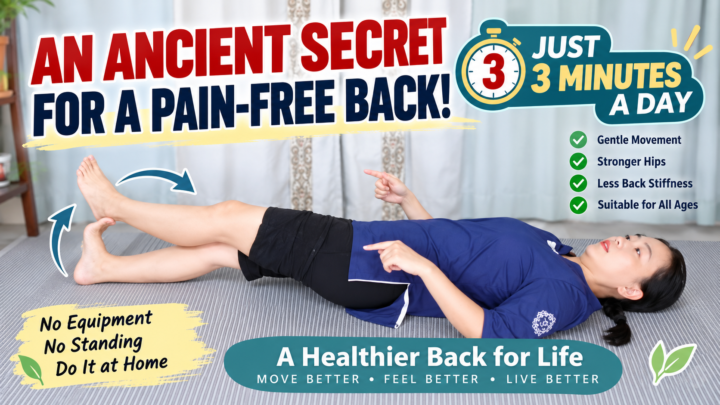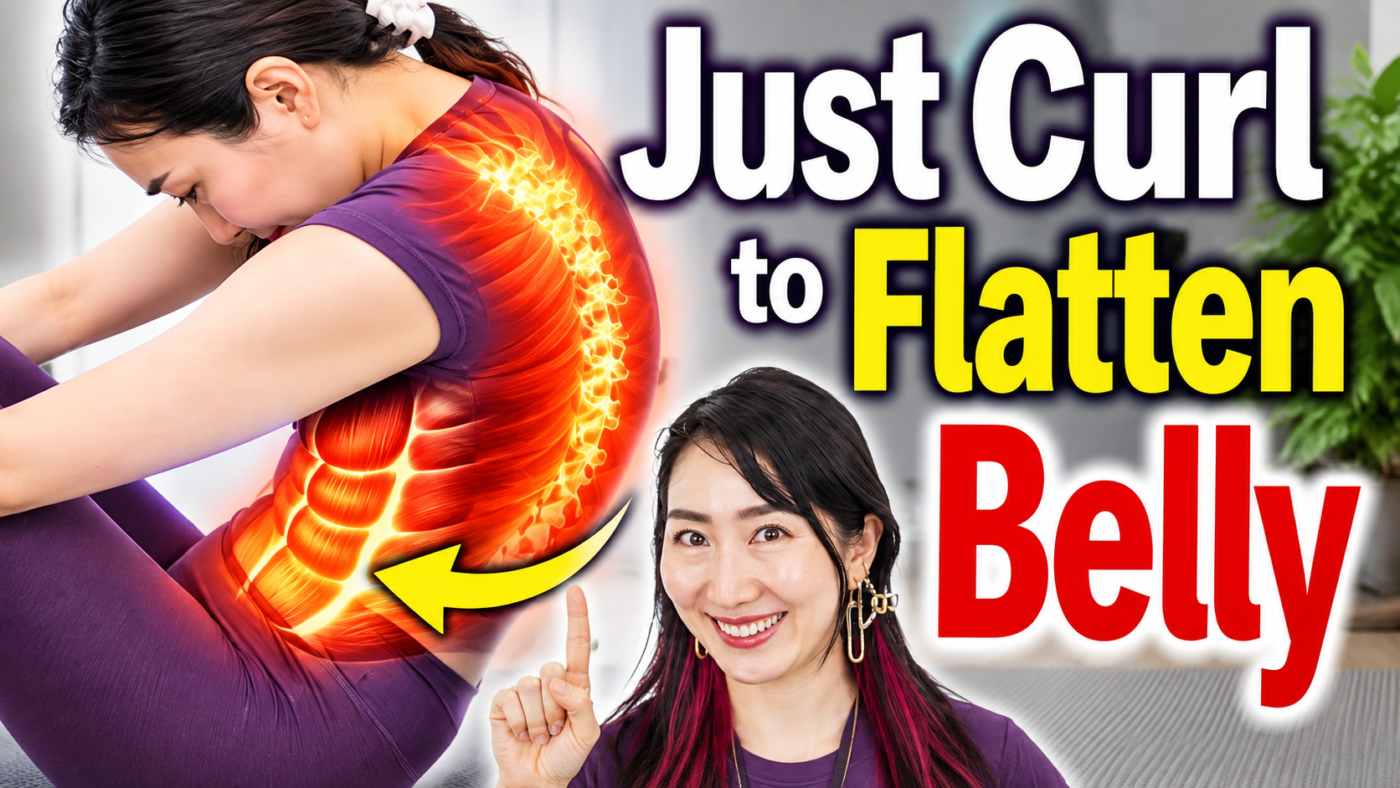
Lower belly core exercises after 40 can help improve trunk control, hip mobility and movement awareness without requiring an intense workout.A lower belly that seems to protrude more than the rest of your body can be frustrating, especially when it appears alongside stiffness or aching in the lower back. After 40, many people immediately blame menopause, aging or weak abdominal muscles.
Sometimes those factors matter. But posture, breathing patterns, hip mobility, trunk strength and the way you move throughout the day can also influence how your abdomen looks and how your lower back feels.
That is why a gentle routine based on spinal flexion, breathing and controlled core work can be useful.
It will not instantly remove lower-belly fat, permanently “reset” your nervous system or cure chronic back pain. But it may help you explore a less rigid spinal position, improve awareness of your abdominal muscles and give stiff hips and back muscles a different movement challenge.
Why the Lower Belly Can Look More Prominent After 40
The appearance of the lower abdomen is influenced by more than body fat.
Several factors can contribute, including body-fat distribution, abdominal muscle tone, pelvic position, posture, bloating, age-related changes in skin and connective tissue, pregnancy history and hormonal changes.
For some people, standing with an exaggerated lumbar curve can also make the lower abdomen appear more prominent.
That does not mean everyone with a visible lower belly has a postural problem.
And it does not mean that rounding your back will remove abdominal fat.
The important distinction is between changing body composition and changing body position.
A posture change can alter appearance immediately. Fat loss cannot.
Is an Arched Lower Back Always a Problem?
No.
Your lumbar spine naturally has a curve.
The goal is not to flatten that curve permanently.
Problems may arise when someone spends long periods in one position, especially if that position is uncomfortable or accompanied by poor movement variety.
Some people feel better when they temporarily move into spinal flexion after spending much of the day extended or stiff.
Others do not.
There is no single “perfect posture” that everyone must maintain all day.
A healthier goal is being able to move comfortably through several positions.
What About Swayback or Anterior Pelvic Tilt?
Online fitness content often blames a protruding abdomen on anterior pelvic tilt or “swayback posture.”
The reality is more complex.
Pelvic position varies naturally between people, and posture alone does not reliably explain pain.
A person can have an anteriorly tilted pelvis and feel perfectly healthy.
Another person can appear to have ideal posture and still experience back pain.
Rather than trying to force your skeleton into one rigid alignment, focus on strength, movement tolerance and comfort.
Does the Psoas “Shut Down”?
Not literally.
The psoas is a deep muscle involved in hip flexion and trunk function.
It does not simply switch off because your lower back is arched.
Similarly, there is no single deep muscle whose only job is to flatten your lower belly.
The abdominal wall includes multiple muscles that contribute to breathing, trunk control and movement.
Instead of trying to “wake up” one magical muscle, think about improving coordination across your trunk and hips.
Can Rounding the Spine Help?
For some people, gentle spinal flexion can feel relieving.
If you spend hours sitting stiffly, standing with your back arched or guarding your lower back, curling forward may provide a different sensory experience.
It can stretch some muscles along the back and may help you feel your abdominal muscles engage.
But spinal flexion is not universally therapeutic.
People with certain disc problems, osteoporosis, acute back injuries or symptoms aggravated by bending forward should be cautious.
Comfort matters more than ideology.
Exercise 1: Seated Spine Curl
Sit comfortably on the floor, a cushion or a firm chair.
Bend your knees.
Hold behind your thighs or clasp your wrists beneath your knees if that feels comfortable.
Slowly round your upper and lower back.
Allow your head to follow naturally.
Exhale as you curl.
Do not force your chin toward your chest.
Hold for approximately 10 to 20 seconds.
Then return to a neutral position.
Repeat three to five times.
The goal is gentle movement, not maximum rounding.
Add Breathing to the Curl
Breathing changes the way your trunk muscles behave.
As you exhale, the abdominal wall naturally participates in controlling pressure inside the torso.
Try taking a comfortable inhale before curling.
As you round your back, breathe out slowly.
Avoid sucking your stomach inward as hard as possible.
The contraction should feel controlled rather than strained.
Exercise 2: Seated Curl and Chest Open
From the same seated position, alternate between two movements.
First, round your spine gently while exhaling.
Then return toward neutral and allow your chest to open slightly as you inhale.
Do not throw your ribs forward or force your lower back into a deep arch.
Move smoothly between the two positions.
Perform 8 to 10 repetitions.
This gives the spine movement in both directions rather than treating one position as “good” and the other as “bad.”
Why Your Shoulder Blades May Feel Different
When you round your upper back, your shoulder blades move apart.
When you open the chest, they move closer together.
That can create a stretch or warm sensation around the upper back.
It does not mean your lungs are literally expanding through your shoulder blades, but deeper breathing combined with thoracic movement can make the rib cage feel more mobile.
Exercise 3: Supported Core Curl With a Cushion
Place a firm cushion behind your lower to mid back while seated.
The support should feel comfortable.
Hold behind your thighs.
Exhale slowly and gently press your back into the cushion.
Think about bringing your ribs and pelvis slightly closer together.
Do not violently “crush” the cushion.
Hold the contraction for approximately 5 to 10 seconds.
Relax.
Repeat 5 to 8 times.
This can help you feel abdominal engagement without performing a traditional sit-up.
Should You Pull Your Belly Button Toward Your Spine?
This cue can be useful for some people, but it is often overdone.
Instead of aggressively hollowing the abdomen, imagine gently tightening your trunk as if you were preparing for a cough.
You should still be able to breathe.
A healthy core is not one that stays permanently sucked inward.
It needs to contract and relax appropriately.
Exercise 4: Small Seated Rocking
Sit with your knees bent.
Hold behind your thighs.
Round your back slightly.
Rock backward a small distance, then return.
Keep the movement controlled.
Do not roll all the way onto your neck.
Perform approximately 8 to 12 repetitions.
This challenges the abdominal muscles while asking the hips and spine to coordinate.
If you have osteoporosis, spinal fractures or significant back problems, skip rolling movements unless cleared by a clinician.
Exercise 5: Gentle Seated Twist
Sit upright.
Place one arm across or outside the opposite knee.
Rotate gently through your upper body.
Do not wrench yourself deeper using your arms.
Hold for 15 to 20 seconds.
Return to center.
Repeat on the other side.
This may help your trunk and hips feel less stiff after repeated curling.
Exercise 6: Single-Leg Rocking
From a reclined or seated curled position, hold behind one thigh.
Gently rock backward and forward through a small comfortable range.
Switch sides.
This introduces asymmetrical core control.
If it creates hip pinching or lower-back pain, reduce the range or skip it.
Exercise 7: Supported Rolling
A more advanced version involves hugging the legs and rolling gently along the back.
Only do this on a padded surface.
Keep the head off the floor and avoid rolling directly onto the neck.
Perform three to five gentle repetitions.
This is not necessary for getting stronger.
If it feels awkward or unsafe, leave it out.
Why Rolling Is Not “Massaging the Spine”
Your vertebrae are not being manually massaged in the same way muscles are.
Rolling primarily changes pressure across soft tissues and provides movement through the trunk.
It may feel pleasant, but the goal should not be to grind the spine against the floor.
Use padding.
Exercise 8: Hug-and-Breathe Recovery
Finish in a comfortable curled position.
Hug your knees or thighs lightly.
Let your head and shoulders relax.
Take three to five slow breaths.
Then gradually open the body and return to a neutral seated or lying position.
This creates a clear contrast between contraction and relaxation.These lower belly core exercises after 40 are designed to emphasize controlled movement rather than aggressive abdominal training.
A Simple 8-Minute Core and Hip Routine
Try this sequence:
1. Seated spine curl — 60 seconds
Move slowly with your breathing.
2. Curl and chest open — 60 seconds
Alternate between flexion and neutral.
3. Cushion-supported core press — 60 seconds
Use controlled abdominal tension.
4. Small seated rocking — 60 seconds
Keep the range modest.
5. Gentle twist — 30 seconds per side
Do not force the rotation.
6. Single-leg rocking — 30 seconds per side
Stop if you feel hip pinching.
7. Supported rolling — 60 seconds
Optional.
8. Hug-and-breathe recovery — 60 seconds
Finish relaxed.
Can This Flatten the Lower Belly?
Lower belly core exercises after 40 can strengthen the abdominal muscles, but they cannot selectively burn fat from one area.It can change the way your abdomen looks temporarily.
When you engage your abdominal muscles and reposition the ribs and pelvis, your lower belly may appear less prominent.
But this is not the same as losing fat.
You cannot spot-reduce fat from the lower abdomen through curling exercises.
Meaningful changes in body fat depend on overall energy balance, nutrition, exercise and time.
Can It Help Lower-Back Pain?
Some people with mild, nonspecific lower-back discomfort feel better after gentle movement.
But back pain has many causes.
Spinal flexion helps some people and aggravates others.
If you experience pain shooting into the leg, numbness, weakness, bowel or bladder changes, unexplained weight loss, fever or severe persistent pain, seek medical evaluation.
Do not try to “exercise through” neurological symptoms.
What About Hip Pain?
Hip discomfort can also have many causes.
Gentle rocking and mobility work may feel useful when stiffness is the main issue.
But arthritis, tendon problems, labral injuries and other conditions need different approaches.
If your hip consistently catches, locks or produces significant pain, exercise alone may not be enough.
Does Core Activation Continue for 16 Hours?
No.
A short exercise session does not keep your abdominal muscles maximally activated all day.
What can happen is that repeated practice improves movement awareness.
You may become more likely to notice when you are slumped, over-braced or holding unnecessary tension.
That awareness can influence your movement throughout the day.
This is motor learning, not a permanent post-exercise activation state.
Are You “Rewiring the Nervous System”?
Movement practice always involves the nervous system.
Repeated practice can improve coordination.
But phrases such as “rewiring your nervous system” can make a normal training process sound more dramatic than it is.
A simpler description is more accurate:
You are practicing a movement so your body gets better at controlling it.
Does a Warm Belly Mean the Core Is Activated?
Not necessarily.
Warmth can come from muscle activity, local circulation or simply increased body temperature.
It can be a normal sensation during exercise.
But warmth alone does not prove that a specific deep muscle has activated correctly.
Can This Replace Ab Training?
No.
Gentle floor mobility and core awareness can be useful, but they do not replace progressive strengthening.
If your goal is a stronger trunk, consider gradually including exercises such as:
- Dead bugs
- Bird dogs
- Side planks
- Pallof presses
- Loaded carries
- Squats
- Hip hinges
These exercises provide greater resistance and can build strength over time.
Why Strength Still Matters After 40
Muscle strength becomes increasingly important with age.
A stronger trunk and lower body can support daily activities such as lifting, carrying, getting out of chairs and maintaining balance.
Gentle mobility work is a starting point.
Progressive resistance training is what drives larger strength adaptations.
Lower Belly Changes Around Menopause
Menopause can influence body composition.
Hormonal changes are associated with shifts in fat distribution, including a greater tendency toward central abdominal fat accumulation in some women.
That means it is inaccurate to say menopause has nothing to do with lower-belly changes.
Age, hormones, sleep, activity level, nutrition and genetics can all contribute.
Posture may influence appearance, but it does not replace the biological effects of menopause.
What Actually Helps With Lower-Belly Fat?
If reducing abdominal fat is appropriate for you, the most effective strategy is whole-body rather than local.
That usually includes:
- Adequate protein
- Fiber-rich foods
- Sustainable calorie control
- Resistance training
- Regular walking or aerobic activity
- Sufficient sleep
- Stress management
No single curl, massage or breathing technique can selectively remove lower-belly fat.
Why Gentle Exercise Can Still Be Powerful
Not everything needs to burn.
A short, comfortable routine is easier to repeat.
And consistency often matters more than intensity for improving mobility and movement confidence.
If gentle floor work helps you reconnect with your trunk and hips, that is already worthwhile.
When to Avoid Deep Spinal Flexion
Use caution with strong rounding or rolling if you have:
- Osteoporosis
- Known spinal compression fractures
- Recent back surgery
- Acute disc-related symptoms
- Severe back pain
- Significant balance limitations
- Neurological symptoms
A physical therapist can help determine which spinal movements are appropriate for your condition.
A Better Goal Than “Move Like You Are 20”
You do not need to move exactly as you did decades ago.
Aging changes the body.
That is normal.
The more useful goal is maintaining enough strength and mobility to live independently and comfortably.
Can you get up from the floor?
Can you carry groceries?
Can you bend to put on shoes?
Can you walk without fear?
Can you move your spine and hips without feeling fragile?
Those abilities matter more than chasing a younger appearance.
The Bottom Line
The best lower belly core exercises after 40 combine gentle trunk control with broader strength, mobility and healthy lifestyle habits.A lower belly and stiff lower back are not always explained by one faulty muscle or one “structural imbalance.”
Body composition, hormonal changes, posture, movement habits, strength and mobility can all play a role.
Gentle spinal curling and core exercises may help you explore movement, improve abdominal awareness and reduce the sensation of stiffness.
They cannot spot-reduce belly fat or guarantee relief from chronic pain.
Use the routine as one tool.
Move comfortably.
Strengthen gradually.
Breathe normally.
And focus on creating a body that feels capable—not perfect.
FAQ
Can lower belly core exercises after 40 flatten the stomach?
They can strengthen and activate abdominal muscles and may temporarily change posture, but they cannot selectively remove lower-belly fat.
Can posture make the lower belly look bigger?
Yes, rib-cage and pelvic position can influence how the abdomen appears, although body fat, skin, genetics and hormones also matter.
Does menopause cause lower-belly fat?
Hormonal changes around menopause can contribute to changes in fat distribution, including greater central abdominal fat in some women.
Does rounding the back help lower-back pain?
It can feel relieving for some people, but not everyone responds the same way. People whose symptoms worsen with spinal flexion should avoid forcing it.
Does the psoas shut down when the back is arched?
No. The psoas does not simply switch off because of posture. Muscle coordination is more complex than that.
Can gentle core exercises strengthen the abs?
Yes, but progressive resistance is usually needed for larger strength gains. Gentle exercises are useful for beginners and movement awareness.
How often can I do this routine?
A short routine can be practiced several times per week or as tolerated, provided it does not cause worsening pain.
Should my abs burn during these exercises?
Mild muscular effort is normal. Sharp pain, significant back pain or neurological symptoms are reasons to stop.
Can these exercises replace strength training?
No. They are best used alongside broader resistance training, walking and other physical activity.
Medical Disclaimer
This article is for educational and informational purposes only and is not medical advice. Stop exercise if you experience sharp pain, numbness, weakness, dizziness or symptoms radiating into the legs. People with osteoporosis, spinal fractures, recent surgery, severe back pain or neurological symptoms should consult an appropriate healthcare professional before performing deep spinal flexion or rolling exercises.
This article is for general education and does not replace individualized care from a qualified health professional. Seek appropriate advice for persistent, severe, or concerning symptoms.
Read the full medical disclaimer