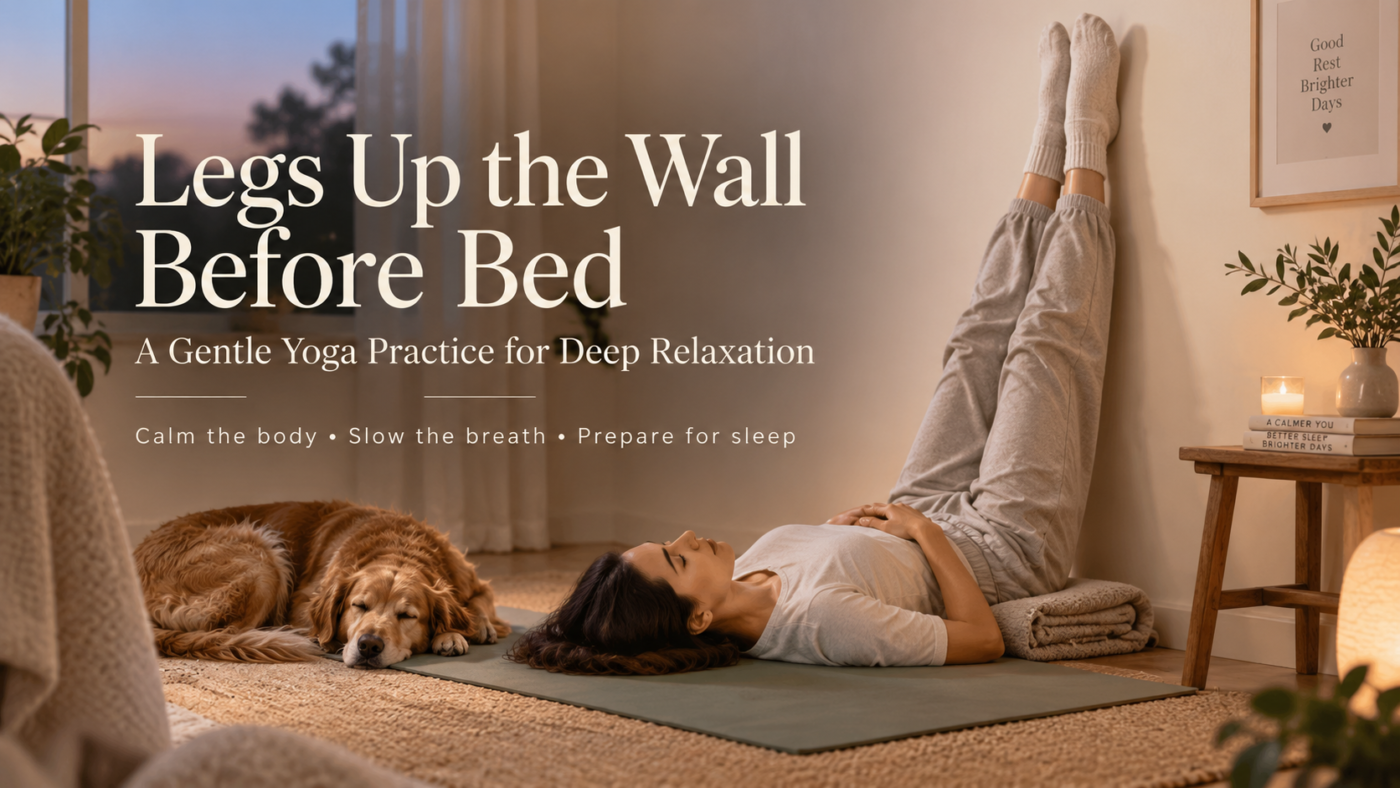
Legs up the wall before bed is a simple restorative yoga practice for slowing down at the end of the day. Traditionally known as Viparita Karani, the posture requires very little movement and can be adapted using a wall, chair, couch, or bed.
This short evening practice focuses less on stretching deeply and more on settling the body, softening the breath, and creating a calm transition toward rest. The goal is not to achieve a perfect yoga shape, but to find a position that feels stable, supported, and comfortable enough to remain still for several minutes.
When the day has been long and your body feels ready to slow down, a simple restorative posture may be all you need. Legs Up the Wall, traditionally known as Viparita Karani, is a quiet yoga position that requires very little movement and can be adapted for different comfort levels.
This short evening practice focuses less on stretching deeply and more on settling the body, softening the breath, and creating a calm transition toward rest. You can practice with your legs supported by a wall, or modify the position by placing your lower legs on a couch, chair, or bed.
The goal is not to achieve a perfect shape. It is to find a position that feels stable, supported, and easy enough that you can remain still for several minutes.
What Is Legs Up the Wall?
Legs Up the Wall is a restorative yoga posture in which you lie on your back with the legs elevated and supported.
In the traditional wall variation, the hips are positioned near a wall and the legs extend upward. However, the knees do not have to be completely straight. You can keep them slightly bent or place the lower legs on a chair or couch instead.
The defining feature of the posture is simple: the legs are elevated while the rest of the body is supported and relaxed.
For an evening practice, comfort matters more than depth.
How to Set Up the Pose
Choose a quiet area near a wall, couch, chair, or bed.
If you are using a wall, place a folded blanket a short distance away from it. The blanket can support the pelvis or sacrum if that feels comfortable.
Sit sideways near the wall and carefully lower yourself onto your back while bringing the legs upward.
Adjust the distance between your hips and the wall until the position feels natural.
You have several options:
Keep the legs extended upward against the wall.
Bend the knees slightly.
Place the feet against the wall.
Rest the calves on a chair or couch.
Use a folded blanket beneath the pelvis for extra support.
There is no single correct distance from the wall. Some people feel better closer to it, while others prefer more space.
Your setup should create a sense of comfort, stability, and ease.
Let the Body Become Heavy
Once you are settled, place your hands somewhere comfortable.
You might rest one or both hands on the lower abdomen, ribcage, chest, or heart area.
Allow the head to become heavy against the floor.
Let the shoulders soften.
Relax the muscles of the face.
You may close your eyes fully or simply lower your gaze.
At this point, there is nothing else you need to accomplish.
The posture becomes an opportunity to stop doing and simply notice.
Bring Attention to Your Breathing
Begin to observe the natural movement of the breath.
You do not need to control it or make it dramatically deeper.
Notice the gentle expansion and release of the body as you inhale and exhale.
You may also notice sensations in the feet, ankles, calves, or legs. These sensations can change as you remain in the posture.
Rather than reacting immediately, simply observe what feels comfortable.
If at any point the position becomes uncomfortable, bend your knees or bring the feet lower.
Restorative yoga should feel supportive, not demanding.
Allow the Mind to Slow Down
As the body becomes quieter, thoughts may continue to appear.
That is normal.
Instead of trying to force the mind to become completely empty, notice each thought and then gently return your attention to the breath.
You may also become aware of sounds in the room or outside your space.
Let them remain part of the background.
Continue resting without needing to change anything.
This practice is less about performing a technique and more about giving yourself permission to be still for a few minutes.
Stay for Several Slow Breaths
Remain in the position for several minutes if it continues to feel comfortable.
Allow the breathing to become smooth, slow, and steady.
Notice the sense of stillness.
Notice the weight of the body against the floor.
Notice how little effort is required.
For many people, this kind of quiet pause can become a useful transition between the activity of the day and the slower pace of the evening.
There is no need to stay longer simply because you think you should.
A short, comfortable practice can be more valuable than forcing yourself to remain in a position that no longer feels good.
How to Come Out Safely
When you are ready to finish, avoid moving suddenly.
Take a comfortable breath in.
Slowly bend one knee and lower one leg.
Then lower the other.
Pause with the knees bent if you would like.
Roll gently onto one side and rest there for a moment.
Use your hands to help yourself return to a seated position.
Bring the palms together near the chest or simply rest the hands in your lap.
Take a moment to notice how you feel before standing up or moving on with your evening.
Wall, Chair, or Couch: Which Version Is Best?
The best variation is the one that allows you to relax.
A wall works well if you are comfortable lying close to the floor with the legs elevated.
A chair may be more comfortable if your hamstrings feel tight or if straightening the legs creates too much sensation.
A couch or bed can provide another gentle option if getting onto and off the floor is inconvenient.
You can also experiment with how much the knees are bent.
There is no need to force the legs straight.
Restorative movement is most useful when the position works with your body rather than against it.
When to Practice
This sequence is especially well suited to the evening because it is quiet, low-effort, and easy to perform without complicated transitions.
You might use it:
After a long workday
After extended periods of standing or sitting
As part of a gentle evening yoga routine
Before reading or winding down for bed
Whenever you want a few minutes of stillness
It can also serve as a brief reset during the day when you have access to a comfortable place to lie down.
A Practice of Less, Not More
Many exercise routines ask you to move farther, work harder, or achieve more.
This practice offers the opposite experience.
The legs are supported.
The body is still.
The breath is observed rather than forced.
The goal is simply to become more comfortable with slowing down.
For people who spend much of the day moving from one task to another, that simplicity can be part of the value.
Final Thoughts
Legs Up the Wall is one of the simplest restorative yoga practices to adapt at home.
You do not need advanced flexibility, complicated equipment, or a long practice session.
A wall, chair, couch, blanket, and a few quiet minutes may be enough.
Settle into a position that feels stable.
Relax the head and shoulders.
Notice your breathing.
Allow thoughts to come and go.
Then give yourself a few minutes to experience stillness without needing to accomplish anything.
Sometimes the most restorative part of a yoga practice is not another movement.
It is the moment when you stop moving.
FAQ
What is Legs Up the Wall pose?
Legs Up the Wall, traditionally known as Viparita Karani, is a restorative yoga position in which you lie on your back while the legs are elevated and supported. A wall is commonly used, although a chair, couch, or bed can provide a comfortable alternative.
Can I practice Legs Up the Wall before bed?
Yes, many people use legs up the wall before bed as part of a quiet evening or restorative yoga routine. The practice involves very little active movement and can be combined with slow breathing and several minutes of stillness.
Do my legs have to be completely straight?
No. The knees can remain slightly bent. You can also place the feet against the wall or rest the calves on a chair or couch. Comfort and stability are more important than keeping the legs perfectly straight.
How close should my hips be to the wall?
There is no single correct distance. Move closer to or farther away from the wall until the position feels comfortable. People with tighter hamstrings may prefer slightly more distance.
How long should I stay in Legs Up the Wall?
For this routine, several minutes of comfortable stillness are enough. There is no need to remain in the posture longer if the legs, hips, back, or feet begin to feel uncomfortable.
Can I use a chair instead of a wall?
Yes. Resting the lower legs on a chair, couch, or bed is a useful alternative, particularly if straightening the legs against a wall feels uncomfortable.
Should Legs Up the Wall hurt?
No. The posture should feel supported and relatively easy. Stop or change position if you experience pain, numbness, tingling, dizziness, difficulty breathing, or other unusual discomfort.
Does Legs Up the Wall cure insomnia?
No. Legs Up the Wall should not be presented as a treatment or cure for insomnia. It can be used as a quiet restorative practice as part of an evening wind-down routine, but persistent sleep problems may require appropriate professional assessment.
Medical Disclaimer
This article is for educational and informational purposes only and is not medical advice. Yoga positions should be adapted to your individual comfort, mobility, and health status. Stop the practice if you experience pain, dizziness, numbness, difficulty breathing, or unusual discomfort. If you have a medical condition, recent injury, circulation concerns, or other symptoms that may affect your ability to practice safely, consult an appropriate healthcare professional before beginning a new exercise or yoga routine.
This article is for general education and does not replace individualized care from a qualified health professional. Seek appropriate advice for persistent, severe, or concerning symptoms.
Read the full medical disclaimer