When people reach their 40s, 50s and beyond, exercise often becomes less about looking athletic and more about staying capable.
Can you climb stairs comfortably?
Can you get up from a chair without struggling?
Can you walk for an hour without your legs feeling exhausted?
Can you recover your balance when you step on an uneven surface?
These everyday abilities depend heavily on the muscles of the legs and hips, together with ankle control, balance and core stability.
Muscle strength and physical performance can gradually decline with age. Staying active and including regular resistance and balance training can help slow that decline and preserve independence.
You do not need an elaborate gym routine to start.
A simple standing movement that combines hip motion with controlled weight shifting can challenge several important physical skills at the same time.
The exercise described below is inspired by traditional movement practices but can also be understood through modern exercise science.
Why Leg Strength Becomes More Important With Age
The muscles of the legs perform some of the most important tasks of everyday life.
They help you stand.
They move you forward when you walk.
They help you climb stairs.
They absorb force when you step down.
They allow you to rise from a chair.
They also play a major role in preventing falls.
Age related loss of muscle mass, strength and physical function is often discussed under the term sarcopenia.
This process does not suddenly begin when someone becomes elderly.
Changes in muscle performance can begin much earlier, particularly when physical activity declines.
Long periods of sitting, low levels of resistance exercise, illness, poor nutrition and aging can all contribute to loss of strength and physical capacity.
The encouraging news is that muscle remains responsive to exercise throughout life.
Appropriate strength training can help older adults maintain or improve physical function, making everyday activities such as climbing stairs, carrying groceries and standing from a chair easier.
Why the Hips Matter for Walking
The hips are central to almost every step you take.
Muscles around the hip help move the thigh forward, backward and sideways while stabilizing the pelvis.
Good walking does not depend on having extremely flexible hips.
However, adequate hip mobility and strength allow the legs to move efficiently while the trunk remains controlled.
Weakness or restricted movement around the hips can sometimes contribute to changes in walking mechanics.
But it would be inaccurate to say that anyone who struggles to lift the feet while walking automatically has a locked hip joint.
Walking difficulties can have many causes, including muscle weakness, arthritis, neurological conditions, foot problems, pain and balance disorders.
Persistent walking difficulty deserves professional evaluation rather than self diagnosis.
The Simple Standing Hip Circle Exercise
For this movement, you need a small object to use as a visual guide.
You could use:
A small box
A foam block
A rolled towel
A low plastic container
The object does not need to be high.
In fact, beginners should start with something very low.
The purpose of the object is simply to guide the path of your foot.
How to Set Up
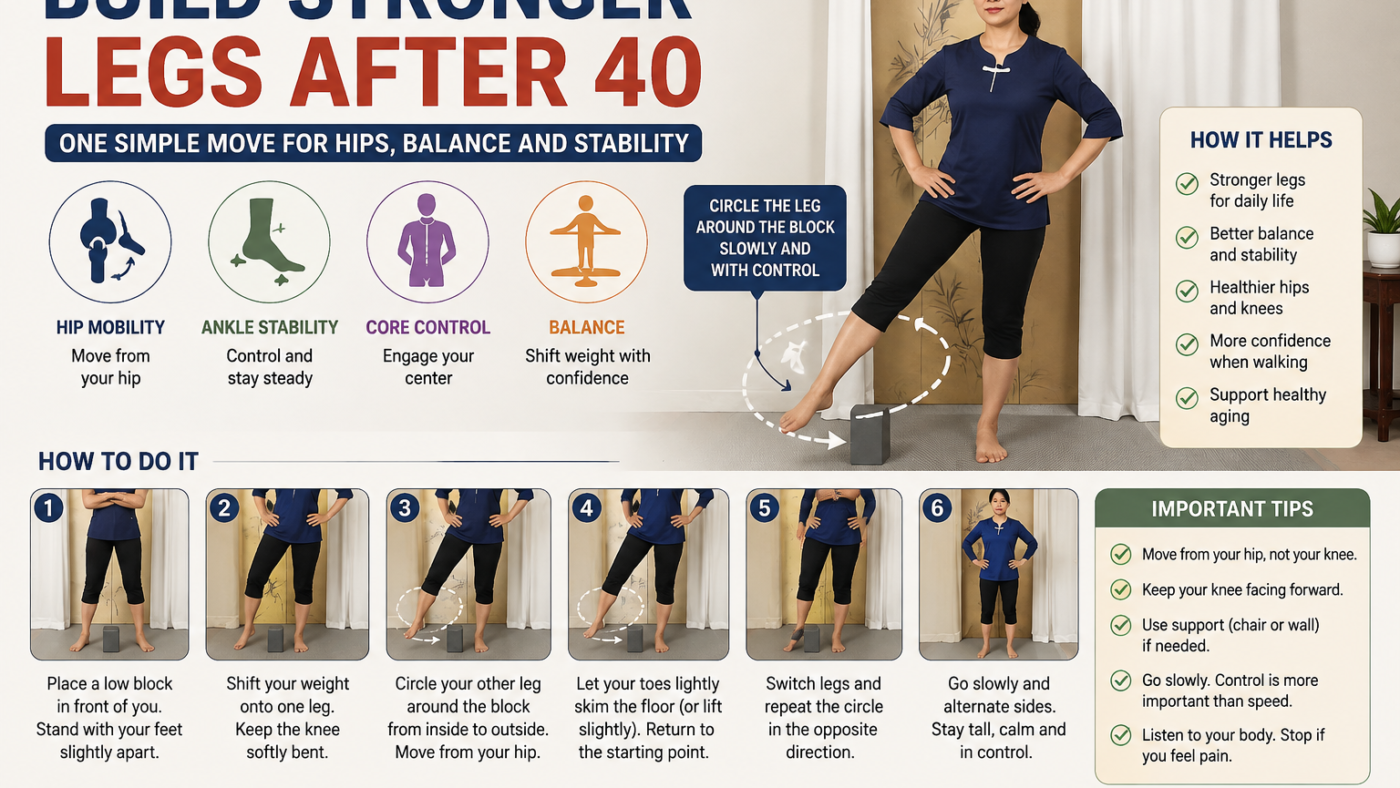
Place the object on the floor in front of you.
Stand slightly behind it with your feet comfortably apart.
Keep your posture upright but relaxed.
Your knees should remain soft rather than rigidly locked.
If your balance is uncertain, position yourself beside a sturdy chair, countertop or wall before beginning.
Do not wait until you lose your balance to look for support.
How to Perform the Movement
Shift most of your weight onto your left leg.
Keep the supporting knee slightly bent.
Move your right leg around the outside of the object in a slow circular path.
Allow the movement to originate mainly from the hip.
Your right toes can lightly skim the floor.
If your balance is good, the foot can briefly lift slightly above the ground.
Return to the starting position.
Then shift your weight onto the right leg and circle the left leg around the object.
Continue alternating sides.
Move slowly.
Control is more important than speed.
Think About Moving From the Hip
One of the most important parts of this exercise is understanding where the movement comes from.
The hip is designed to move through several directions.
The knee primarily bends and straightens, although it also allows a small amount of rotation.
For this exercise, think about moving the thigh from the hip rather than twisting aggressively through the knee.
The supporting knee can bend slightly as your weight shifts.
The knee does not have to remain perfectly frozen or point in exactly the same direction every second.
Human movement is more complex than that.
The goal is simply to avoid uncontrolled twisting or forcing the knee into painful positions.
Never continue an exercise because someone tells you that knee pain is normal.
Pain is information.
If the movement repeatedly causes knee pain, reduce the range, slow down, use support or stop and choose another exercise.
Why the Supporting Leg Matters
While one leg circles, the other leg is doing significant work.
The supporting foot and ankle help control your balance.
The calf and thigh muscles help maintain your position.
The muscles around the hip stabilize your pelvis.
Your trunk muscles help prevent excessive swaying.
This is why the movement can feel more challenging than it looks.
It is not simply a hip mobility exercise.
It combines mobility with balance and lower body control.
The Role of the Ankles
Healthy walking requires continuous adjustments at the ankles.
Each time your body weight moves from one foot to the other, muscles around the ankle help control your position.
Balance exercises that challenge the ankles in a safe environment can therefore be useful components of a healthy aging program.
However, you do not need to deliberately make yourself unstable.
The safest balance training creates a manageable challenge while keeping support nearby.
If you need one hand on a chair, use it.
Progress can come gradually.
Why Core Stability Helps
The word core refers to more than the abdominal muscles you can see in the mirror.
It includes muscles around the abdomen, back, pelvis and hips that help control the trunk.
During this exercise, gently engage your midsection while remaining able to breathe normally.
You should not hold your breath or aggressively pull your stomach inward.
Think about maintaining a tall, controlled posture while the legs move underneath you.
Traditional movement systems sometimes describe this central region as the Dantian.
That concept comes from traditional Chinese movement and internal martial arts.
Modern anatomy uses different terminology, but both perspectives place considerable importance on controlling the body’s center during movement.
How Much Knee Bend Should You Use?
Only a small amount is necessary.
Think of the supporting leg as flexible rather than rigid.
A slight bend allows the hips, knees and ankles to work together as your center of mass shifts.
Do not force yourself into a deep squat.
If your thighs are burning intensely or your knees feel overloaded, you are probably bending farther than necessary for this particular drill.
A shallow and controlled position is enough.
A Beginner Routine
If you are new to balance training, begin conservatively.
Perform 5 slow circles with the right leg.
Then perform 5 with the left.
Rest.
Repeat for 1 or 2 additional rounds if you feel comfortable.
You could also alternate legs after every repetition.
A session may initially take only 2 to 5 minutes.
That is perfectly acceptable.
There is no scientifically established requirement to perform exactly 49 repetitions.
There is also no need for beginners to immediately complete 100 or 200 repetitions per day.
Quality is more important than an arbitrary number.
Progress gradually as your balance and endurance improve.
A More Advanced Version
Once you can perform the basic movement comfortably while remaining stable, you can make it slightly more challenging.
Use a somewhat larger circle.
Lift the moving foot slightly farther from the floor.
Slow the movement down.
Pause briefly when the leg reaches the side.
Reduce how much support you use from a chair.
Do not progress several variables at once.
For balance training, harder is not automatically better.
The objective is controlled adaptation rather than testing how close you can come to falling.
Modification for Older Adults
Place a sturdy chair directly in front of you.
Hold the back of the chair with both hands.
Perform the same slow leg circle with a smaller range.
Once you become comfortable, try using only one hand.
Eventually, some people may progress to lightly touching the chair with their fingertips.
There is no benefit to removing support before you are ready.
Safety is part of effective training.
Should You Practice Barefoot?
Barefoot exercise can give some people useful sensory feedback from the floor.
But it is not necessary.
Some people are safer wearing supportive athletic shoes.
Choose the option that gives you the most secure contact with the surface.
Avoid slippery socks.
Make sure the floor or exercise mat cannot slide underneath you.
People with diabetes related foot problems, reduced sensation in the feet or other conditions affecting foot safety should be especially careful about exercising barefoot.
What This Exercise Can Realistically Improve
With consistent practice, this type of movement may help train several physical qualities.
Hip mobility
The circling motion takes the hip through several directions.
Hip muscle control
The muscles around the hip must guide the moving leg while stabilizing the supporting side.
Balance
The body repeatedly transfers weight between the two legs.
Ankle stability
The supporting ankle makes small adjustments to keep the body controlled.
Core stability
The trunk must remain relatively steady while the leg moves.
Coordination
The brain must coordinate the hip, knee, ankle, foot and trunk throughout each repetition.
Leg endurance
Repeated weight bearing can challenge muscles of the thighs, hips and lower legs.
These are meaningful benefits.
But one exercise cannot provide everything your body needs.
One Exercise Is Not a Complete Strength Program
This movement is useful, but it should not replace conventional strength training.
For healthy aging, a more complete program should include exercises that progressively challenge major muscle groups.
Examples include:
Chair squats
Sit to stand exercises
Step ups
Calf raises
Glute bridges
Resistance band exercises
Rows
Wall push ups
Loaded carries
Appropriate resistance training gives muscles a reason to become stronger.
A gentle mobility drill alone is unlikely to provide enough resistance to maximize muscle strength.
For most adults, muscle strengthening activities should be performed at least two days each week.
Older adults also benefit from regular balance training alongside aerobic activity.
What About Knee Pain?
The original version of this movement is sometimes promoted as safe even for people with bad knees.
That promise is too broad.
Some people with knee discomfort may tolerate this exercise well.
Others may not.
Knee pain can arise from many different conditions, and different exercises are appropriate for different people.
Do not assume that pain means you simply need to improve your technique.
If you experience repeated knee pain, swelling, locking, giving way or difficulty bearing weight, stop and seek appropriate medical or physical therapy advice.
Exercise should be adapted to the individual.
Can This Exercise Make Your Knees More Flexible?
It may improve movement confidence and lower body control in some people.
But it does not guarantee healthier knees.
Knee health depends on many factors, including muscle strength, joint structure, previous injuries, body weight, physical activity and underlying conditions such as osteoarthritis.
Strengthening the muscles around the hips and knees is often an important component of maintaining function.
But gradual, appropriate loading matters more than any single special movement.
Can It Reduce Belly Fat?
Not specifically.
A standing leg exercise cannot selectively burn fat from the lower abdomen.
Spot reduction is not how body fat loss works.
Exercise can contribute to overall energy expenditure and metabolic health, while resistance training can help maintain or build muscle.
Changes in body fat generally depend on overall energy balance, nutrition, activity and individual physiology.
You may feel your abdominal muscles working during the movement, but that does not mean fat is being burned specifically from that location.
Traditional Martial Arts Connection
Slow circular stepping and controlled weight shifting appear in several traditional Chinese martial arts and movement systems.
Bagua practice, for example, includes distinctive stepping methods emphasizing body alignment, coordination and controlled changes in direction.
Traditional training methods were developed for purposes that included martial skill, body control and conditioning.
For modern wellness practice, there is no need to perform these movements with combat intensity.
Their most useful features can be adapted into gentle exercise.
Slow weight shifting.
Controlled hip movement.
Stable posture.
Awareness of the feet.
Coordination between the lower body and trunk.
These principles also fit naturally with modern balance training.
Why Balance Training Matters as You Age
Strong muscles are important, but strength alone does not prevent every fall.
Balance depends on input from several systems, including vision, the inner ear, sensation from the feet and joints, and the nervous system’s ability to coordinate movement.
Balance exercises challenge the body to integrate these systems.
Examples include:
Standing on one leg with support nearby
Heel to toe walking
Side stepping
Tai chi
Controlled weight shifting
Sit to stand practice
Exercises like the standing hip circle can be one part of that broader program.
When to Stop
Stop the exercise if you develop:
Sharp joint pain
New or increasing knee pain
Severe hip pain
Dizziness
Chest pain
Unusual shortness of breath
Numbness
Sudden weakness
Loss of balance that you cannot safely control
Persistent symptoms deserve professional evaluation.
People who have recently had hip, knee, ankle or spinal surgery should follow the exercise guidance provided by their healthcare team.
A Simple Weekly Strategy
You do not need to perform one movement hundreds of times.
A better goal is to build a varied physical activity routine.
For example, you might combine:
Walking or another aerobic activity
Two or more weekly strength sessions
Balance exercises several times each week
Gentle mobility work
Your standing hip circles can fit into the balance or mobility portion.
Even five minutes can be useful when it becomes part of a consistent routine.
Frequently Asked Questions
What is the Best Exercise for Leg Strength After 40?
There is no single best exercise.
Squats, sit to stands, step ups, calf raises and other resistance exercises can all help develop lower body strength when appropriately progressed.
Balance and mobility exercises can complement strength training.
Is It Too Late to Strengthen My Legs After 60?
No.
Older muscles remain capable of responding to appropriate resistance training.
Starting gradually and selecting exercises appropriate for your health and ability are more important than age alone.
Does Hip Mobility Improve Walking?
Adequate hip mobility can contribute to comfortable walking, but strength, balance, neurological function, joint health and cardiovascular fitness also influence walking ability.
Can Balance Exercises Prevent Falls?
Balance and strength training are important components of fall prevention.
Falls have many possible causes, however, so exercise should be combined with attention to medications, vision, footwear, home hazards and medical conditions when appropriate.
Should My Knees Stay Completely Straight During the Exercise?
No.
The supporting knee can remain slightly bent.
The goal is controlled movement rather than rigidly locking the joint.
How Many Repetitions Should I Do?
There is no special evidence supporting exactly 49, 100 or 200 repetitions.
Beginners can start with 5 to 10 controlled repetitions per side and gradually increase according to comfort, balance and fatigue.
Should I Continue if My Knee Hurts?
No exercise should be continued simply because someone claims that pain is harmless.
Reduce the range or stop the exercise if it produces pain.
Persistent knee pain deserves appropriate evaluation.
Bottom Line
Maintaining strong legs is one of the most useful investments you can make in healthy aging.
Your legs, hips, ankles and core work together every time you stand, walk, climb stairs or recover your balance.
The standing hip circle is a simple way to practice several of these abilities at once.
Move slowly.
Use your hip to guide the leg.
Keep the supporting knee comfortably soft.
Control your weight shift.
Use a chair or wall whenever necessary.
And do not chase large repetition numbers.
For long term results, combine exercises like this with progressive strength training, aerobic activity and regular balance practice.
The goal is not to perform a traditional movement perfectly.
The goal is to keep moving confidently, safely and independently for as many years as possible.
Affiliate Disclosure
This article may contain affiliate links. If you purchase through one of these links, we may earn a commission at no additional cost to you. Affiliate relationships do not influence our editorial standards or health recommendations.
Medical Disclaimer
This article is for educational and informational purposes only and is not medical advice. Exercise recommendations should be adapted to individual health, fitness and mobility. Consult a qualified healthcare professional or physical therapist if you have significant joint pain, balance problems, recent surgery, recurrent falls or other medical concerns before beginning a new exercise program.
This article is for general education and does not replace individualized care from a qualified health professional. Seek appropriate advice for persistent, severe, or concerning symptoms.
Read the full medical disclaimer