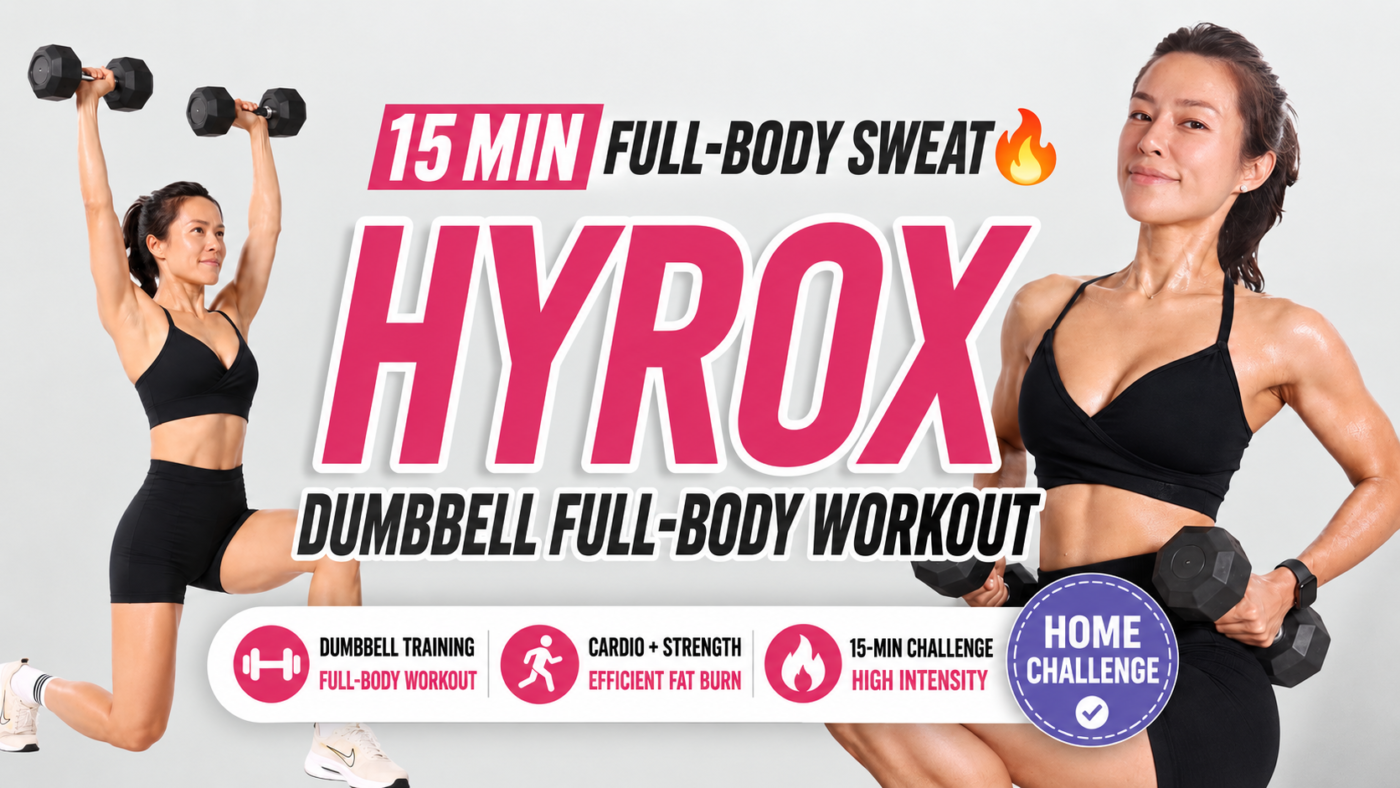
HYROX workout at home is a practical way to combine cardio and functional strength training without needing access to a full training facility.
This 15-minute HYROX-inspired dumbbell workout combines running-style cardio, loaded strength exercises, carries, lunges, rowing movements, burpee variations, and a home-friendly sled-push alternative. All you need is a pair of dumbbells, a towel, and enough space to move safely.
Want to experience the intensity of mixed cardio and functional strength training without leaving home?
This 15-minute HYROX-inspired home workout combines running-style cardio, loaded strength exercises, carries, lunges, rowing movements, burpee variations, and a home-friendly sled-push alternative. All you need is a pair of dumbbells, a towel, and enough space to move safely.
The goal is not to recreate an official HYROX race inside your living room. Instead, this shortened workout borrows the central idea of alternating cardiovascular effort with functional strength movements to challenge your heart, lungs, legs, core, grip, and overall muscular endurance.
It is short, demanding, equipment-light, and easy to scale to your current fitness level.
What Is a HYROX-Inspired Workout?
HYROX-style training combines endurance work with functional movements such as loaded carries, lunges, pushing, pulling, squatting, and full-body conditioning.
For home training, the same general concept can be adapted without a running track, SkiErg, rowing machine, heavy sled, or wall-ball station.
In this workout, running is replaced by jogging, high knees, and sprinting in place. Loaded functional exercises are performed with dumbbells, while a towel provides a simple home-based variation inspired by sled pushing.
The result is a compact mixed-modality workout that challenges several qualities at the same time:
Cardiorespiratory fitness
Muscular endurance
Lower-body strength
Core stability
Grip strength
Coordination
Work capacity
Movement control under fatigue
Because the intensity can become high quickly, the workout is better suited to people who already have some basic exercise experience. Beginners can still use the structure, but should choose lighter dumbbells, slower movements, low-impact variations, and longer recovery periods.
What You Need
A pair of light-to-moderate dumbbells
One towel
Athletic shoes with good traction
Enough clear floor space to move safely
Water nearby
Choose dumbbells you can control throughout the workout. The objective is not to use the heaviest weight possible. Your posture, breathing, balance, and movement quality should remain under control even when your heart rate rises.
15-Minute Workout Structure
The session is divided into three stages.
Warm-Up
Approximately 2–3 minutes
Main Workout
Approximately 9–10 minutes
Cool-Down
Approximately 2–3 minutes
Use short transitions between movements. If your technique begins to deteriorate, reduce your pace, use a lower-impact variation, lighten the weight, or take additional rest.
Warm-Up
- Chest Opener and Upper-Back Reach
Begin standing tall.
Extend both arms forward while gently rounding your upper back. Imagine wrapping your arms around a large exercise ball as you spread your shoulder blades apart.
Then sweep your arms backward and open your chest.
Move slowly between the two positions rather than forcing the stretch.
This movement prepares the shoulders, upper back, and chest for the pressing, carrying, rowing, and floor-based exercises later in the workout.
Keep your knees relaxed and breathe continuously.
- Knee Hug With Rotation
Stand tall and bring one knee toward your chest.
Gently draw the thigh upward while maintaining an upright torso. Release the leg and add a controlled trunk rotation before switching sides.
Avoid collapsing forward as you lift the knee.
The exercise helps prepare the hips, glutes, trunk, and balance system for the lunges and running movements that follow.
If balance is difficult, perform the movement next to a wall or sturdy chair.
- Straight-Leg Front Kicks
Brace your abdominal muscles gently and keep the supporting knee slightly bent.
Raise one straight leg forward to a comfortable height, lower it under control, and alternate sides.
Do not lock the standing knee.
Your kicking height should be determined by your mobility rather than how high someone else can lift their leg.
A smaller controlled movement is preferable to a higher kick performed with a rounded back or unstable pelvis.
Main Workout
Now the mixed cardio and functional strength portion begins.
The intensity should gradually rise as the workout progresses, but harder does not mean uncontrolled. Maintain good technique and adjust the pace whenever necessary.
- Dumbbell Thruster
Hold one dumbbell in each hand near shoulder height.
Sit into a controlled squat while keeping your chest lifted and feet firmly planted.
As you stand, drive through your legs and use that upward momentum to press the dumbbells overhead.
Lower the weights back toward your shoulders before beginning the next repetition.
Think of the exercise as one continuous movement:
Squat down.
Drive upward.
Press overhead.
Return with control.
The dumbbell thruster combines lower-body strength with upper-body pressing and can quickly increase cardiovascular demand.
Keep your trunk braced and avoid excessively arching your lower back as the dumbbells move overhead.
- Slow Jog in Place
Transition into a light jog.
Keep your steps quiet and controlled rather than pounding the floor.
Maintain an upright torso with your head over your shoulders and hips.
Allow your arms to swing naturally.
This interval provides cardiovascular work while giving your upper body a temporary break from the dumbbells.
If jogging is uncomfortable, replace it with brisk marching in place.
- Dumbbell Farmer March
Hold one dumbbell at each side.
Stand tall with your shoulders relaxed and your rib cage stacked over your pelvis.
Begin marching in place while lifting one knee at a time.
Imagine balancing a glass of water on top of your head. The objective is to prevent excessive side-to-side movement as the legs alternate.
Avoid shrugging your shoulders toward your ears.
The farmer march challenges grip strength, postural control, hip stability, and the trunk muscles that resist unwanted movement.
- High Knees
Put the dumbbells down safely.
Begin alternating knee drives at a faster rhythm.
Stay tall and keep your steps light.
Rather than trying to force your knees as high as possible, choose a height that allows you to maintain good posture and consistent breathing.
For a lower-impact alternative, perform fast marching knee drives without leaving the floor.
- Dumbbell Gorilla Row
Place your feet wider than hip width and hold a dumbbell in each hand.
Push your hips backward and hinge your torso forward while maintaining a long, neutral spine.
From this position, pull one dumbbell toward your torso by driving the elbow backward and upward.
Lower it under control and alternate sides.
Avoid repeatedly twisting your torso to lift the weight.
The movement primarily challenges the upper back, arms, posterior chain, and core stability.
If maintaining the bent-over position becomes difficult, reduce the dumbbell weight or perform a more upright supported row.
- Weighted March or Light Jog
Hold your dumbbells securely at your sides and return to a rhythmic march.
More experienced exercisers may progress to a very light weighted jog if they can maintain excellent control.
Keep the weights close to your body, your trunk stable, and your breathing continuous.
A weighted march is the safer choice for most home exercisers and still provides a significant conditioning challenge.
Do not allow fatigue to turn the movement into uncontrolled bouncing.
Take a Short Recovery
At this point your breathing may be considerably faster.
Use the recovery period to regain control rather than immediately worrying about the next exercise.
Walk slowly.
Relax your shoulders.
Take steady breaths.
Continue only when you feel ready to move with good technique.
- Dumbbell Reverse Lunge
Hold the dumbbells at your sides.
Step one foot backward and lower into a comfortable split-stance position.
Keep your pelvis facing forward and maintain an upright torso.
Push primarily through the front foot to return to standing.
Alternate sides.
You should feel the front leg and gluteal muscles doing much of the work.
Shorten your range of motion or perform the exercise without weights if balance or knee comfort becomes an issue.
- Fast Alternating Knee Drives
Place the dumbbells down.
Begin alternating knee drives from side to side at a quick but controlled rhythm.
Brace your trunk and maintain your breathing.
The goal is to increase movement frequency without losing posture.
If the faster version becomes too demanding, return to controlled marching.
Consistency is more important than matching someone else’s speed.
- High-Plank Burpee
From standing, bend down and place your hands on the floor.
Step or jump your feet backward into a high plank.
Bring your feet forward again and return to standing.
Unlike a traditional chest-to-floor burpee, this version reduces some of the movement complexity while preserving the transition between standing and plank positions.
Keep your abdominal muscles active and avoid allowing your lower back to sag when you reach the plank.
For a lower-impact version, step one foot backward at a time instead of jumping.
You can also place your hands on a stable elevated surface to reduce the difficulty.
- Sprint in Place
Stand tall and rapidly alternate your feet.
Focus on quick ground contact rather than exaggerated vertical bouncing.
Your arms can move naturally to support the running rhythm.
This is one of the most demanding cardiovascular intervals in the workout.
If you can no longer maintain control, reduce the movement to a jog or fast march.
The goal is challenging conditioning, not exercising to the point where technique collapses.
- Towel Sled-Push Variation
Place a folded towel on a suitable floor surface and use it only in an area where you can maintain reliable footing.
Move into an athletic position with your knees and hips bent.
Brace your trunk and lean forward slightly while driving through your legs to push the towel forward in short, controlled steps.
Think about producing force through your legs rather than rounding your back and pushing only with your arms.
The movement is intended to imitate some of the lower-body pushing demands associated with sled work.
Because flooring and friction vary considerably between homes, this exercise should only be performed when the setup is stable and safe.
If the surface is too slippery or the movement feels awkward, substitute a wall drive, resisted march, or additional dumbbell farmer march.
- Jumping Jacks
Finish the main workout with jumping jacks.
Land softly with your knees slightly bent and keep your trunk controlled.
Maintain a rhythm you can sustain without holding your breath.
For a joint-friendlier alternative, perform step jacks:
Step one foot sideways while raising your arms overhead.
Return to center.
Repeat on the other side.
Continue alternating until the interval ends.
The main workout is now complete.
Cool-Down
Do not stop moving abruptly after the final cardio interval.
Use the next few minutes to gradually reduce your pace and transition toward slower breathing.
- Marching Chest Opener
Walk slowly in place.
Bring your hands behind your body and gently draw your shoulders backward and downward.
Open through the front of the chest without forcing your shoulders into an uncomfortable position.
Keep your abdominal muscles lightly engaged and allow your breathing to gradually settle.
- Standing Quadriceps Stretch
Stand tall and bend one knee, bringing your heel toward your glutes.
Hold the ankle or foot if comfortable.
Keep your knees relatively close together and avoid allowing the bent knee to drift far forward.
Maintain a neutral pelvis rather than excessively arching your lower back.
Hold briefly, then switch sides.
Use a wall for support if necessary.
- Lunge Calf Stretch
Step one foot backward into a comfortable staggered stance.
Keep the back heel directed toward the floor and point both feet generally forward.
Maintain an upright torso while gently shifting your weight forward.
You should feel a comfortable stretch through the calf of the rear leg.
Switch sides.
Do not bounce or force the stretch.
How Hard Should This Workout Feel?
This routine is intentionally challenging, but the correct intensity is individual.
You may notice faster breathing, increased body temperature, and muscular fatigue. Those responses commonly occur during demanding exercise.
However, the objective is not to ignore warning signs.
Slow down or stop if you develop dizziness, unusual shortness of breath, chest discomfort, loss of coordination, sharp pain, or symptoms that feel significantly different from normal exercise fatigue.
Good conditioning training should challenge your capacity while preserving enough control to move safely.
How to Make the Workout Easier
Use lighter dumbbells.
Replace jogging with marching.
Replace high knees with controlled knee drives.
Replace jumping jacks with step jacks.
Step through burpees instead of jumping.
Perform reverse lunges without weights.
Take longer recovery periods.
Reduce your range of motion.
Complete only part of the circuit initially.
These changes can substantially lower the impact while preserving the overall cardio-and-strength structure.
How to Make It Harder
Experienced exercisers can progress the workout gradually by:
Using moderately heavier dumbbells while maintaining technique.
Increasing movement speed during the cardio intervals.
Reducing unnecessary transition time.
Using deeper lunges when mobility and control allow.
Performing jumping rather than stepping variations.
Repeating the main circuit after adequate recovery.
Progress one variable at a time.
Increasing weight, speed, impact, range of motion, and total training volume simultaneously can make it unnecessarily difficult to determine whether your body is adapting well.
Why Mixed Cardio and Strength Training Feels So Demanding
Traditional strength training often allows more recovery between sets.
Steady-state cardio usually involves repeating a relatively consistent movement.
Mixed-modality conditioning repeatedly switches between the two.
One moment you may be squatting and pressing weights overhead. Shortly afterward you are jogging, carrying dumbbells, lunging, rowing, performing burpees, or sprinting.
Your cardiovascular system therefore has to support working muscles while those muscles repeatedly change tasks.
This is one reason a short workout can feel surprisingly demanding.
The session also challenges your ability to preserve movement quality while fatigued, an important component of functional fitness and general athletic conditioning.
Can Beginners Do This Workout?
Yes, but beginners should modify it substantially.
If you have been inactive for a long period, it is usually better to establish a foundation with regular walking, basic resistance exercises, and moderate-intensity cardio before making high-intensity mixed workouts a major part of your routine.
Your first attempt does not need to look like the full workout.
A beginner version might include:
Bodyweight squats instead of thrusters.
Marching instead of jogging.
Unweighted farmer marches.
Slow alternating knee raises.
Light dumbbell rows.
Bodyweight reverse lunges.
Step-back burpees.
Fast marching instead of sprinting.
Step jacks instead of jumping jacks.
Over time, movements can be progressed as strength, coordination, and cardiovascular capacity improve.
The Bottom Line
You do not need access to an entire HYROX training facility to experiment with mixed cardio and functional strength training.
With two dumbbells, a towel, and approximately 15 minutes, this HYROX-inspired home workout combines squatting, pressing, carrying, rowing, lunging, running-style cardio, burpee movements, pushing, and jumping into one compact conditioning session.
The workout can challenge cardiovascular endurance, muscular endurance, core stability, grip strength, and whole-body coordination.
But intensity should always be earned rather than forced.
Choose movements you can control, adjust the impact when necessary, and let your fitness level determine the pace.
Consistent, progressive training is far more valuable than exhausting yourself during a single workout.
Frequently Asked Questions
Is 15 minutes enough for a HYROX-style workout?
Fifteen minutes is not equivalent to completing or fully preparing for an official HYROX race. However, a short mixed cardio and strength workout can provide a useful conditioning session, especially when performed consistently as part of a broader exercise program.
Can I train for HYROX at home?
Some components of HYROX-style conditioning can be trained at home, including running fitness, lunges, loaded carries, squatting, pressing, rowing movements, burpees, grip work, and general cardiovascular conditioning. Specific race stations and loads may require specialized equipment and facility access.
What dumbbell weight should I use?
Choose a weight that allows you to perform every repetition with controlled technique. During a fast circuit, a lighter weight than you would normally use for traditional strength training is often appropriate.
Can I do this workout without jumping?
Yes. Jogging can become marching, high knees can become controlled knee drives, burpees can use step-backs, and jumping jacks can become step jacks. You can still create a challenging workout without repeated jumping.
Is this workout good for weight loss?
A workout like this increases physical activity and energy expenditure, but no individual exercise guarantees fat loss. Long-term body-fat management depends on overall activity, nutrition, energy balance, sleep, recovery, and consistency.
Does this workout burn belly fat?
Exercises cannot selectively remove fat from the abdomen. The core is heavily involved in many movements in this routine, but changes in abdominal fat depend primarily on overall fat loss rather than performing specific abdominal movements.
How often can I do this workout?
Training frequency depends on your fitness level, exercise intensity, recovery, and what other training you perform. Beginners generally need more recovery, while experienced exercisers may tolerate mixed conditioning more frequently. Avoid repeatedly training at maximal intensity when you have not recovered from previous sessions.
Medical Disclaimer
This content is provided for general educational and fitness information only and is not medical advice. Exercise may not be appropriate for everyone. People with cardiovascular disease, uncontrolled blood pressure, significant joint problems, balance disorders, recent injuries, pregnancy-related exercise restrictions, or other medical concerns should seek individualized professional guidance before beginning demanding exercise. Stop exercising and seek appropriate medical care if you experience concerning symptoms.
This article is for general education and does not replace individualized care from a qualified health professional. Seek appropriate advice for persistent, severe, or concerning symptoms.
Read the full medical disclaimer