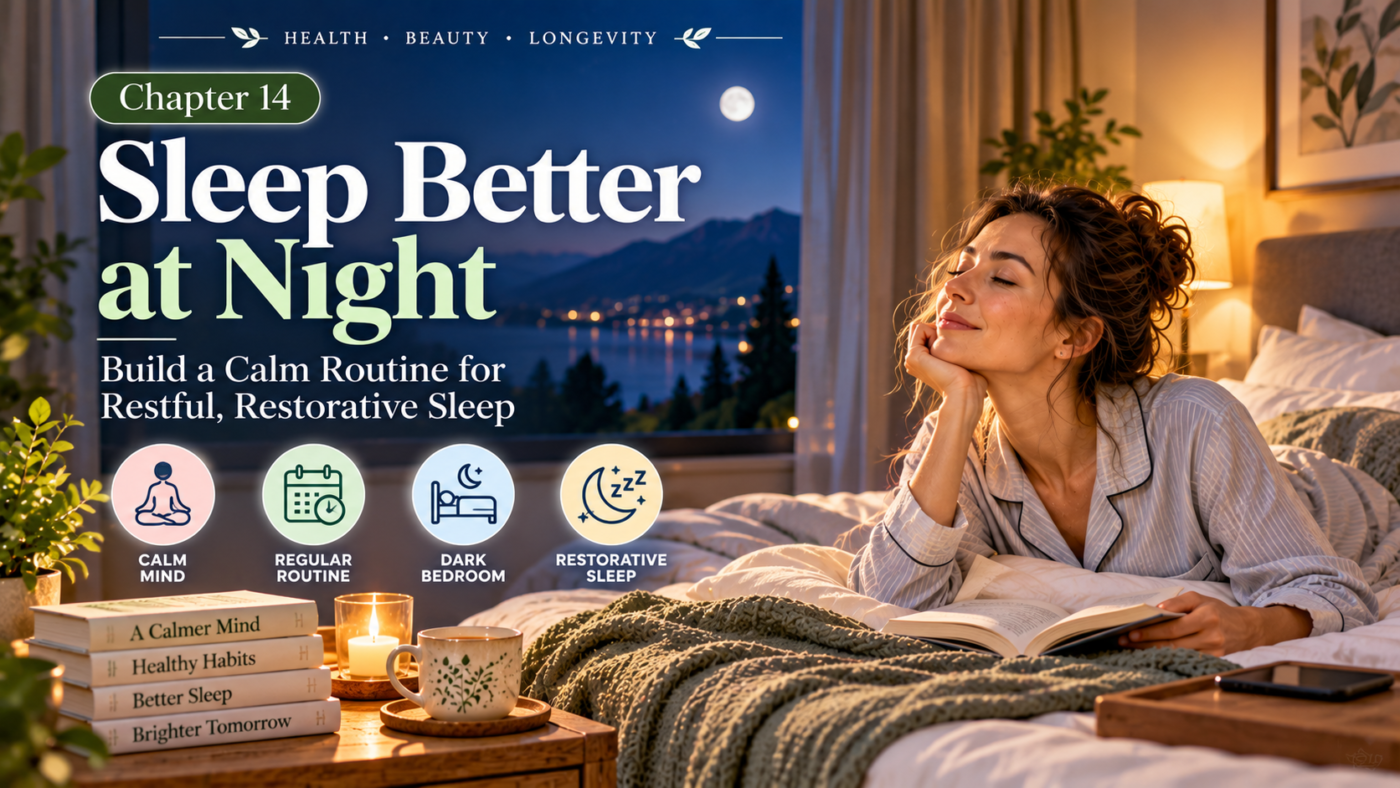
How to Sleep Better at Night: Start With the Foundations
Learning how to sleep better at night usually begins with strengthening the basic signals that regulate sleep: a reasonably consistent schedule, sufficient daytime light, regular activity, appropriate caffeine timing, a calm evening transition, and a bedroom associated with sleep rather than prolonged wakefulness. Persistent insomnia, however, may require evidence-based treatment rather than sleep hygiene alone.
How to sleep better at night is a question many people ask after discovering that physical exhaustion does not always lead to easy sleep. You may finish a long day feeling completely drained, only to become mentally alert the moment your head reaches the pillow. Stress, irregular schedules, caffeine, light exposure, pain, alcohol, medications, and learned sleep habits can all interfere with the transition from wakefulness to restorative sleep.After a long and exhausting day, sleep should feel easy.
You are tired. Your body wants rest. The day is finally over.
And yet, the moment your head reaches the pillow, your mind becomes alert.
You replay conversations.
You think about unfinished work.
You worry about tomorrow.
You check the time.
You calculate how many hours remain before morning.
The harder you try to force sleep, the farther away it seems.
This experience is common because being exhausted and being ready to sleep are not exactly the same thing.
A tired body can coexist with an activated mind.
Stress, irregular schedules, caffeine, late-night light exposure, pain, alcohol, medications, sleep disorders, and learned sleep habits can all interfere with the transition from wakefulness to sleep.
Good sleep therefore depends on more than simply “being tired enough.”
It depends on creating conditions that allow the body and brain to shift from activity into recovery.
Sleep Is Part of Recovery, Not Time Left Over
Busy people often treat sleep as flexible.
Work has a deadline.
Family responsibilities cannot wait.
Messages keep arriving.
Entertainment fills the evening.
Sleep becomes whatever time remains after everything else is finished.
But sleep is not empty time.
It supports attention, memory, emotional regulation, immune function, metabolic health, physical recovery, and daytime performance.
Chronic sleep restriction can make ordinary problems feel harder.
Concentration declines.
Irritability increases.
Exercise feels more difficult.
Caffeine becomes more necessary.
And the next evening may begin with an even more exhausted nervous system.
The goal is not to become obsessed with sleep.
It is to stop treating it as optional.
How Much Sleep Do Adults Need?
There is no universal requirement that every adult must sleep exactly eight hours.
Sleep needs vary by age and individual biology.
Current public-health guidance generally recommends:
- adults ages 18–60: at least 7 hours per night
- adults ages 61–64: around 7–9 hours
- adults ages 65 and older: around 7–8 hours
Some people naturally need somewhat more sleep than others.
The important question is not only:
“How many hours was I in bed?”
It is also:
“Do I wake reasonably restored, and can I function well during the day?”
Sleep duration and sleep quality both matter.
Being in Bed Is Not the Same as Sleeping
One of the most frustrating features of insomnia is spending long periods in bed without sleeping.
When this happens repeatedly, the bed can gradually become associated with:
worry,
frustration,
clock-watching,
phone use,
television,
planning,
and trying very hard to sleep.
That association works against you.
A key principle used in behavioral sleep treatment is to rebuild the connection between bed and sleep.
Go to bed when you are sleepy rather than simply because the clock says you should.
Use the bed primarily for sleep and intimacy.
If you remain awake and increasingly frustrated, get out of bed for a while and do something quiet in dim light.
Return when sleepiness returns.
This may feel counterintuitive, but lying in bed for hours trying to force sleep often strengthens the problem.
A Regular Wake Time Is More Powerful Than It Looks
People often focus entirely on bedtime.
Wake time is just as important.
Getting up at approximately the same time each day helps reinforce the body’s sleep-wake rhythm.
Sleeping several hours later on weekends may feel like recovery, but large shifts can make Sunday night and Monday morning more difficult.
You do not need military precision.
Consistency is the goal.
A reasonably stable waking time gives the body a predictable daily anchor.
Morning Light Helps Set the Clock
The body uses light as one of its strongest signals for timing sleep and wakefulness.
Natural daylight, especially earlier in the day, helps communicate:
“This is daytime. Be awake now.”
This can make the contrast between daytime and nighttime clearer.
A practical morning routine might include:
opening the curtains,
stepping outside,
walking for a few minutes,
having breakfast near natural light,
or taking a morning or lunchtime walk.
There is no need to stare at the sun.
Simply being outdoors during daylight usually provides much stronger light exposure than remaining inside a typical room.
Build a Wind-Down Period
Many people move directly from stimulation to sleep.
Work.
Messages.
News.
Television.
Social media.
Then lights off.
The nervous system may not change gears that quickly.
Create a transition period.
It does not need to be elaborate.
Thirty to sixty minutes of quieter activity may be enough.
Dim the lights.
Finish work.
Put away emotionally activating content.
Take a warm shower.
Read something calm.
Stretch gently.
Listen to music.
Practice slow breathing.
Prepare what you need for tomorrow.
The purpose is repetition.
Over time, the sequence itself can become a cue that the day is ending.
Reduce Late-Night Light and Screens
Screens are not the only cause of poor sleep, but they can contribute in several ways.
Bright light late at night may delay the biological signal for sleep.
Content can also be stimulating.
One short video becomes another.
A work email triggers worry.
News creates emotional arousal.
Social media extends bedtime without you noticing.
The solution does not need to be a dramatic digital detox.
Begin with a boundary.
Stop work messages at a chosen time.
Move the phone away from the bed.
Reduce brightness.
Avoid highly stimulating content during the final part of the evening.
The goal is to make nighttime look and feel different from daytime.
Caffeine Can Last Longer Than You Think
Caffeine can temporarily improve alertness.
That is precisely why timing matters.
Coffee, tea, energy drinks, some soft drinks, chocolate, and certain medications may contain caffeine.
People differ substantially in how sensitive they are.
One person can drink coffee after dinner and sleep normally.
Another may still feel the effect many hours later.
If you struggle to fall asleep, experiment with moving caffeine earlier in the day rather than assuming it is harmless because you “feel tired anyway.”
Feeling exhausted does not mean caffeine is no longer affecting sleep.
Alcohol Is Not a Reliable Sleep Aid
Alcohol can make some people feel sleepy.
That does not mean it produces better sleep.
Alcohol may help with falling asleep initially while contributing to lighter, more fragmented sleep later in the night.
It can also worsen snoring and sleep-disordered breathing in susceptible people.
Using alcohol as a nightly sleep strategy can therefore create a misleading pattern:
fall asleep faster,
sleep less well,
wake less restored.
Sleep quality matters as much as sleep onset.
Exercise Usually Helps Sleep—Timing Is Individual
Regular physical activity supports overall health and can also support better sleep.
Older advice sometimes said that exercise should never occur in the evening.
The reality is more individual.
Many people can exercise later in the day without difficulty.
However, very vigorous activity close to bedtime can leave some people feeling too activated to sleep.
Notice your response.
If evening exercise consistently keeps you awake, move intense sessions earlier.
Gentle walking, stretching, tai chi, or relaxing mobility work may be suitable later in the day for many people.
The best schedule is the one that improves both activity and sleep.
Make the Bedroom Sleep-Friendly
A bedroom does not need expensive technology.
The basics matter most.
Aim for:
a dark environment,
comfortable temperature,
low noise,
a supportive mattress and pillow,
and as little unnecessary stimulation as practical.
If outside noise is unavoidable, some people find consistent background sound useful.
If light enters the room, curtains or an eye mask may help.
Comfort matters, but no mattress can compensate for severe untreated insomnia or another sleep disorder.
Do not let the search for the “perfect” sleep product become another source of anxiety.
Stop Watching the Clock
Clock-watching turns sleep into arithmetic.
“It is 1:20.”
“Now I only have five hours.”
“If I do not fall asleep in ten minutes, tomorrow will be terrible.”
This increases pressure.
Pressure increases arousal.
Arousal makes sleep harder.
If possible, turn the clock away.
Do not repeatedly check the phone.
You do not need to know how badly the night is going while you are still trying to sleep.
A Short Nap Can Help—But Timing Matters
A brief daytime nap can improve alertness for some people.
A short nap of roughly 20 minutes early in the afternoon may feel refreshing without producing much sleep inertia.
But naps can also reduce nighttime sleep pressure.
If you regularly struggle with insomnia, long or late naps may make nighttime sleep more difficult.
There is no requirement to nap.
Use naps strategically rather than automatically.
If you sleep well at night and enjoy a brief nap, it may fit your routine.
If nighttime sleep is poor, consider whether daytime sleep is part of the pattern.
What If Sleep Hygiene Is Not Enough?
This is where many older sleep articles stop too early.
Someone with chronic insomnia may already have:
a dark bedroom,
no evening coffee,
a comfortable mattress,
a bedtime routine,
and no television in bed.
Yet sleep remains difficult.
That does not mean they are failing.
Long-term insomnia often requires more than general sleep tips.
One of the most effective non-drug treatments is cognitive behavioral therapy for insomnia, or CBT-I.
CBT-I usually combines several strategies:
sleep education,
stimulus control,
carefully adjusting time in bed,
relaxation approaches,
and changing unhelpful beliefs or anxiety surrounding sleep.
The goal is not simply to “think positively.”
It is to retrain patterns that can perpetuate insomnia.
Why Worry About Sleep Can Become Part of the Problem
Insomnia can create its own anxiety.
You begin the evening thinking:
“What if I cannot sleep?”
Then:
“I have an important day tomorrow.”
Then:
“I absolutely must get eight hours.”
Then:
“Something is wrong with me.”
The bed becomes a test.
Sleep does not respond well to tests.
CBT-I often helps people challenge rigid beliefs such as:
“If I do not get exactly eight hours, tomorrow is ruined.”
A poor night can make tomorrow harder.
It does not necessarily make tomorrow impossible.
Reducing catastrophic thinking around sleep can lower some of the arousal that keeps insomnia going.
Relaxation Is a Skill, Not a Command
“Relax” is rarely useful advice.
If relaxation could be produced by command, insomnia would be simple.
A better approach is to practice specific skills.
These may include:
slow breathing,
progressive muscle relaxation,
guided imagery,
meditation,
or other calming routines.
They work best when practiced regularly rather than used desperately only after two hours of frustration in bed.
The goal is not to force unconsciousness.
It is to reduce unnecessary physiological and mental activation.
What About Sleeping Pills?
Sleep medications can be useful in selected situations.
But the category is much more complicated than “prescription sedatives versus natural remedies.”
Different prescription medicines act through different mechanisms and have different benefits, risks, durations of action, and indications.
Some are designed for difficulty falling asleep.
Others may target sleep maintenance.
Some may be used short term.
Others may be considered for longer periods in selected patients.
The correct choice depends on the person.
Sleep medications can also cause side effects such as next-day sedation, dizziness, falls, abnormal sleep behaviors, or interactions with other medications.
They should be discussed with a qualified healthcare professional rather than selected only because someone else found them helpful.
Over-the-Counter Does Not Mean Risk-Free
Many nonprescription sleep products contain sedating antihistamines.
They can make people drowsy, but routine use is not automatically a good long-term strategy.
Side effects can include next-day grogginess, dry mouth, constipation, urinary difficulties, and other problems.
Older adults may be particularly vulnerable to some medication-related effects.
If you are repeatedly relying on an over-the-counter sleep aid, it is worth discussing the underlying sleep problem rather than simply continuing indefinitely.
Melatonin Is Not a Universal Sleeping Pill
Melatonin is a hormone involved in circadian timing.
Supplemental melatonin can be useful in some situations, particularly certain circadian-rhythm problems such as jet lag or delayed sleep timing.
That does not make it a universal treatment for chronic insomnia.
Product dose and purity can also vary.
Short-term use appears relatively safe for many adults, but long-term safety is less certain.
If you are taking other medications, are pregnant, have significant medical conditions, or plan to use melatonin regularly, professional guidance is reasonable.
Valerian: Popular, but Evidence Is Inconsistent
Valerian has a long history of traditional use for sleep and relaxation.
That history is not the same as strong clinical evidence.
Modern studies have produced inconsistent results, and its effectiveness for chronic insomnia has not been demonstrated reliably.
Short-term use appears to be tolerated by many adults, but long-term safety is uncertain.
Valerian can also interact with alcohol and sedative medicines.
It should not be presented as a proven natural replacement for established insomnia treatment.
Kava: Sleep Claims Do Not Outweigh the Safety Concern
Kava is sometimes marketed for anxiety or sleep.
The evidence for insomnia is limited.
More importantly, kava products have been linked to rare cases of serious and sometimes fatal liver injury.
Kava may also interact dangerously with alcohol or other sedating substances.
For a general health website, it is not appropriate to recommend kava as a routine sleep aid.
“Natural” does not remove pharmacological risk.
St. John’s Wort Is Not a General Sleep Remedy
St. John’s wort is best known for research related to depression, not as a routine sleep aid.
It can interact with a large number of medications.
It may reduce the effectiveness of some birth-control pills, anticoagulants, transplant medicines, seizure medications, heart medicines, HIV drugs, cancer treatments, and other therapies.
Combining it with certain antidepressants or other serotonin-related medicines can also create serious problems.
This is an excellent example of why supplements should always be included when telling a healthcare professional what you take.
Tell Your Healthcare Team About Supplements
People sometimes think:
“This is an herb, so it does not count as medication.”
It counts.
A supplement can:
produce side effects,
change how a prescription drug works,
increase sedation,
affect the liver,
or alter the level of another drug in the body.
Keep an accurate list of:
prescription medicines,
over-the-counter medicines,
vitamins,
herbs,
sleep products,
and other supplements.
Bring the list to appointments.
Medication safety requires the full picture.
When Poor Sleep May Signal Another Disorder
Not every sleep problem is insomnia.
Seek evaluation if sleep problems are persistent or if you experience signs such as:
loud habitual snoring,
gasping or choking during sleep,
significant daytime sleepiness,
repeated leg discomfort or urges to move the legs,
unusual behaviors during sleep,
frequent nighttime urination,
persistent pain,
marked mood changes,
or unexplained fatigue.
Sleep apnea, restless legs syndrome, circadian-rhythm disorders, depression, anxiety, medication effects, and other conditions can interfere with sleep.
Treating “insomnia” without recognizing the underlying problem may delay appropriate care.
A Practical Evening Routine
A realistic routine might look like this:
Two to Three Hours Before Bed
Finish very heavy meals when possible.
Avoid excessive alcohol.
Begin reducing work-related demands.
One Hour Before Bed
Dim the lights.
Reduce stimulating screen use.
Prepare the bedroom.
Take a shower or bath if that is relaxing.
Do gentle stretching or quiet reading.
At Bedtime
Go to bed when sleepy.
Keep the environment dark, quiet, and comfortable.
Avoid clock-watching.
If You Cannot Sleep
Do not spend hours becoming increasingly frustrated.
Get up for a while.
Keep the lights dim.
Do something calm.
Return to bed when sleepy.
The Next Morning
Get up at approximately your normal time.
Seek daylight.
Move your body.
Do not try to “fix” every poor night by dramatically shifting the next day’s schedule.
Consistency helps rebuild rhythm.
Sleep Is a Rhythm, Not a Performance
One of the most useful changes is psychological.
Stop trying to perform sleep perfectly.
Some nights will be excellent.
Some will not.
Travel changes sleep.
Stress changes sleep.
Illness changes sleep.
Age changes sleep.
Life changes sleep.
Healthy sleep is not a perfect score every night.
It is a pattern.
Protect enough time for sleep.
Keep a reasonably consistent rhythm.
Use daylight and movement during the day.
Reduce unnecessary stimulation at night.
Be thoughtful with caffeine and alcohol.
Build a bedroom associated with sleep.
Seek evidence-based help when insomnia becomes persistent.
And be cautious with anything marketed as a quick, “natural” cure.
The goal is not to force yourself to sleep.
It is to create conditions in which sleep no longer has to fight against the rest of your life.
For people wondering how to sleep better at night, consistency usually matters more than finding one perfect sleep product.
Understanding how to sleep better at night also means recognizing when ordinary sleep tips are no longer enough.
If you are learning how to sleep better at night, start with your daytime rhythm rather than focusing only on bedtime.
7 Evidence-Based Habits for Better Sleep
1. Keep a Consistent Wake Time
Wake at roughly the same time each day, including most weekends. A stable wake time helps reinforce the sleep-wake rhythm and can make nighttime sleep more predictable.
2. Get Daylight During the Day
Spend time outdoors, particularly earlier in the day when practical. Natural daylight provides a strong environmental cue for circadian timing.
3. Create a Calm Wind-Down Routine
Use the final part of the evening to transition away from work, intense digital stimulation, and problem-solving. Quiet reading, gentle stretching, relaxing music, or other low-stimulation activities can help signal that the day is ending.
4. Be Strategic With Caffeine and Alcohol
Move caffeine earlier if it interferes with sleep. Alcohol may initially increase sleepiness but can contribute to disrupted sleep later in the night.
5. Make the Bedroom Support Sleep
Aim for a dark, quiet, comfortable environment. Use the bed primarily for sleep and intimacy rather than prolonged work, scrolling, television, or worrying.
6. Stop Trying to Force Sleep
If you remain awake and increasingly frustrated, get out of bed temporarily and do something calm in dim light. Return when sleepiness returns. This principle forms part of stimulus-control strategies used in CBT-I. NHLBI describes CBT-I as a 6–8 week intervention and says it is usually recommended first for long-term insomnia.
7. Seek Help When Insomnia Persists
Sleep hygiene is useful, but chronic insomnia may require more. Professional assessment can identify insomnia, sleep apnea, restless legs syndrome, medication effects, mood disorders, circadian problems, or other contributors.
How Much Sleep Do Adults Need?
| Age | Recommended Sleep |
|---|---|
| 18–60 years | 7 or more hours |
| 61–64 years | 7–9 hours |
| 65+ years | 7–8 hours |
Individual sleep needs vary. These are population-level recommendations, not a requirement that every person sleep exactly the same number of hours.
FAQ
How can I sleep better at night naturally?
Start with consistent sleep and wake times, daytime light exposure, regular physical activity, appropriate caffeine timing, a calm evening routine, and a dark, quiet bedroom. Persistent insomnia may require more than lifestyle changes.
How many hours of sleep do adults need?
CDC recommends at least 7 hours for adults ages 18–60, about 7–9 hours for ages 61–64, and about 7–8 hours for adults 65 and older.
What should I do if I cannot fall asleep?
Avoid spending long periods in bed becoming increasingly frustrated. Stimulus-control strategies used in CBT-I include going to bed when sleepy and temporarily leaving bed when unable to sleep, returning when sleepiness returns.
What is CBT-I?
Cognitive behavioral therapy for insomnia is a structured treatment that addresses behaviors and thoughts that can maintain chronic insomnia. NHLBI describes CBT-I as usually the first treatment option for long-term insomnia.
Does caffeine affect sleep even if I still feel tired?
Yes. Feeling tired does not necessarily mean caffeine is no longer affecting sleep. People vary considerably in caffeine sensitivity, so moving caffeine earlier may help when sleep onset is difficult.
Does alcohol help you sleep?
Alcohol can make some people sleepy initially but may disrupt sleep later in the night. It should not be relied upon as a sleep treatment.
Is melatonin good for insomnia?
Melatonin is not a universal sleeping pill. NCCIH notes that evidence varies by sleep problem; short-term use appears relatively safe for many adults, while long-term safety remains less certain.
Does valerian help with sleep?
Evidence is inconsistent. NCCIH states that valerian’s usefulness for insomnia has not been demonstrated reliably.
Is kava safe for sleep?
Kava should not be treated as a routine sleep aid. It has been linked to rare cases of serious and sometimes fatal liver injury.
When should sleep problems be professionally evaluated?
Seek professional assessment when sleep difficulty persists, significantly affects daytime functioning, or occurs with symptoms such as loud snoring, gasping, severe daytime sleepiness, unusual nighttime behaviors, or unexplained persistent fatigue.
Medical Disclaimer: This article is for general educational and informational purposes only and is not intended as medical advice, diagnosis, or treatment. Sleep needs and sleep problems vary among individuals. Persistent insomnia, severe daytime sleepiness, loud snoring or gasping, unusual nighttime behaviors, or unexplained fatigue should be discussed with a qualified healthcare professional. Prescription medicines, over-the-counter sleep aids, melatonin, herbal products, and other supplements can have side effects and interactions and should be used with appropriate guidance.
This article is for general education and does not replace individualized care from a qualified health professional. Seek appropriate advice for persistent, severe, or concerning symptoms.
Read the full medical disclaimer

