A Science Based Guide to Medial Elbow Pain and Safe Stretching
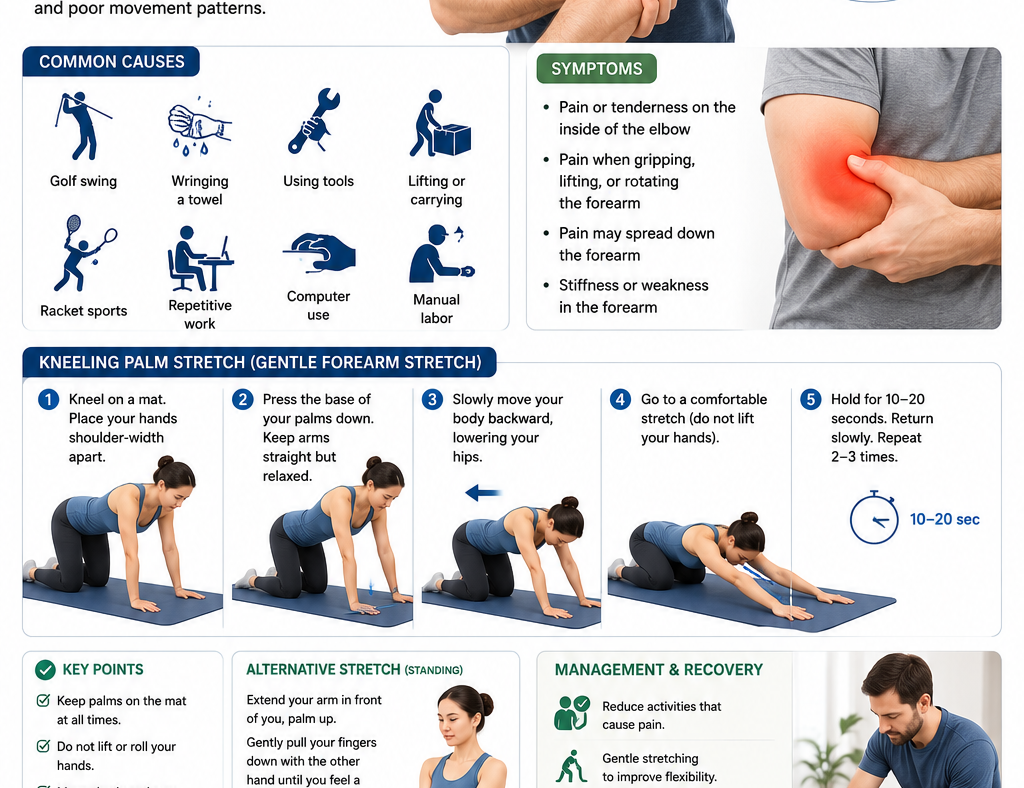
Pain on the inside of the elbow can appear during everyday activities such as carrying groceries, wringing out a towel, using hand tools, gripping sports equipment, or performing repetitive computer and manual work.
One common cause is a condition often called golfer’s elbow.
Its medical name is medial epicondylalgia or medial elbow tendinopathy. It typically causes pain and tenderness around the inner side of the elbow, and discomfort may sometimes extend into the forearm.
Despite its name, golfer’s elbow does not affect only golfers. Anyone who repeatedly performs gripping, wrist flexion, forearm rotation, throwing, or forceful manual tasks may develop similar symptoms.
What Causes Golfer’s Elbow?
Golfer’s elbow is usually related to repeated loading of the muscles and tendons on the inner side of the forearm.
These muscles help bend the wrist, grip objects, and control certain movements of the forearm.
When they are repeatedly exposed to more load than they can comfortably tolerate, especially without adequate recovery, the tendon attachment near the inner elbow may gradually become painful and sensitive.
Activities that may contribute include:
Frequent heavy gripping.
Repeated wrist bending.
Wringing towels.
Using hand tools for long periods.
Lifting or carrying heavy objects.
Golf swings.
Racket sports.
Throwing activities.
Repetitive occupational tasks.
Golfer’s elbow is therefore better understood as an overuse related tendon problem rather than simply an elbow joint being out of alignment.
Do the Shoulders and Upper Back Matter?
Although the symptoms are usually felt around the elbow and forearm, the entire upper body works together during many movements.
The shoulder, shoulder blade, trunk, elbow, wrist, and hand all contribute to activities such as swinging, throwing, lifting, and gripping.
If movement patterns are inefficient, or one part of the body repeatedly absorbs more load than it can tolerate, stress on the elbow may increase.
For example, in golf, excessive grip pressure, poor swing mechanics, sudden increases in practice volume, or repeated forceful movements may increase stress on the muscles and tendons around the inner elbow.
However, it is too simplistic to say that golfer’s elbow is caused only by poor thoracic rotation or elbow valgus.
A more useful approach is to consider overall movement technique, training load, recovery, muscle strength, and tendon capacity.
A Simple Forearm Stretch
Gentle stretching of the wrist and forearm may help some people manage mild tightness around the inner elbow.
One simple option is to straighten the affected arm in front of you with the palm facing upward.
With the opposite hand, gently guide the wrist and fingers downward until you feel a mild stretch along the inner forearm.
The sensation should be comfortable and controlled.
You should not force the stretch into pain.
Hold the position briefly while breathing normally, then slowly release.
Can You Use the Kneeling Palm Stretch?
Another option is a kneeling stretch performed on a mat.
Begin on your hands and knees.
Place your hands approximately shoulder width apart.
Keep the palms comfortably in contact with the surface.
Allow the elbows to remain straight but relaxed rather than forcefully locked.
Slowly move your hips backward.
Continue only until you feel a gentle stretch through the wrists and inner forearms.
Breathe normally.
Hold for approximately 10 to 20 seconds.
Slowly return to the starting position.
Repeat two or three times if comfortable.
The goal is not to move as far backward as possible.
The goal is a gentle, controlled stretch without significant pain.
Do Not Force Your Palms Flat
Wrist mobility varies considerably from person to person.
Some people naturally have less wrist extension than others.
If keeping the entire palm flat causes sharp pain or excessive pressure, do not force the position.
Reduce the amount you move backward or choose a different forearm stretch.
Stretching should never become a test of how much discomfort you can tolerate.
Stretching Is Only One Part of Recovery
Golfer’s elbow usually cannot be managed effectively with stretching alone.
A more complete approach often includes modifying activities that repeatedly aggravate the elbow and gradually rebuilding the strength and load tolerance of the forearm muscles.
In many rehabilitation programs, progressive resistance exercise is an important component.
For example, controlled wrist flexion exercises may be introduced with very light resistance and gradually increased as symptoms allow.
The broader recovery strategy usually includes:
Reducing excessive or repetitive loading.
Adjusting painful work or sports activities.
Maintaining comfortable movement.
Using gentle stretching when appropriate.
Gradually rebuilding forearm strength.
Progressively returning to normal work, exercise, or sport.
The aim is not simply to make the elbow feel better for a few minutes.
The longer term goal is to help the muscles and tendons tolerate normal physical demands again.
Do You Need Complete Rest?
When elbow pain begins, completely avoiding all arm movement may seem like the safest solution.
Reducing activities that clearly aggravate the symptoms can be helpful, particularly during a painful flare.
However, prolonged complete rest is not always the best approach for a tendon problem.
Tendons generally need appropriate and gradually increasing mechanical load to rebuild their capacity.
A more practical approach is to reduce or temporarily modify painful activities while continuing comfortable movement and gradually restoring strength.
How Long Does Recovery Take?
Tendon related pain often takes longer to improve than ordinary muscle soreness.
Some people improve within several weeks, while others may experience symptoms for considerably longer.
Recovery depends on factors such as how long the problem has been present, the amount of repetitive loading involved, general health, occupational demands, and whether rehabilitation is performed consistently.
For persistent symptoms, gradual load management and progressive strengthening are usually more realistic than expecting one stretch or exercise to provide an immediate cure.
When Should You Seek Professional Advice?
Not every case of inner elbow pain is golfer’s elbow.
Similar symptoms can sometimes be related to nerve irritation, joint problems, ligament injuries, neck related conditions, trauma, or other causes.
Consider professional evaluation if the pain continues for several weeks without improving or significantly interferes with work, sleep, exercise, or daily activities.
Seek medical attention more promptly if you experience:
Significant swelling.
Severe pain after an injury.
Persistent numbness or tingling.
Noticeable weakness in the hand or arm.
Loss of grip strength.
Difficulty moving the elbow normally.
Pain that continues to worsen.
Symptoms extending into the hand or fingers.
These signs may require a more detailed examination rather than self treatment with stretching alone.
The Bottom Line
Golfer’s elbow is not simply an elbow alignment problem, and you do not have to play golf to develop it.
It is commonly associated with repeated loading of the muscles and tendons on the inner side of the forearm.
Gentle stretching may help reduce stiffness and improve comfort, but no single stretch should be promoted as a cure.
A more effective long term approach usually combines activity modification, appropriate movement, gradual strengthening, good technique, and progressive return to normal physical activity.
If inner elbow pain persists, becomes more severe, or is accompanied by numbness, weakness, swelling, or significant loss of function, professional evaluation is more appropriate than continuing to exercise through the pain.
Medical Disclaimer
This article is intended for general health education and wellness information only. It is not a substitute for professional medical advice, diagnosis, treatment, or individualized rehabilitation. If you experience persistent or worsening elbow pain, numbness, weakness, significant swelling, reduced grip strength, or difficulty using your arm normally, consult a qualified healthcare professional.
This article is for general education and does not replace individualized care from a qualified health professional. Seek appropriate advice for persistent, severe, or concerning symptoms.
Read the full medical disclaimer