The feet are sometimes called the body’s second heart.
That phrase is a metaphor, not an anatomical fact.
Your heart remains the organ responsible for pumping blood throughout the body.
However, the feet and lower legs do play an important role in movement, balance and everyday circulation.
Every step requires muscles in the feet, ankles and calves to contract and relax.
These structures help you walk, climb stairs, maintain balance and remain physically independent.
Traditional Chinese medicine also gives the feet considerable importance.
Several traditional meridians and acupuncture points are described along the inner foot and ankle.
This has led to claims that massaging particular areas of the feet can lower blood sugar, strengthen the kidneys or even protect the brain from dementia.
Some of those claims go much further than current medical evidence allows.
Foot massage can still be useful.
The key is understanding what it can realistically do.
Two Foot Areas Commonly Emphasized in Traditional Wellness
The original traditional routine focuses on two areas.
The first runs along the inner side of the foot.
The second involves the heel and Achilles tendon.
In traditional Chinese medicine, parts of the inner foot are associated with the Spleen and Kidney meridians.
The heel and ankle are also crossed by traditional meridian pathways.
Modern anatomy describes these regions differently.
They contain muscles, tendons, fascia, bones, nerves and blood vessels.
There is no single anatomical tendon that simultaneously represents the spleen and kidney.
But gentle massage and movement of these tissues can still provide sensory stimulation and may help some people feel more relaxed and mobile.
Area 1: Gentle Massage Along the Inner Foot
Sit comfortably.
Place one foot across the opposite leg if that position is comfortable.
Use the pad of your thumb to gently explore the inner side of the foot.
Start near the base of the big toe.
Move gradually along the inner arch toward the ankle.
Use slow pressure.
Do not aggressively dig into the tissues.
You may notice areas that feel slightly tender.
Tenderness does not automatically mean that a meridian is blocked or that an internal organ is unhealthy.
Foot tenderness can have many explanations, including footwear, activity, muscle tension, joint irritation and normal individual variation.
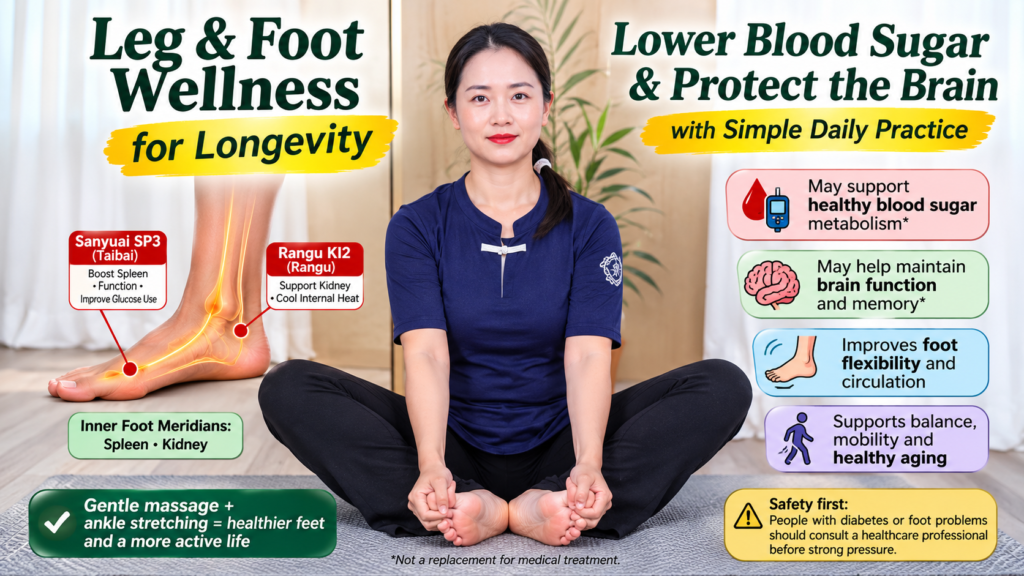
The Traditional Taibai SP3 Point
In traditional Chinese medicine, Taibai is known as SP3.
It is located on the medial side of the foot near the first metatarsal region.
TCM traditionally classifies SP3 as an important point on the Spleen meridian.
It is commonly discussed in relation to traditional patterns involving digestion, fatigue and fluid metabolism.
That historical interpretation should not be confused with modern metabolic physiology.
Your pancreas, liver, skeletal muscles, adipose tissue, gastrointestinal hormones and insulin signaling all contribute to blood glucose regulation.
Pressing SP3 has not been proven to make the body use glucose sufficiently to treat diabetes.
The Traditional Rangu KI2 Point
Rangu, commonly written as KI2, belongs to the traditional Kidney meridian.
It is located on the inner part of the foot.
Traditional practitioners may use it in patterns described as Yin deficiency or internal heat.
These traditional concepts may include symptoms such as thirst or dryness.
Again, this does not mean KI2 has been clinically established as a treatment for high blood glucose.
Acupuncture research has investigated various points in people with diabetes and diabetic neuropathy, including SP3 in some protocols, but these studies do not establish that pressing one foot point can replace medical glucose management. PubMed
Can Foot Acupressure Lower Blood Sugar?
This is where the original claim needs the most caution.
There is not strong evidence that rubbing the inner foot or pressing SP3 or KI2 reliably lowers blood glucose in people with diabetes.
Diabetes is a metabolic disease.
For type 2 diabetes, evidence based management may involve nutrition, physical activity, weight management when appropriate, blood glucose monitoring and medication.
Regular physical activity is particularly important because skeletal muscles use glucose and exercise can improve insulin sensitivity.
That is very different from saying that a tender point on the foot controls blood sugar.
If you enjoy acupressure, it may be used as a complementary relaxation practice.
It should not determine whether you take prescribed diabetes medication.
Why Physical Activity Matters More for Blood Sugar
If your goal is better glucose control, moving the whole body has far stronger evidence.
Walking.
Cycling.
Resistance training.
Swimming.
Chair exercises.
Strength training.
All of these activate large muscle groups.
The American Diabetes Association continues to recommend regular physical activity as a fundamental part of diabetes management.
Foot exercises can contribute to an active lifestyle.
But their role is mobility and movement rather than acting as a substitute for diabetes treatment.
An Important Warning for People With Diabetes
Do not use the instruction to find the most painful area and press it harder if you have diabetes.
Diabetic peripheral neuropathy can reduce sensation in the feet.
Some people may have nerve damage without realizing it.
Reduced sensation means you might injure the skin without experiencing normal warning pain.
Diabetes can also impair healing.
For this reason, the CDC recommends daily foot inspection for cuts, redness, swelling, blisters and other changes, while the ADA recommends regular professional foot evaluation, particularly when neuropathy is present.
Avoid aggressive massage over:
Open sores
Blisters
Ulcers
Infected skin
Significant swelling
Unexplained redness
Recent fractures
Painful inflamed joints
If you have reduced sensation or a history of diabetic foot ulcers, ask your healthcare professional or podiatrist before using intense massage techniques.
Area 2: The Achilles Tendon and Heel
The second area from the original routine is much easier to understand anatomically.
The Achilles tendon is the strong tendon at the back of the ankle.
It connects the calf muscles to the heel bone.
It plays an essential role in:
Walking
Running
Standing on the toes
Climbing stairs
Controlling the ankle
Transferring force between the calf and foot
Maintaining adequate ankle mobility and calf function becomes increasingly important with age.
Gentle Achilles and Calf Massage
Sit comfortably.
Place the foot where you can reach the heel without twisting awkwardly.
Use your fingers to gently massage the tissues around the calf and Achilles region.
Avoid aggressively pinching directly into a painful tendon.
Move slowly.
Thirty seconds to a few minutes may be enough.
Massage should feel comfortable.
You do not need to create strong pain for the treatment to be useful.
Gentle Calf and Achilles Stretch
A simpler way to improve flexibility is a traditional calf stretch.
Stand facing a wall.
Place both hands against the wall.
Step one foot backward.
Keep the rear heel on the floor.
Keep the rear knee comfortably straight.
Move your body slightly forward.
You should feel a gentle stretch through the calf and Achilles region.
Hold approximately 15 to 30 seconds.
Relax.
Repeat two or three times.
Then switch legs.
Do not bounce.
Does a Flexible Achilles Tendon Mean Strong Kidney Qi?
Traditional medicine sometimes associates the heel and ankle with Kidney meridian concepts.
Modern medicine does not use Achilles tendon stiffness as a diagnostic test of kidney function.
A stiff Achilles tendon does not mean your kidneys are weak.
A flexible tendon does not prove strong kidney function.
Achilles stiffness may be influenced by:
Age
Activity level
Previous injury
Calf flexibility
Tendon loading
Footwear
Ankle mobility
Arthritis
Other musculoskeletal factors
Kidney function is evaluated with medical history, blood tests, urine testing and other clinical information.
Can Massaging the Heel Prevent Dementia?
There is no reliable evidence that massaging the left heel increases blood flow to the right side of the brain or that massaging the right heel increases blood flow to the left brain.
The nervous system does have crossed pathways.
For example, each cerebral hemisphere controls many movements on the opposite side of the body.
But that does not mean traditional foot meridians function as blood supply channels to the opposite hemisphere.
Foot massage should therefore not be promoted as a technique that prevents brain atrophy or dementia.
What Foot Massage Research Actually Shows About Dementia
There has been limited research on foot massage in people who already have dementia.
Some small studies have investigated relaxation, agitation, mood and physiological stress.
One randomized trial of people with moderate to severe dementia did not find strong evidence that foot massage produced a specific physiological stress benefit compared with quiet human presence.
Researchers concluded that relaxation and social interaction may themselves contribute to the response.
Another small study suggested possible behavioral benefits, but researchers emphasized the need for better trials.
These findings are interesting.
They do not show that massage prevents Alzheimer’s disease.
What Actually Supports Brain Health?
Brain health involves much more than one tendon.
Factors being studied or targeted for healthier cognitive aging include:
Regular physical activity
Blood pressure control
Diabetes management
Not smoking
Adequate sleep
Social engagement
Hearing treatment when needed
Healthy cardiovascular function
Cognitive activity
The National Institute on Aging notes that exercise has many established health benefits and may help support cognitive health, although no specific exercise can guarantee prevention of Alzheimer’s disease.
Recent NIA research also continues to associate lifelong physical activity and cardiovascular fitness with healthier brain aging.
That is a much stronger foundation for brain health than trying to manipulate one tendon in the heel.
Why Foot Health Still Matters for the Brain
There is an indirect connection worth understanding.
Healthy feet help you remain mobile.
Mobility makes walking and exercise easier.
Physical activity supports cardiovascular health.
Cardiovascular health influences brain health.
Balance and mobility also help maintain independence and social activity.
So caring for your feet can contribute to healthy aging.
Just not through a mysterious direct foot to brain energy pathway.
Foot Massage May Help With Relaxation
One benefit that should not be underestimated is relaxation.
Small studies in older adults have found that hand or foot massage can make people feel relaxed and refreshed.
Some studies have also reported short term changes in physiological or neurological measures, although the research is small and preliminary. PubMed
Relaxation is a worthwhile outcome.
A practice does not need to cure diabetes or prevent dementia to be useful.
Foot and Ankle Mobility May Help Balance
There is also some evidence that manual massage and mobilization of the feet and ankles may temporarily improve certain balance measures in older adults.
A small randomized crossover study involving adults aged 65 to 95 found immediate improvements in some balance and mobility tests following foot and ankle massage and mobilization. PubMed
This does not prove long term fall prevention.
But it provides a more realistic mechanism for why attention to the feet may be useful as we age.
A Simple Five Minute Foot Routine
You can combine gentle massage and mobility.
First minute
Gently massage the inner arch of the right foot.
Second minute
Repeat on the left foot.
Third minute
Gently move both ankles through comfortable circles.
Fourth minute
Perform a calf and Achilles stretch on one side.
Fifth minute
Repeat on the other side.
You do not need to search for painful knots.
You do not need to press until the foot hurts.
You do not need essential oils.
Simple comfortable movement is enough.
What About Essential Oils?
Massage lotion can reduce friction.
Essential oils are optional.
They do not make the massage more effective for blood sugar or dementia prevention.
Some essential oils can irritate the skin.
If you use one, it should be appropriately diluted.
Avoid applying irritating products to cracked skin or diabetic foot wounds.
What About Foot Pain?
Foot pain should not automatically be interpreted as a blocked meridian.
Common causes include:
Plantar fasciitis
Arthritis
Tendon problems
Footwear irritation
Bunions
Neuropathy
Stress injuries
Calluses
Gout
Nerve compression
Persistent unexplained foot pain deserves proper evaluation.
Frequently Asked Questions
Can Foot Massage Lower Blood Sugar?
There is not enough evidence to recommend foot massage as a treatment for high blood sugar.
Exercise, nutrition, prescribed medication and appropriate medical monitoring have much stronger evidence.
Does Pressing Taibai SP3 Help Diabetes?
SP3 is traditionally used within Chinese medicine.
Modern clinical evidence is insufficient to say that pressing SP3 reliably lowers blood glucose.
What Is Rangu KI2 Used For?
Traditional Chinese medicine associates KI2 with Kidney meridian patterns involving heat and Yin deficiency.
Those traditional indications should not be interpreted as proven medical treatments for diabetes.
Does Foot Massage Improve Circulation?
Massage may temporarily increase local warmth and alter local blood flow.
That does not mean it clears blocked arteries or treats vascular disease.
Does Achilles Massage Improve Brain Blood Flow?
There is no good evidence that massaging one Achilles tendon selectively improves blood flow to the opposite side of the brain.
Can Foot Massage Prevent Dementia?
No.
Foot massage has not been proven to prevent dementia.
It may provide relaxation and comfort.
Is Foot Massage Good for Older Adults?
Gentle foot massage can be comfortable for many older adults.
People with diabetes, neuropathy, poor circulation, wounds or other foot conditions should be more cautious.
Why Are My Feet Tender During Massage?
Tenderness may come from muscles, fascia, joints, footwear, activity or other local causes.
Pain is not proof of a blocked organ or meridian.
Should I Massage Painful Areas Harder?
No.
More pain does not mean better treatment.
Use comfortable pressure and stop if symptoms worsen.
What Is Better for Brain Health Than Foot Massage?
Regular physical activity, cardiovascular risk management, adequate sleep, social engagement and treatment of medical risk factors have considerably stronger evidence for healthy cognitive aging.
Bottom Line
The feet deserve attention as we age.
They help us walk.
Balance.
Stand.
Exercise.
Remain independent.
Traditional Chinese medicine also gives the feet a rich history of acupressure and meridian based wellness practices.
Gentle massage of the inner foot can be relaxing.
Calf and Achilles stretching can support ankle mobility.
Foot and ankle movement may help maintain comfortable movement and balance.
But these practices should not be turned into medical promises.
Foot massage has not been proven to lower blood sugar.
A painful point does not diagnose diabetes.
Achilles tendon stiffness does not diagnose kidney weakness.
Massaging the left heel does not selectively increase blood flow to the right brain.
And no foot massage technique has been proven to prevent Alzheimer’s disease.
Use foot massage for realistic reasons.
Comfort.
Relaxation.
Mobility.
Body awareness.
Foot care.
Healthy movement.
For blood sugar control, rely on proven diabetes management.
For brain health, prioritize regular physical activity and cardiovascular health.
And if you have diabetes, protect your feet carefully rather than aggressively searching for painful pressure points.
That combination respects traditional wellness while keeping modern health advice safe and scientifically grounded.
Affiliate Disclosure
This article may contain affiliate links. If you purchase through one of these links, we may earn a commission at no additional cost to you. Affiliate relationships do not influence our editorial standards or health recommendations.
Medical Disclaimer
This article is for educational and informational purposes only and is not medical advice. Foot massage and acupressure should not replace diabetes treatment, neurological evaluation or other professional medical care. People with diabetes, peripheral neuropathy, poor circulation, foot ulcers or significant foot pain should consult a qualified healthcare professional before using aggressive massage or pressure techniques.
This article is for general education and does not replace individualized care from a qualified health professional. Seek appropriate advice for persistent, severe, or concerning symptoms.
Read the full medical disclaimer