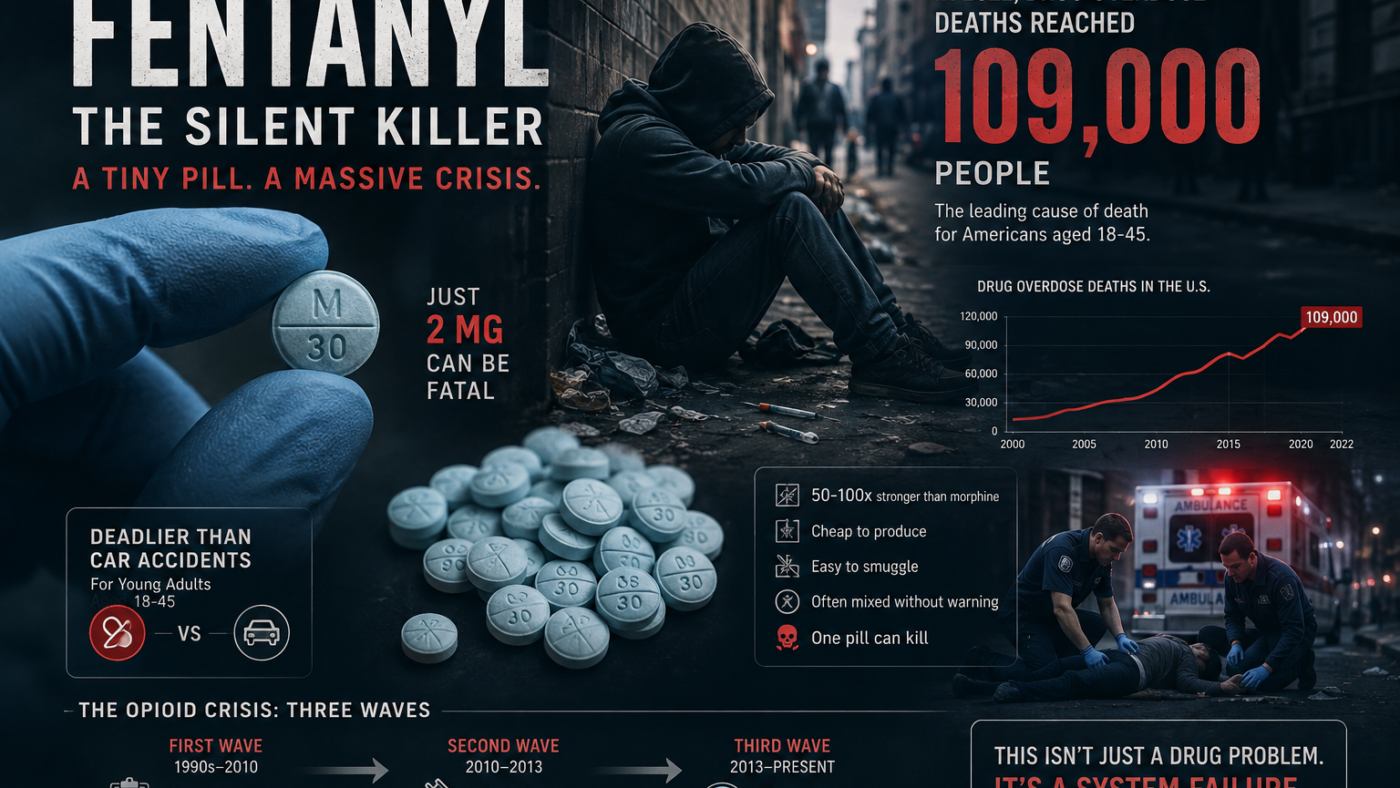
A pill can look completely ordinary.
It may have the same color, shape, and markings as a prescription medication.
But if it did not come directly from a licensed pharmacy, appearance alone cannot tell you what is actually inside.
That uncertainty has become one of the defining dangers of the modern U.S. overdose crisis.
Fentanyl is a legitimate and important medical opioid. In hospitals and carefully controlled medical settings, pharmaceutical fentanyl is used for severe pain and anesthesia-related care.
The problem is primarily illegally manufactured fentanyl entering the unregulated drug supply, sometimes on its own and sometimes inside counterfeit pills or mixed with other substances without the user’s knowledge. Fentanyl is approximately 50 to 100 times more potent than morphine.
The Numbers Are Serious, but the Story Is Changing
The United States recorded 107,941 drug overdose deaths in 2022.
That number refers to all drug overdoses, not fentanyl alone.
The situation has improved considerably since that peak.
In 2024, the United States recorded 79,384 drug overdose deaths. Of these, 47,735 involved synthetic opioids other than methadone, a category dominated by illegally manufactured fentanyl and related substances.
The age-adjusted death rate involving synthetic opioids fell 35.6 percent between 2023 and 2024.
Provisional CDC data suggest that the decline continued in 2025.
An estimated 69,973 drug overdose deaths occurred in 2025, about 14 percent fewer than the provisional estimate for 2024. Opioid-involved deaths were estimated to have fallen from 55,296 to 44,564.
Those 2025 numbers remain provisional and may change as additional death records are processed.
This improvement matters.
It shows that an overdose epidemic is not irreversible.
But tens of thousands of deaths each year still represent a major public-health problem.
What Is Fentanyl?
Fentanyl is a synthetic opioid.
Pharmaceutical fentanyl has legitimate medical uses, particularly for severe pain, including certain surgical and advanced cancer settings.
Illegally manufactured fentanyl is different because its strength and contents are not controlled by pharmaceutical manufacturing standards.
Like other opioids, fentanyl interacts with opioid receptors in the nervous system.
Its powerful analgesic effect is precisely why it is medically useful.
The same pharmacology also makes overdose dangerous.
At excessive exposure, opioids can suppress the brain’s drive to breathe.
Breathing may become slow, shallow, irregular, or stop entirely. Severe respiratory depression can lead to loss of consciousness, brain injury, and death if it is not reversed quickly.
Why Fentanyl Is Different From Many Older Opioids
Potency is one reason.
Fentanyl is far more potent by weight than morphine.
But potency alone does not explain the modern overdose crisis.
A second problem is uncertainty.
A pharmaceutical medication produced and dispensed legally has a known dose.
A counterfeit pill does not.
Illegally manufactured fentanyl may appear in counterfeit pills made to resemble prescription opioids, anti-anxiety medications, or stimulants. It may also be found with heroin, cocaine, methamphetamine, and other substances.
This means someone may be exposed to fentanyl without intentionally seeking fentanyl.
That has fundamentally changed overdose risk.
The Opioid Crisis Did Not Begin With Fentanyl
The CDC describes the U.S. opioid overdose epidemic in three major waves.
The first began with increasing prescription opioid use in the 1990s.
The second began around 2010 with rapidly rising heroin overdose deaths.
The third began around 2013 with sharp increases in deaths involving synthetic opioids, particularly illegally manufactured fentanyl and fentanyl analogs.
Prescription opioid exposure increased substantially before the fentanyl era.
CDC data show that the U.S. opioid prescribing rate reached approximately 81 prescriptions per 100 people around 2010–2012 before beginning a sustained decline.
That history matters because today’s crisis cannot be explained by one drug appearing suddenly.
It evolved as medical prescribing patterns, opioid dependence, heroin availability, and eventually a highly potent illicit synthetic opioid supply interacted over many years.
Tolerance, Dependence, and Opioid Use Disorder Are Not the Same Thing
People sometimes use the words tolerance, dependence, and addiction as if they mean exactly the same thing.
They do not.
Tolerance means that repeated exposure can reduce a drug’s effect, sometimes requiring a greater dose to produce the same response.
Physical dependence means that the body has adapted to repeated exposure and withdrawal symptoms may occur if use stops abruptly.
Opioid use disorder is a chronic medical condition characterized by patterns such as difficulty controlling opioid use, cravings, continued use despite harm, or withdrawal and other diagnostic features. It is treatable.
This distinction matters because stigma can stop people from seeking care.
Effective treatments exist.
Why Counterfeit Pills Are Especially Dangerous
Counterfeit pills are designed to resemble legitimate prescription medications.
The visual similarity can be extremely convincing.
CDC warns that fake pills may contain fentanyl and cannot reliably be identified by sight, smell, or taste.
In CDC educational material citing 2024 testing, approximately 5 out of 10 fentanyl-containing counterfeit pills tested contained a potentially deadly amount.
That does not mean every counterfeit pill contains fentanyl.
It does mean that pills obtained outside a licensed pharmacy should never be assumed safe simply because they look like medication.
The safest rule is straightforward:
Take prescription medication only when it has been prescribed for you and supplied by a licensed pharmacy.
Is 2 Milligrams of Fentanyl Always Fatal?
No single number can predict death for every person.
The DEA commonly uses approximately 2 milligrams as an example of a potentially lethal amount of fentanyl, but individual risk varies.
Factors can include opioid tolerance, body size, other medications or drugs taken at the same time, health conditions, and the actual fentanyl concentration.
That is why comparisons such as “a few grains of salt will always kill someone” are medically misleading.
The important point is simpler:
Very small amounts of fentanyl can produce life-threatening respiratory depression, particularly in people without opioid tolerance.
Why Mixing Drugs Makes Overdose More Dangerous
Fentanyl does not always appear alone.
It may be combined intentionally or unintentionally with other drugs.
The FDA warns that combining opioids with benzodiazepines, alcohol, or other central nervous system depressants can produce profound sedation, respiratory depression, coma, and death.
Fentanyl is also found in drug supplies involving stimulants such as cocaine and methamphetamine.
A person using a stimulant may therefore encounter an opioid without expecting one.
In 2023, almost half of overdose deaths in a subset of U.S. jurisdictions involved both opioids and stimulants, illustrating how polysubstance overdose has become an important part of the modern crisis.
What Does an Opioid Overdose Look Like?
An opioid overdose does not always look dramatic.
A person may appear to be sleeping.
Warning signs include:
Inability to wake the person
Very slow or shallow breathing
No breathing
Choking, gurgling, or unusual snoring sounds in someone who cannot be awakened
Blue, gray, or otherwise discolored lips or nails
Very small pinpoint pupils
Loss of consciousness
This is a medical emergency.
Do not assume that someone simply needs to “sleep it off.”
What to Do if You Suspect an Opioid Overdose
Naloxone is an opioid overdose reversal medication.
It can temporarily reverse opioid effects, including fentanyl overdose, and can be administered by bystanders.
CDC states that naloxone will not harm a person if it is given when the suspected overdose turns out not to involve an opioid.
If you suspect an opioid overdose:
Give naloxone if it is available.
Call emergency services immediately.
Try to keep the person breathing.
Place the person on their side when appropriate to reduce choking risk.
Stay with them until emergency medical help arrives.
Naloxone is not a substitute for emergency care.
Its effects are temporary, and additional medical treatment may be necessary.
Naloxone Is Only Part of the Solution
Preventing death during an overdose is essential.
Preventing the next overdose matters too.
Opioid use disorder is treatable.
FDA-approved medications include methadone, buprenorphine, and naltrexone.
Research shows that treatment with methadone or buprenorphine reduces opioid use and is associated with lower risks of overdose and death.
Yet fewer than one in five people with opioid use disorder receive these medications.
Treatment should therefore be viewed as healthcare, not punishment or moral failure.
What About the Decline in U.S. Life Expectancy?
The fentanyl crisis has contributed significantly to premature deaths, particularly among working-age adults.
But it is inaccurate to say that fentanyl caused the entire decline in U.S. life expectancy between 2019 and 2021.
U.S. life expectancy fell by approximately 2.7 years during that period, and CDC analysis found that most of the decline was associated with the COVID-19 pandemic.
Drug overdose deaths contributed through the category of unintentional injuries, particularly during 2021, but they were not the dominant explanation for the entire decline.
More recent data are considerably more encouraging.
U.S. life expectancy increased to 79.0 years in 2024, up 0.6 year from 2023.
Why the Crisis Became So Severe
There is no single explanation.
The U.S. opioid epidemic developed through overlapping changes in healthcare, patterns of opioid exposure, illegal drug markets, social conditions, and the increasing toxicity of the unregulated drug supply.
CDC’s three-wave framework demonstrates how the dominant source of opioid deaths shifted from prescription opioids to heroin and then to illegally manufactured synthetic opioids.
Counterfeit pills created another risk because they blurred the visual boundary between a pharmaceutical medication and an illicit drug.
A pill that looks familiar is not necessarily a pharmaceutical product.
That uncertainty is one of the most important lessons of the fentanyl era.
The Crisis Is Improving, but It Is Not Over
It is easy to look at years of rising overdose deaths and assume nothing works.
The newest data show otherwise.
The U.S. overdose death rate fell 26.2 percent between 2023 and 2024, the largest annual decrease seen during the 2014–2024 period.
Synthetic-opioid overdose death rates declined even more sharply.
Provisional 2025 data show another substantial national decline.
These improvements have occurred during a period of expanding overdose education, naloxone availability, treatment efforts, changes in the illegal drug supply, and other public-health and community responses.
Because several things have changed at the same time, it would be too simplistic to credit the national decline to one intervention alone.
The most important conclusion is that overdose mortality can change.
Prevention and treatment matter.
How Families Can Reduce Risk
The most useful prevention steps are practical rather than dramatic.
Keep prescription opioids and other controlled medications secured.
Do not share prescription medication.
Do not use pills obtained through social media, acquaintances, or unlicensed online sellers.
Understand the warning signs of opioid overdose.
Keep naloxone available when opioid exposure or overdose risk is possible.
Talk openly about counterfeit pills with teenagers and young adults.
Seek evidence-based treatment when opioid use becomes difficult to control.
Frequently Asked Questions
Is medical fentanyl the same as illegal fentanyl?
The molecule can be the same, but the context is completely different.
Pharmaceutical fentanyl is manufactured under controlled conditions and used for specific medical indications.
Most recent fentanyl-related overdoses in the United States are associated with illegally manufactured fentanyl circulating in the unregulated drug supply.
Is fentanyl really 100 times stronger than morphine?
Fentanyl is generally described as approximately 50 to 100 times more potent than morphine.
Potency comparisons do not mean that every exposure produces the same effect because dose, route, tolerance, and other factors matter.
Can you tell if a pill contains fentanyl by looking at it?
No.
Counterfeit pills can closely resemble legitimate medications.
Fentanyl cannot reliably be detected by appearance, taste, or smell.
Does one counterfeit pill always cause an overdose?
No.
But a counterfeit pill has an unknown composition and may contain a potentially fatal amount of fentanyl.
That unpredictability is precisely why taking pills from an unregulated source is so dangerous.
Can naloxone reverse fentanyl overdose?
Yes.
Naloxone can reverse an opioid overdose involving fentanyl.
Emergency medical services should still be contacted because naloxone is temporary and the person requires monitoring and further care.
Is opioid addiction treatable?
Yes.
Opioid use disorder is a treatable chronic medical condition.
Methadone, buprenorphine, and naltrexone are FDA-approved treatments, and methadone and buprenorphine are associated with lower overdose and mortality risk.
Are overdose deaths still increasing in the United States?
Nationally, no.
Deaths peaked earlier in the decade and have since declined substantially.
Final CDC data show 79,384 drug overdose deaths in 2024, compared with 105,007 in 2023.
Provisional data indicate a further decline to approximately 69,973 deaths in 2025.
Bottom Line
Fentanyl did not create the U.S. opioid crisis by itself.
The crisis evolved over decades.
What fentanyl did was dramatically increase the danger of an already established opioid problem because an extremely potent synthetic opioid became widespread in an unpredictable illegal drug supply.
Counterfeit pills have made the risk even harder to recognize.
A pill can look like a familiar prescription medication and still contain fentanyl.
But the newest statistics also provide an important message that is often missing from discussions about fentanyl:
The situation can improve.
Overdose deaths have fallen sharply since 2022, even though the national burden remains severe.
Knowing the risks, avoiding unregulated pills, recognizing overdose, making naloxone available, and expanding evidence-based addiction treatment can save lives.
Medical Disclaimer
This article is for educational and informational purposes only and is not intended as medical advice, diagnosis, emergency treatment, or substance-use treatment guidance. Suspected opioid overdose is a medical emergency. Contact local emergency medical services immediately and use an approved opioid overdose reversal medication such as naloxone when available and appropriate.
This article is for general education and does not replace individualized care from a qualified health professional. Seek appropriate advice for persistent, severe, or concerning symptoms.
Read the full medical disclaimer