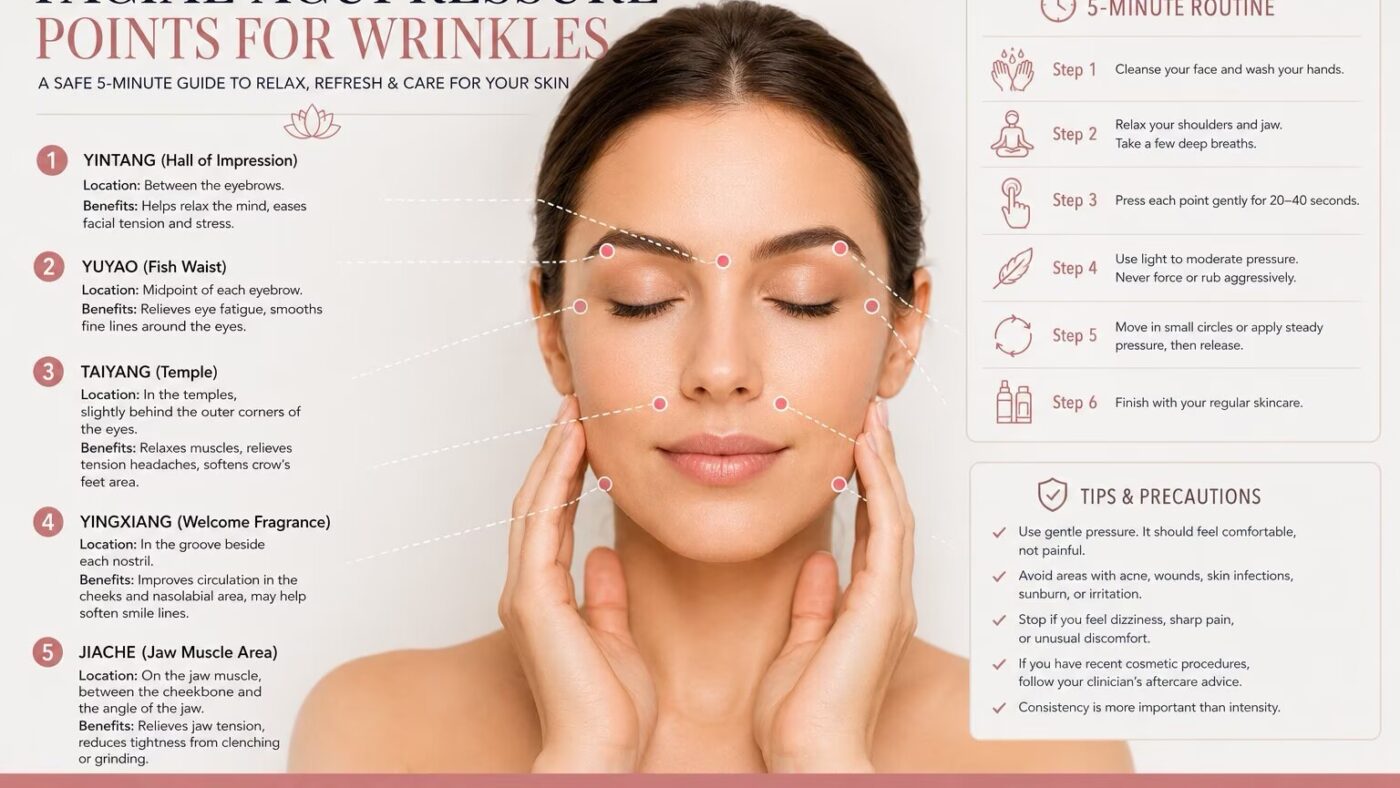
Facial acupressure for wrinkles has become increasingly popular as a gentle self-care practice for people interested in facial relaxation and healthy aging.
Fine lines, wrinkles, and changes in facial firmness are a natural part of aging. In addition to sunscreen, skincare, and professional dermatologic treatments, facial acupressure and gentle massage have become increasingly popular as simple self-care practices.
But can pressing a few facial points really reduce wrinkles?
The answer is more nuanced than many online claims suggest.
Current evidence indicates that gentle facial massage may temporarily increase local blood flow, reduce feelings of muscular tension, and make the face appear more relaxed or refreshed. However, there is not yet enough high-quality evidence to show that facial acupressure alone can erase established wrinkles.
A more realistic approach is to view facial acupressure as:
a gentle self-care practice that may support relaxation and facial comfort—not as a proven anti-aging treatment.
Why Do Wrinkles Develop?
Wrinkles do not have a single cause.
As we age, the skin gradually undergoes structural changes. Collagen and elastin levels and organization change, skin hydration may decline, and the tissues beneath the skin also evolve over time.
Several external and lifestyle factors can accelerate visible skin aging, including:
Long-term ultraviolet exposure
Smoking
Chronic sleep deprivation
Repetitive facial expressions
Persistent skin dryness
Age-related tissue changes
Genetic factors
For this reason, claims that a single pressure point can “remove wrinkles” should be treated with caution.
What Might Facial Acupressure Actually Do?
Acupressure and acupuncture are not the same thing.
Acupuncture uses fine needles inserted into the skin, while acupressure generally involves applying gentle pressure with the fingertips to selected areas of the body or face.
From a modern physiological perspective, gentle facial pressure and massage may produce several short-term effects.
1. Temporarily Increase Local Blood Flow
Facial massage can produce mild temporary flushing, which may make the skin look more vibrant for a short period of time.
2. Reduce Facial Muscle Tension
People who frequently frown, clench their jaw, spend long hours looking at screens, or carry stress in the face may notice tension around the forehead, temples, eyebrows, and jaw.
Gentle massage may help these areas feel more relaxed.
3. Encourage Relaxation
Slow, comfortable pressure combined with calm breathing can itself become a useful relaxation practice.
4. Support a Consistent Self-Care Routine
Spending a few minutes caring for the face may encourage people to become more consistent with broader skincare habits.
However, these possible effects should not be confused with claims such as:
“Acupressure rebuilds collagen”
or
“Facial pressure permanently removes wrinkles.”
Those claims are not supported by strong evidence.
Five Facial Areas Commonly Used in Gentle Acupressure
The goal is never to press as hard as possible.
A good rule is:
gentle, comfortable pressure without pulling or stretching the skin.
1. Yintang — Between the Eyebrows
Location: The midpoint between the eyebrows.
Use the pad of the index or middle finger to apply light, steady pressure for approximately 20–30 seconds while breathing normally.
This area is commonly included in relaxation-focused facial routines and may be useful for people who habitually tense the brow.
2. Yuyao Area — Mid-Eyebrow
Location: Around the midpoint of each eyebrow.
Place the pads of the index or middle fingers over both sides and press very gently.
The skin around the eyes is thin and delicate, so avoid dragging, stretching, or pressing deeply.
3. Taiyang — Temple Area
Location: The soft area beside the outer corner of each eye.
Using two fingertips, make small, slow circular movements for approximately 20–30 seconds.
This area may feel especially tense after prolonged screen use or periods of stress.
4. Yingxiang Area — Beside the Nostrils
Location: In the shallow grooves beside the nostrils.
Apply gentle, symmetrical pressure with the index fingers.
Avoid aggressively rubbing the nasolabial folds or pulling the skin in an attempt to create a “lifting” effect.
5. Jaw Muscle Area
Lightly clench your teeth and feel for the prominent jaw muscle on each side of the face.
Then relax your jaw.
Use the fingertips to make slow circular movements over the muscle for 20–30 seconds.
People who habitually clench their teeth may notice considerable tension in this region.
A Simple Five-Minute Facial Acupressure Routine
You do not need special equipment.
Step 1: Wash Your Hands and Cleanse Your Face
Clean hands are important, particularly if your skin is prone to acne or irritation.
Step 2: Relax Your Shoulders and Jaw
Sit or stand comfortably.
Let the shoulders drop naturally and avoid clenching the teeth.
Take two or three slow breaths before beginning.
Step 3: Start Between the Eyebrows
Apply light pressure to the Yintang area for about 20–30 seconds.
Pressure should feel comfortable.
Step 4: Move Across the Face
Continue to the eyebrow area, temples, sides of the nose, and jaw.
Spend approximately 20–40 seconds on each area.
Slow movements are usually better than vigorous rubbing.
Step 5: Never Chase Pain
Acupressure is not more effective simply because it hurts.
Stop if you experience:
Significant pain
Dizziness
Intense redness
Increased skin irritation
Unusual discomfort
Step 6: Finish With Your Usual Skincare Routine
Afterward, continue with the skincare products your skin already tolerates well.
There is no need for vigorous tapping, pulling, or stretching.
Do You Need to Practice Every Day?
There is no scientifically established schedule for facial acupressure specifically for wrinkle reduction.
If your skin tolerates it well, you can use it as a short relaxation ritual several times a week or even daily.
For most people, three to five minutes is enough.
The goal is not intensity.
The goal is:
gentle, consistent, comfortable care.
If your skin becomes irritated, sensitive, swollen, or painful, reduce the frequency or stop.
What Does the Research Actually Say?
Research specifically examining facial acupressure for wrinkles is still limited.
Some small studies involving facial massage and massage tools have reported short-term changes in facial blood flow, muscle tone, facial contours, or certain skin measurements.
These findings suggest that manual facial techniques may be worthy of further study.
However, they do not prove that pressing specific facial points can permanently remove wrinkles.
Research on cosmetic acupuncture has also reported some changes in skin elasticity in small studies, but acupuncture and acupressure are different interventions.
Acupuncture involves needles.
Acupressure does not.
Therefore, acupuncture findings should not automatically be applied to fingertip facial massage.
The most scientifically responsible conclusion is:
Facial acupressure may support relaxation, temporary circulation changes, and a pleasant self-care experience, but its wrinkle-reducing effects remain insufficiently proven.
When Should You Avoid Facial Acupressure?
Avoid direct pressure or massage over areas with:
Open wounds
Active skin infections
Severe inflammatory acne
Unexplained facial swelling
Fresh burns
Significant sunburn
Recent facial trauma
You should also be cautious if you have recently undergone:
Botulinum toxin injections
Dermal fillers
Laser procedures
Microneedling
Chemical peels
Facial surgery
In these situations, follow the aftercare instructions provided by your clinician before resuming facial massage.
Persistent facial pain, numbness, weakness, significant swelling, or unexplained skin changes should be medically evaluated rather than treated with massage alone.
What Actually Matters Most for Healthy Skin Aging?
If your goal is to slow visible skin aging, several strategies have much stronger evidence than acupressure.
1. Daily Sun Protection
Long-term ultraviolet exposure is one of the major drivers of premature skin aging.
Consistent sunscreen use and sensible sun protection can help reduce the development of pigmentation changes, fine lines, and photoaging.
2. Avoid Smoking
Smoking accelerates visible skin aging and contributes to wrinkle formation.
3. Support the Skin Barrier
Regular moisturization can reduce dryness and make fine lines associated with dehydration appear less noticeable.
4. Maintain Adequate Sleep and Nutrition
Chronic sleep deprivation and poor nutrition affect overall health and may also be reflected in the appearance of the skin.
5. Seek Professional Dermatologic Care When Needed
For significant photoaging, pigmentation, deep wrinkles, or other persistent concerns, a dermatologist can discuss treatments with stronger clinical evidence.
Frequently Asked Questions
Can facial acupressure really remove wrinkles?
There is currently not enough high-quality evidence to show that facial acupressure can remove established wrinkles.
It is better viewed as a relaxation and self-care practice.
How long should I press each area?
Around 20–40 seconds of light, comfortable pressure is generally sufficient for a simple home routine.
Does harder pressure work better?
No.
Pain does not mean the technique is more effective.
If it hurts, reduce the pressure or stop.
Is facial acupressure the same as facial acupuncture?
No.
Acupressure uses external pressure from the fingers.
Acupuncture involves the insertion of needles and is a different procedure.
Can I practice facial acupressure every day?
Some people enjoy a short daily routine.
If your skin remains comfortable and free of irritation, this may be reasonable.
If redness, swelling, tenderness, or sensitivity develops, stop and allow the skin to recover.
The Bottom Line
The greatest value of facial acupressure may not be dramatic wrinkle reduction.
Instead, it can be viewed as a:
simple, inexpensive, and easy-to-maintain facial relaxation practice.
A few minutes of gentle pressure may help the face feel less tense, encourage mindful self-care, and temporarily increase local circulation.
But if your goal is to meaningfully support healthy skin aging, the fundamentals matter far more:
sun protection, avoiding smoking, evidence-based skincare, good sleep, balanced nutrition, and professional dermatologic care when appropriate.
Traditional wellness practices do not need to be either blindly accepted or completely dismissed.
A better approach is to:
respect traditional practices while using modern evidence to understand what they may help with, what they cannot reliably do, and how to use them safely.
Medical Disclaimer
This article is for educational and general wellness purposes only. It is not intended to diagnose, treat, cure, or prevent any medical condition and should not replace individualized medical or dermatologic advice. Seek qualified medical care for persistent skin problems, facial pain, numbness, swelling, weakness, or other concerning symptoms.
Suggested Category: Eastern Wellness → Acupressure
Suggested Tags:
Author: Eastern Wellness Research Team
This article is for general education and does not replace individualized care from a qualified health professional. Seek appropriate advice for persistent, severe, or concerning symptoms.
Read the full medical disclaimer