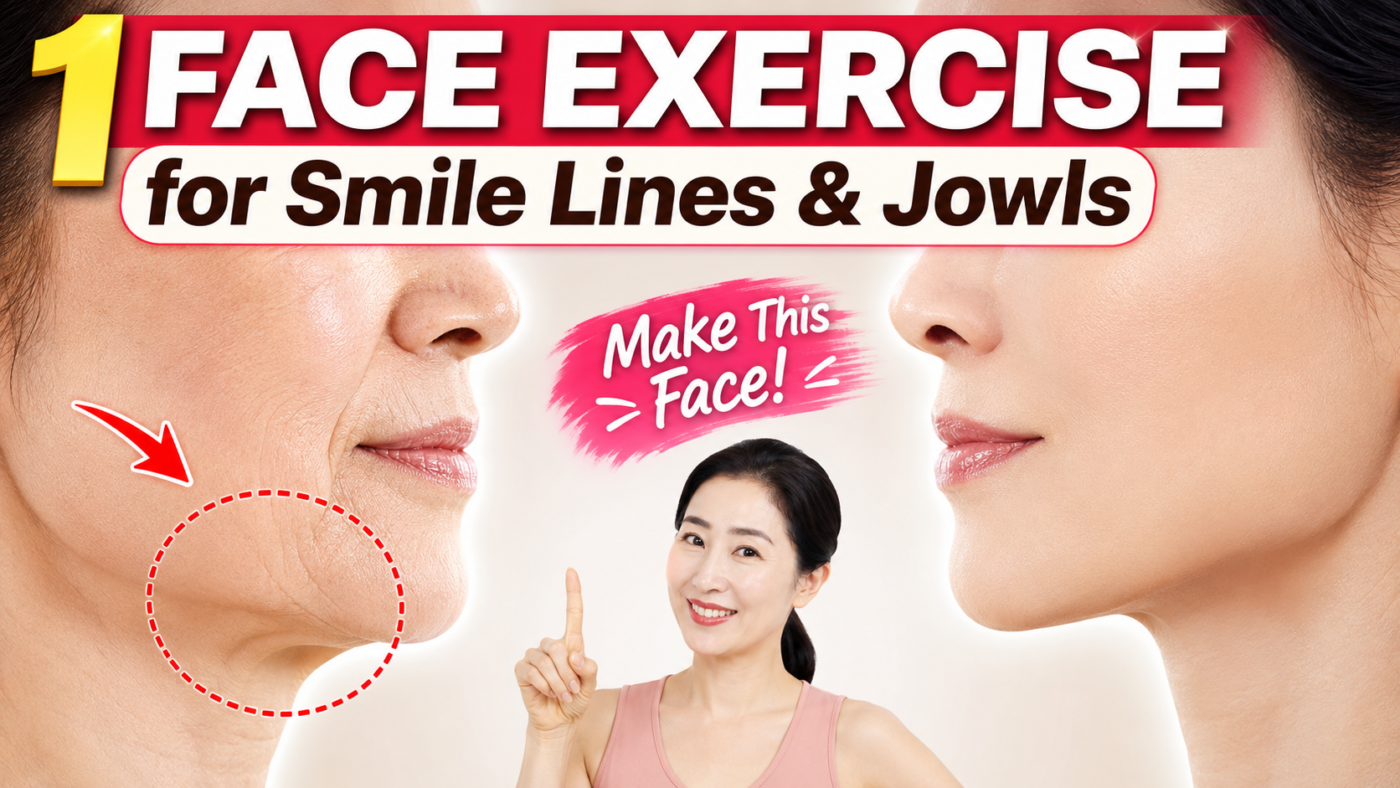
Nasolabial folds—the lines that run from the sides of the nose toward the corners of the mouth—become more noticeable for many people as they get older.
At the same time, changes around the cheeks, mouth and jawline can create a softer or heavier-looking lower face.
That has helped make face exercises for nasolabial folds increasingly popular.
Some routines promise that a few exaggerated facial expressions, massage techniques or tapping movements can completely erase smile lines and jowls.
The reality is more nuanced.
Facial exercises cannot reliably remove deep nasolabial folds or permanently lift jowls. But gentle facial movement may train certain muscles around the cheeks and mouth, improve awareness of facial tension and, in some people, modestly change facial appearance over time.
The important question is not whether one dramatic facial expression can “erase” aging.
It is whether a safe, consistent routine can complement good skincare and healthy aging habits.
What Causes Nasolabial Folds?
Nasolabial folds are normal anatomical features.
Even young people have them.
They tend to become more visible with age because several structures change at the same time, including:
- Skin elasticity
- Collagen
- Facial fat distribution
- Cheek volume
- Bone structure
- Ligament support
- Repeated facial expression
This is why no single muscle is responsible for a nasolabial fold.
And it is why one exercise cannot simply “switch off” the line.
What Causes Jowls?
Jowls refer to sagging or fullness along the lower jawline.
They can reflect age-related changes in:
- Skin
- Fat compartments
- Connective tissue
- Bone
- Facial support structures
Genetics also matters.
Facial exercise may influence muscle activity, but it cannot fully reverse these structural changes.
Can Face Exercises Really Change Facial Appearance?
There is limited but interesting research.
A small JAMA Dermatology study followed middle-aged women performing a structured facial exercise routine for 20 weeks.
Researchers reported improvement in upper and lower cheek fullness, and blinded evaluators estimated participants looked modestly younger by the end of the program. However, only 16 participants completed the study, there was no control group and dropout was substantial. JAMA Network
An earlier systematic review concluded that the evidence available at the time was insufficient to determine whether facial exercises are genuinely effective for facial rejuvenation because studies were generally small and lacked rigorous controls. PubMed
So the appropriate conclusion is:
Facial exercise may have modest cosmetic effects, but it is not proven to erase wrinkles or jowls.
Which Muscles Are Involved Around the Mouth?
The original routine focuses on several facial muscles.
These include the:
Orbicularis Oris
This circular muscle surrounds the mouth.
It helps with:
- Lip closure
- Puckering
- Speech
- Facial expression
Zygomaticus Muscles
The zygomaticus major and minor help elevate the corners of the mouth during smiling.
Levator Labii Superioris
This muscle contributes to lifting the upper lip.
These muscles absolutely participate in facial expression.
But activating them does not automatically mean nasolabial folds disappear.
A Gentle Face Exercise Routine for the Mouth and Cheeks
The goal of this routine is controlled movement rather than aggressive stretching.
Use a mirror the first few times.
Stop if you feel pain.
1. Shoulder Shrug and Release
Sit upright.
Bring your shoulders gently toward your ears.
Hold for 2 seconds.
Release.
Repeat 5 times.
This does not directly remove smile lines, but relaxing the neck and shoulders may make the routine more comfortable.
2. Overhead Reach
Bring your hands together.
Reach upward comfortably.
Take a slow breath in.
Lower the arms while exhaling.
Repeat 3 times.
Avoid forcing the shoulders.
3. Gentle Neck Stretch
Place one hand lightly on the opposite shoulder.
Tilt your head slightly away.
Hold for about 15 seconds.
Switch sides.
Do not pull your head with your hand.
4. Ear Massage
Hold the outer ear gently between your fingers.
Make small circular movements.
Continue for 15–20 seconds.
Ear massage may feel relaxing, but it should not be promoted as a technique that mechanically lifts the face.
The Main Mouth Exercise
5. Controlled “O” Shape
Open your mouth into a comfortable “O.”
Do not stretch as wide as possible.
Hold for 2 seconds.
Relax.
Repeat 5 times.
Focus on smooth movement around the lips.
6. Lip Roll
Gently roll the lips inward over the teeth.
Hold lightly.
Do not bite the lips.
Then relax.
Repeat 5 times.
7. Smile From the Cheeks
With the lips relaxed, create a gentle smile.
Try to feel the cheeks lifting.
Hold for about 2 seconds.
Relax.
Repeat 8 times.
Avoid squinting aggressively.
Why Not Use Extreme Facial Expressions?
More intensity is not automatically better.
Repeated exaggerated expressions can deepen temporary skin creasing.
The goal is muscle control—not forcing the skin into the strongest possible fold.
Upper-Lip Exercise
8. Gentle Upper-Lip Lift
Keep the forehead relaxed.
Slightly lift the upper lip.
Do not wrinkle your nose forcefully.
Hold for 1–2 seconds.
Relax.
Repeat 5 times.
This activates muscles around the upper lip and nose.
Will This Erase Nasolabial Folds?
No reliable evidence shows that this specific exercise permanently removes them.
Think of it as facial muscle training, not wrinkle removal.
Cheek Massage
9. Light Cheek Circles
Place clean fingertips over the cheeks.
Make small circles.
Use gentle pressure.
Continue for about 20 seconds.
Avoid aggressive pinching.
Can Massage Improve Blood Flow?
Gentle massage can temporarily increase warmth and local circulation.
That may make the face appear more refreshed.
But circulation changes do not equal permanent lifting.
What About Pinching Nasolabial Folds?
The original routine recommends pinching directly along the folds.
That is unnecessary.
Aggressive pinching may cause:
- Redness
- Bruising
- Irritation
- Broken capillaries in susceptible skin
A safer alternative is to use light fingertip pressure around the cheeks.
What About Tapping the Face?
Light tapping is generally harmless when comfortable.
But it should not be described as “creating collagen.”
Does Facial Tapping Increase Collagen?
There is not enough clinical evidence to claim that tapping your face meaningfully increases collagen production.
For collagen preservation and photoaging, stronger evidence exists for approaches such as:
- Daily sunscreen
- Retinoids
- Avoiding smoking
- Appropriate moisturization
Gum Massage: Should You Do It?
The original routine includes pressing through the cheek toward the gums.
This is not necessary for treating wrinkles.
Do not aggressively press the gums from outside the cheek.
If you have:
- Gum pain
- Bleeding
- Swelling
- Tooth pain
- Dental infection
see a dentist instead of massaging the area.
Lower-Face Exercise
10. Gentle Smile Hold
Bring the lips to a neutral position.
Smile naturally.
Hold for 3 seconds.
Relax completely.
Repeat 5 times.
11. Corner-of-Mouth Lift
Create a small smile.
Focus on lifting the mouth corners rather than stretching them sideways.
Hold briefly.
Release.
Repeat 5–8 times.
Can Face Exercises Lift Jowls?
Probably not in the way cosmetic marketing often implies.
Jowls are influenced by structural aging of the skin, fat, bone and connective tissues.
Muscle exercise may modestly affect lower-face appearance, but it cannot mechanically reposition sagging tissue.
The existing facial exercise research is too limited to claim otherwise. JAMA Network
What About Facial Massage for Jowls?
Massage may temporarily change:
- Puffiness
- Skin warmth
- Muscle tension
That may make the jawline look slightly sharper for a short period.
But this is not the same as permanently lifting jowls.
Can Face Exercises Improve Smile Lines?
Possibly modestly in some people, but not necessarily by making the folds disappear.
Potential cosmetic changes might come from:
- Better cheek muscle tone
- Changes in facial expression
- Temporary reduction in puffiness
- Increased awareness of habitual tension
Long-term evidence remains limited.
How Often Should You Practice?
You do not need an intense daily routine.
Start with:
5–10 minutes, 3–5 times per week.
Use low effort.
Consistency is more important than aggressive movement.
The small 2018 study used a much longer program—30 minutes daily initially and then every other day—but that does not establish an ideal dose for everyone. JAMA Network
What Should Face Exercise Feel Like?
You may feel:
- Mild muscle fatigue
- Warmth
- Increased awareness of facial muscles
You should not feel:
- Sharp pain
- Jaw locking
- Headache
- Dental pain
- Skin burning
- Severe eye strain
If you do, stop.
Who Should Be Extra Careful?
Consider avoiding aggressive facial exercise if you recently had:
- Facial surgery
- Injectable treatments
- Dental surgery
- Significant TMJ symptoms
- Facial nerve problems
Ask your healthcare professional when it is appropriate to resume facial massage or exercise.
What Works Better for Nasolabial Folds?
If your primary concern is visible skin aging, evidence-supported basics matter more than facial exercise.
Sunscreen
Use broad-spectrum SPF 30 or higher.
UV exposure accelerates collagen degradation and skin aging.
Moisturizer
Well-hydrated skin can make fine lines appear softer.
Retinoids
Retinoids are among the most studied topical options for photoaging and fine wrinkles.
Healthy Lifestyle
Avoid smoking, stay physically active and maintain adequate sleep.
When Cosmetic Treatments Are Different
Face exercise should not be compared directly with professional cosmetic procedures.
Options such as:
- Fillers
- Neuromodulators
- Laser procedures
- Radiofrequency treatments
- Surgery
work through completely different mechanisms and have different benefits and risks.
A dermatologist or appropriately qualified clinician can explain which options are suitable for a specific concern.
The Bottom Line
Face exercises for nasolabial folds can be a gentle, inexpensive addition to a skincare routine.
They may help improve:
- Facial muscle awareness
- Cheek activation
- Mouth control
- Jaw relaxation
- Temporary facial freshness
But they should not be marketed as a guaranteed way to:
- Remove nasolabial folds
- Eliminate jowls
- Restore lost collagen
- Permanently lift sagging skin
A better goal is subtle improvement, relaxation and consistent self-care.
Treat your facial skin gently.
More pressure does not mean better results.
Frequently Asked Questions
Can face exercises remove nasolabial folds?
There is not enough evidence to show that they can completely remove them. Modest changes in facial appearance may occur with consistent exercise.
Can facial exercise lift jowls?
It may affect muscle tone, but it cannot reliably reverse structural sagging.
How long does face yoga take to work?
The limited research showing changes used approximately 20 weeks of consistent facial exercise. JAMA Network
Does tapping increase collagen?
There is insufficient evidence that facial tapping significantly stimulates collagen.
Should I pinch smile lines?
Aggressive pinching is unnecessary and may irritate the skin.
Can smiling exercises make cheeks firmer?
They activate cheek muscles. A small study suggests facial exercise may improve cheek fullness, but stronger research is needed. JAMA Network
How often should I do these exercises?
A practical starting point is 5–10 minutes, three to five times per week.
Can face yoga replace fillers?
No. Facial exercises and injectable treatments work through very different mechanisms.
Can massage permanently tighten skin?
No. Massage may produce temporary cosmetic effects but cannot permanently tighten loose skin.
Is face yoga safe after 40?
Generally, gentle facial movement is low risk for most healthy adults, but painful or aggressive techniques should be avoided.
Medical Disclaimer:
This article is for educational purposes only and is not medical advice. Facial exercise should not be painful. Avoid aggressive pulling, pinching, deep pressure near the eyes, or forceful manipulation of the jaw and gums. Stop if you develop facial pain, jaw locking, numbness, severe headache, dental pain or persistent skin irritation. Seek professional evaluation for new facial weakness, unexplained swelling, persistent jaw symptoms or significant dental concerns.
References
Alam M, Walter AJ, Geisler A, et al. Association of Facial Exercise With the Appearance of Aging. JAMA Dermatology. 2018;154(3):365–367. The small uncontrolled pilot study found improvements in cheek fullness after a 20-week facial exercise program but emphasized the need for further research.
Van Borsel J, De Vos MC, Bastiaansen K, Welvaert J, Lambert J. The Effectiveness of Facial Exercises for Facial Rejuvenation: A Systematic Review. The review concluded that available evidence was insufficient because studies were small and methodologically weak.
This article is for general education and does not replace individualized care from a qualified health professional. Seek appropriate advice for persistent, severe, or concerning symptoms.
Read the full medical disclaimer