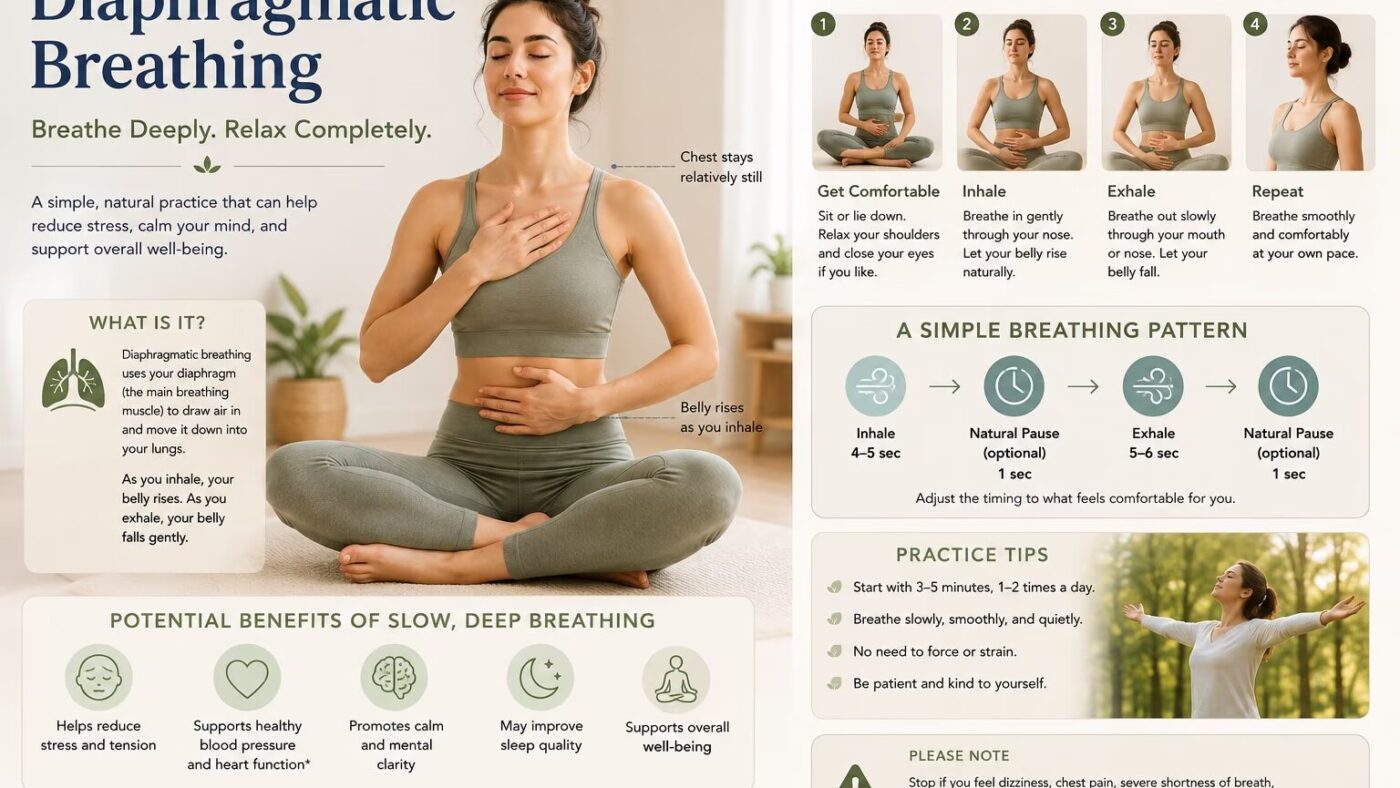
Diaphragmatic breathing is a simple breathing technique that can be used to support relaxation, stress management, and better awareness of how the body breathes.Breathing is something we do every minute of every day, usually without thinking about it.
Traditional Chinese health practices have long placed special emphasis on slow, deep breathing and on the idea of allowing the breath to “sink” toward the lower abdomen.
Modern physiology describes this somewhat differently.
Air does not literally travel into the abdomen. Instead, during diaphragmatic breathing, the diaphragm—the main muscle involved in breathing—moves downward as you inhale. This movement allows the lungs to expand and often causes the abdomen to gently rise. During exhalation, the diaphragm relaxes and the abdomen naturally falls.
This pattern is often called diaphragmatic breathing, abdominal breathing, belly breathing, or deep breathing.
Used comfortably, it can be a simple relaxation practice that may help reduce stress and improve awareness of breathing patterns.
What Is Diaphragmatic Breathing?
The diaphragm is a dome-shaped muscle located beneath the lungs.
When you inhale, the diaphragm contracts and moves downward, creating more space for the lungs to expand.
With relaxed diaphragmatic breathing, the abdomen usually moves outward during inhalation and gently returns inward during exhalation. The upper chest may still move, but the breathing pattern is generally less dominated by the shoulders and upper chest.
This is why “belly breathing” does not mean that the stomach itself is breathing.
The abdominal movement is mainly a visible result of the diaphragm doing more of the work.
Why Slow Breathing May Feel Relaxing
Slow breathing is commonly used as part of relaxation training.
The U.S. National Center for Complementary and Integrative Health describes slow, deep breathing as a relaxation technique and notes that research suggests diaphragmatic breathing may modestly reduce blood pressure and cortisol levels in some people. Evidence for stress reduction is promising, although the strength of the research varies.Regular diaphragmatic breathing practice does not need to be long or complicated; a few comfortable minutes can be a practical starting point.
Slow breathing also changes the natural interaction between breathing and heart rate.
A large systematic review and meta-analysis found that voluntary slow breathing can increase measures of heart rate variability associated with parasympathetic activity during and after breathing practice. These findings help explain why slow breathing is often associated with a calmer physiological state, but they do not mean that breathing exercises can prevent disease or guarantee longevity.
A Simple Way to Practice
You do not need a complicated breathing formula.
Begin in a comfortable seated or lying position.
Place one hand on your upper chest and the other over your abdomen.
Allow your shoulders, jaw, and neck to relax.
Breathe in gently through your nose.
As you inhale, allow the lower hand to rise slightly as the abdomen expands.
Try to keep the movement smooth rather than forcing the stomach outward.
Then exhale slowly and comfortably.
Allow the abdomen to soften and gently fall.
Continue breathing at an easy pace.
The U.S. Department of Veterans Affairs describes the goal of diaphragmatic breathing as deep, abdominal, slow, and smooth, while emphasizing that people should avoid trying too hard or over-breathing.
Do You Need to Hold Your Breath?
No.
Breath-holding is not required for ordinary diaphragmatic breathing practice.
Some traditional breathing systems include brief pauses between inhalation and exhalation, but beginners do not need to add breath retention to receive the relaxation benefits of slow breathing.
A simpler pattern is often better:
Breathe in comfortably.
Breathe out slowly.
Pause naturally if your body wants to.
Then begin the next breath.
There is no need to force yourself to hold your breath for three to five seconds.
If breath-holding causes dizziness, chest discomfort, anxiety, or a feeling of air hunger, stop and return to normal breathing.
How Slow Should You Breathe?
There is no single perfect breathing rate for everyone.
Research on slow breathing often examines breathing rates below normal resting respiration, with some protocols using approximately six breaths per minute. The VA also notes physiological effects at slow breathing rates in the range of roughly six to ten breaths per minute.
However, beginners do not need to count every breath.
The more useful goal is to breathe:
slowly,
comfortably,
smoothly,
and without strain.
If you feel that you are gasping between breaths, you are probably breathing too slowly for your current comfort level.
Try a Longer, Easier Exhalation
Some people find that allowing the exhalation to last slightly longer than the inhalation feels calming.
For example, you might breathe in gently for about four seconds and breathe out for about five or six seconds.
This is only an example, not a medical requirement.
Your breathing should remain comfortable at all times.
The purpose is not to “win” by making each breath longer.
It is to reduce unnecessary effort.
How Long Should You Practice?
You do not need to practice for 30 minutes every day to benefit from breathing awareness.
For beginners, even a few minutes can be a reasonable starting point.
You might begin with approximately three to five minutes once or twice a day.
If that feels comfortable, you can gradually spend more time practicing.
Consistency is usually more useful than forcing yourself through long sessions.
The original idea that everyone must perform 50 to 100 abdominal movements or practice until the body becomes warm is not supported by modern evidence.
A breathing exercise should leave you feeling comfortable, not exhausted.
The Abdomen Should Move Naturally
Another common mistake is deliberately pushing the stomach as far outward as possible during every inhalation and pulling it aggressively inward during every exhalation.
That is unnecessary.
The abdominal movement should be gentle.
Think of allowing the abdomen to expand rather than forcing it.
On the exhale, simply let it return toward its resting position.
Over-contracting the abdominal muscles can actually make breathing feel more difficult.
Can You Practice While Walking or Exercising?
Breathing awareness can certainly be used during walking and physical activity, but formal slow diaphragmatic breathing is usually easiest to learn while sitting or lying down.
During exercise, your body naturally needs to breathe faster as oxygen demand increases.
Trying to maintain an artificially slow breathing rate during running or vigorous activity may be uncomfortable and is unnecessary.
It is better to first learn diaphragmatic breathing at rest and then allow a natural breathing rhythm during exercise.
What About the Traditional Chinese View?
Traditional Chinese health systems often describe breathing practices in terms such as qi, the lower abdomen, and cultivating internal vitality.
These ideas are part of a traditional wellness framework.
They should not be interpreted literally as proof that air or “heavenly qi” travels into the navel, nor is there evidence that breathing into the abdomen guarantees a longer life.
Modern physiology instead explains diaphragmatic breathing through changes in respiratory mechanics, autonomic regulation, heart rate variability, and the relaxation response.
Both perspectives can be discussed respectfully, as long as traditional concepts are not presented as established biological facts.
Can Diaphragmatic Breathing Make You Live Longer?
There is no good evidence that a specific breathing exercise directly extends lifespan.
Healthy aging depends on many factors, including physical activity, sleep, nutrition, cardiovascular health, metabolic health, smoking, alcohol use, social connection, genetics, and access to appropriate medical care.
Breathing practice can be one small part of a healthy lifestyle.
Its more realistic benefits are relaxation, breathing awareness, and possibly modest improvements in some stress-related physiological measures.
When to Stop
Slow breathing and other relaxation techniques are generally considered safe for healthy people, but not everyone finds them comfortable. NCCIH notes that some people occasionally experience increased anxiety or other unpleasant reactions during relaxation practices.
Stop the exercise if you develop:
dizziness,
lightheadedness,
chest pain,
significant shortness of breath,
numbness or tingling,
panic,
or unusual discomfort.
Return to your normal breathing pattern.
If symptoms persist, seek appropriate medical advice.
People with significant heart or lung disease, unexplained breathing difficulty, or other serious medical conditions should discuss new breathing practices with a healthcare professional rather than using them as a substitute for medical treatment.
A Simple Five-Minute Practice
For everyday relaxation, try this:
Sit comfortably and relax your shoulders.
Place one hand over your abdomen.
Breathe in gently through your nose.
Allow the abdomen to rise slightly.
Breathe out slowly and let the abdomen soften.
Keep the breath smooth and quiet.
Continue for several minutes without forcing the depth or timing.
If your mind wanders, simply bring your attention back to the movement of the breath.
That is enough.
The Bottom Line
Diaphragmatic breathing does not need to be mysterious or complicated.
You do not need to “breathe into the navel,” hold your breath for long periods, perform exactly 100 abdominal movements, or practice until your body becomes warm.
The basic principle is much simpler:
Breathe slowly, comfortably, and with less unnecessary tension.
Allow the diaphragm to do its job.
Let the abdomen move naturally.
Use the exercise as a brief opportunity to slow down and reconnect with your body.
Research suggests that slow diaphragmatic breathing can support relaxation and may influence measures such as stress, blood pressure, cortisol, and heart rate variability, but it should be viewed as a supportive wellness practice rather than a cure-all or longevity guarantee.
Medical Disclaimer
This article is provided for general educational and wellness purposes only. It is not intended to diagnose, treat, cure, or prevent any disease and should not replace professional medical advice.
If breathing exercises cause persistent dizziness, chest discomfort, faintness, severe shortness of breath, or other concerning symptoms, stop practicing and consult a qualified healthcare professional.
This article is for general education and does not replace individualized care from a qualified health professional. Seek appropriate advice for persistent, severe, or concerning symptoms.
Read the full medical disclaimer