Cold plunges are everywhere.
Social media is full of people climbing into tubs of near-freezing water before sunrise, breathing through the discomfort and describing the experience as a shortcut to better health.
The claims are impressive.
Burn more fat.
Improve metabolism.
Strengthen willpower.
Boost immunity.
Increase dopamine.
Recover faster.
Live longer.
But cold-water immersion is a perfect example of a wellness practice where some benefits are real and others have grown far beyond the evidence.
Cold exposure definitely changes human physiology.
The important question is whether those changes translate into meaningful long-term health benefits.
The answer depends on what you are trying to achieve.
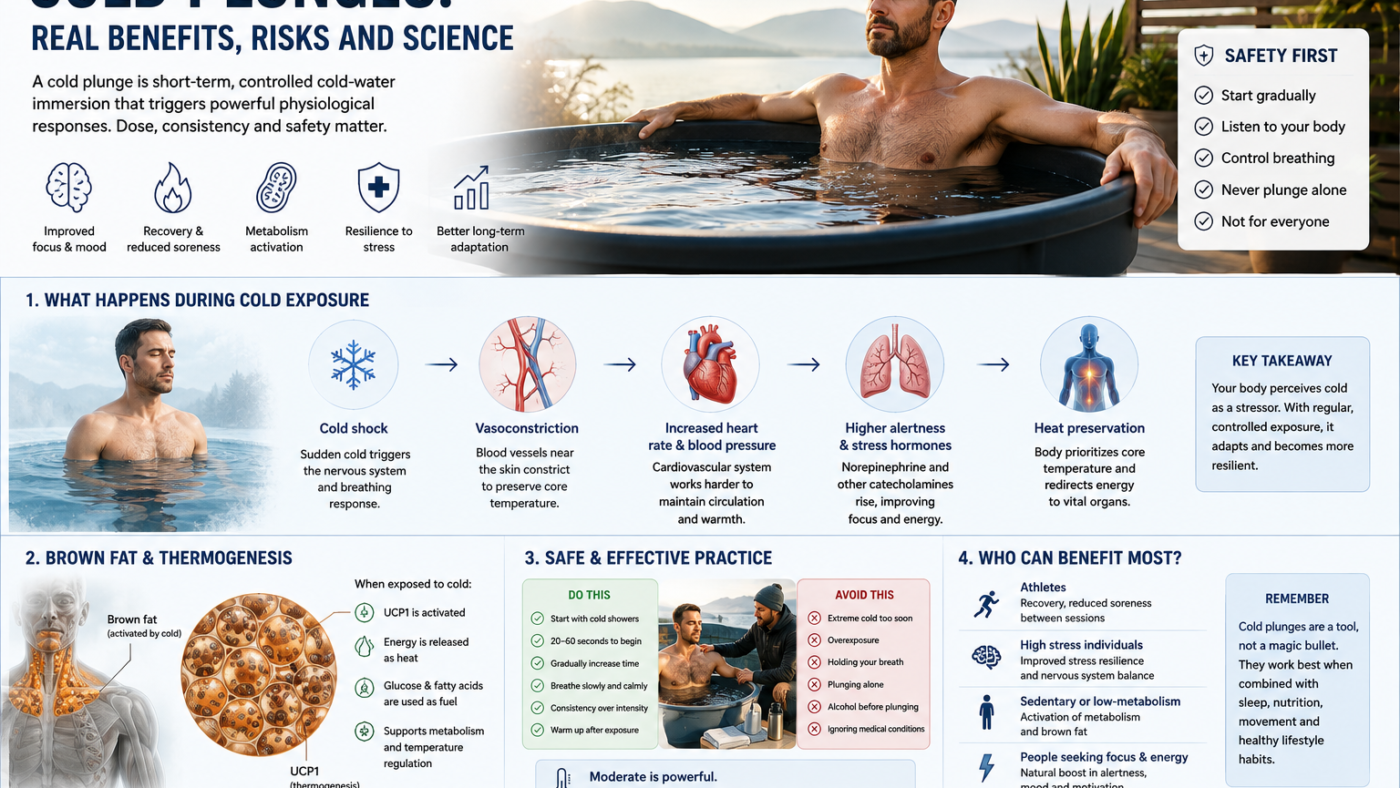
What Happens When You Enter Cold Water
The first thing your body experiences is not relaxation.
It is stress.
Sudden cold exposure activates the sympathetic nervous system.
Blood vessels near the skin constrict.
Breathing may become faster.
Heart rate and blood pressure can change rapidly.
Your body immediately begins trying to preserve its core temperature.
This reaction is known as the cold shock response.
For a healthy person using controlled exposure, the sensation may simply feel intensely uncomfortable.
For someone with cardiovascular disease or someone unexpectedly falling into very cold water, the same response can become dangerous.
Cold exposure therefore should not be treated as a harmless wellness ritual simply because it has become fashionable.
Cold Exposure Is a Form of Physiological Stress
One useful way to understand cold exposure is through the concept of hormesis.
Hormesis describes the idea that a small, temporary stress can trigger adaptive responses.
Exercise is the classic example.
A workout temporarily stresses muscle and metabolism.
Recovery from that stress helps the body adapt.
Cold exposure can also function as an acute stressor.
But hormesis does not mean that more stress produces more benefit.
The important principles are:
The stress should be temporary.
The dose should be tolerable.
Recovery should be possible.
The exposure should not create unnecessary danger.
Extremely cold water is therefore not automatically better than moderately cold water.
Pain is not proof that something is working.
Why Cold Water Makes You Feel Alert
One of the most noticeable effects of cold exposure is increased alertness.
This is biologically plausible because cold activates the sympathetic nervous system and increases catecholamines such as norepinephrine.
A frequently quoted human study reported very large increases in norepinephrine and dopamine during cold-water immersion.
Those numbers are often repeated online as proof that a cold shower can increase norepinephrine by more than 500 percent and dopamine by 250 percent.
There is an important problem with that interpretation.
Those values came from a small physiological experiment using prolonged immersion under controlled temperatures.
It was not a typical thirty-second morning shower.
Therefore, the study demonstrates that substantial cold stress can strongly affect stress hormones.
It does not prove that every cold shower produces the same percentages.
Does the Dopamine Boost Last for Hours?
You may see claims that one cold plunge creates a dopamine high lasting three to six hours.
Current evidence does not justify presenting that as a guaranteed effect.
Some people report greater alertness, energy, or improved mood after cold exposure.
That experience is plausible.
But individual response varies considerably.
Cold immersion should not be marketed as a treatment for depression or as a substitute for appropriate mental healthcare.
Think of the post-cold feeling as an acute physiological response, not a medically established long-lasting dopamine therapy.
Cold Plunges and Exercise Recovery
This is where cold-water immersion has some of its strongest practical evidence.
Athletes have used cold-water immersion for years after demanding exercise.
Research suggests that it can reduce perceived muscle soreness and may help some aspects of short-term recovery.
This can be useful when an athlete needs to recover quickly between competitions, games, or demanding training sessions.
However, cold-water immersion is not automatically better for every athlete.
The reason is surprisingly important.
Cold Water May Interfere With Muscle Growth
The inflammation and cellular signaling that occur after resistance training are not simply harmful.
Some of those signals are part of the process that tells muscle to adapt and grow.
Repeatedly using cold-water immersion immediately after strength training may blunt some of these anabolic signals.
Human training studies have found that regular post-workout cold-water immersion can reduce some gains in muscle mass and strength compared with normal recovery.
So your goal matters.
If you are competing again tomorrow and reducing soreness is the priority, cold-water immersion may make sense.
If your main goal is maximizing muscle growth from resistance training, making an ice bath part of every post-lifting routine may not be ideal. PubMed
Can Cold Exposure Burn Fat?
Cold exposure does increase heat production.
Your body must defend its core temperature.
One mechanism involves brown adipose tissue.
Unlike white fat, which primarily stores energy, brown fat specializes in thermogenesis.
Brown fat contains many mitochondria and expresses a protein called UCP1.
When activated by cold, this system allows energy to be released as heat.
That biology is real.
What often gets exaggerated is the next step.
Activating brown fat does not automatically mean that occasional ice baths cause meaningful weight loss.
The amount of additional energy expenditure depends on:
Temperature
Exposure duration
Body composition
Individual brown fat activity
Previous cold adaptation
Age
Sex
Metabolic health
Diet
A cold plunge should not be viewed as a replacement for nutrition, physical activity, sleep, and long-term energy balance.
What About the Famous 43 Percent Improvement in Insulin Sensitivity?
This is another number that often appears in cold-exposure discussions.
A small human study examined eight adults with type 2 diabetes who underwent ten days of cold acclimation at approximately 14 to 15 degrees Celsius.
Researchers reported roughly a 43 percent improvement in peripheral insulin sensitivity.
That is scientifically interesting.
But it does not mean:
A cold shower improves insulin sensitivity by 43 percent.
One ice bath produces that change.
Cold exposure treats diabetes.
Everyone will respond the same way.
The study involved a small number of people and a very specific repeated cold-acclimation protocol.
More research is needed before cold exposure can be treated as a standard metabolic therapy.
Cold Exposure and Brown Fat
Repeated mild cold exposure can increase brown-fat activity in some humans.
That may influence glucose and lipid metabolism.
Researchers are actively studying whether brown fat could eventually become a useful target for metabolic disease.
But there is a major difference between:
A promising metabolic mechanism
and
A proven weight-loss intervention
At present, cold plunges belong much more clearly in the first category.
Does Cold Water Boost Immunity?
This claim also needs perspective.
One large randomized study involving more than 3,000 adults tested finishing normal showers with 30, 60, or 90 seconds of cold water.
The cold-shower groups reported fewer days absent from work.
But they did not have significantly fewer days of illness.
That is an interesting result, but it is not evidence that cold showers prevent infections or universally strengthen the immune system. PubMed
So the phrase “boosts immunity” is much stronger than the evidence supports.
Can Cold Plunges Extend Lifespan?
There is currently no good human evidence showing that cold plunges extend lifespan.
Cold exposure can affect:
Sympathetic nervous system activity
Thermogenesis
Brown fat
Circulation
Metabolic signaling
Stress responses
None of these observations alone proves longevity.
Living longer is determined by a much larger collection of factors including smoking, blood pressure, metabolic health, physical activity, sleep, diet, cancer risk, genetics, healthcare access, and many others.
Cold exposure may become one small wellness tool.
It should not be elevated to the status of a longevity intervention without evidence.
Do You Need Ice?
No.
You do not need floating ice cubes to produce a cold response.
And you definitely do not need to make the experience as painful as possible.
Research protocols use many different temperatures and exposure durations.
There is no universally proven temperature that everyone should use for general wellness.
For someone new to cold exposure, a cool or cold shower is much easier to control than full-body immersion.
That makes it a more practical starting point.
A Beginner Approach
If you are a healthy adult and want to experiment with cold exposure, keep it simple.
Take your normal shower.
At the end, gradually reduce the temperature.
Start with approximately 30 seconds of cool-to-cold water.
Focus on calm breathing.
Do not deliberately hyperventilate.
If the experience is comfortable over time, you can gradually extend the exposure.
You do not need to reach near-freezing temperatures.
The goal is controlled exposure.
Not suffering.
Cold Water and Breathing
The first few seconds of sudden immersion can cause an involuntary gasp and rapid breathing.
This is one reason entering extremely cold water is different from simply feeling uncomfortable.
If you cannot control your breathing, feel panicked, become dizzy, or feel chest discomfort, stop.
Never combine prolonged breath holding with underwater cold exposure.
Loss of consciousness in water can be fatal.
Who Should Be Especially Careful?
Cold plunges are not appropriate for everyone.
People should seek medical guidance before experimenting with intense cold exposure if they have:
Known heart disease
Previous heart attack
Heart rhythm disorders
Uncontrolled high blood pressure
Severe vascular disease
Raynaud’s phenomenon
A history of fainting
Certain neurological conditions
Severe asthma triggered by cold
Pregnancy with medical complications
Other serious chronic illnesses
Sudden cold immersion can sharply increase breathing, heart rate and blood pressure, creating a substantial cardiovascular load. www.heart.org
Never Cold Plunge Alone
Cold-water immersion is fundamentally different from standing under a shower.
If you use a plunge tub, pool, lake, river, or ocean, another person should be nearby.
Unexpected cold shock can impair breathing and coordination.
Prolonged exposure can lead to hypothermia.
Cold can also reduce hand strength and make it harder to climb out of water.
Avoid alcohol and recreational drugs before cold-water immersion.
Never rely on willpower as your safety plan.
Colder Is Not Better
One of the biggest mistakes in modern cold-plunge culture is treating extreme discomfort as a performance metric.
The scientific question is not:
How much suffering can you tolerate?
It is:
What is the smallest effective exposure that produces the outcome you want without unnecessary risk?
For muscle recovery, research protocols often involve controlled cold-water immersion.
For general wellness, the optimal dose remains uncertain.
There is no prize for making the water dangerously cold.
Cold Showers Versus Ice Baths
Cold showers have several advantages for beginners.
They are easier to control.
You can stop instantly.
The head remains out of the water.
You are less likely to become trapped in the cold.
The temperature usually does not fall as low as an ice bath.
That does not mean cold showers produce every benefit observed in immersion studies.
The two forms of exposure are not identical.
But from a practical risk-benefit perspective, a shower is a reasonable first experiment for healthy beginners.
When Should Athletes Use Cold Water?
Cold-water immersion makes the most sense when short-term recovery is more important than long-term training adaptation.
Examples might include:
Tournament competition
Multiple races
Games on consecutive days
Very demanding endurance events
Periods when muscle soreness must be minimized quickly
It may make less sense immediately after every hypertrophy-focused resistance-training session.
Recovery and adaptation are not always the same goal.
What Cold Plunges Cannot Replace
No amount of cold exposure compensates for:
Chronic sleep deprivation
Smoking
Heavy alcohol intake
Physical inactivity
Poor nutrition
Untreated hypertension
Uncontrolled diabetes
Severe obesity
Persistent psychological stress
Ignoring medical screening
Cold exposure is an optional layer.
The basics remain the basics.
Frequently Asked Questions
Do cold plunges burn fat?
Cold increases thermogenesis and can activate brown adipose tissue, but there is not strong evidence that occasional cold plunges produce meaningful long-term fat loss.
Do cold plunges increase dopamine?
Cold exposure can affect catecholamines, including dopamine and norepinephrine. Frequently quoted percentage increases come from specific experimental conditions and should not be assumed to occur after an ordinary cold shower.
Do cold showers boost immunity?
Evidence is limited. One large randomized trial reported less sickness-related work absence but did not show fewer actual illness days.
Can cold plunges improve insulin sensitivity?
Experimental cold acclimation has improved insulin sensitivity in small human studies, including people with type 2 diabetes. This does not establish cold showers as diabetes treatment.
Are cold plunges good after exercise?
They can reduce soreness and may help short-term recovery after demanding exercise.
Should I use an ice bath after lifting weights?
If maximizing muscle growth and strength is your priority, repeated immediate post-strength-training cold immersion may interfere with some training adaptations.
Do I need ice cubes?
No.
Extreme cold is not necessary simply for the sake of being extreme.
Is a 30-second cold shower enough?
Thirty seconds is a reasonable conservative starting point for a healthy beginner, but there is no universally established medical dose for general wellness.
Is three to five minutes better?
Not necessarily.
Longer exposure is not automatically more beneficial and increases total cold stress.
Can cold plunges make you live longer?
There is currently no convincing human evidence that they increase lifespan.
Bottom Line
Cold exposure is neither a miracle nor nonsense.
The strongest practical case for cold-water immersion is currently in short-term exercise recovery.
Cold exposure also produces real effects on the nervous system, thermogenesis, catecholamines, and brown adipose tissue.
But many popular claims are ahead of the science.
Cold plunges are not proven fat-loss treatments.
They are not established immune boosters.
They do not cure metabolic disease.
And there is no solid evidence that they extend human lifespan.
If you enjoy cold exposure and you are medically appropriate for it, use it as an optional wellness practice.
Start gently.
Do not chase extreme temperatures.
Never confuse discomfort with effectiveness.
And never let an ice bath replace the health habits that actually matter most.
Medical Disclaimer
This article is for educational and informational purposes only and is not intended as medical advice, diagnosis, or treatment. Sudden cold-water immersion can cause rapid changes in breathing, heart rate and blood pressure. People with cardiovascular disease, uncontrolled hypertension, respiratory disease, circulatory problems or other significant medical conditions should consult a qualified healthcare professional before attempting cold-water immersion.
This article is for general education and does not replace individualized care from a qualified health professional. Seek appropriate advice for persistent, severe, or concerning symptoms.
Read the full medical disclaimer