Cold hands and feet are common during autumn and winter, especially when temperatures fall and the body reduces blood flow near the skin to conserve heat.Cold hands and feet are common during autumn and winter.
For many people, this is simply the body’s normal response to cold. When temperatures drop, blood vessels near the skin constrict to reduce heat loss and preserve warmth for the body’s core.
But some people feel unusually cold even when others around them are comfortable. Their hands and feet may stay cold for long periods, or they may experience numbness, tingling, pain, or noticeable color changes.
Traditional Chinese wellness practices often describe this pattern as a “cold constitution” or a tendency toward insufficient yang.
Modern medicine does not use “cold constitution” as a diagnosis.
Persistent cold intolerance can have many possible explanations, including anemia, an underactive thyroid, blood-vessel conditions such as Raynaud phenomenon, chronic illness, or other health factors.
For people who simply want a comfortable winter self-care routine, gentle rubbing around the wrists and upper back may provide warmth and relaxation.
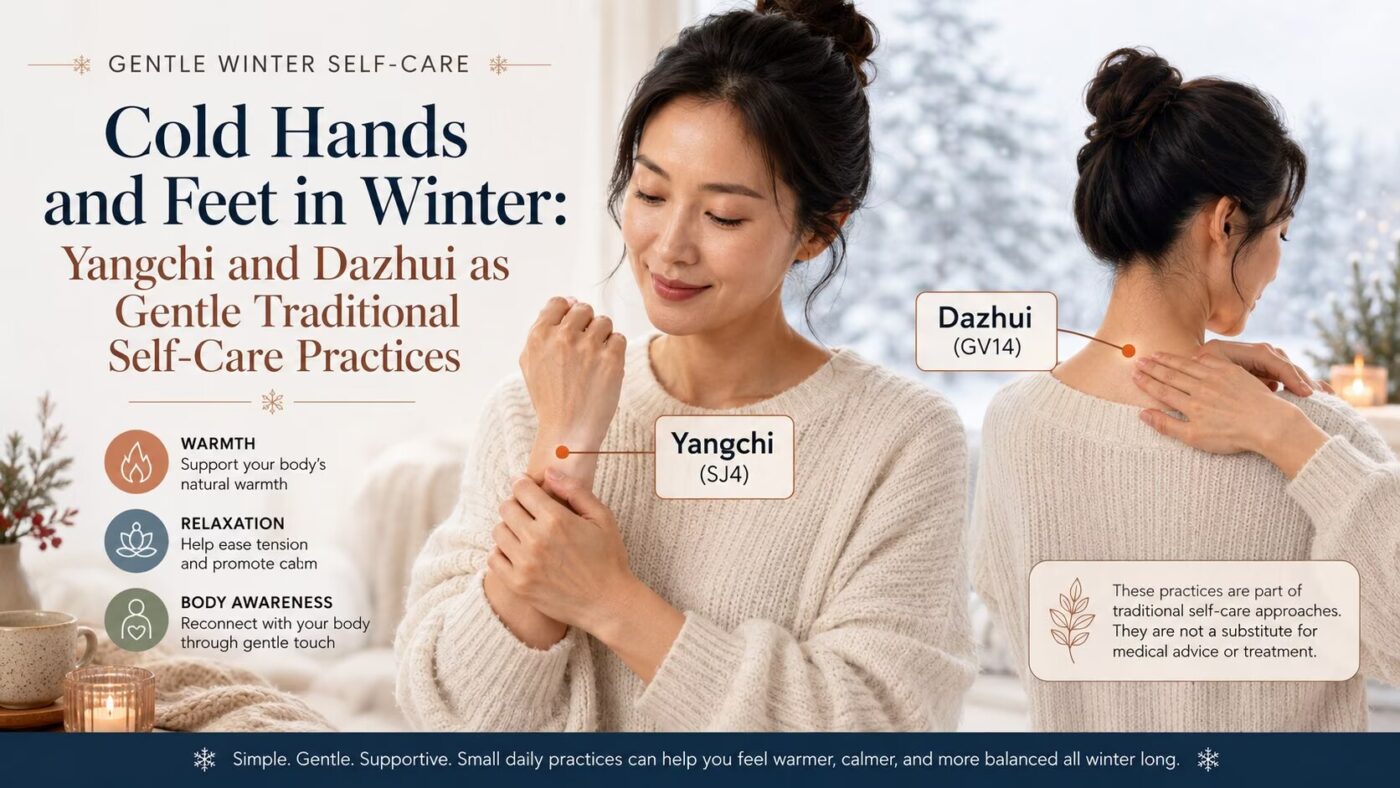
Two traditional points often used in these routines are Yangchi and Dazhui.
What Does “Cold Constitution” Mean?
In traditional Chinese medicine, people who frequently feel cold may be described in terms of yang deficiency, qi and blood circulation, or an internal tendency toward “cold.”
These ideas belong to a traditional medical framework.
They can be useful for understanding historical wellness practices, but they should not be treated as modern physiological diagnoses.
Feeling cold easily does not automatically mean that someone has “weak yang.”
For example, hypothyroidism can cause increased sensitivity to cold, fatigue, weight gain, constipation, dry skin, and other symptoms. Anemia can also be associated with weakness, dizziness, and cold hands and feet.
That is why persistent or unexplained cold intolerance deserves more attention than simply trying to “warm the meridians.”
What Is Yangchi?
Yangchi is traditionally known as SJ4 or TE4.
It is located around the back of the wrist near the wrist crease.
In traditional Chinese medicine, Yangchi belongs to the Sanjiao, or Triple Burner, meridian and has historically been used in practices involving the wrist, hand, and broader concepts of qi circulation.
For everyday wellness, there is no need to press the point with extreme precision.
A simple approach is to focus on the broader wrist area.
A Gentle Yangchi Warming Practice
Hold one wrist with the opposite hand.
Using your fingers or palm, gently rub the back of the wrist around the Yangchi area.
The movement can be brisk enough to create comfortable warmth without irritating the skin.
Continue for a short period.
Then switch hands.
The purpose is simple:
to warm the skin,
encourage movement,
increase sensory awareness,
and create a relaxing self-care ritual.
There is no established medical reason to perform exactly 100 repetitions on each wrist.
You can stop once the area feels comfortably warm.
Why Does Rubbing Make the Hands Feel Warmer?
Rubbing creates friction and mechanically warms the skin.
Movement also increases local muscle activity and may temporarily make the hands feel warmer.
This does not prove that an acupuncture point has “unblocked qi and blood.”
The warming sensation itself is real, but the modern explanation does not require the concept of meridian blockage.
That distinction is important when presenting traditional practices in a health-education setting.
What Is Dazhui?
Dazhui, or GV14, is a traditional acupuncture point located at the base of the neck along the posterior midline.
Traditional Chinese medicine describes Dazhui as an important point associated with yang meridians and seasonal protection.
Modern medicine does not recognize GV14 as a source of measurable “yang energy” or as a point that can raise oxygen levels throughout the body.
However, the lower neck and upper-back region is an area where many people accumulate muscular tension after prolonged sitting, computer work, or cold exposure.
Gentle touch and warmth in this area may feel soothing.
A Gentler Alternative to Forceful Tapping
Instead of hitting the base of the neck hard, use comfortable pressure.
You can place one hand over the opposite shoulder and upper-back area and gently rub or pat the muscles around the base of the neck.
Another option is to interlace your fingers and use the soft part of your hands to lightly tap the upper-back muscles.
Avoid striking directly and forcefully on the cervical spine.
The movement should feel relaxing—not painful.
There is no need to perform a specific number of taps.
Can Dazhui Tapping Raise Oxygen Levels?
There is no good evidence that tapping Dazhui increases blood oxygen levels in a healthy person.
Blood oxygen is primarily determined by respiratory and cardiovascular function.
A local tapping technique at the neck should therefore not be advertised as a method for “boosting oxygen.”
It may simply make the upper back feel warmer and more stimulated.
That is a more realistic claim.
Can These Practices Treat Cervical Spondylosis?
No.
Gentle massage or tapping around the upper back may temporarily feel pleasant for someone with muscular stiffness, but it should not be presented as a treatment for cervical spondylosis.
Acupuncture itself has been studied for some forms of neck pain, and NCCIH notes that acupuncture may help certain chronic pain conditions, including neck pain. But evidence about professionally delivered acupuncture cannot automatically be applied to self-rubbing or tapping one specific point.
If neck symptoms include numbness, weakness, severe pain, loss of coordination, or pain radiating into an arm, medical evaluation is more appropriate than simply tapping the Dazhui area.For occasional cold hands and feet, gentle wrist rubbing, movement, warm clothing, and other simple self-care strategies may provide comfort.
Cold Hands and Feet May Sometimes Be Raynaud Phenomenon
If your fingers or toes become very cold, numb, painful, or change color—especially turning white or blue in response to cold or emotional stress—Raynaud phenomenon is one possibility.
Raynaud phenomenon occurs when small blood vessels narrow excessively in response to cold or stress, reducing blood flow to the affected areas.
As blood flow returns, the fingers or toes may tingle, throb, or become red.
Rubbing your wrists may feel comforting, but recurrent episodes of significant color change or pain should not simply be labeled “cold constitution.”
A Better Winter Routine for Cold Hands and Feet
Traditional self-massage can be one small part of a broader winter wellness routine.
More practical strategies include:
keeping your whole body warm rather than focusing only on the hands,
wearing warm socks and gloves,
avoiding prolonged exposure to cold,
staying physically active,
changing wet clothing promptly,
and reducing exposure to triggers that worsen circulation problems.
Keeping hands, feet, and the rest of the body adequately covered is especially important for people prone to Raynaud symptoms.
What About Cold Foods?
The original material suggests that people with a “cold constitution” cannot tolerate raw or cold foods and may immediately develop abdominal pain or diarrhea.
Some people certainly notice gastrointestinal symptoms after particular foods or drinks.
But recurrent abdominal pain or diarrhea after eating should not automatically be explained as internal “cold.”
Food intolerance, irritable bowel syndrome, infection, medication effects, and other gastrointestinal conditions can produce similar symptoms.
If the pattern is persistent or worsening, identifying the actual trigger is more useful than relying only on a constitutional label.
When Cold Intolerance Deserves Medical Attention
Consider discussing persistent cold intolerance with a healthcare professional if you regularly feel much colder than other people or if the problem is getting worse.
Medical evaluation may be especially useful if cold sensitivity occurs together with:
fatigue,
unexplained weight changes,
constipation,
pale skin,
shortness of breath,
dizziness,
significant numbness,
or repeated color changes in the fingers or toes.
Cold intolerance can occur with anemia, hypothyroidism, Raynaud phenomenon, and other conditions.
Cold Exposure Can Occasionally Become Dangerous
Ordinary cold hands are not the same thing as hypothermia.
But prolonged exposure to cold—especially when someone is wet or inadequately protected—can cause dangerous loss of body heat.
Hypothermia can lead to confusion, sleepiness, poor coordination, and other neurological changes. A body temperature below 95°F, or 35°C, is considered a medical emergency.
Severe numbness, hard pale skin, or tissue changes after prolonged cold exposure may also indicate frostbite and require appropriate care.
The Traditional Chinese Medicine Perspective
Traditional Chinese medicine may describe Yangchi and Dazhui through concepts involving yang qi, meridians, warming the body, and supporting circulation.
These concepts are part of an established traditional healing system.
They can be presented respectfully as historical and cultural explanations.
But it is important not to turn them into modern biological claims such as:
“Yangchi restores circulation throughout the body.”
“Dazhui boosts oxygen.”
“Tapping GV14 cures cervical spondylosis.”
or
“100 repetitions eliminate a cold constitution.”
Those statements are not supported by current evidence.
NCCIH also emphasizes that traditional Chinese medicine approaches should not be used to replace or delay conventional care for a health problem.
A Simple Two-Part Winter Self-Care Routine
If you enjoy these traditional practices, keep the routine simple.
First, gently rub the backs of both wrists until they feel comfortably warm.
Then massage or lightly pat the muscles around the base of the neck and upper shoulders.
Keep the pressure comfortable.
Breathe naturally.
Stop if the technique causes pain, numbness, dizziness, skin irritation, or other unusual symptoms.
You do not need to count 100 repetitions.
You do not need to hit the body hard.
And you do not need to believe that stronger stimulation produces stronger health effects.
The Bottom Line
Yangchi and Dazhui are well-known points in traditional Chinese wellness practice.
Gentle rubbing or massage around these areas may be a pleasant way to create warmth, movement, and relaxation during cold weather.
But these practices should be understood realistically.
They do not diagnose or eliminate a “cold constitution.”
They do not treat Raynaud phenomenon, anemia, hypothyroidism, or cervical spine disease.
And tapping Dazhui does not scientifically “raise yang energy” or increase blood oxygen.
For occasional cold hands and feet, warmth, movement, appropriate clothing, and gentle self-care may be enough.
For persistent cold intolerance, numbness, pain, pronounced color changes, or other unusual symptoms, identifying the underlying cause is more important than simply warming an acupuncture point.
Medical Disclaimer
This article is provided for general educational and wellness purposes only. It is not intended to diagnose, treat, cure, or prevent any disease and should not replace professional medical advice.
Traditional acupressure and self-massage may be used as complementary comfort practices. If you experience persistent or severe cold intolerance, significant finger or toe color changes, numbness, unexplained fatigue, dizziness, weakness, severe neck symptoms, or other concerning changes, consult a qualified healthcare professional.
This article is for general education and does not replace individualized care from a qualified health professional. Seek appropriate advice for persistent, severe, or concerning symptoms.
Read the full medical disclaimer