Inflammation is not automatically bad.
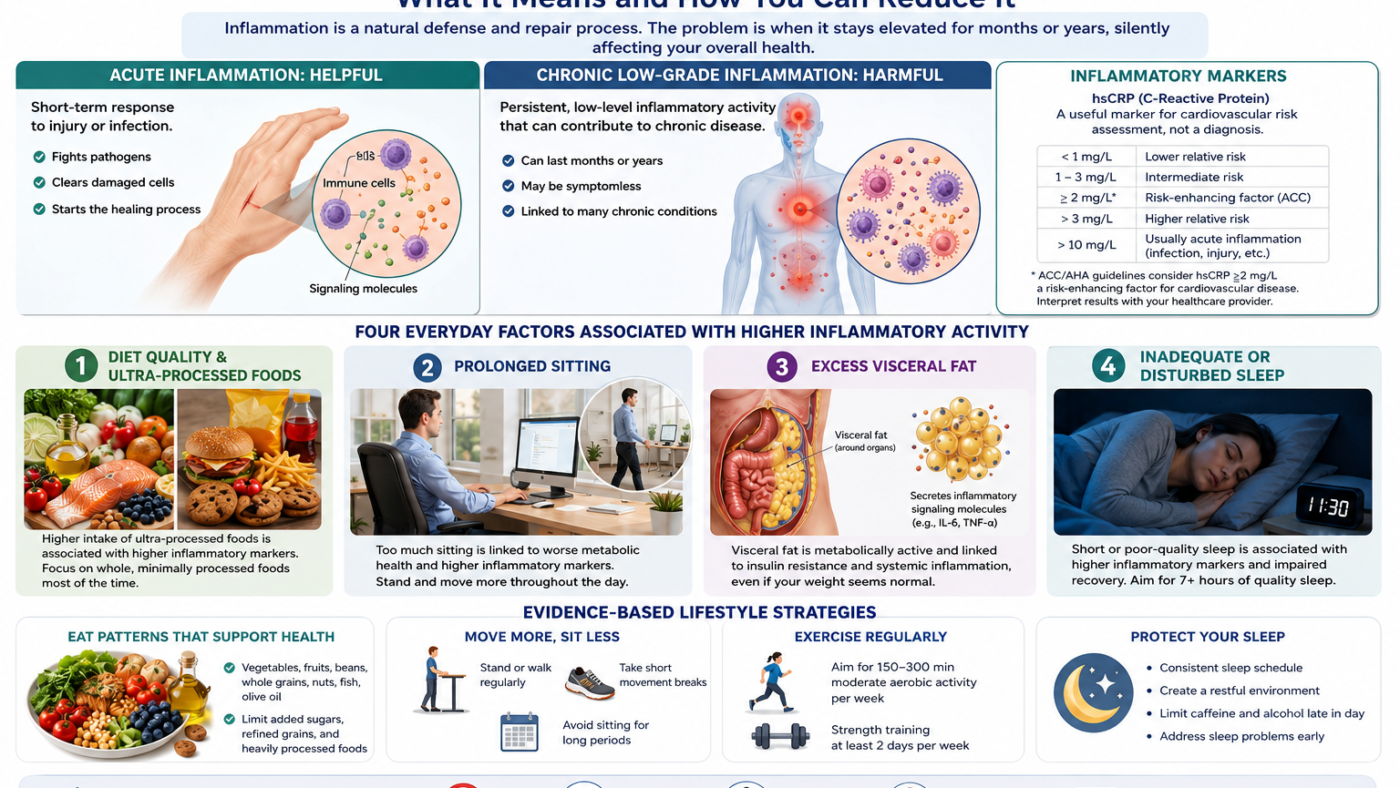
When you cut your finger, fight an infection, or recover from an injury, inflammation is part of the body’s normal defense and repair system. Acute inflammation helps immune cells respond to threats and damaged tissue.
The problem is different when inflammatory activity remains elevated over long periods.
Chronic inflammation can persist for months or years and may occur in infections, autoimmune diseases, obesity, metabolic disorders, exposure to certain irritants, and many other conditions. It is not one single disease and it does not have one single cause.
For otherwise healthy adults, several everyday factors are consistently associated with a more inflammatory metabolic environment.
Four worth paying attention to are dietary pattern, excessive sedentary time, excess visceral fat, and inadequate or disturbed sleep.
They are not the only causes of chronic inflammation.
But unlike age or genetics, they are areas where meaningful lifestyle changes are often possible.
What Is Chronic Low-Grade Inflammation?
Acute inflammation usually develops rapidly in response to infection or tissue injury.
Chronic inflammation is different.
It can continue at a lower level for prolonged periods and may involve ongoing activation of immune cells and inflammatory signaling molecules.
Low-grade systemic inflammation is particularly relevant to cardiometabolic health.
Higher levels of inflammatory markers are frequently found alongside obesity, insulin resistance, cardiovascular disease, smoking, and several chronic conditions.
However, feeling tired, bloated, stressed, or generally unwell does not prove that you have chronic inflammation.
These symptoms have many possible causes.
There is also no home symptom checklist that can reliably tell you whether your body’s inflammatory activity is elevated.
Can a Blood Test Detect Chronic Inflammation?
C-reactive protein, or CRP, is produced by the liver in response to inflammatory signaling.
Standard CRP testing is commonly used when clinicians are investigating infection or inflammatory disease.
High-sensitivity CRP, usually written hsCRP, can detect lower concentrations and has been extensively studied as a cardiovascular risk marker.
But hsCRP is not a test that tells you exactly where inflammation is occurring or what caused it.
An elevated value can occur with infection, injury, obesity, smoking, inflammatory disease, and many other conditions.
That is why a single result should be interpreted in clinical context rather than treated as a diagnosis of “chronic inflammation.”
For cardiovascular risk assessment, current ACC guidance considers an hsCRP level of 2 mg/L or higher a risk-enhancing factor in appropriate patients. The 2026 ACC/AHA dyslipidemia guideline also includes hsCRP among additional markers that can help refine cardiovascular risk when clinically useful.
Older categories of below 1 mg/L, 1 to 3 mg/L, and above 3 mg/L have often been used to describe lower, intermediate, and higher relative cardiovascular risk.
Those numbers should not be interpreted as stages of whole-body inflammation.
Factor 1: Diet Quality and Ultra-Processed Foods
Nutrition discussions often make inflammation sound much simpler than it really is.
One food does not suddenly switch your entire body into an inflammatory state.
Likewise, eating one processed product does not mean your gut has been damaged.
What matters far more is your habitual dietary pattern.
What Are Ultra-Processed Foods?
The NOVA food-classification system describes ultra-processed foods as industrial formulations that often contain refined food components and ingredients used for flavor, texture, appearance, or shelf life.
But the classification is not a perfect measure of nutritional quality.
An unfamiliar ingredient name does not automatically mean a food is dangerous.
And a short ingredient list does not automatically mean a food is healthy.
The most useful approach is to consider processing alongside the Nutrition Facts label and the overall role the product plays in your diet.
Are Ultra-Processed Foods Linked to Inflammation?
Research increasingly finds an association between higher ultra-processed food consumption and higher systemic inflammatory markers, particularly CRP and hsCRP.
A 2025 systematic review found that higher ultra-processed food intake was frequently associated with higher inflammatory biomarkers, although results for individual cytokines were less consistent.
This does not prove that every emulsifier, stabilizer, or packaged food directly causes inflammation in humans.
Diet quality, excess calorie intake, body weight, fiber intake, metabolic health, and other factors can all contribute.
A well-known NIH randomized feeding study also found that adults offered an ultra-processed diet spontaneously ate about 500 more calories per day and gained weight compared with when the same participants ate a minimally processed diet. The study demonstrated an effect on food intake and weight, not that every processed ingredient directly damages the gut.
A Better Anti-Inflammatory Eating Strategy
Instead of trying to identify one “inflammatory ingredient,” focus on the overall pattern.
Build more meals around:
Vegetables
Whole fruits
Beans and lentils
Whole grains
Nuts and seeds
Fish
Minimally processed protein sources
Unsaturated fats such as olive oil
Fermented foods when tolerated
Healthy dietary patterns such as the Mediterranean diet have repeatedly been associated with lower inflammatory biomarkers. Randomized-trial meta-analyses have reported reductions in CRP and several other markers.
You do not need a perfect diet.
Replacing some heavily processed snacks, sweetened drinks, and convenience meals with nutrient-dense foods is a more realistic starting point.
Factor 2: Too Much Sitting
You can exercise regularly and still spend too much of the rest of your day sitting.
These are related but distinct behaviors.
Sedentary behavior means spending waking time sitting, reclining, or lying down with very low energy expenditure.
WHO recommends that adults limit sedentary time and replace it with physical activity whenever possible. Higher amounts of sedentary behavior are associated with poorer cardiometabolic outcomes.
Studies have also found associations between greater sedentary time and higher inflammatory markers, although the relationship varies among populations and does not prove that sitting alone directly causes systemic inflammation.
Does Exercise Cancel Out Sitting?
Exercise remains extremely valuable.
The claim that going to the gym “does not count” if you sit afterward is misleading.
Higher physical activity provides major cardiovascular, metabolic, musculoskeletal, and overall health benefits.
At the same time, spending less of the day sitting may provide additional benefits.
WHO recommends 150 to 300 minutes of moderate-intensity aerobic activity per week, or 75 to 150 minutes of vigorous activity, together with muscle-strengthening activity on at least two days per week.
Think of regular exercise and reducing sedentary time as complementary goals rather than competing ones.
How Often Should You Get Up?
There is no universally established rule that everyone must stand up exactly every 30 minutes for exactly two minutes.
Laboratory studies have used many different interruption patterns, and brief activity breaks can improve some post-meal metabolic outcomes.
A practical approach is to avoid remaining motionless for hours at a time.
During desk work, occasionally stand, stretch, refill your water, walk down the hall, climb stairs, or take a brief walking break.
If a reminder every 30 to 60 minutes helps you do that, use it.
The habit matters more than obsessing over the exact minute.
Factor 3: Excess Visceral Fat
Not all body fat behaves identically.
Subcutaneous fat lies beneath the skin.
Visceral fat accumulates deeper in the abdomen around internal organs.
Excess visceral adiposity is metabolically active and is associated with insulin resistance and systemic inflammatory signaling. Adipose tissue in obesity contains immune cells and can contribute to the production of inflammatory mediators including IL-6 and TNF-related pathways.
This is one reason abdominal fat distribution can matter even when total body weight does not appear dramatically elevated.
Can Someone With a Normal BMI Have Excess Abdominal Fat?
Yes.
BMI is a useful population-level screening measure, but it does not directly measure visceral fat or distinguish fat from muscle.
WHO recognizes that waist circumference and other measures of central adiposity can provide additional information beyond BMI.
This can be especially relevant in some Asian populations.
Research has long shown that cardiometabolic risks can occur at lower BMI levels in Asian populations and that central or visceral adiposity may be more pronounced at a given BMI.
But this should not be turned into the stereotype that a normal-weight Asian person automatically has unhealthy visceral fat.
Individual variation is substantial.
Does Visceral Fat Cause Dark Circles or Facial Sagging?
There is not enough evidence to claim that excess visceral fat is usually the reason someone has under-eye hollows, facial sagging, or looks tired.
Facial aging is influenced by skin structure, bone remodeling, facial fat compartments, sun exposure, genetics, sleep, and many other factors.
Visceral adiposity is important for metabolic health, but it should not be blamed for every visible sign of aging.
How Can You Reduce Visceral Fat?
Regular exercise can reduce visceral adipose tissue.
Aerobic exercise, resistance training, combined training, and higher-intensity approaches can all be useful depending on the individual.
It is not accurate to say that resistance training is universally more effective than aerobic exercise for visceral fat.
Some analyses have found meaningful reductions with aerobic and combined exercise, while resistance exercise provides the additional advantage of helping preserve or build muscle.
For most people, a combination is an excellent approach:
Regular walking or other aerobic activity
Strength training at least twice weekly
A sustainable dietary pattern
Adequate protein
Gradual fat loss when medically appropriate
Factor 4: Poor or Disturbed Sleep
Sleep and inflammation interact with one another.
A major meta-analysis involving more than 50,000 participants found that sleep disturbance was associated with higher CRP and IL-6, while shorter sleep duration was associated with modestly higher CRP.
Experimental evidence also supports an inflammatory response to repeated partial sleep deprivation.
However, a newer meta-analysis suggests that measurable increases in CRP and IL-6 are more consistently seen after persistent partial sleep restriction rather than proving that one single short night automatically causes a major inflammatory surge.
So the statement that sleeping fewer than six hours for one night will definitely raise CRP is too strong.
How Much Sleep Do You Need?
For adults aged 18 to 60, the CDC recommends at least seven hours of sleep per night.
Sleep quality and regularity also matter.
Useful habits include:
Keeping a relatively consistent wake time
Allowing enough time for sleep
Getting daylight during the day
Exercising regularly
Reducing caffeine late in the day if it disrupts sleep
Limiting alcohol near bedtime
Keeping the bedroom comfortable and dark
Addressing persistent insomnia rather than simply trying harder to sleep
Can You Catch Up on Sleep at the Weekend?
Extra sleep after a difficult week may reduce sleepiness, but repeatedly restricting sleep during the week and trying to repair everything on the weekend is not an ideal long-term strategy.
A consistent pattern that provides sufficient sleep most nights is generally preferable.
There is also no need to focus on claims that gut melatonin is “400 times higher than brain melatonin” as an explanation for chronic inflammation.
The relationship between sleep, circadian biology, gut physiology, and inflammation is considerably more complex than a single melatonin number.
Do You Need an Anti-Inflammatory Supplement?
Probably not as your first step.
Turmeric, curcumin, omega-3 products, and many other supplements are marketed as solutions for inflammation.
Some have been studied and may affect certain biomarkers in selected populations.
But a supplement cannot compensate for smoking, chronic sleep deprivation, excess calorie intake, severe obesity, inactivity, or an untreated inflammatory disease.
Before buying another supplement, the higher-value questions are often:
How is my overall diet?
Am I physically active?
Do I spend most of the day sitting?
Am I sleeping enough?
Do I smoke?
Is my weight and waist circumference moving in an unhealthy direction?
Do I have a medical condition that needs treatment?
Supplements should be considered additions, not replacements for fundamentals.
A Practical Anti-Inflammatory Lifestyle Plan
You do not need to change everything tomorrow.
Start with four realistic goals.
- Improve One Daily Meal
Replace one highly processed meal or snack with a meal built around vegetables, a protein source, whole grains or another fiber-rich carbohydrate, and minimally processed foods.
Do not try to eliminate every packaged food.
- Interrupt Long Sitting Periods
Stand or move periodically during long desk sessions.
Walk while making phone calls.
Use stairs when practical.
Take a short walk at lunch.
The goal is simply to accumulate more movement across the day.
- Combine Aerobic and Strength Exercise
Aim toward WHO physical-activity recommendations.
Walking is an excellent place to begin.
Add strength training twice weekly when possible.
Both types of activity contribute to metabolic health.
- Protect Your Sleep
Give yourself enough time for at least seven hours of sleep if you are an adult who needs that amount.
Keep your schedule reasonably regular.
If insomnia, loud snoring, gasping during sleep, or excessive daytime sleepiness persists, seek medical evaluation rather than relying exclusively on supplements or sleep hacks.
Should You Ask for an hsCRP Test?
hsCRP can provide useful information in cardiovascular risk assessment.
Current ACC guidance increasingly recognizes hsCRP as a useful cardiovascular risk marker, particularly when a clinician is refining an individual’s risk profile.
But do not order it simply because you feel tired and assume you have inflammation.
A high value does not tell you the cause.
Recent illness, infection, injury, smoking, obesity, inflammatory disease, and numerous other factors can influence CRP.
If your result is elevated, interpretation should consider your symptoms, health history, cardiovascular risk, medications, and whether the result needs to be repeated.
The goal is not to chase the lowest possible inflammation number.
The goal is to understand your overall health risk.
Frequently Asked Questions
Is inflammation always harmful?
No.
Acute inflammation is an essential part of normal immunity and healing.
Problems can arise when inflammatory responses become persistent, inappropriate, or associated with chronic disease.
Can I feel chronic low-grade inflammation?
Not reliably.
Some people with inflammatory diseases have obvious symptoms, while low-grade elevations in inflammatory biomarkers may produce no specific sensation.
Fatigue or poor concentration alone does not diagnose inflammation.
Do ultra-processed foods directly cause inflammation?
Higher ultra-processed food consumption is associated with higher inflammatory biomarkers in many studies, but the causal pathway is still being investigated.
It is too simplistic to claim that every additive or packaged product directly inflames the body.
Is sitting worse than not exercising?
There is no useful reason to rank them that way.
Both regular physical activity and limiting excessive sedentary time matter.
Exercise provides substantial health benefits even if you work at a desk.
Does visceral fat cause inflammation?
Excess adiposity, particularly metabolically unhealthy visceral fat, is associated with inflammatory immune activity and altered cytokine signaling.
Can one bad night of sleep cause inflammation?
One poor night can affect how you feel and several physiological processes, but evidence does not support claiming that everyone develops a significant CRP increase after one night below six hours.
Repeated sleep disturbance and chronic insufficient sleep are more consistently associated with inflammatory changes.
Does hsCRP tell me how inflamed my body is?
Not in a simple way.
hsCRP is a nonspecific inflammatory biomarker with particular value in cardiovascular risk assessment.
A result must be interpreted alongside your overall clinical situation.
Bottom Line
Inflammation is not an enemy that needs to be eliminated.
It is an essential biological system.
The concern is persistent inflammatory activity associated with chronic disease and adverse metabolic health.
There is also no single “inflammation switch.”
Diet quality, sedentary behavior, excess visceral adiposity, poor sleep, smoking, infections, autoimmune conditions, chronic diseases, and many other factors can influence inflammatory pathways.
For most people, the best starting point is not an expensive supplement or a complicated laboratory panel.
Eat mostly nutrient-dense foods.
Move throughout the day.
Exercise regularly.
Maintain a healthy body composition.
Get sufficient sleep.
Do not smoke.
And treat actual medical conditions appropriately.
These habits are not dramatic.
That is exactly why they work so well as long-term health strategies.
Medical Disclaimer
This article is for educational and informational purposes only and is not intended as medical advice, diagnosis, or treatment. Inflammation can result from infections, autoimmune diseases, cardiovascular conditions, metabolic disorders, medications, injuries, and many other causes. If you have persistent symptoms or abnormal laboratory results, consult a qualified healthcare professional.
This article is for general education and does not replace individualized care from a qualified health professional. Seek appropriate advice for persistent, severe, or concerning symptoms.
Read the full medical disclaimer