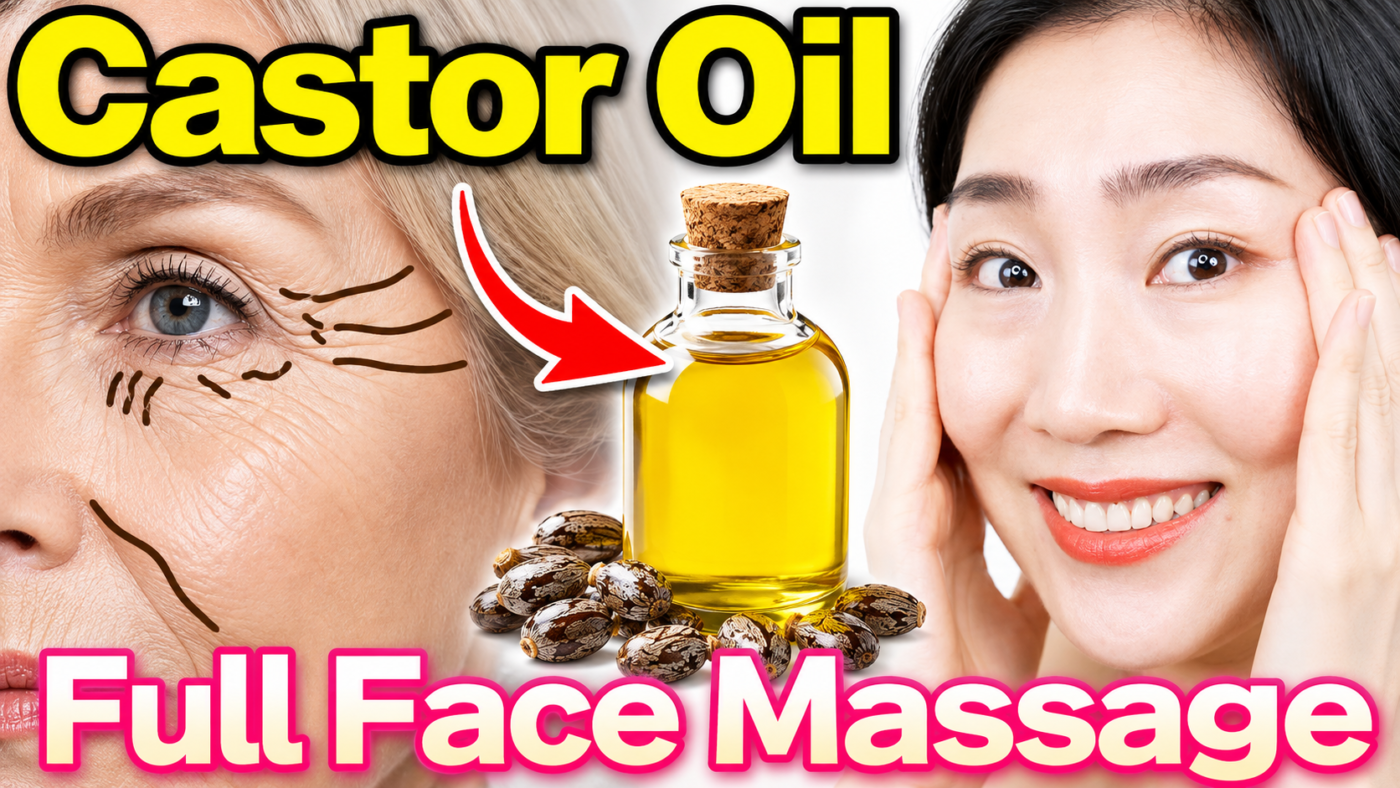
Castor oil for face after 40 has become one of the most talked-about inexpensive beauty treatments online.
Supporters claim that a few drops can soften wrinkles, firm sagging skin, reduce under-eye puffiness, brighten dark circles, and even produce results comparable to expensive cosmetic treatments.
Castor oil does have properties that make it interesting for dry and mature skin.
It is thick.
It is highly occlusive.
It contains a large proportion of ricinoleic acid.
And when used appropriately, it may help reduce water loss from the skin and make dry skin feel softer and smoother.
What it cannot do is replace Botox, permanently lift sagging tissue, or erase deep wrinkles.
The best way to think about castor oil is as a potentially useful moisturizing oil, not as a miracle facelift in a bottle.
What Is Castor Oil?
Castor oil is obtained from the seeds of the castor plant, Ricinus communis.
It has been used for many purposes throughout history, including cosmetic and traditional applications.
The finished cosmetic oil is very different from the raw castor bean itself.
Properly processed castor oil does not contain meaningful amounts of the toxic protein ricin.
Its unusual texture comes largely from its fatty-acid composition.
What Makes Castor Oil Different From Many Other Oils?
Castor oil is particularly rich in ricinoleic acid.
This fatty acid gives the oil its characteristically thick, sticky texture.
Compared with many lighter facial oils, castor oil tends to remain on the skin surface longer.
That can make it useful for people who experience:
- Dryness
- Flaking
- Tightness
- Dehydration
- Rough texture
Its main immediate cosmetic effect is often very simple:
It helps reduce moisture loss.
Can Castor Oil Moisturize Mature Skin?
Yes, this is one of its most realistic uses.
Oils act primarily as emollient and occlusive ingredients.
They help smooth the spaces between surface skin cells and reduce transepidermal water loss.
That can make dry skin feel:
- Softer
- Smoother
- More comfortable
- More supple
The American Academy of Dermatology notes that moisturizers can temporarily plump the skin and make fine lines less noticeable.
That is likely one reason someone may apply castor oil and immediately think their wrinkles look improved.
Can Castor Oil Remove Wrinkles?
No.
It may make some fine dehydration lines appear softer because moisturized skin looks plumper.
But deep wrinkles are caused by structural changes involving:
- Collagen
- Elastin
- Repeated facial movement
- UV damage
- Skin thinning
- Changes in facial fat
- Bone remodeling
An oil applied to the surface cannot reverse all of those processes.
Dermatologists emphasize that moisturizers can reduce the appearance of fine lines, but creams and lotions cannot deeply lift sagging skin.
Is Castor Oil Better Than Botox?
No.
These treatments do completely different things.
Botulinum toxin injections temporarily reduce the activity of specific muscles responsible for dynamic wrinkles.
Castor oil moisturizes the skin surface.
They are not clinically interchangeable.
Claims that castor oil performs “better than Botox” are not supported by good comparative trials.
Can Castor Oil Lift Sagging Skin?
Not in a structural way.
After applying a thick moisturizing product, skin can look:
- Smoother
- Shinier
- More hydrated
- Slightly fuller
That may create the impression of firmer skin.
But dermatologists note that topical creams and lotions generally cannot penetrate deeply enough to truly lift sagging tissues.
Can Castor Oil Stimulate Collagen?
This remains uncertain.
Laboratory and review literature has discussed possible antioxidant and skin-supporting properties of castor oil, and a recent dermatology review described potential benefits for hydration, elasticity and signs of aging.
However, the authors also emphasized the need for more clinical investigation.
That is very different from saying:
“Castor oil activates collagen and erases forehead wrinkles.”
There is not enough evidence for that claim.
Does Castor Oil Have Anti-Inflammatory Properties?
Ricinoleic acid has shown anti-inflammatory activity in experimental settings.
But translating laboratory findings directly into dramatic facial anti-aging claims is risky.
It is reasonable to say castor oil has potential anti-inflammatory properties.
It is not reasonable to promise that it will eliminate “micro-inflammation” responsible for wrinkles or eye bags.
Is Inflammation the Main Cause of Wrinkles After 40?
No.
Inflammation can contribute to skin damage, but aging skin is influenced by multiple processes.
These include:
- UV exposure
- Oxidative stress
- Hormonal change
- Collagen decline
- Elastin changes
- Genetics
- Smoking
- Repeated facial expression
Sun exposure is one of the most important preventable causes of premature skin aging. The American Academy of Dermatology recommends daily broad-spectrum SPF 30 or higher as a foundation of anti-aging skincare.
Can Castor Oil Reduce Under-Eye Puffiness?
Possibly temporarily—but evidence is limited.
Gentle cooling, hydration and very light massage can sometimes change the appearance of mild morning puffiness.
But under-eye bags can also reflect:
- Genetics
- Fat-pad changes
- Fluid retention
- Allergies
- Lack of sleep
- Age-related tissue changes
Castor oil cannot remove structural eye bags.
Can Castor Oil Fix Dark Circles?
Not reliably.
Dark circles can come from:
- Pigmentation
- Thin skin
- Visible blood vessels
- Shadows from hollowness
- Allergies
- Genetics
No good evidence shows that pure castor oil consistently removes dark circles.
If darkness comes partly from dryness, moisturizing may make the area look somewhat healthier.
That is a much more realistic expectation.
Can You Put Castor Oil Around the Eyes?
With caution.
The eye area is delicate.
Keep oil away from the actual eye surface.
Do not deliberately place large amounts directly on the eyelids or lash line.
If oil enters the eye, it can cause irritation or blurred vision.
Avoid aggressive pumping, pressing or rubbing around the eyeball.
Should You Massage the Eyeball or Eyelids?
No.
This is one part of the original routine I would specifically change.
Do not press on the globe of the eye.
Do not repeatedly “pump” the eyelids.
A safer approach is to apply a very small amount around the orbital bone, not directly against the eyeball.
Does Facial Pumping Improve Blood Flow?
Gentle massage can temporarily increase local circulation.
But there is no need to target “facial arteries” directly.
You should not try to press strongly over blood vessels.
The benefit of massage is more likely to come from:
- Gentle movement
- Warmth
- Relaxation
- Temporary fluid redistribution
Can Massage “Drain Waste” From the Face?
That phrase is commonly used online but is misleading.
Your body already manages metabolic waste through the lymphatic, circulatory, liver and kidney systems.
Gentle facial massage may temporarily influence superficial fluid movement.
It does not manually squeeze toxins out of facial tissues.
How to Choose Castor Oil for Facial Use
If you decide to try it, simplicity matters more than exotic marketing.
Look for a product that is:
- Intended for cosmetic or topical use
- 100% castor oil
- Fragrance-free
- Free of unnecessary additives
- Packaged hygienically
Cold-pressed oil is popular, but there is not strong evidence that cold pressing automatically makes a facial oil dramatically more effective against wrinkles.
Does It Have to Be Organic?
No.
Organic certification relates primarily to agricultural production standards.
It does not prove that a product is safer, non-allergenic or more effective for mature skin.
A well-formulated, properly manufactured non-organic cosmetic can still be completely appropriate.
What About “Hexane-Free”?
Some consumers prefer hexane-free products because hexane can be used in certain extraction processes.
However, properly manufactured cosmetic oils must meet safety and purity requirements for finished products.
“Hexane-free” can be a preference.
It should not automatically be interpreted as proof that every other castor oil contains dangerous chemical residue.
Always Patch Test First
This is important.
Castor oil can cause allergic contact dermatitis in some people.
A systematic review of lip cosmetics identified castor oil among ingredients associated with allergic reactions.
Before applying it to your entire face:
- Apply a small amount to the inner forearm.
- Leave the area alone.
- Monitor for redness, itching, swelling or rash.
- Repeat cautiously over several days if needed.
The American Academy of Dermatology also recommends testing new skincare products before widespread facial use.
A Safer Castor Oil Facial Routine After 40
The original video uses a lot of oil and repeated pressing around the eyes.
I would make the website version gentler.
Step 1: Cleanse Your Face
Use a mild cleanser.
Pat dry.
Do not scrub.
Step 2: Start With Very Little Oil
Castor oil is thick.
You usually do not need to coat the entire face heavily.
Start with:
1–2 drops
Warm them between clean fingertips.
Step 3: Dilute If Needed
People who find pure castor oil too sticky can mix a small amount with a lighter moisturizer or compatible facial oil.
For example:
- Squalane
- Jojoba oil
Patch test the mixture first.
Step 4: Press Into Dry Areas
Gently press the oil onto:
- Cheeks
- Forehead
- Dry areas around the mouth
Avoid dragging the skin.
Step 5: Treat Fine Lines as Dry Skin
For fine lines caused partly by dehydration, gently press a tiny amount over the area.
Do not try to force oil “deep into the wrinkle.”
Topical oils primarily work near the skin surface.
Step 6: Use Extreme Caution Around the Eyes
Use only residual oil left on your ring finger.
Tap lightly along the orbital bone.
Stay away from:
- Eyeball
- Lash line
- Inner eyelid
- Tear ducts
Do not pump the eyes.
Step 7: Temple Massage
Place fingertips lightly on the temples.
Make small circles for 15–20 seconds.
This may help reduce a sensation of tension.
Step 8: Forehead Press
Instead of vigorously shaking the forehead, place your palms or fingertips lightly over the skin.
Hold for several seconds.
Release.
Step 9: Cheek Press
Cup the cheeks gently.
Press and release.
Avoid aggressive upward pulling.
Step 10: Jaw Relaxation
Place fingertips along the jaw muscles.
Make gentle circular movements.
This can be soothing if you clench your jaw.
Step 11: Lips
A tiny amount can act as an occlusive lip moisturizer.
However, stop if you develop:
- Itching
- Scaling
- Swelling
- Burning
Castor oil can trigger allergic reactions in susceptible people.
Step 12: Neck
Press a small amount onto dry neck skin.
Do not aggressively stretch or pull the skin downward or upward.
When Should You Use It?
Nighttime is usually the easiest.
Its thick texture can feel heavy beneath makeup or sunscreen.
A simple routine could be:
Cleanser → moisturizer → tiny amount of castor oil
Using the oil last can help seal moisture in.
How Often Should You Use Castor Oil?
Start slowly.
Try:
2–3 nights per week
If your skin tolerates it, frequency can be adjusted.
You do not need to use it multiple times every day.
Is More Oil Better?
No.
Heavy use can feel greasy and may not suit everyone.
Using too much of any skincare product can increase irritation or clogged pores in susceptible people.
AAD guidance also advises using products as directed rather than assuming more produces better results.
Is Castor Oil Good for Acne-Prone Skin?
It depends.
Some people tolerate it.
Others may find its thick texture uncomfortable or experience breakouts.
If you are acne-prone, test a small area before applying it widely.
For active acne, proven acne treatments are more appropriate than relying on castor oil.
What If You Have Rosacea or Very Sensitive Skin?
Be especially cautious.
Any new oil can potentially irritate reactive skin.
If your skin is actively inflamed, burning or extremely red, keep the routine simple and consider discussing products with a dermatologist.
Can Pregnant Women Use Castor Oil on the Face?
Topical cosmetic use is different from ingesting castor oil.
However, pregnancy is a reasonable time to keep skincare simple and discuss uncertain products with a clinician when needed.
More importantly, do not ingest castor oil for beauty purposes.
What Actually Works Better for Wrinkles?
For evidence-based anti-aging, castor oil should be considered optional.
The stronger foundation is:
Broad-Spectrum Sunscreen
SPF 30 or higher every day.
AAD identifies sunscreen as one of the most important anti-aging products.
Moisturizer
Keeps skin hydrated and can make fine lines look less noticeable.
Retinoids
Retinoids have much stronger evidence for fine lines, texture and collagen support than castor oil.
Avoiding Smoking
Smoking accelerates visible skin aging.
Sun Protection
UV exposure is one of the biggest drivers of premature wrinkles.
Can Castor Oil Replace a Moisturizer?
Sometimes it can supplement one, but not always replace it.
Traditional moisturizers often combine:
- Humectants
- Emollients
- Occlusives
Castor oil mainly provides the oily emollient/occlusive component.
If your skin is very dry, applying it over a regular moisturizer may work better than using oil alone.
Why Does the Skin Look Better Immediately?
A thick oil can immediately create:
- Shine
- Smoothness
- Reduced flaking
- More visible plumpness
This can make fine lines look less obvious.
That is a legitimate cosmetic effect.
Just remember:
temporary plumping ≠ wrinkle removal
What Castor Oil Cannot Realistically Do
Castor oil cannot be expected to:
- Replace Botox
- Permanently lift sagging skin
- Remove deep eye bags
- Eliminate dark circles from all causes
- Melt facial “waste”
- Heal facial cells through hand energy
- Restore collagen instantly
- Erase nasolabial folds
- Permanently eliminate marionette lines
These claims go beyond the evidence.
The Bottom Line
Castor oil for face after 40 can be a useful option for people who enjoy rich, occlusive skincare.
Its biggest realistic benefit is moisture retention.
That can make dry skin feel softer and make some fine dehydration lines temporarily look less noticeable.
There is also emerging interest in its antioxidant and skin-supporting properties, but current clinical evidence is not strong enough to treat it as a proven anti-aging therapy.
Use it gently.
Patch test first.
Keep it out of the eyes.
Do not press the eyeballs.
And do not expect it to outperform Botox or permanently lift sagging skin.
For long-term skin aging, daily sunscreen, moisturizer and evidence-based ingredients such as retinoids remain much better established.
Frequently Asked Questions
Is castor oil good for wrinkles?
It may moisturize and temporarily soften the appearance of fine dehydration lines, but it does not erase deep wrinkles.
Can castor oil tighten sagging skin?
There is no good evidence that it can structurally lift sagging facial tissue.
Is castor oil better than Botox?
No. They work in completely different ways, and no credible evidence shows that castor oil outperforms Botox.
Can castor oil reduce under-eye bags?
It may make dry under-eye skin look smoother, but it cannot remove structural eye bags.
Can castor oil remove dark circles?
Not reliably. Dark circles have multiple causes.
Can I put castor oil on my eyelids?
It is safer to avoid direct application to the eyelid margin or eyeball. Use very small amounts around the orbital bone instead.
Does castor oil stimulate collagen?
There is currently insufficient clinical evidence to claim that topical castor oil significantly stimulates facial collagen in humans.
Can castor oil cause allergies?
Yes. Allergic contact dermatitis has been reported.
Should castor oil be cold pressed?
Cold-pressed products are popular, but there is limited evidence that this alone produces superior anti-aging results.
How often should I use castor oil?
Start two or three nights per week and increase only if your skin tolerates it.
Medical Disclaimer:
This article is for educational and informational purposes only and is not medical advice. Patch test castor oil before facial use and discontinue it if you develop redness, itching, swelling, burning or rash. Keep oils out of the eyes and avoid direct pressure on the eyeballs or aggressive eyelid massage. People with persistent eye symptoms, severe acne, rosacea, eczema, unexplained swelling or active skin disease should consult a qualified healthcare professional.
References
- Girdler C, et al. Use of Castor Oil in Dermatology: A Narrative Review. 2026. The review describes potential dermatologic benefits while emphasizing that further clinical investigation is needed.
- American Academy of Dermatology. Wrinkle Remedies: How to Reduce the Signs of Aging. Moisturizer can temporarily plump fine lines; sunscreen remains fundamental.
- American Academy of Dermatology. Retinoid or Retinol? Retinoids have established evidence for improving fine lines, pigmentation and skin texture.
- American Academy of Dermatology. Many Ways to Firm Sagging Skin. Topical creams cannot deeply lift sagging skin; moisturizer-related improvements are generally temporary.
- Allergic Contact Dermatitis to Lip Care Cosmetic Products — A Systematic Review. Castor oil was among ingredients associated with allergic contact dermatitis.
This article is for general education and does not replace individualized care from a qualified health professional. Seek appropriate advice for persistent, severe, or concerning symptoms.
Read the full medical disclaimer