Cancer often feels unpredictable.
Genes matter. Age matters. Biology matters. Sometimes cancer develops even in people who appear to have done everything “right.”
But cancer is not entirely beyond our influence.
A major 2026 global analysis from the World Health Organization and the International Agency for Research on Cancer estimated that about 37 percent of new cancer cases worldwide in 2022, roughly 7.1 million cases, were linked to preventable causes.
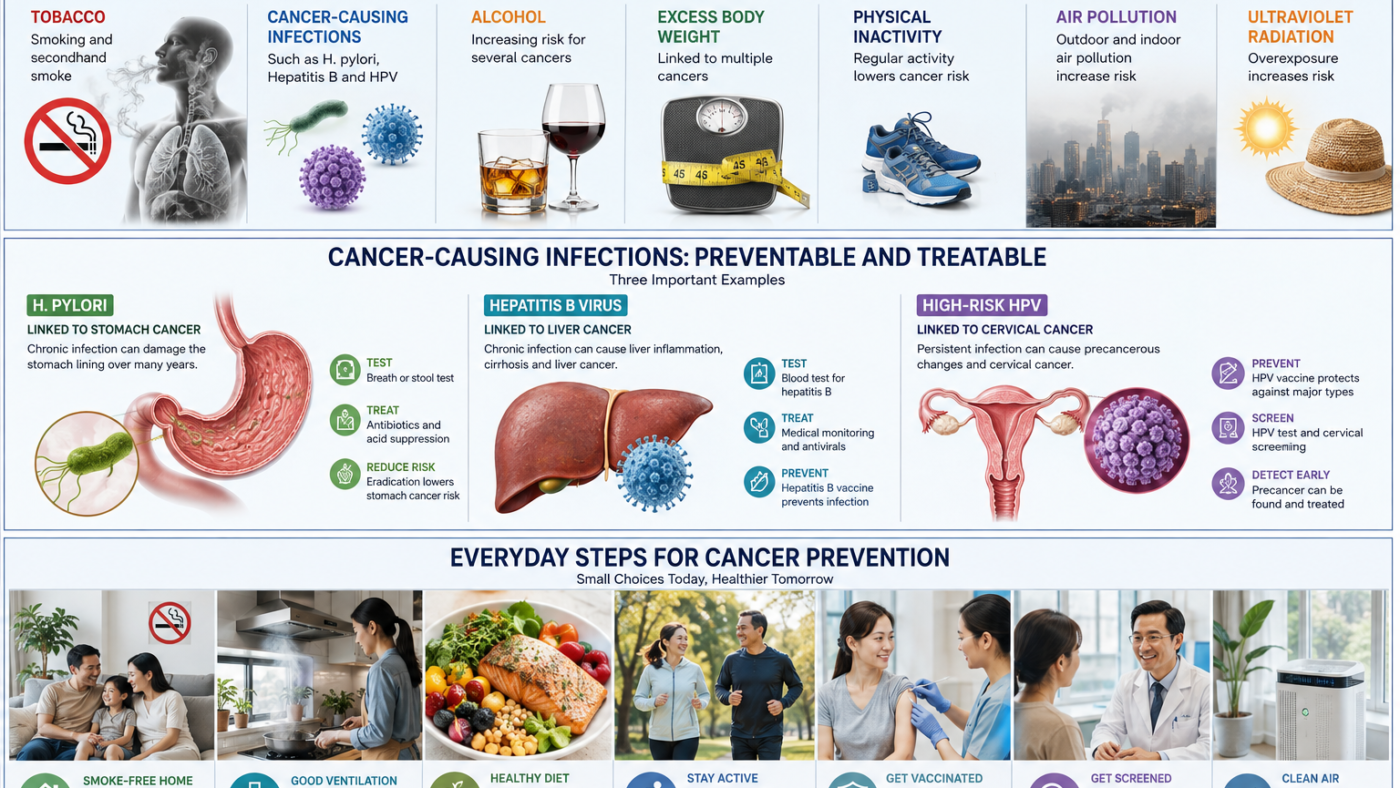
The analysis examined 30 modifiable causes across 36 cancer types and 185 countries. Tobacco was the largest contributor, accounting for about 15 percent of new cancer cases globally. Cancer-causing infections accounted for about 10 percent, followed by alcohol at about 3 percent. citeturn306029view0turn306029view1
That does not mean every cancer can be prevented.
It also does not mean the other 63 percent are simply caused by genes.
Inherited harmful genetic changes are thought to cause roughly 5 to 10 percent of cancers. The remainder can involve aging, acquired DNA changes, environmental exposures, infections, hormones, chance biological events, and risk factors that science has not yet fully explained. citeturn890790search0turn890790search2
Cancer prevention is therefore not about achieving perfect control.
It is about reducing risks that can realistically be changed.
Smoking Remains the Most Important Preventable Cancer Risk
If there is one cancer-prevention step with exceptionally strong evidence behind it, it is avoiding tobacco.
The 2026 WHO and IARC analysis identified tobacco as the largest preventable cause of cancer worldwide. citeturn306029view1
Smoking is strongly associated with lung cancer, but its effects extend well beyond the lungs.
Tobacco increases the risk of cancers involving several organs, including the mouth, throat, esophagus, bladder, kidney, pancreas, stomach, liver, colon and rectum, and cervix.
Stopping smoking lowers future cancer risk, even after years of smoking.
The earlier someone quits, the greater the potential benefit, but quitting remains worthwhile at virtually any age.
Secondhand Smoke Matters Too
You do not have to smoke personally to be exposed to tobacco carcinogens.
Secondhand smoke causes lung cancer in people who do not smoke. The CDC estimates that nonsmokers exposed to secondhand smoke have approximately a 20 to 30 percent higher risk of developing lung cancer. citeturn286501search1
Opening a window is not enough to make indoor smoking safe.
Fans, air cleaners and ventilation may reduce some particles, but they cannot eliminate exposure to secondhand tobacco smoke.
The most effective protection is keeping homes, cars and indoor spaces completely smoke-free. citeturn286501search9turn286501search13
What About Cooking Fumes?
Cooking can generate fine particulate matter and other indoor pollutants.
High-temperature frying, grilling, broiling and other cooking methods can produce more airborne particles than lower-temperature cooking.
That makes kitchen ventilation worthwhile.
The U.S. Environmental Protection Agency recommends using a range hood whenever cooking. If possible, use a hood that vents outdoors rather than simply recirculating air back into the kitchen.
The EPA also recommends leaving the hood running for approximately 10 to 20 minutes after cooking has finished. citeturn286501search0
If oil begins smoking heavily, lowering the temperature is also sensible.
However, it is important not to turn this into another cancer myth.
Research on cooking emissions and lung cancer is considerably more complicated than saying that kitchen fumes explain lung cancer in women who have never smoked.
Lung cancer in never-smokers has multiple potential causes and biological subtypes.
Cooking exposure alone is also not currently a standard reason for healthy people to undergo yearly CT scans.
Who Actually Needs Lung Cancer Screening?
Low-dose CT screening can reduce lung cancer deaths in appropriately selected high-risk people.
But screening is not the same as prevention.
It is designed to find cancer earlier.
Current American Cancer Society guidance recommends annual low-dose CT screening for generally healthy adults ages 50 to 80 who currently smoke or previously smoked and have accumulated at least a 20 pack-year smoking history. citeturn584245search3turn584245search7
Routine annual CT screening is not recommended simply because someone cooks frequently.
CT scans also involve radiation and can detect harmless abnormalities that lead to additional testing.
Anyone concerned about personal lung cancer risk should discuss screening with a healthcare professional rather than arranging repeated scans without an evidence-based indication.
Some Cancers Begin With an Infection
One of the most important lessons from modern cancer prevention is that several cancers are linked to infections.
The 2026 WHO and IARC analysis found that cancer-causing infections accounted for approximately 10 percent of new cancer cases globally. citeturn306029view1
This creates unusually powerful prevention opportunities because some of these infections can be detected, treated, or prevented with vaccines.
H. pylori and Stomach Cancer
Helicobacter pylori, usually called H. pylori, is a bacterium that can live in the stomach lining for many years.
Most infected people will never develop stomach cancer.
However, chronic H. pylori infection is an established cause of gastric adenocarcinoma and gastric MALT lymphoma.
IARC classified H. pylori as a human carcinogen decades ago, and studies have shown that eradicating the infection can reduce future stomach cancer risk in appropriate populations. citeturn306029view3
This is one of the clearest examples of an infection that can contribute to cancer.
Should Everyone Be Tested for H. pylori?
Not necessarily.
Recommendations vary between countries and depend on individual risk.
Testing may be particularly relevant for people with certain stomach or duodenal ulcers, persistent dyspepsia, gastric precancerous conditions, a family history of gastric cancer, household exposure, or backgrounds associated with higher gastric cancer risk.
Recent American College of Gastroenterology guidance has expanded testing recommendations for several higher-risk groups rather than recommending indiscriminate testing of everyone. citeturn286501search3
Common noninvasive tests include the urea breath test and stool antigen test.
If an active infection is confirmed, treatment usually involves antibiotics combined with acid-suppressing medication.
Eradication should later be confirmed according to medical guidance.
Salt and Stomach Cancer Risk
Diet also matters.
High intake of salt and heavily salted or processed foods has been associated with increased stomach cancer risk, particularly in the context of H. pylori infection. citeturn306029view3
This does not mean salt must disappear completely from your kitchen.
The practical goal is to avoid making highly salted foods the foundation of your everyday diet.
Hepatitis B Is Also a Cancer-Prevention Issue
Chronic hepatitis B infection can cause long-term liver inflammation, cirrhosis and liver cancer.
Many infected people have no obvious symptoms.
Fortunately, hepatitis B is vaccine-preventable. citeturn306029view4
Taiwan provides one of the best-known public-health examples.
A nationwide newborn hepatitis B immunization program was launched in 1984. Long-term research subsequently documented major reductions in chronic hepatitis B and hepatocellular carcinoma among vaccinated generations. citeturn581403search4
This was an important demonstration that a vaccine against an infection can ultimately prevent cancer.
Should Adults Be Tested for Hepatitis B?
Recommendations vary internationally.
In the United States, the CDC currently recommends that all adults age 18 and older receive hepatitis B screening at least once during their lifetime.
Initial screening uses three blood markers: HBsAg, anti-HBs and total anti-HBc. citeturn306029view4
These tests can help determine whether someone currently has hepatitis B, has recovered from a previous infection, has vaccine-related immunity, or remains susceptible.
People with chronic hepatitis B can receive medical monitoring and, when appropriate, antiviral treatment to reduce complications.
Vaccination remains the best way to prevent new hepatitis B infection.
HPV and Cervical Cancer
Cervical cancer offers another remarkable opportunity for prevention.
Almost all cervical cancers are related to persistent infection with cancer-causing types of human papillomavirus, or HPV. citeturn306029view5
Most HPV infections disappear naturally.
The concern is persistent infection with high-risk HPV types, which can gradually produce precancerous changes in cervical cells.
This process often takes many years.
That long interval gives healthcare systems an opportunity to intervene before cancer develops.
HPV Vaccination and Screening Work Together
HPV vaccination can prevent infection with important cancer-causing HPV types.
Cervical screening can identify high-risk HPV infection or precancerous cervical changes before invasive cancer develops.
WHO considers cervical cancer largely preventable when vaccination, screening and appropriate treatment of precancerous lesions are available. citeturn306029view5
Specific vaccination ages and cervical screening schedules vary between countries.
Follow the recommendations used where you live rather than applying one country’s schedule universally.
Alcohol and Cancer
Alcohol is another established cancer risk that is frequently underestimated.
Alcohol consumption increases the risk of at least seven cancer types, including cancers of the mouth, throat, larynx, esophagus, liver, colorectum and female breast. citeturn483729search0turn483729search12
One mechanism involves acetaldehyde.
When the body metabolizes alcohol, ethanol is converted into acetaldehyde, a toxic compound capable of damaging DNA and proteins. citeturn483729search0
Cancer risk generally increases as alcohol consumption increases.
For cancer prevention, less alcohol is better.
No threshold has been established below which cancer risk is guaranteed to be zero. citeturn483729search1
This does not require turning an occasional drink into a source of fear.
It does mean that alcohol should not be consumed because someone believes a daily drink is necessary for cancer prevention or overall health.
Excess Body Fat and Cancer Risk
Higher amounts of body fat are associated with increased risk of multiple cancers.
These include endometrial, esophageal, kidney, colorectal, pancreatic and postmenopausal breast cancers, among others. citeturn483729search13
There is no single mechanism.
Researchers have identified several possible pathways involving insulin signaling, inflammation, sex hormones and other biological processes.
The practical goal is not crash dieting.
Maintaining a healthy body weight through sustainable eating habits and regular physical activity is more useful than repeatedly cycling through extreme weight-loss programs.
Physical Activity Has Benefits Beyond Weight
Exercise should not be viewed only as a way to burn calories.
Higher levels of physical activity are associated with lower risks of several cancers, including colon, breast, endometrial and bladder cancers. citeturn483729search21
Walking, cycling, swimming, resistance training and other activities can all contribute.
The best exercise plan is usually the one that can be maintained for years rather than the most extreme program someone can tolerate for a few weeks.
Air Pollution Is a Real Cancer Risk
Outdoor air pollution is an established cancer risk, particularly for lung cancer, and was included among the preventable exposures assessed by WHO and IARC in the 2026 global analysis. citeturn306029view0turn306029view1
Individuals cannot personally eliminate regional air pollution.
But exposure can sometimes be reduced.
Checking local air-quality information, reducing prolonged outdoor exertion during severe pollution episodes, keeping indoor sources of smoke low, and improving indoor air quality when appropriate can all help.
Cooking, tobacco smoke, candles, combustion appliances and outdoor pollution entering the home can all contribute to indoor particulate matter.
Source control and effective ventilation are important parts of indoor air management. citeturn286501search12turn286501search16
Does Stress Cause Cancer?
This is where cancer discussions need particular care.
Chronic stress affects sleep, mental health, cardiovascular health, eating behavior, alcohol use and physical activity.
Managing stress is worthwhile.
But current evidence does not establish ordinary psychological stress as a direct cause of cancer in the same way that tobacco, alcohol, HPV or H. pylori are established causes.
Human studies examining stress and cancer incidence have produced inconsistent results. citeturn306029view2
Laboratory research suggests that biological stress pathways may influence tumor behavior in some circumstances, but that is not the same as proving that being stressed causes someone to develop cancer. citeturn306029view2
This distinction matters.
People with cancer should never be made to feel that they developed the disease because they worried too much, worked too hard, or failed to remain positive.
Why Stress Management Still Matters
Stress can influence behaviors that do affect long-term health.
Someone under chronic stress may sleep poorly, smoke more, drink more alcohol, exercise less, overeat, or delay healthcare appointments.
Managing stress can therefore support cancer-prevention habits indirectly. citeturn306029view2
Useful approaches may include walking, physical activity, meditation, breathing exercises, adequate sleep, social connection and professional mental-health support when needed.
The purpose is not to create a cancer-proof state of mind.
It is to make daily life healthier and more manageable.
Prevention and Screening Are Not the Same Thing
Cancer prevention tries to reduce the chance that cancer develops.
Examples include:
Avoiding tobacco.
Receiving HPV and hepatitis B vaccination when appropriate.
Reducing alcohol intake.
Maintaining a healthy body weight.
Reducing exposure to known carcinogens.
Treating certain cancer-causing infections.
Cancer screening looks for cancer or precancer before symptoms appear.
Examples include:
Cervical screening.
Colorectal cancer screening.
Mammography.
Low-dose CT in selected people at high risk for lung cancer.
These approaches are complementary.
Good prevention does not replace recommended screening.
And screening does not make continued smoking or other major exposures harmless.
A Practical Cancer-Prevention Checklist
You do not need to change your life overnight.
Start with the areas that actually apply to you.
Do not smoke, and work toward quitting if you currently smoke.
Keep your home and car smoke-free.
Use kitchen ventilation when cooking.
Keep alcohol intake as low as practical.
Stay physically active.
Work toward maintaining a healthy body weight.
Know your hepatitis B status and vaccination status according to local recommendations.
Consider H. pylori testing if you have appropriate symptoms or risk factors.
Keep HPV vaccination and cervical screening up to date when applicable.
Follow evidence-based cancer screening recommendations for your age and risk profile.
Reduce unnecessary exposure to air pollution and other known carcinogens where realistically possible.
One meaningful change maintained for years can matter more than ten dramatic changes abandoned after a month.
Frequently Asked Questions
Can 40 Percent of All Cancers Really Be Prevented?
The latest WHO and IARC analysis estimated that approximately 37 percent of new cancer cases worldwide in 2022 were attributable to preventable causes.
That is close to four in ten.
It does not mean every individual has a 37 percent ability to prevent their own cancer. Population-level estimates cannot predict exactly what will happen to one person. citeturn306029view0
Are Most Cancers Genetic?
Most cancers are not caused by an inherited cancer syndrome.
NCI estimates that harmful genetic changes inherited from a parent account for approximately 5 to 10 percent of cancers.
However, genes still influence cancer risk in more complicated ways, and cancers also acquire genetic changes during life. citeturn890790search2
Can Someone Who Never Smoked Still Get Lung Cancer?
Yes.
Lung cancer occurs in never-smokers as well.
Possible contributors include secondhand smoke, radon, air pollution, occupational exposures and biological factors that are still being investigated.
Never smoking greatly lowers risk, but it does not reduce the risk to zero.
Should Everyone Get a Low-Dose CT Scan?
No.
Routine lung cancer screening is intended for selected people at high risk.
For example, current American Cancer Society guidance recommends annual screening for generally healthy adults ages 50 to 80 with at least a 20 pack-year smoking history who currently or previously smoked. citeturn584245search3
Can H. pylori Really Cause Cancer?
Yes.
Chronic H. pylori infection is an established cause of certain stomach cancers.
However, most people infected with H. pylori will never develop stomach cancer.
Testing and treatment should be based on individual medical circumstances and local guidelines. citeturn306029view3
Can Vaccines Prevent Cancer?
Yes.
Hepatitis B vaccination reduces infections that can eventually lead to liver cancer.
HPV vaccination prevents infections responsible for most cervical cancers and several other HPV-related cancers. citeturn306029view4turn306029view5
Does Stress Cause Cancer?
There is currently no convincing evidence that ordinary psychological stress directly causes cancer.
Stress management remains important for mental health, sleep and maintaining healthy behaviors, but people should not blame themselves for developing cancer because they experienced stress. citeturn306029view2
Bottom Line
Cancer prevention is not about believing that every cancer is avoidable.
It is also not about blaming people who become ill.
The strongest global evidence shows that a substantial proportion of cancer cases are linked to risk factors that societies and individuals can change.
Tobacco remains the largest preventable cause.
Cancer-causing infections are another major opportunity, particularly H. pylori, hepatitis viruses and HPV.
Alcohol, excess body weight, physical inactivity, air pollution and other exposures also contribute to cancer burden. citeturn306029view1
The best strategy is not fear.
It is knowing which risks are supported by evidence, taking reasonable preventive action, and participating in appropriate vaccination and screening programs.
You cannot control every biological event that happens inside your body.
But there are meaningful steps you can take to reduce risk.
Medical Disclaimer
This article is for educational and informational purposes only and is not intended as medical advice, diagnosis, cancer screening guidance, or treatment. Cancer risk and screening recommendations vary according to age, medical history, family history, previous exposures and country-specific guidelines. Discuss individualized prevention, vaccination, testing and screening decisions with a qualified healthcare professional.
This article is for general education and does not replace individualized care from a qualified health professional. Seek appropriate advice for persistent, severe, or concerning symptoms.
Read the full medical disclaimer