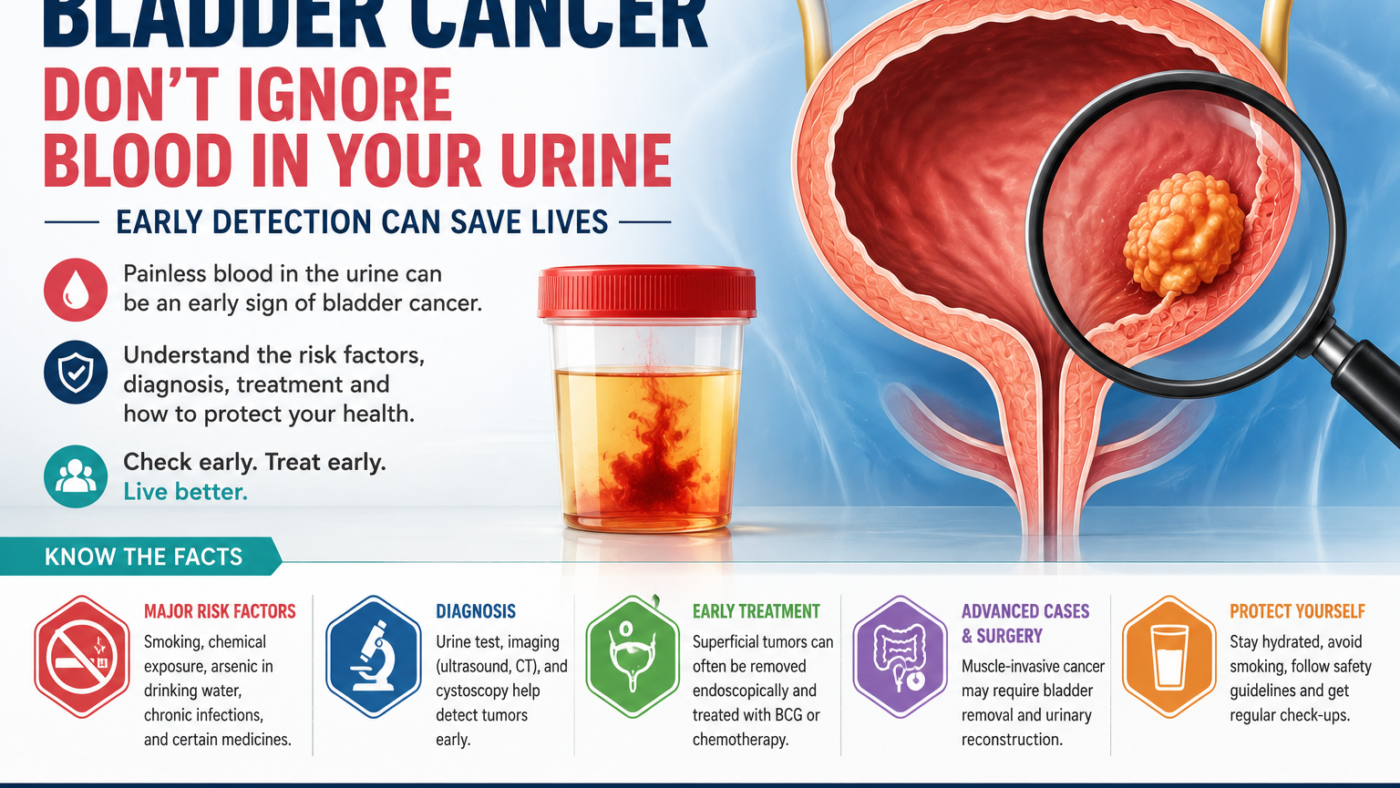
Bladder cancer is not among the most common cancers overall, yet it is one of the major cancers treated in urology. One reason it deserves attention is that its earliest warning sign can be surprisingly easy to dismiss.
A person may feel completely well, urinate normally and experience no pain—yet suddenly notice blood in the urine.
The bleeding may disappear again.
That temporary improvement can create false reassurance.
But one of the strongest messages from the clinical discussion behind this article is simple:
Visible or unexplained blood in the urine, especially painless blood, should not be ignored.
Bladder cancer can often be treated more conservatively when detected before it grows deeply into the bladder wall. Once it becomes muscle-invasive, treatment becomes substantially more complex.
Why Painless Blood in the Urine Matters
Blood in the urine is called hematuria.
It can have many causes, including:
- urinary tract infection
- kidney or urinary stones
- trauma
- kidney disease
- tumors of the urinary tract
Pain can sometimes provide a clue.
For example, urinary stones and infections often produce discomfort, burning, flank pain or other symptoms.
Bladder tumors, however, may cause painless hematuria.
That does not mean every episode of painless hematuria is cancer.
It means painless bleeding deserves proper medical investigation rather than being dismissed because nothing hurts.
Blood in the Urine May Come and Go
One dangerous feature is that hematuria may be intermittent.
Someone may notice red urine once or twice, drink more water, and then see completely normal urine again.
It is easy to think:
“The problem disappeared.”
But disappearance of the bleeding does not necessarily mean disappearance of the underlying cause.
In the patient story presented in the discussion, visible blood appeared repeatedly and then stopped after symptomatic treatment. Because the bleeding improved, the patient initially delayed hospital evaluation.
That delay illustrates an important lesson:
Do not use disappearance of blood as proof that everything is normal.
Hematuria Is Not Always Visible
Sometimes there is enough blood to make urine appear:
- pink
- red
- tea-colored
- dark brown
But in other cases, the amount is too small to see.
This is called microscopic hematuria.
It may only be found during urinalysis.
For people with certain risk factors, microscopic blood in the urine may justify additional evaluation depending on age, medical history and clinical findings.
The Patient Story: From Hematuria to Bladder Reconstruction
The discussion described a man who first noticed dramatic visible hematuria during a trip.
He had no significant pain.
Initially, he hoped the cause was something relatively benign such as a stone.
Eventually, he underwent urologic evaluation.
Cystoscopy revealed bladder tumors.
One lesion appeared relatively superficial, while another had characteristics suggesting more extensive involvement.
Ultimately, treatment required removal of the bladder and reconstruction of a urinary reservoir using a segment of intestine.
More than a decade later, he reported remaining active without an external urine collection bag.
This is an example of what is commonly called an orthotopic neobladder reconstruction in selected patients.
How Can Intestine Become a New Bladder?
When the natural bladder must be removed, surgeons need another way for urine to leave the body.
One option is to use a segment of intestine to create an internal urinary reservoir.
The intestinal segment is reshaped into a pouch and connected to the urinary tract.
However, an intestinal reservoir does not behave exactly like a normal bladder.
A natural bladder:
- stores urine
- produces a sensation of fullness
- contracts during urination
A reconstructed intestinal reservoir may provide different sensations.
The patient may gradually learn to interpret abdominal fullness as a signal to urinate.
Some people use abdominal pressure to help empty the reservoir.
Scheduled Urination May Be Important After Neobladder Surgery
Immediately after reconstruction, patients may be advised to urinate according to a schedule rather than waiting for a familiar urge.
Over time, they learn how their reconstructed urinary system feels.
Some may eventually recognize fullness more naturally.
Others need continued attention to:
- scheduled voiding
- hydration
- complete emptying
- urinary infections
- kidney function
The exact routine depends on the reconstruction and the individual’s recovery.
Bladder Cancer Can Recur
Another important characteristic discussed is recurrence.
Superficial bladder tumors can behave somewhat like weeds: one tumor may be removed, but another can later appear elsewhere in the bladder lining.
This is why bladder cancer treatment does not necessarily end when the first tumor is removed.
Long-term surveillance can be essential.
Follow-up may include repeated:
- cystoscopy
- urine testing
- imaging
- other testing according to risk
Patients should not stop follow-up simply because they feel well.
Why Does Bladder Cancer Develop?
Bladder cancer usually arises from cells lining the urinary tract.
These cells are continually exposed to substances concentrated in urine.
Certain carcinogens can enter the bloodstream, be filtered through the kidneys and eventually remain in contact with the bladder lining.
Long-term exposure to some of these substances can increase cancer risk.
Smoking Is One of the Most Important Risk Factors
The discussion strongly emphasizes tobacco exposure.
Cigarette smoke contains carcinogenic chemicals, including compounds that can ultimately reach the urinary tract.
After being processed by the body, some of these substances are excreted into urine.
The bladder lining is then repeatedly exposed to them.
This explains why smoking is not only associated with lung cancer.
It is also an important risk factor for bladder cancer.
Quitting Smoking Still Matters
Someone who has smoked in the past does not instantly return to the same risk as someone who has never smoked.
However, quitting remains worthwhile.
The clinical discussion emphasizes that risk generally declines after smoking cessation compared with continued smoking.
The practical message is straightforward:
The best time not to start smoking is before exposure begins. The next best step is to quit.
What About E-Cigarettes?
The source discussion also raised concern about electronic cigarettes.
Because e-cigarettes are relatively newer, their long-term relationship with bladder cancer is less well established than that of conventional cigarette smoking.
They should therefore not be assumed to be harmless simply because there is no tobacco combustion in the traditional sense.
Long-term exposure data continue to evolve.
Occupational Chemical Exposure
Another major issue discussed is occupational exposure to aromatic amines and related industrial chemicals.
Historically, increased bladder cancer risk has been observed in certain occupational environments involving substances used in industries such as:
- dyes
- leather processing
- painting
- chemical manufacturing
- some historical hairdressing-related chemical exposures
The important distinction is long-term occupational exposure, not the idea that occasionally coloring one’s hair automatically causes bladder cancer.
Modern workplace regulation and chemical formulations have changed considerably.
Workers in higher-risk industries should follow occupational safety standards carefully.
Workplace Protection Matters
Risk reduction may include:
- proper ventilation
- appropriate protective equipment
- safe handling procedures
- minimizing unnecessary skin and inhalation exposure
- following workplace chemical safety regulations
- regular occupational health examinations
A simple disposable mask may not protect against every chemical exposure.
The appropriate protective equipment depends on the substance involved.
Arsenic-Contaminated Groundwater and Bladder Cancer
The discussion also described an important historical environmental risk in certain regions where people previously relied heavily on groundwater.
Some groundwater sources have contained elevated levels of arsenic.
Long-term arsenic exposure is associated with increased risk of several cancers, including cancers of the urinary tract.
The patient described growing up drinking household well water and wondered whether that might have contributed to his later disease.
That cannot establish an individual cause retrospectively, but it illustrates why environmental exposure history can be important.
Modern Treated Water Has Reduced Some Historical Risks
Where safe municipal water supplies have replaced contaminated wells, exposure risk may be substantially reduced.
However, people using private wells should still consider whether local water quality is known and appropriately tested.
Clear water is not necessarily contaminant-free.
Chronic Kidney Disease and Dialysis
The discussion also identifies people receiving long-term dialysis as a group requiring closer attention to urinary tract malignancy.
The reasons are complex and should not be reduced to a single mechanism.
What matters clinically is that certain chronic kidney disease populations can carry different cancer risks and require appropriate surveillance according to their medical circumstances.
Is Hair Dye a Major Cause of Bladder Cancer?
This is a common fear.
The source discussion connects bladder cancer risk primarily to prolonged exposure to certain aromatic amines and industrial chemicals.
That does not mean that every person who uses modern commercial hair dye will develop bladder cancer.
Historically, occupational exposure in industries using particular chemical compounds has been a more important concern than occasional personal cosmetic use.
The practical focus should remain on known major risk factors and appropriate workplace protection rather than fear of isolated exposures.
Can Drinking More Water Prevent Bladder Cancer?
The discussion raises a logical idea:
If some carcinogens are excreted in urine, perhaps drinking more water could dilute them and reduce contact with the bladder.
The physician appropriately notes that the evidence is not strong enough to claim that drinking extra water can reliably prevent bladder cancer.
Reasonable hydration may support urinary health, but it should not be presented as a substitute for established preventive measures such as:
- not smoking
- reducing carcinogen exposure
- using safe drinking water
- seeking evaluation for hematuria
Hydration is beneficial for many reasons, but it is not a proven cancer treatment or guarantee of prevention.
What Happens When You See a Urologist for Hematuria?
Evaluation generally begins with medical history and urine testing.
A physician will consider:
- whether the blood is visible or microscopic
- whether urination is painful
- whether infection is present
- age
- smoking history
- occupational exposure
- previous urinary disease
- kidney function
- other risk factors
The next steps depend on the overall risk profile.
Urinalysis
A urine sample can identify:
- red blood cells
- infection-related findings
- other abnormalities
This is especially useful when blood is microscopic and cannot be seen directly.
Finding hematuria does not diagnose bladder cancer.
It tells the clinician that the source needs to be investigated.
Ultrasound, CT and MRI
Imaging may be used to examine the urinary tract.
Depending on the clinical situation, doctors may use:
- ultrasound
- CT imaging
- MRI
The urinary tract includes more than the bladder.
Because similar lining cells extend through parts of the renal collecting system and ureters, evaluation may need to examine the upper urinary tract as well.
Why Cystoscopy Is So Important
Cystoscopy allows a urologist to look directly inside the bladder.
A thin instrument containing a camera is passed through the urethra.
The physician examines the bladder lining for abnormalities such as:
- tumors
- suspicious tissue
- bleeding areas
- other lesions
Bladder tumors often arise from the inner lining, making direct visualization particularly valuable.
Is Cystoscopy Painful?
The experience varies.
Modern flexible cystoscopy is often performed with local anesthetic gel in an outpatient setting, although practices differ according to the procedure, patient and healthcare system.
Men generally have a longer urethra, which can make instrumentation more uncomfortable.
Women have a shorter urethra, so the procedure may be technically easier.
When a more extensive procedure is required, sedation or anesthesia may be used.
Early Bladder Cancer Can Often Be Treated Without Removing the Bladder
This is one of the most important reasons early detection matters.
When the tumor has not invaded deeply into the bladder muscle, treatment may begin with an endoscopic operation performed through the urethra.
This is commonly known as transurethral resection of bladder tumor, or TURBT.
The surgeon removes visible tumor tissue without making a large external incision.
Pathological examination then determines:
- tumor type
- grade
- depth
- risk category
These findings guide further treatment.
Intravesical Therapy
Some patients with non-muscle-invasive bladder cancer need additional treatment placed directly into the bladder.
This is called intravesical therapy.
Treatment may involve:
- intravesical chemotherapy
- BCG immunotherapy
The goal is to reduce recurrence or progression in appropriately selected patients.
Why Is BCG Used for Bladder Cancer?
BCG is best known as a vaccine associated with tuberculosis prevention, which makes its use in bladder cancer seem surprising.
But when BCG is placed inside the bladder, it produces a local immune response.
That immune activation can help the body attack residual bladder cancer cells and reduce the likelihood of recurrence or progression in selected non-muscle-invasive bladder cancers.
So the objective is not simply to “infect” the bladder.
It is to stimulate an anti-tumor immune response.
BCG Treatment Requires Continued Surveillance
Even after tumor removal and intravesical treatment, follow-up remains necessary.
The source discussion describes repeated cystoscopic monitoring, particularly during the first years after treatment.
The schedule depends on the patient’s risk category.
Higher-risk disease generally requires more intensive surveillance.
What Happens When Bladder Cancer Invades Muscle?
The treatment strategy changes substantially when cancer penetrates into the muscular bladder wall.
At that point, simply removing the visible surface tumor may no longer be adequate.
Treatment may involve:
- systemic chemotherapy
- radical cystectomy
- urinary diversion or reconstruction
- other systemic therapies depending on stage and individual factors
The exact sequence varies according to cancer stage, general health and multidisciplinary assessment.
What Is Radical Cystectomy?
Radical cystectomy is removal of the bladder as part of treatment for selected invasive bladder cancers.
Afterward, surgeons must create a new pathway for urine.
Options may include:
Ileal conduit
Urine is diverted through a segment of intestine to an opening on the abdomen and collected in an external bag.
Neobladder
A segment of intestine is reconstructed into an internal reservoir connected to the urethra in appropriately selected patients.
Other continent urinary diversions
Different reconstructive approaches may be considered depending on the patient.
No single option is best for everyone.
Early Detection Can Preserve More Treatment Options
This is perhaps the central lesson of the entire discussion.
When bladder cancer is discovered before deep invasion:
The bladder can often be preserved.
When it progresses into deeper tissue:
Removal of the bladder and systemic treatment may become necessary.
That makes unexplained hematuria a warning sign worth acting on quickly.
Who Should Be Particularly Alert?
Greater vigilance is reasonable for people with factors such as:
- current or previous smoking
- significant occupational chemical exposure
- historical exposure to arsenic-contaminated water
- certain chronic urinary or kidney conditions
- previous bladder tumors
- unexplained visible or microscopic hematuria
This does not mean everyone in these groups has cancer.
It means suspicious symptoms should not be ignored.
What Can You Do to Reduce Risk?
Several practical steps emerge from the discussion.
Stop smoking
This is one of the strongest modifiable actions.
Avoid tobacco exposure when possible
Secondhand exposure should also be minimized.
Follow occupational safety rules
People working with paints, dyes, leather-processing chemicals and related compounds should use appropriate protective systems.
Use safe drinking water
Private well water should be assessed according to local environmental recommendations where contamination is a concern.
Attend appropriate health checks
People with significant occupational or medical risk may benefit from regular health evaluation.
Investigate hematuria
Do not assume blood in the urine is harmless simply because it disappears.
The Warning Sign You Should Remember
If only one message from this article is remembered, it should be this:
Painless blood in the urine deserves medical attention.
It may be caused by something other than cancer.
But bladder cancer is one of the conditions that must be considered.
Waiting until bleeding becomes persistent, painful or severe can allow valuable time to pass.
Frequently Asked Questions
What is the most common early sign of bladder cancer?
Blood in the urine is one of the classic warning signs. It may be visible or detectable only through urinalysis.
Does bladder cancer always cause pain?
No. Painless hematuria can be an important presentation.
Can blood in the urine disappear even if a tumor is still present?
Yes. Hematuria may be intermittent, so temporary disappearance does not necessarily mean the cause has resolved.
Does smoking increase bladder cancer risk?
Yes. Tobacco exposure is an important established risk factor.
Do kidney stones also cause blood in the urine?
Yes. Stones are one of many possible causes and often produce pain, although symptoms vary.
Can bladder cancer be diagnosed with a urine test alone?
No. Urinalysis can identify blood and other abnormalities, but additional evaluation such as imaging and cystoscopy may be necessary.
What is cystoscopy?
Cystoscopy is an examination in which a small camera is passed through the urethra so a urologist can directly inspect the bladder lining.
Does early bladder cancer require bladder removal?
Not necessarily. Many non-muscle-invasive bladder cancers can initially be treated through endoscopic tumor removal, sometimes followed by intravesical therapy.
Why is BCG used for bladder cancer?
Intravesical BCG stimulates a local immune response that can help reduce recurrence or progression in selected patients.
Can a person live without a natural bladder?
Yes. After bladder removal, urinary diversion options such as an ileal conduit or reconstructed neobladder can allow urine to leave the body.
Medical Disclaimer
This article is for general educational purposes only and does not replace individualized medical evaluation. Visible blood in the urine, persistent microscopic hematuria, difficulty urinating or other unexplained urinary symptoms should be discussed with a qualified healthcare professional. Cancer diagnosis and treatment decisions require specialist assessment.
This article is for general education and does not replace individualized care from a qualified health professional. Seek appropriate advice for persistent, severe, or concerning symptoms.
Read the full medical disclaimer