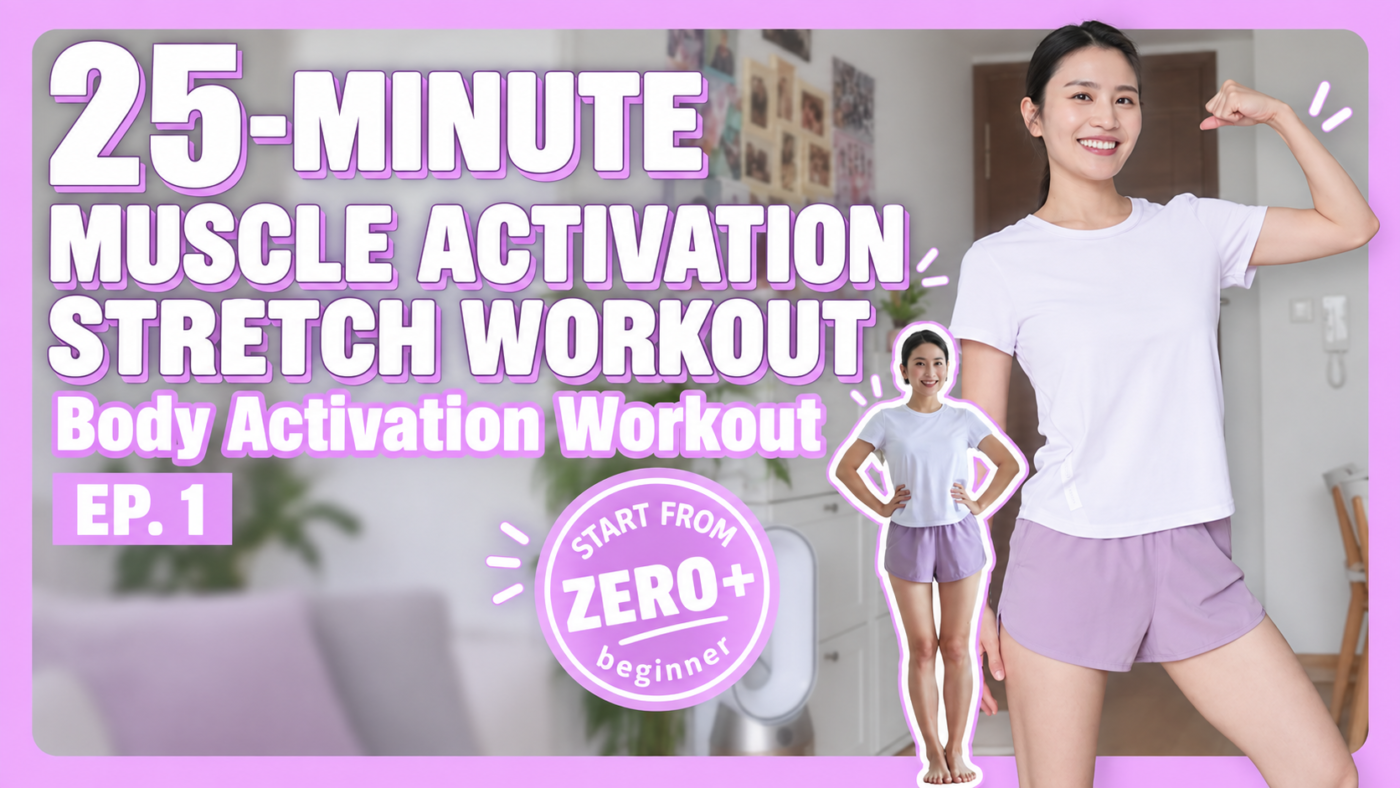
This beginner wall workout is a gentle 28-minute full-body routine designed to improve mobility, balance, flexibility, posture awareness, and muscle activation. Using a wall for support can make many movements feel more stable and accessible, especially if you are returning to exercise or prefer a lower-impact workout.Starting exercise again can sometimes be harder than exercising itself.
You may be tired. You may be busy. The weather may be bad. Work, family, and everyday responsibilities constantly give you reasons to postpone your workout until tomorrow.
For many beginners, the real challenge is not knowing which exercise burns the most calories or builds the most muscle.
It is simply getting started.
That is exactly what this beginner-friendly wall workout is designed to address.
Instead of jumping straight into an intense fitness program, this approximately 28-minute routine combines stretching, mobility, balance work, posture awareness, and gentle muscle activation.
All you need is a stable wall and enough space to move.
The goal is not to exhaust yourself.
The goal is to make movement part of your life again.
Why Start With Mobility and Muscle Activation?
After weeks or months of reduced physical activity, your body may feel stiff, weak, or less coordinated than you remember.
Long periods of sitting may also leave the shoulders, hips, hamstrings, calves, and upper back feeling restricted.
That does not necessarily mean something is structurally “wrong” with your posture.
It often means your body has simply become accustomed to spending long periods in the same positions.
A gradual return to movement can help restore confidence and tolerance for exercise.
This routine combines two useful elements.
Mobility and stretching help you comfortably explore movement through the shoulders, spine, hips, legs, ankles, and wrists.
Muscle activation exercises reintroduce your body to basic muscular effort through movements such as wall-supported squats, balance exercises, and controlled standing positions.
Together, they create a practical bridge between inactivity and more demanding exercise.
Who Is This Workout For?
This routine may be especially useful for:
People returning to exercise after a long break
Beginners who find conventional workouts intimidating
People who spend long hours sitting
Adults who feel generally stiff after work
People who want a low-impact home workout
Anyone who wants to rebuild a regular movement habit
The wall provides additional support, making many movements easier to control.
However, “beginner friendly” does not mean every exercise will be easy for everyone.
Always adjust your range of motion according to your current mobility and strength.
The 28-Minute Beginner Wall Routine
Exercise 1: Wall-Supported Shoulder and Upper-Back Stretch
Stand facing a wall and place both hands against it.
Step backward until there is enough space to hinge forward comfortably.
Slowly move your chest downward while keeping your hands on the wall.
Allow your shoulders to move into a comfortable overhead position.
Do not force your chin toward the wall.
Instead, focus on allowing the chest and upper back to move gradually.
Then return to standing.
Repeat slowly.
This movement can help open the shoulders and upper back after long periods of sitting.
Exercise 2: Elbow Wall Stretch
Place both elbows against the wall.
Bring your palms together.
Slowly shift your torso backward and downward while allowing your hands to move toward the back of your head.
Keep the movement comfortable.
You may feel a stretch through the shoulders, upper arms, chest, and upper back.
Hold briefly and return.
Avoid forcing the shoulders into a painful range.
Exercise 3: Wall-Assisted Side Stretch
Place your hands against the wall.
Cross one hand over the other.
Rotate your torso slightly and reach upward toward one side.
You should feel a gentle stretch along the side of your torso.
Return slowly and repeat several times.
Then switch sides.
This movement combines shoulder mobility with lateral trunk movement.
Move only as far as you can without discomfort.
Exercise 4: Wrist and Forearm Stretch
Place the backs of your hands against the wall with the fingers pointing downward.
Keep the pressure light.
Slowly bend your knees and shift your body downward.
You may feel a stretch through the wrists and forearms.
Then reverse the hand position so the palms face the wall with the fingers pointing upward.
Again, gently adjust your body position to explore the stretch.
The wrists contain relatively small joints and sensitive structures, so avoid aggressive pressure.
Exercise 5: Wall-Supported Hamstring Mobility
Place both hands on the wall around head height.
Step backward and hinge from the hips.
Alternate bending one knee while straightening the opposite leg.
Then change sides.
This creates a dynamic stretch through the backs of the legs.
Think about moving your hips backward and upward rather than rounding your spine excessively.
After several repetitions, straighten both legs only as far as comfortable and hold briefly.
People with tight hamstrings do not need to completely straighten the knees.
Exercise 6: Wall Chest Stretch
Stand sideways beside the wall.
Place one forearm or upper arm against it with the elbow bent approximately 90 degrees.
Slowly rotate your chest away from the wall.
Stop when you feel a comfortable stretch across the chest and front of the shoulder.
Return to the starting position.
Repeat before changing sides.
Do not force the shoulder backward.
The amount of rotation needed varies considerably between individuals.
Exercise 7: Shoulder and Arm Rotation Stretch
Place one hand against the wall.
Use the opposite hand to gently support the elbow.
Slowly rotate your body away from the wall while allowing the arm to remain supported.
The original workout progresses toward a fingers-down position.
This can produce a strong stretch through the forearm, upper arm, shoulder, and chest.
Use a very small range if your shoulders or wrists feel tight.
Never force the arm into an uncomfortable position.
Repeat on the opposite side.
Exercise 8: Double-Hand Wall Chest Opener
Place both hands against the wall with the fingers pointing downward if comfortable.
Move your hips slightly backward while allowing your chest to move forward.
Hold the stretch briefly.
Return and repeat.
This exercise should feel like a gentle opening across the chest and front of the shoulders.
If pointing the fingers downward feels uncomfortable, use a neutral hand position instead.
Exercise 9: Standing Wall-Supported Quadriceps Stretch
Place one hand against the wall for balance.
Bend the opposite knee and hold the foot or ankle behind you.
Keep your knees relatively close together.
Gently move the foot upward only as far as comfortable.
You should feel the stretch through the front of the thigh.
Avoid aggressively pulling the foot toward your body.
Perform several gentle repetitions or hold the position.
Then switch sides.
Exercise 10: Cross-Leg Standing Hamstring Stretch
Stand with your hands on your hips.
Cross one leg slightly in front of the other.
Keep the legs comfortably straight.
Hinge forward from the hips.
Do not worry about reaching the floor.
The goal is simply to feel a controlled stretch through the backs and outer portions of the legs.
Return to standing and repeat.
Then change the crossed-leg position.
Keep your spine comfortably long instead of aggressively rounding downward.
Exercise 11: Standing Side Reach
Return both feet to the floor.
Reach one arm overhead while keeping both feet grounded.
Allow the torso to move gently toward the opposite side.
Return to the center and repeat with the other arm.
This provides a simple stretch through the side of the trunk while also encouraging shoulder movement.
Avoid collapsing or twisting aggressively through the lower back.
Exercise 12: Wall Sit
Place your back against the wall.
Walk your feet slightly forward.
Slowly bend the knees and slide downward.
The original routine moves toward approximately a 90-degree knee position, but beginners do not need to go that low.
A higher wall sit is completely acceptable.
Keep your weight comfortably distributed through the feet.
Hold for as long as you can maintain good control.
This is one of the main strengthening exercises in the routine.
The quadriceps, glutes, and other lower-body muscles must work continuously to support your position.
If holding the position for a long time is too difficult, try shorter intervals such as 10 to 30 seconds.
Rest and repeat.
There is no requirement to reach a specific number immediately.
Exercise 13: Elevated Wall Hamstring Stretch
Stand facing the wall.
Place one foot against the wall at a comfortable height.
The original routine demonstrates a relatively high position, but beginners should choose a much lower height if necessary.
Keep the standing leg stable.
Hinge slightly forward from the hips toward the elevated leg.
Do not round aggressively through your back.
You should feel the stretch mainly through the back of the elevated leg.
The goal is not to get your chest as close to your leg as possible.
The goal is controlled flexibility.
Exercise 14: Elevated Side-Leg Stretch
From the elevated-leg position, rotate your torso gradually so that you are more side-on to the wall.
Keep the elevated foot controlled.
Reach the upper arm toward the side.
This increases the stretch through the inner thigh, hamstrings, and side of the torso.
This movement requires more mobility than the previous exercises.
Beginners should keep the foot much lower than waist height if necessary.
Repeat on the other side.
Exercise 15: Wall Calf and Ankle Stretch
Bring one foot down toward the base of the wall.
Place the heel on the floor with the forefoot gently contacting the wall.
Keep the leg relatively straight.
Shift your body slightly toward the wall.
You should feel a stretch through the calf and ankle.
The back foot can remain behind you for balance.
Move slowly in and out of the stretch.
Then change sides.
This can be particularly useful for people whose calves and ankles feel stiff after sitting or walking in restrictive footwear.
Exercise 16: Final Wall Alignment Hold
Finish by standing with your back against the wall.
Allow your pelvis, upper back, and head to approach the wall without forcing them into contact.
Keep your feet in a comfortable position.
Remain tall and relaxed.
Hold for approximately 30 to 60 seconds.
This exercise is best understood as a body-awareness drill rather than a way to “correct” your posture permanently.
The wall provides a reference point that helps you notice where your head, shoulders, trunk, and pelvis are positioned.
There is no single perfect posture that everyone must maintain all day.
Comfortable movement and regularly changing position are usually more useful goals.
Why a Wall Makes This Workout Beginner Friendly
A wall provides three important advantages.
First, it gives you support.
Balance exercises become less intimidating when you have something stable to hold.
Second, it provides feedback.
During stretches and standing exercises, the wall gives your body a fixed reference point.
Third, it allows you to adjust difficulty easily.
You can change how far you stand from the wall, how deeply you bend your knees, how high you raise your leg, and how far you rotate your body.
That makes the same exercise adaptable to many different fitness levels.
You Do Not Need to Push Through Pain
Stretching does not need to hurt to work.
A mild or moderate stretching sensation is enough.
Reduce the range or stop the movement if you experience:
Sharp pain
Joint pain
Numbness or tingling
Sudden weakness
Dizziness
Pain radiating into an arm or leg
Persistent pain after the exercise ends
More intensity is not automatically better.
Consistency matters far more.
How Often Should Beginners Do This Routine?
The original program suggests performing the routine several times over approximately two weeks before progressing to a harder workout.
That is a sensible general idea.
For someone restarting exercise, performing a gentle routine like this two to four times per week can be a practical starting point.
You do not necessarily need to complete all 28 minutes every time.
You could begin with 10 or 15 minutes.
Once that feels comfortable, gradually perform more of the sequence.
What Matters Most When Restarting Exercise
People often believe that restarting fitness requires motivation first.
In reality, motivation comes and goes.
Habits are more reliable.
Instead of waiting until you feel completely ready, make the first workout deliberately easy.
If the session leaves you feeling capable rather than defeated, you are more likely to exercise again.
A useful progression might look like this:
Week 1
10 to 20 minutes of gentle mobility two or three times.
Week 2
Complete more of the wall routine three or four times if recovery is good.
Week 3
Begin adding basic strength exercises such as squats, bridges, rows, or modified push-ups.
Week 4 and beyond
Gradually build toward a balanced program containing strength training, aerobic activity, mobility work, and regular walking.
The objective is not to prove how much discomfort you can tolerate during your first workout.
The objective is to build a routine you can continue.
Can Wall Exercises Improve Posture?
Wall exercises can improve body awareness, mobility, and muscular endurance.
Those things may help some people feel more comfortable standing and moving.
But posture cannot usually be reduced to a simple idea of “good” versus “bad” alignment.
Age, skeletal structure, mobility, muscle strength, working positions, pain, fatigue, habits, and individual anatomy all influence posture.
There is also no need to maintain one rigid position throughout the day.
Regular movement and changing position frequently are often more important than trying to hold a supposedly perfect posture for hours.
Can This Workout Help With Neck and Shoulder Stiffness?
Some of the shoulder, chest, wrist, and upper-back movements may help people who feel stiff after long periods of sitting.
However, exercise should not be considered a treatment for every type of neck or shoulder pain.
Persistent or worsening symptoms, weakness, numbness, trauma-related pain, or neurological symptoms should be evaluated appropriately.
How Hard Should This Workout Feel?
For a beginner, aim for approximately 3 to 6 out of 10 in perceived effort during most of the routine.
You should feel that your muscles are working and that some stretches are noticeable.
You should not feel as though you are struggling to complete every movement.
The wall sit may naturally feel harder than the stretching exercises.
That is normal.
Shorten the hold whenever your technique begins to deteriorate.
Final Thoughts
Restarting exercise does not require a perfect plan.
It requires a first step.
A wall, 20 to 30 minutes, and a few simple movements can be enough.
This routine gradually takes you through the shoulders, chest, upper back, wrists, trunk, hips, hamstrings, quadriceps, calves, ankles, and lower-body muscles.
It combines flexibility with balance and basic strength work.
More importantly, it gives you an approachable way to begin moving again.
You do not have to perform every movement perfectly.
You do not have to finish every repetition.
You do not even have to complete the entire workout on your first attempt.
Do what your body can comfortably manage today.
Then return and do a little more next time.
That is how exercise becomes a habit.
Frequently Asked Questions
Is this wall workout suitable for complete beginners?
Yes, most movements can be modified for beginners. Reduce the range of motion, shorten the wall sit, keep elevated-leg stretches lower, and rest whenever necessary.
Can I do this workout after not exercising for months?
It can be a reasonable gentle re-entry routine for many healthy adults. Start with a shorter session and gradually increase the duration instead of immediately trying to complete the entire workout.
Will wall exercises fix rounded shoulders?
They may improve shoulder mobility and body awareness, but rounded shoulders do not have one single cause and cannot always be “fixed” by one stretch or exercise.
Can this workout help me lose weight?
It contributes some physical activity, but it is primarily a mobility and muscle-activation session rather than a high-calorie-burning workout. Long-term weight management depends on overall activity, nutrition, sleep, and other lifestyle factors.
How many times a week should I do it?
Two to four sessions per week can be a reasonable starting range for many beginners, depending on recovery and other activity.
Do I need any equipment?
No special fitness equipment is necessary. You only need a stable wall, comfortable clothing, supportive footwear if preferred, and enough space to move safely.
Is 28 minutes too long for a beginner?
Not necessarily, but you do not need to complete the whole session immediately. Ten to fifteen minutes can be an excellent starting point.
Medical Disclaimer
This content is intended for general educational and fitness purposes and is not medical advice. Stop exercising if you experience sharp pain, dizziness, unusual shortness of breath, numbness, weakness, or other concerning symptoms. People with existing joint, spinal, cardiovascular, neurological, balance, or other medical conditions, as well as those recovering from injury or surgery, should seek individualized professional guidance before beginning a new exercise program.
This article is for general education and does not replace individualized care from a qualified health professional. Seek appropriate advice for persistent, severe, or concerning symptoms.
Read the full medical disclaimer