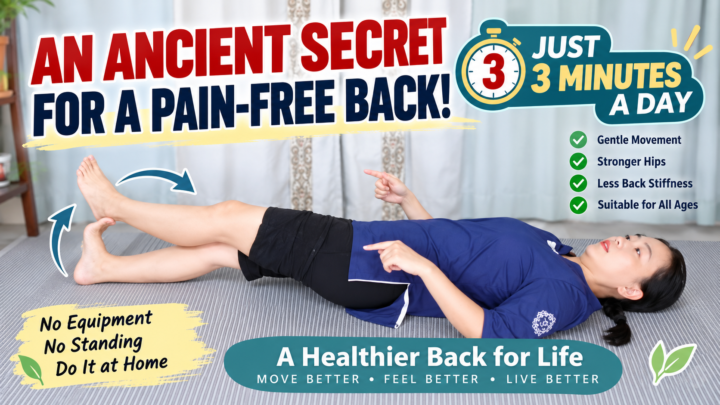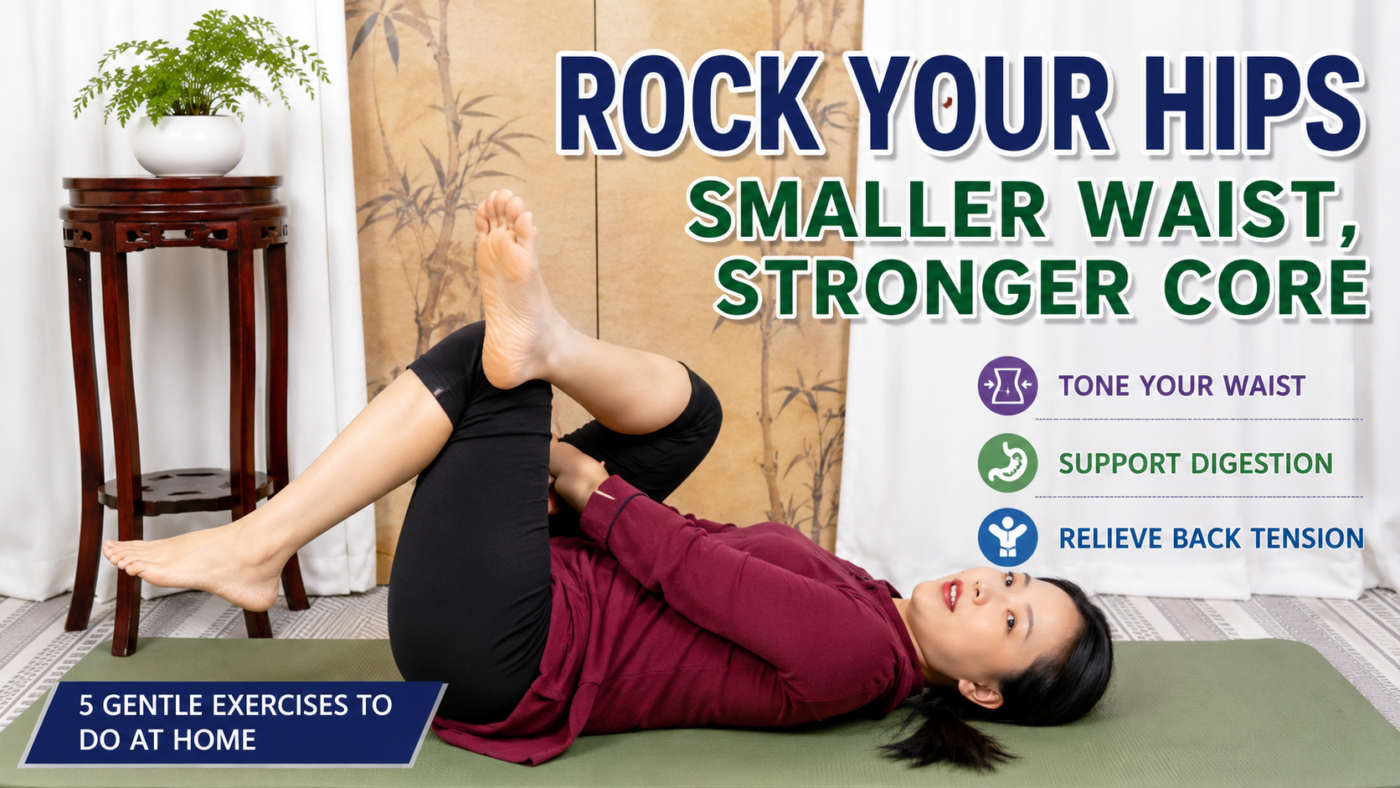
Long hours of sitting can leave your hips, lower back and legs feeling stiff by the end of the day.
You may notice that your lower back feels uncomfortable while sitting.
Then you lie down at night and still cannot find a comfortable position.
Your hips may feel tight.
Your thighs may feel heavy.
Your lower back may simply feel as though it needs to move.
This does not automatically mean that your meridians or internal organs are blocked.
For many people, prolonged sitting, reduced physical activity, muscle tension, limited hip mobility and ordinary age related changes can contribute to stiffness and discomfort.
The good news is that movement does not always need to be intense.
A gentle five minute routine performed lying down can move the hips and lower back through several comfortable ranges of motion.
The five exercises below require no gym equipment.
You can perform them on a firm bed, exercise mat or other stable surface.
The goal is not to force flexibility.
The goal is to move comfortably, breathe naturally and finish feeling more relaxed than when you started.
Why Sitting Can Make Your Hips and Lower Back Feel Stiff
The human body is designed to move.
When you remain in one position for hours, several things can happen.
Muscles around the hips remain in relatively fixed positions.
The lower back receives little variation in movement.
Your glutes may remain relatively inactive.
The hip flexors remain shortened for long periods.
Your body may become less comfortable changing positions.
This does not mean sitting permanently damages your body.
It simply means that regularly changing position and staying physically active can be helpful.
Walking, strength training and mobility exercises all have roles.
Stretching alone is not a complete solution.
But gentle mobility work can be a comfortable way to end the day.
Exercise 1: Supine Windshield Wipers
This is one of the simplest ways to gently move the hips and lower trunk.
How to Do It
Lie on your back.
Bend both knees.
Place your feet flat on the bed or floor.
Keep your feet approximately hip width apart.
Relax your shoulders.
Allow your arms to rest comfortably beside your body.
Slowly let both knees move toward the left.
Only go as far as feels comfortable.
Bring the knees back toward the center.
Then lower them toward the right.
Continue alternating sides.
Breathe naturally throughout the movement.
Try approximately 30 to 60 seconds.
What This Exercise Does
The movement gently rotates the hips and lower trunk.
It may help mobilize muscles and joints around the hips, pelvis and lower back.
You may feel a mild stretch through the outer hip, inner thigh or lower back.
You do not need to force the knees all the way to the surface.
Your comfortable range is enough.
Do Not Force the Lower Back Flat
Your spine naturally has curves.
There is no need to force every part of your lower back firmly into the bed while the knees move.
Allow your body to move naturally.
The goal is smooth motion rather than perfect positioning.
Exercise 2: Supine Knee Drop Rotation
This variation creates a slightly larger rotational movement.
How to Do It
Lie on your back.
Bend both knees.
Bring the knees slightly closer toward your body than in the first exercise.
Keep your shoulders relaxed against the surface.
Slowly lower both knees toward one side.
Return to the middle.
Then move toward the other side.
Continue alternating sides.
Use a smaller range if the movement produces discomfort.
Try approximately 30 to 60 seconds.
Why It May Feel Good After Sitting
This movement changes the position of the pelvis and gently rotates the lower trunk.
Many people find controlled rotation comfortable after remaining in a relatively fixed position for much of the day.
However, twisting should never be used aggressively.
More rotation does not automatically produce more benefit.
Can It Help Digestion?
Movement and physical activity can support general digestive health.
Regular activity is also commonly encouraged for people who experience constipation.
But this exercise should not be described as physically squeezing waste through the intestines.
Hearing digestive sounds during the movement is usually just normal gastrointestinal activity.
It does not prove that toxins or blocked energy are being released.
Exercise 3: Supine Butterfly
This movement focuses more on the hips and inner thighs.
How to Do It
Lie on your back.
Bend your knees.
Bring the soles of your feet together.
Allow your knees to gently open toward the sides.
Then slowly bring the knees back toward each other.
Open again.
Continue using a comfortable range.
Try approximately 30 to 60 seconds.
Do Not Push the Knees Down
Your knees do not need to reach the bed or floor.
Never press aggressively on the knees to create a stronger stretch.
The movement should feel mild and controlled.
People with tight hips may initially have a very small range.
That is completely normal.
What You May Feel
You may notice a stretch through the inner thighs and groin.
The hips are moving into a combination of external rotation and abduction.
These are normal hip movements.
The exercise may be especially comfortable for people who spend much of their day sitting.
Does This Exercise Calm the Liver Meridian?
Traditional Chinese Medicine associates areas of the inner leg with several meridian pathways.
These traditional concepts can be understood as part of a historical wellness system.
Modern anatomy does not recognize a liver meridian that can be opened through stretching.
The practical benefit of this movement is better understood as gentle mobility of the hips and stretching of the inner thigh muscles.
Exercise 4: Supine Hip Circles
This movement takes the hips through a larger combination of positions.
How to Do It
Lie comfortably on your back.
Place your arms beside your body.
Bend both knees and bring them gradually toward your torso.
Allow the knees to separate slightly.
Move the legs outward in a slow circular path.
Then bring them back toward the center.
Continue tracing smooth circles.
Keep the movement controlled.
After several repetitions, reverse the direction.
Try approximately 30 to 60 seconds.
Start With Small Circles
Large circles are not necessary.
The hips may initially feel stiff.
Begin with a range that feels easy.
Increase the movement gradually only if your body remains comfortable.
What This Exercise Trains
This movement combines several hip positions.
It can challenge hip mobility.
It also requires mild abdominal and pelvic control.
The muscles of the thighs and hips remain active as you guide the legs through the circle.
This makes it a useful mobility exercise.
It should not be considered a treatment for digestive disorders or emotional conditions.
Exercise 5: Figure Four Hip Rotation
The final movement emphasizes the glutes and outer hip.
How to Do It
Lie on your back.
Bend both knees.
Place your left ankle gently across your right thigh above the knee.
Your legs should resemble the shape of the number four.
Keep your shoulders relaxed.
Slowly allow the hips and legs to move slightly toward one side.
Return toward the middle.
Move toward the other side if comfortable.
Continue gently for approximately 30 to 60 seconds.
Then switch legs.
What You May Feel
You may notice a stretch around the buttock and outer hip of the crossed leg.
Some people also feel the movement along the outer thigh.
The sensation should remain comfortable.
A strong pulling feeling is not necessary.
Important Note About Tingling or Radiating Pain
Do not assume that pain traveling down the leg is simply a healthy stretch.
Pain, tingling, numbness or burning that travels down the leg can sometimes involve nerve irritation.
Stop the movement if these symptoms appear or worsen.
Persistent radiating symptoms deserve evaluation by an appropriate healthcare professional.
A Simple 5 Minute Bedtime Routine
You can perform the five movements in sequence.
Supine windshield wipers
Approximately 1 minute
Supine knee drop rotations
Approximately 1 minute
Supine butterfly
Approximately 1 minute
Supine hip circles
Approximately 1 minute
Figure four hip rotation
Approximately 30 seconds on each side
You can also spend less time on each movement.
There is nothing medically special about exactly five minutes.
The routine should fit your body and your schedule.
Should You Perform These Exercises on a Bed?
A firm mattress may work well for gentle mobility exercises.
A very soft mattress can make some movements more difficult to control.
An exercise mat on the floor provides a firmer surface.
Choose whichever option feels safer and more comfortable.
If getting down to the floor and standing back up is difficult, a firm bed may be more practical.
Can These Exercises Help Lower Back Pain?
Some people with nonspecific lower back discomfort find gentle movement helpful.
But lower back pain has many possible causes.
No single stretch is appropriate for every person.
The goal should be comfortable movement rather than trying to twist pain away.
If a movement reduces stiffness and feels good, it may be useful as part of your routine.
If it increases pain, stop.
What About a Herniated Disc?
This requires much more caution than the original video suggests.
People with a diagnosed disc herniation should not automatically assume that every twisting exercise is safe.
Symptoms and appropriate exercises vary considerably from person to person.
Some people tolerate gentle rotation.
Others may find it aggravates their symptoms.
If you have a known disc problem, significant sciatica, numbness or weakness, follow guidance from a doctor or physical therapist who understands your individual condition.
Can These Exercises Reduce Belly Fat?
No specific hip or abdominal movement can selectively burn fat from the belly.
Spot reduction does not work that way.
The exercises may move the abdominal and hip muscles, but that is different from specifically burning abdominal fat.
Reducing body fat generally depends on overall energy balance, nutrition, physical activity, sleep and individual factors.
These exercises are better used for mobility and relaxation.
Can They Improve Digestion?
Gentle physical activity can support digestive health.
But five minutes of hip movements should not be promoted as a cure for indigestion, bloating or constipation.
Persistent abdominal bloating can have many causes.
These may include diet, constipation, food intolerance, irritable bowel syndrome and other medical conditions.
If bloating is persistent, severe or accompanied by weight loss, vomiting, bleeding or significant pain, seek medical evaluation.
Do These Exercises Improve Sleep?
Gentle evening movement may help some people relax.
A calm stretching routine can become part of a bedtime routine.
However, these exercises are not a treatment for insomnia.
Long term sleep problems may be influenced by stress, sleep habits, medications, sleep apnea, pain and many other factors.
If sleep problems are persistent, addressing the underlying cause matters more than relying on one exercise.
Natural Breathing Matters
Do not hold your breath while stretching.
Breathe normally.
Slow breathing can help keep the exercise relaxed.
You do not need to perfectly coordinate every breath with every repetition.
Comfort is more important than rigid breathing rules.
How Much Stretch Should You Feel?
Aim for a mild to moderate stretching sensation.
You should not feel sharp pain.
You should not feel joint pinching.
You should not force a position because someone else can move farther.
Mobility varies significantly between individuals.
Progress does not require discomfort.
Who Should Be More Cautious?
Ask for individualized guidance if you have recently had surgery involving the spine, hip, knee or abdomen.
Use additional caution if you have severe osteoporosis.
Pregnant people should choose exercises appropriate for their stage of pregnancy rather than assuming every supine exercise is suitable.
People with significant balance or mobility limitations should also consider professional guidance.
When to Stop
Stop the exercise if you experience sharp back pain.
Stop if you develop severe hip or knee pain.
Stop if numbness or tingling appears.
Stop if pain travels strongly down the leg.
Stop if you become dizzy or unwell.
Stop if you develop significant abdominal pain.
Exercise should make you feel better over time, not encourage you to ignore warning signs.
One Mobility Routine Is Not Enough
Mobility exercises can feel good.
But long term physical health requires more than stretching.
A well rounded routine should include regular walking or other aerobic exercise.
It should include muscle strengthening.
It should include balance training, particularly as you get older.
It should also reduce excessive sedentary time.
Five minutes of stretching before bed can complement these habits.
It should not replace them.
Frequently Asked Questions
Are Bedtime Hip Mobility Exercises Good for Tight Hips?
They may help some people move the hips through comfortable ranges after long periods of sitting.
Regular strengthening and general physical activity are also important.
How Long Should I Stretch Before Bed?
There is no single required duration.
A few minutes of comfortable mobility work may be enough.
Start with approximately five minutes and adjust according to how your body responds.
Should Stretching Hurt?
No.
A gentle stretch is acceptable.
Sharp pain, burning, numbness or significant joint pain are reasons to stop.
Can I Do These Exercises Every Night?
Many people can perform gentle mobility exercises regularly when they remain comfortable.
If the routine repeatedly causes pain or worsens symptoms, stop and seek appropriate guidance.
Are These Exercises Good for Older Adults?
Many of them can be adapted for older adults.
Use a comfortable range and move slowly.
People with significant spinal, hip or knee conditions should seek individualized advice.
Can Hip Exercises Improve Constipation?
Physical activity in general may support healthy bowel function.
However, no particular hip exercise can guarantee constipation relief.
Can These Exercises Flatten My Stomach?
Not directly.
They may improve mobility and activate muscles around the hips and trunk, but they cannot selectively remove abdominal fat.
Do I Need to Feel a Strong Stretch?
No.
A stronger stretch does not necessarily produce better results.
Gentle, repeatable movement is usually a better goal.
Bottom Line
Five gentle exercises performed while lying down can be a simple way to move stiff hips and the lower back before bed.
Supine windshield wipers provide gentle rotation.
Knee drop rotations move the lower trunk.
The butterfly exercise opens the hips and inner thighs.
Hip circles move the joints through several directions.
Figure four rotations stretch the glutes and outer hips.
None of these exercises needs to be aggressive.
Move slowly.
Breathe naturally.
Stay within a comfortable range.
Stop if you develop pain, numbness or worsening symptoms.
And remember that mobility is only one part of healthy movement.
For lasting results, combine gentle stretching with regular walking, strength training and less prolonged sitting.
The best bedtime routine is not the one that looks the most impressive.
It is the one you can perform comfortably, consistently and safely.
Affiliate Disclosure
This article may contain affiliate links. If you purchase through one of these links, we may earn a commission at no additional cost to you. Affiliate relationships do not influence our editorial standards or health recommendations.
Medical Disclaimer
This article is for educational and informational purposes only and is not medical advice. Exercise should be adapted to individual health, mobility and medical conditions. Consult a qualified healthcare professional or physical therapist if you have persistent or severe back pain, radiating leg symptoms, a diagnosed spinal condition, recent surgery or other significant medical concerns.
Featured Image Publishing Elements
Featured Image Title
5 Bedtime Moves for Tight Hips and Lower Back
Featured Image Subtitle
Gentle Mobility You Can Do Lying Down
Featured Image File Name
bedtime-hip-mobility-exercises-lower-back.webp
Featured Image Alt Text
Woman performing five gentle bedtime hip mobility exercises for tight hips and lower back stiffness
Featured Image Caption
Five gentle lying down movements can help mobilize the hips and lower back after long periods of sitting.
Featured Image Description
A professional healthy aging fitness infographic showing five lying down hip mobility exercises including windshield wipers, knee drop rotations, butterfly movement, hip circles and a figure four stretch. The illustration emphasizes gentle movement, natural breathing and lower back comfort.
Rank Math SEO Setup
Focus Keyword
bedtime hip mobility exercises
SEO Title
5 Bedtime Hip Mobility Exercises for Lower Back and Hip Stiffness
Slug
bedtime-hip-mobility-exercises-lower-back-stiffness
Meta Description
Try these 5 gentle bedtime hip mobility exercises to loosen tight hips, reduce stiffness after sitting, improve mobility and help your body relax before sleep.
Additional Keywords
hip mobility exercises in bed
lower back stretches before bed
gentle hip exercises
hip mobility for older adults
exercises for tight hips
Schema
Article
Recommended Article Type
Medical Web Page if available
Otherwise use Article
Author
Eastern Wellness Research Team
Publisher
Health, Beauty & Longevity
Open Graph Title
5 Gentle Bedtime Moves for Tight Hips and Lower Back
Open Graph Description
Spend a few minutes before bed moving your hips and lower back with these five gentle exercises designed for comfortable mobility and relaxation.
Pinterest Title
5 Bedtime Hip Mobility Exercises for Tight Hips
Pinterest Description
Try these five gentle lying down exercises before bed to move tight hips, loosen your lower back and relax after a long day of sitting.
Recommended Affiliate Product Placement
After the section about exercise surfaces
Non slip exercise mat
After the first exercise section
Yoga bolster or supportive pillow
After the Figure Four section
Stretching strap
After the healthy movement section
Resistance bands
Recommended Amazon Button Text
Check Price on Amazon
Recommended Internal Link Topics
Hip mobility
Lower back mobility
Leg strength after 40
Balance exercises
Healthy aging
Walking
Gentle exercise
Constipation and physical activity
This article is for general education and does not replace individualized care from a qualified health professional. Seek appropriate advice for persistent, severe, or concerning symptoms.
Read the full medical disclaimer