A relaxing bedtime routine can change how your abdomen feels by the next morning.
That does not mean abdominal fat has disappeared overnight.
But gentle massage, slow breathing, hip mobility and a comfortable resting position may reduce the sensation of abdominal tension, help some people feel less bloated and make the hips and lower back feel looser.
That difference can sometimes be noticeable enough that the waist feels or even measures slightly different the next morning.
The important question is why.
A dramatic overnight change is much more likely to reflect temporary changes in bloating, intestinal contents, fluid balance, posture or abdominal muscle tension than actual loss of body fat.
That makes bedtime abdominal massage useful—but for different reasons than many “overnight slimming” claims suggest.
Can Your Waist Really Change Overnight?
Yes, waist circumference can fluctuate from morning to evening and from one day to the next.
Possible reasons include:
Food volume.
Gas.
Bowel contents.
Hydration.
Salt intake.
Menstrual-cycle changes.
Posture.
Abdominal muscle tension.
Temporary fluid retention.
Because of these factors, someone may measure a smaller waist in the morning than the previous evening.
But losing two inches of actual body fat overnight is not physiologically realistic.
Fat loss occurs gradually through sustained energy expenditure over time.
Why Bedtime Can Be a Good Time for Gentle Massage
Before sleep, many people are finally still enough to notice how tense their abdomen and hips feel.
During the day, sitting, walking, stress and repeated bracing can make the abdominal wall and hip region feel tight.
A slow massage can become a signal to stop bracing.
The breathing slows.
The abdomen softens.
The hips relax.
That may be especially useful for people who unconsciously keep their stomach pulled in throughout the day.
What the Lymphatic System Actually Does
The lymphatic system is a network of vessels, nodes and organs involved in fluid balance and immune function.
It helps return excess interstitial fluid to the bloodstream and transports immune cells.
There are important lymphatic structures throughout the abdomen and groin.
But the idea that abdominal lymph “stagnates,” lowers organ energy consumption and directly causes belly fat is not supported by normal physiology.
The lymphatic system does not control fat loss in that direct way.
Does Poor Lymph Flow Slow Metabolism?
Not in healthy adults in the way commonly claimed.
Metabolic rate depends on many factors, including:
Body size.
Lean mass.
Age.
Hormones.
Physical activity.
Diet.
Temperature.
Genetics.
Certain illnesses.
Ordinary abdominal tightness or hip stiffness does not block lymph enough to shut down basal metabolism.
That does not mean movement is irrelevant.
Regular movement supports general circulation and overall health.
It simply does not create weight loss by “unblocking” hidden waste.
Why the Hips Can Feel Stiff at Night
Humans spend much of the day sitting or standing.
Both can leave the hip region feeling restricted.
Sitting keeps the hips flexed for prolonged periods.
Standing and walking place repeated load through the pelvis and lower extremities.
By evening, some people notice:
Hip tightness.
Gluteal fatigue.
Lower-back stiffness.
Reduced comfort in deep hip flexion.
A bedtime mobility routine may help restore a sense of movement.
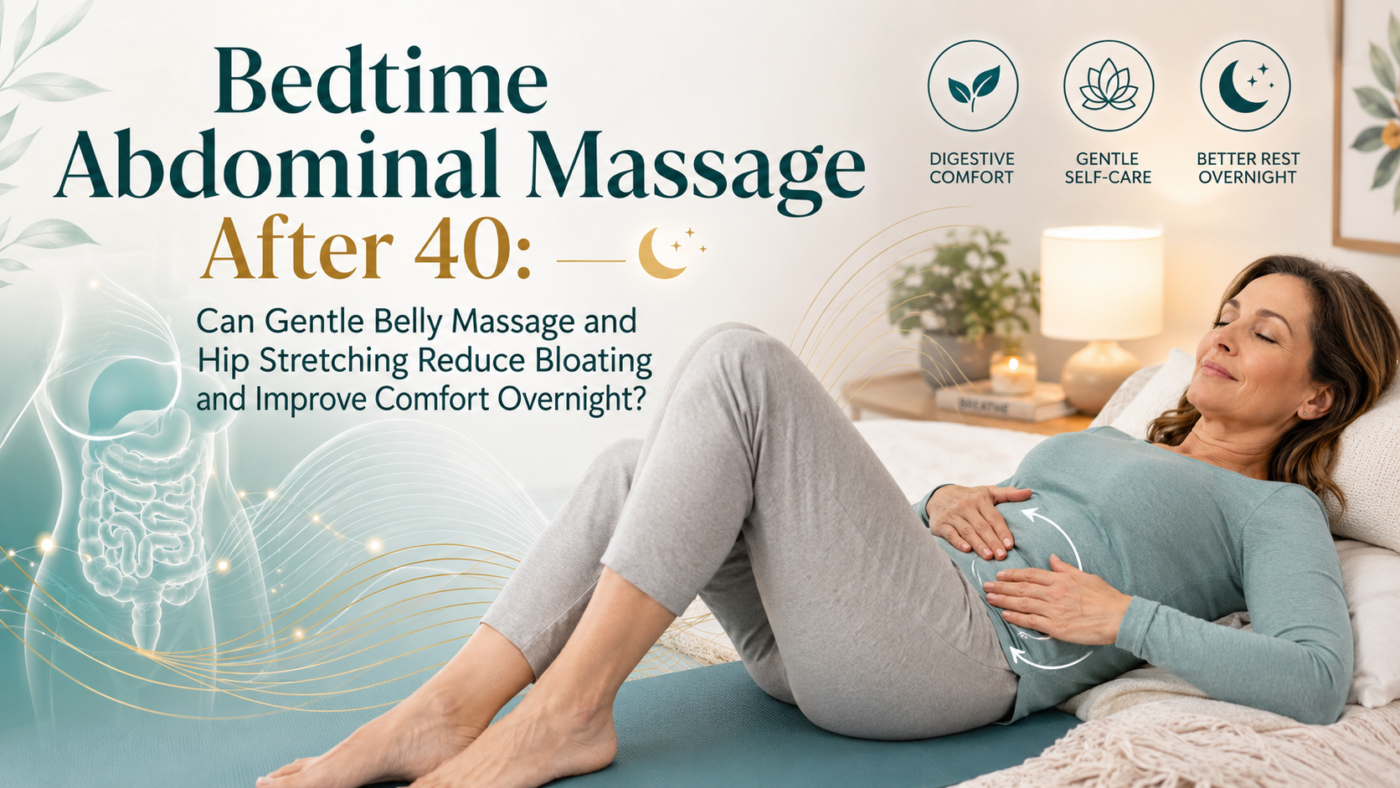
Start With Gentle Belly Rubbing
Lie down or sit in a relaxed position.
Place both hands over the abdomen.
Rub gently in slow circles.
Use comfortable pressure.
Do not dig deeply.
The goal is warmth and relaxation.
This may help you become more aware of abdominal tension.
Can Belly Massage Improve Digestion?
Abdominal massage has been studied in certain settings, especially for constipation.
Some people may find that gentle abdominal massage helps bowel comfort or promotes the urge to have a bowel movement.
The response varies.
It should not be considered a treatment for persistent unexplained gastrointestinal symptoms.
Clockwise Abdominal Massage
One common approach is to massage in a clockwise direction when viewed from your own perspective.
This broadly follows the anatomical direction of the colon.
Begin low on the right side.
Move upward.
Across the upper abdomen.
Then downward on the left.
Keep pressure light.
Slow breathing can make the exercise more comfortable.
Can You “Lift the Colon” With Your Hands?
No.
The intestines are supported within the abdominal cavity by connective tissues and mesenteries.
You cannot permanently lift a “fallen colon” by pushing the abdomen upward.
Massage can move the abdominal wall and possibly influence bowel sensation.
That is different from mechanically repositioning the intestines.
Lower-Abdominal Sweeping
Place your hands on the lower abdomen.
Use broad strokes upward and inward.
Think of the movement as soothing rather than draining.
There is no need to force tissue strongly toward the ribs.
If the area feels painful, reduce pressure.
Side-Waist Massage
Move the palms along the sides of the waist.
Use slow strokes from the lower flank upward or toward the center.
This can feel pleasant after a day of sitting.
It may also temporarily change superficial fluid distribution.
That does not mean fat is being removed from the waist.
Does Flank Massage Create a Smaller Waist?
Temporarily, perhaps in appearance.
A reduction in bloating or muscle guarding may make the waist look smaller.
But massage cannot selectively remove stored fat from the sides of the abdomen.
Spot reduction does not occur through rubbing.
Pelvic and Groin Massage: Use Caution
The groin contains important blood vessels, nerves and lymph nodes.
Avoid aggressive pressure.
Do not “dig into” lymph nodes.
Light external contact is enough.
Painful or enlarged lymph nodes should be medically evaluated rather than repeatedly massaged.
What About “Waste Around the Pelvis”?
The body does not store loose metabolic waste around the pelvis waiting for massage to remove it.
The kidneys, liver, lungs, gastrointestinal tract and lymphatic system continuously manage normal metabolic products.
Feeling heavy or stiff around the pelvis is not proof of toxin buildup.
Pinching the Belly Skin
Some routines pinch the abdominal skin and subcutaneous tissue.
Very gentle skin rolling can increase sensory stimulation and temporary superficial blood flow.
But it cannot restore lost skin elasticity or remove loose abdominal skin.
Too much pinching can bruise or irritate the tissue.
Keep it light.
Can Pinching Tighten Loose Skin?
No reliable evidence supports permanent tightening of loose abdominal skin through pinching.
Skin laxity depends on:
Collagen.
Elastin.
Age.
Genetics.
Pregnancy history.
Weight changes.
Sun exposure.
Hormonal factors.
Massage may make the skin feel warmer or temporarily firmer, but it does not rebuild deep structural support overnight.
Tingling Does Not Mean Fat Is Burning
After rubbing or pinching, the skin may tingle.
That sensation usually comes from:
Nerve stimulation.
Friction.
Warmth.
Changes in superficial blood flow.
It does not mean fat cells are being burned.
Fat oxidation occurs through metabolism, not through local skin sensation.
Hip and Groin Relaxation
After the abdominal work, shift attention to the hips.
Shake the legs gently.
Let the knees relax.
Avoid forcing large stretches.
The goal is to reduce stiffness.
Butterfly Position
Lie or sit with the soles of the feet together.
Allow the knees to fall outward.
Do not force them downward.
Place support under the thighs if needed.
Breathe slowly.
This position can stretch the inner thighs and create a sense of hip opening.
Does the Butterfly Stretch Improve Lymphatic Flow?
Movement and muscle activity support normal circulation.
But the butterfly stretch does not “flush” the groin or melt abdominal fat.
Its main value is mobility and relaxation.
Add Gluteal Awareness
Place your hands over the buttocks or use a soft surface for support.
Gently contract the gluteal muscles.
Hold briefly.
Relax.
This is a better way to activate the glutes than striking or pressing deeply into them.
Gentle Pelvic Rocking
Hold the knees.
Rock the body slowly.
Keep the movement small.
This can feel relaxing through the back and pelvis.
Avoid forceful rolling if you have osteoporosis, acute back pain or recent spinal injury.
Can Rocking Massage the Spine?
It can create broad pressure across the back muscles.
But it does not directly “realign” the spine.
Think of it as a mobility and relaxation technique.
Open-Hip Stretch
Hold the ankles, calves or feet.
Let the knees open only as far as comfortable.
Keep breathing.
Do not chase maximum flexibility.
A gentle stretch is enough.
Why Hip Mobility Matters After 40
Hip mobility often decreases when physical activity becomes less varied.
Many adults spend years moving mostly between sitting, standing and straightforward walking.
Adding gentle rotational and open-hip movements can help maintain comfortable range of motion.
That supports daily function.
Can Hip Mobility Flatten the Belly?
Not directly.
Better hip and pelvic movement may improve posture.
Improved posture can change the way the abdomen appears.
But mobility does not remove abdominal fat.
Why the Abdomen May Feel Flatter After Stretching
Several things may change:
The abdominal wall relaxes.
Gas shifts.
Bowel contents may move.
The pelvis changes position.
The rib cage sits differently.
The lower back relaxes.
Those factors can affect abdominal appearance without changing fat mass.
Heat From the Hands
Rest both hands over the abdomen.
Notice the warmth.
This can be deeply soothing.
It may help calm the body before sleep.
But warmth from the hands does not “heal internal organs.”
The benefit is primarily sensory and relaxing.
Why Relaxation Before Sleep Matters
Stress can influence:
Muscle tension.
Digestive symptoms.
Sleep quality.
Pain perception.
Jaw clenching.
Breathing patterns.
A calming bedtime ritual may therefore have benefits beyond the abdomen.
The strongest effect may be nervous-system downshifting rather than metabolism.
Bedtime Routine: 12 Minutes
Minutes 1–2: Gentle Belly Rubbing
Slow circles.
Light pressure.
Minutes 3–4: Clockwise Abdominal Massage
Move gradually around the abdomen.
Minute 5: Side-Waist Massage
Broad strokes along the flanks.
Minute 6: Lower-Abdominal Relaxation
Place hands over the lower belly and breathe.
Minute 7: Leg Shaking
Relax the hips.
Minutes 8–9: Butterfly Stretch
Stay within a comfortable range.
Minute 10: Pelvic Rocking
Slow and controlled.
Minute 11: Hip Opening
Hold ankles or calves if comfortable.
Minute 12: Hands on Belly and Slow Breathing
Finish calmly.
What Results Can You Expect the Next Morning?
You might notice:
Less abdominal tension.
Reduced sensation of bloating.
A more comfortable bowel movement.
Looser hips.
Less lower-back stiffness.
A slightly different waist measurement.
Better relaxation before sleep.
These are plausible.
What You Should Not Expect
You should not expect:
Two inches of body-fat loss overnight.
Permanent waist reduction after one massage.
Internal organs being lifted into place.
Detoxification of hidden waste.
A dramatic increase in metabolism.
Loose abdominal skin permanently tightening.
Those claims go beyond what massage can do.
Why Morning Measurements Can Be Misleading
Waist circumference is sensitive to:
Time of day.
Food intake.
Hydration.
Breathing.
Tape placement.
Posture.
Whether the abdomen is relaxed.
If you track waist size, measure under consistent conditions.
For example:
Same time of day.
Same location.
Same posture.
Normal exhalation.
Same tape tension.
Then look at trends over weeks, not overnight fluctuations.
What Actually Reduces Waist Circumference Long Term?
For true reductions in abdominal fat, the fundamentals still matter.
Regular physical activity.
Resistance training.
Appropriate calorie intake.
Adequate protein.
Sleep.
Stress management.
Consistency.
Massage can support comfort.
It cannot replace those behaviors.
Can Bedtime Massage Help Weight Loss Indirectly?
Possibly, but indirectly.
If a relaxing routine improves sleep or helps reduce stress, that may support healthier eating and activity patterns.
That is different from the massage itself burning substantial fat.
Constipation and Belly Size
Constipation can make the abdomen feel fuller or more distended.
Gentle abdominal massage may help some people.
But persistent constipation may require:
More fiber.
Adequate fluids.
Movement.
Medication review.
Medical assessment.
Do not rely on massage alone if symptoms are chronic.
When Abdominal Massage Is Not Appropriate
Avoid abdominal massage or seek medical advice if you have:
Severe unexplained abdominal pain.
Recent abdominal surgery.
Active inflammatory bowel flare.
Known abdominal aneurysm.
Pregnancy with uncertainty about massage safety.
Hernia pain.
Persistent vomiting.
Fever with abdominal symptoms.
Unexplained abdominal swelling.
Known serious abdominal disease.
Stop if Massage Causes Pain
A bedtime routine should feel soothing.
If massage causes:
Sharp pain.
Severe tenderness.
Nausea.
Dizziness.
New swelling.
Stop.
Pain is not evidence that toxins are leaving.
Final Takeaway
A bedtime abdominal massage routine can be a useful relaxation practice after 40.
Gentle belly massage, slow breathing, hip stretching and light pelvic movement may reduce the sensation of bloating, ease stiffness and help the body settle before sleep.
You may even notice a slightly smaller waist measurement the next morning because abdominal fullness and fluid balance naturally fluctuate.
But massage does not burn two inches of fat overnight.
It does not lift the colon.
It does not restore loose skin permanently.
And it does not increase metabolism by flushing lymphatic waste.
The best way to use this routine is simple:
Massage gently. Breathe slowly. Relax the hips. Support normal digestion. Sleep well. And judge real body-composition change over weeks and months—not by one morning measurement.
Frequently Asked Questions
Can abdominal massage reduce waist size overnight?
It may temporarily change bloating, fluid balance or abdominal tension, but it cannot remove a large amount of body fat overnight.
Can belly massage help bloating?
Some people find gentle massage helpful for abdominal comfort and mild bloating.
Does abdominal massage help constipation?
It may help certain people with constipation, although persistent symptoms should be medically evaluated.
Can massage improve lymphatic drainage?
Gentle movement and massage may influence superficial fluid movement, but ordinary abdominal massage should not be described as a detox treatment.
Does lymphatic stagnation slow metabolism?
There is no strong evidence that normal abdominal “lymph stagnation” directly lowers basal metabolism in healthy adults.
Can massage burn belly fat?
No. Massage does not selectively burn abdominal fat.
Can pinching tighten belly skin?
No strong evidence shows that pinching permanently tightens loose abdominal skin.
Can massage lift the intestines?
No. Abdominal massage cannot permanently reposition the intestines upward.
Is butterfly stretching good before bed?
For many people, gentle butterfly stretching can be relaxing and may improve hip comfort.
Should abdominal massage hurt?
No. Use light to moderate pressure and stop if significant pain occurs.
Medical and Fitness Disclaimer
This article is for educational purposes only and is not medical diagnosis, gastrointestinal treatment, lymphatic therapy or individualized exercise advice. Persistent abdominal pain, unexplained swelling, severe constipation, vomiting, fever, blood in the stool or major changes in bowel habits require appropriate medical evaluation.
This article is for general education and does not replace individualized care from a qualified health professional. Seek appropriate advice for persistent, severe, or concerning symptoms.
Read the full medical disclaimer