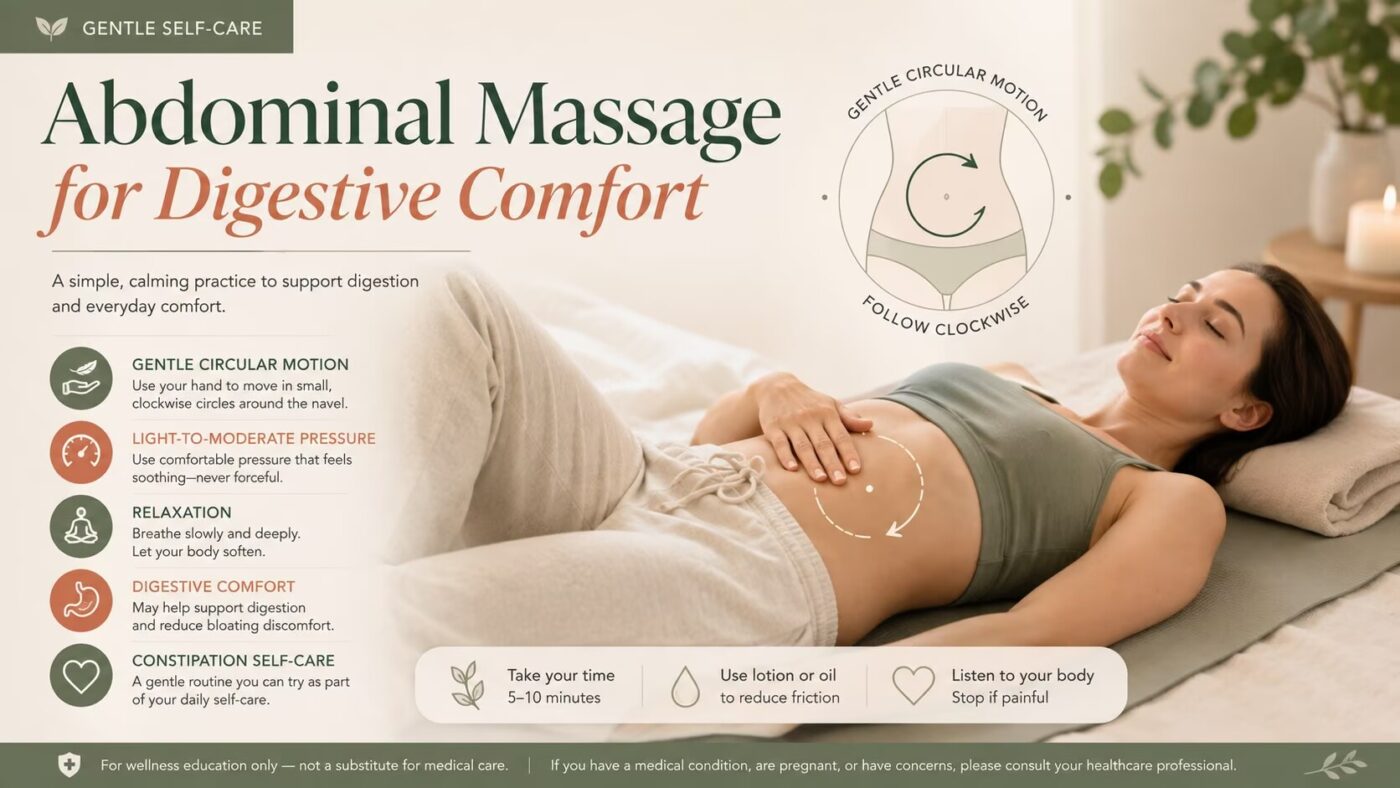
Abdominal massage for digestion has been used in traditional wellness practices for centuries as a simple form of self-care.Abdominal massage has been used in traditional wellness practices for centuries, often as a simple form of self-care performed before bed or after waking.
In traditional Chinese health culture, the abdomen is considered an important area because several meridian pathways are described as passing through it. Classical explanations may refer to supporting qi and blood circulation, harmonizing internal organs, or balancing yin and yang.
Modern medicine uses a different framework.
The abdomen contains the stomach, intestines, liver, pancreas, gallbladder, and other organs, but there is no scientific evidence that rubbing the abdomen “removes pathogenic energy,” cleanses the internal organs, or treats a wide range of chronic diseases.
What abdominal massage may realistically offer is much simpler: gentle touch, relaxation, body awareness, and—in some people—support for bowel comfort and constipation management.
Randomized controlled trials have reported that abdominal massage may improve bowel movement frequency, constipation symptoms, and quality of life in some adults with constipation. Importantly, these studies support massage as a complementary strategy, not as a replacement for medical treatment or prescribed laxatives.
What Is Abdominal Massage?
Abdominal massage is a form of gentle manual pressure applied over the abdomen.
It may involve slow circular movements, broad strokes, or gentle pressure over different parts of the abdominal wall.
Unlike deep tissue massage, the goal is not to press hard into the abdomen.
For everyday self-care, the pressure should remain comfortable and should never cause sharp pain.
Some people use abdominal massage simply because it feels relaxing. Others use it as part of a routine for bloating, bowel awareness, or constipation.
Research has focused mainly on people with constipation rather than on healthy adults seeking general “detoxification” or longevity benefits.
Can Abdominal Massage Help Constipation?
Possibly, for some people.
Constipation may involve fewer than three bowel movements per week, hard or dry stools, difficulty passing stool, or a feeling that bowel movements are incomplete. It can have many different causes, including diet, hydration, physical inactivity, medications, pelvic floor dysfunction, metabolic conditions, and changes in daily routine.
In one randomized controlled trial involving adults with constipation, abdominal massage reduced constipation-related gastrointestinal symptoms and increased bowel movement frequency compared with a control group. However, it did not reduce the participants’ use of laxatives, suggesting that massage may be useful as an adjunct rather than a substitute for established treatment. PubMed
Another randomized trial in older adults found improvements in constipation management and constipation-related quality of life after a structured abdominal massage program.
These findings are encouraging, but they do not mean that everyone with constipation will respond in the same way.
A Simple Abdominal Self-Massage Routine
If you want to try gentle abdominal massage for relaxation or bowel awareness, choose a time when you can lie down comfortably.
Lie on your back.
If it feels better, bend your knees slightly so the abdominal muscles can relax.
Place one hand over your abdomen.
Begin near the area around the navel.
Using the flat part of your hand or your fingertips, make slow, gentle circular movements.
Gradually widen the circles to include more of the abdomen.
Keep your breathing relaxed.
The pressure should be light to moderate.
You should not feel sharp pain, strong tenderness, or a need to “push through” discomfort.
After a few minutes, stop and allow the abdomen to relax.
There is no established medical reason that everyone must perform exactly 50 circles with one hand and another 50 in the opposite direction.
For most people using massage as a general wellness practice, comfort and consistency matter more than counting a specific number of repetitions.For some people, abdominal massage for digestion may provide relaxation and support bowel comfort, particularly when constipation is present.
Does the Direction Matter?
Traditional self-massage routines often recommend clockwise abdominal circles.
This may loosely follow the general direction of the large intestine, but there is not strong evidence showing that one exact hand direction is necessary for general abdominal massage to work.
If you are practicing for comfort rather than following a specific clinical bowel-management program, use slow movements that feel natural and comfortable.
There is also no clear reason to aggressively reverse direction or perform equal numbers of circles in both directions.
How Much Pressure Should You Use?
Gentle pressure is enough.
The abdomen contains sensitive tissues and internal organs, so self-massage should not feel like deep manipulation.
Avoid digging the fingertips sharply into the abdomen.
Do not continue if you experience:
sharp or increasing abdominal pain,
nausea,
dizziness,
significant tenderness,
or unusual discomfort.
Massage should leave the area feeling relaxed rather than sore.
What About “Qi and Blood Circulation”?
Traditional Chinese medicine describes the abdomen through concepts involving meridians, qi, blood, yin, yang, and the functional relationships of internal organs.
These concepts are part of a traditional medical framework.
They can be discussed as cultural and historical explanations, but they should not be presented as established anatomical mechanisms.
Modern research evaluates abdominal massage through measurable outcomes such as bowel movement frequency, constipation severity, abdominal discomfort, and quality of life rather than through claims about removing “evil qi” or cleansing the organs.
Keeping these perspectives separate allows traditional practices to be presented respectfully without turning historical concepts into unsupported medical claims.
Can Abdominal Massage “Detox” the Body?
There is no good evidence that rubbing the abdomen removes toxins from the body.
The liver, kidneys, lungs, gastrointestinal system, and other organs already perform the body’s normal metabolic and waste-processing functions.
Abdominal massage should therefore not be promoted as a detoxification technique.
A more realistic description is that it may help some people feel more relaxed and may support bowel comfort in certain cases.
Can It Treat Chronic Diseases?
No single abdominal massage technique has been shown to treat “many chronic diseases.”
Claims that years of abdominal rubbing can cure or reverse a broad range of chronic illnesses are not supported by evidence.
Some research supports abdominal massage specifically as an adjunctive option for constipation, but that is very different from saying it treats diabetes, liver disease, gastrointestinal disorders, hormonal conditions, or other chronic diseases. PubMed
If you have a diagnosed medical condition, massage should complement—not replace—the care recommended by your healthcare professional.
A Better Routine for Bowel Health
If constipation is your main concern, abdominal massage should be only one part of the strategy.
Constipation can be influenced by fluid intake, fiber intake, physical activity, medications, pelvic floor function, and other health conditions.
A broader bowel-health routine may include:
regular physical activity,
adequate fluid intake when medically appropriate,
enough dietary fiber,
responding to the natural urge to have a bowel movement,
and reviewing medications or health conditions that may contribute to constipation.
If symptoms persist, a healthcare professional can help identify the underlying cause rather than assuming the problem is simply “poor circulation in the abdomen.”
When Abdominal Symptoms Need Medical Attention
Do not rely on massage alone if constipation or abdominal discomfort is persistent or worsening.
The National Institute of Diabetes and Digestive and Kidney Diseases recommends seeking prompt medical attention when constipation occurs together with rectal bleeding, blood in the stool, constant abdominal pain, inability to pass gas, vomiting, fever, unexplained weight loss, or other concerning symptoms.
These symptoms may indicate a problem that needs medical evaluation rather than home massage.
If you have recently had abdominal surgery, have an abdominal injury, are pregnant, have a known hernia, or have a significant gastrointestinal condition, it is sensible to ask a healthcare professional whether abdominal massage is appropriate for you before practicing regularly.
The Bottom Line
Abdominal massage is an old and simple self-care practice that can be approached in a modern, evidence-informed way.
You do not need to believe that massage “drives disease out of the body” or “balances all the internal organs” to find it useful.
For some people, gentle abdominal massage may:
provide relaxation,
increase awareness of abdominal tension,
support digestive comfort,
and serve as a complementary strategy for constipation.
Research suggests possible benefits for constipation in selected groups, but massage should not replace appropriate diet, hydration, movement, medications, or medical evaluation when these are needed.
The safest approach is simple:Use gentle pressure, keep the practice comfortable, avoid exaggerated health claims, and treat abdominal massage as supportive self-care rather than a cure-all.
This article is intended for general educational and wellness purposes only. It is not intended to diagnose, treat, cure, or prevent any disease and does not replace professional medical advice.
Stop abdominal massage if it causes pain, nausea, dizziness, or unusual discomfort. Seek medical care for persistent constipation, severe abdominal pain, vomiting, blood in the stool, inability to pass gas, fever, unexplained weight loss, or other concerning symptoms.
This article is for general education and does not replace individualized care from a qualified health professional. Seek appropriate advice for persistent, severe, or concerning symptoms.
Read the full medical disclaimer