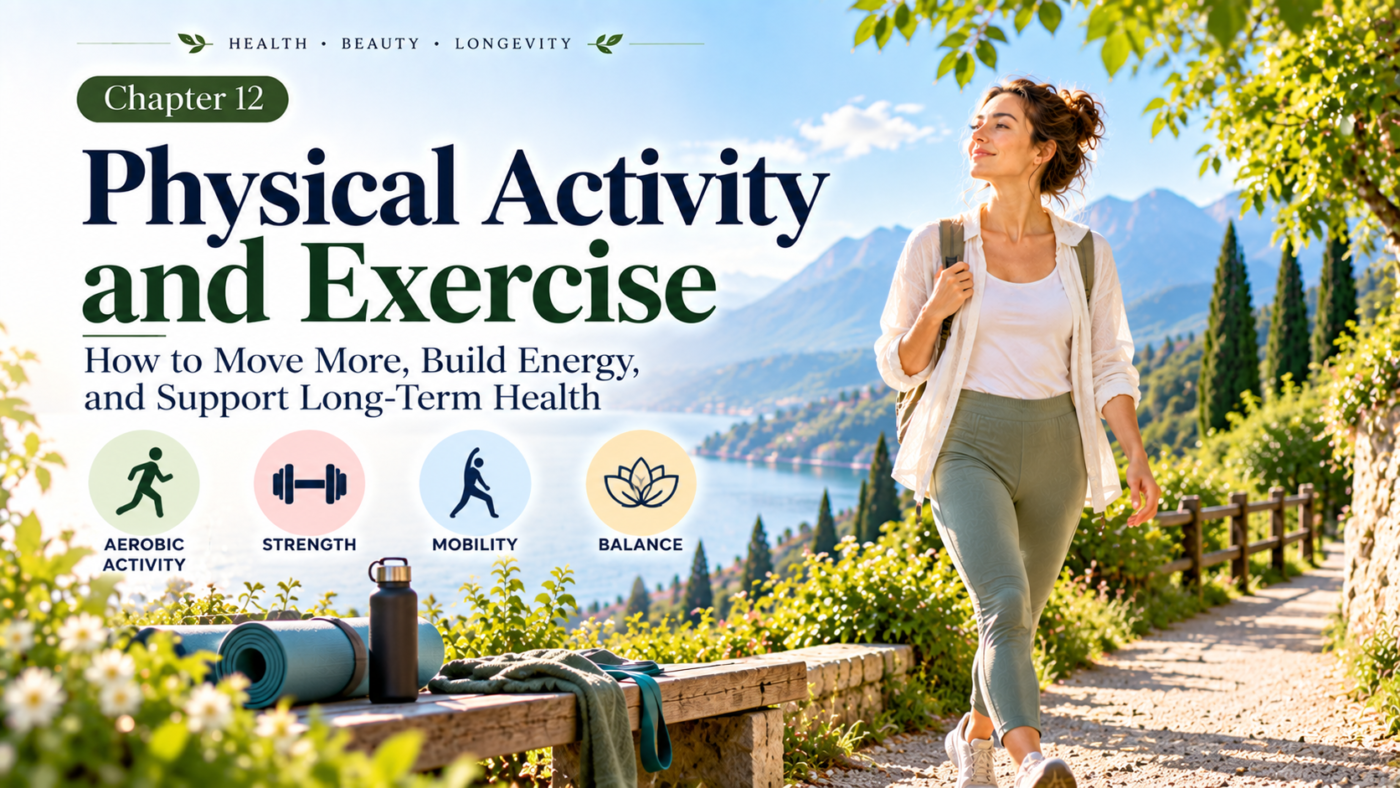
What Is the Difference Between Physical Activity and Exercise?
Physical activity includes any bodily movement that increases energy expenditure, such as walking, gardening, climbing stairs, household tasks, cycling, or playing with children. Exercise is a more structured form of physical activity that is usually planned and repeated with the goal of improving or maintaining fitness. Both can contribute to a healthier, more active life.Physical activity and exercise are among the most important foundations of long-term health, yet modern life makes it remarkably easy to move less. We drive instead of walking, sit while working, sit while eating, and often spend our leisure time in front of screens. As movement disappears from everyday life, many people begin to think of exercise as a separate task that must somehow be squeezed into an already crowded schedule.For most of human history, movement was built into ordinary life. Today, we often have to create it deliberately.
Human beings are built to move.
Yet modern life makes movement surprisingly easy to avoid.
We sit while working, sit while commuting, sit while eating, sit while watching television, and often sit while communicating with other people. Food arrives at the door. Meetings happen on screens. Entertainment is available without leaving the sofa.
Convenience has transformed daily life, but it has also removed much of the movement that once happened automatically.
This does not mean everyone needs an intense workout program.
It means the body benefits from regular opportunities to walk, lift, reach, balance, climb, stretch, and move through space.
Physical activity is not only about fitness.
It supports function.
It helps preserve independence.
It gives the heart, lungs, muscles, bones, and nervous system regular work to do.
And when approached appropriately, it can support mood, sleep, resilience, and everyday energy.
The challenge is not simply knowing that exercise is good for us.
The real challenge is building a form of movement that we can continue.
Physical Activity and Exercise Are Not Exactly the Same
The terms are often used interchangeably, but there is a useful distinction.
Physical activity includes any movement that uses energy.
Walking to the store.
Climbing stairs.
Gardening.
Cleaning.
Carrying groceries.
Playing with children.
Cycling to work.
Dancing.
Exercise is usually more structured.
A strength session.
A scheduled run.
Swimming laps.
A tai chi class.
A resistance-band routine.
Both matter.
You do not need to become an “exercise person” before movement can benefit your health.
A more active daily life is already a meaningful start.
How Much Activity Do Adults Need?
Current U.S. public-health guidance recommends that most adults work toward at least 150 minutes of moderate-intensity aerobic activity each week, or 75 minutes of vigorous-intensity activity, or an equivalent combination of the two.
Adults should also include muscle-strengthening activity on at least two days each week.
The activity does not need to happen all at once.
It can be divided across the week and broken into shorter periods.
Most importantly, some activity is better than none.
The person who begins with ten minutes of walking is not failing because they have not yet reached 150 minutes.
They are starting.
What Does Moderate Intensity Feel Like?
Exercise intensity does not need to be mysterious.
During moderate-intensity activity, your breathing and heart rate increase, but you can usually still speak in sentences.
Examples may include:
brisk walking,
recreational cycling,
water aerobics,
active dancing,
or other activities that noticeably raise effort without making conversation impossible.
During vigorous activity, breathing becomes much harder and speaking more than a few words at a time becomes difficult.
Intensity is relative.
A pace that feels easy to one person may feel demanding to another.
Age, fitness, medical conditions, medications, heat, altitude, and previous activity level all influence how exercise feels.
The appropriate effort is the one matched to the individual.
You Do Not Need to Exercise for 30 Minutes at Once
One of the most persistent barriers to movement is the belief that exercise “does not count” unless it lasts for a long uninterrupted session.
That is unnecessarily discouraging.
Short periods of activity can contribute to a more active day.
Ten minutes before work.
Ten minutes at lunch.
Ten minutes after dinner.
Walking farther across a parking lot.
Taking stairs.
Standing and moving between long periods of desk work.
The most useful movement plan is one that fits real life.
Perfect scheduling is not required.
Consistency matters more.
Aerobic Activity: Train the Heart and Lungs
Aerobic activity uses large muscle groups continuously enough to increase breathing and heart rate.
Examples include:
walking,
jogging,
cycling,
swimming,
dancing,
rowing,
hiking,
and some forms of active sport.
Regular aerobic activity can improve cardiovascular fitness and endurance.
Over time, ordinary activities such as walking uphill, carrying groceries, or climbing stairs may become easier.
For many people, walking is an excellent entry point because it requires little equipment and can be adjusted easily.
The goal does not have to be speed.
The first goal can simply be regularity.
Strength Training: Do Not Ignore Muscle
Cardio often receives most of the attention in discussions of health, but muscle strength matters enormously.
Muscles help us stand up.
Carry objects.
Climb stairs.
Maintain posture.
Protect joints.
Perform household tasks.
Remain independent as we age.
Strength training can involve:
free weights,
machines,
resistance bands,
body-weight exercises,
or appropriately challenging household and recreational activities.
You do not need to become a bodybuilder.
You need muscles that are capable of supporting everyday life.
Adults are generally advised to include muscle-strengthening activities for the major muscle groups on at least two days each week.
Balance Matters More With Age
Balance is easy to ignore until it becomes a problem.
As people get older, maintaining balance becomes increasingly important because falls can have serious consequences.
Balance activities may include:
tai chi,
standing on one foot,
heel-to-toe walking,
controlled stepping,
certain yoga movements,
and other exercises that challenge stability safely.
The National Institute on Aging recommends that older adults combine aerobic activity, strength training, and balance work; its current guidance suggests balance practice about three times per week.
Balance training is not only for people who already fall.
It is a skill worth maintaining before problems appear.
Flexibility Helps You Move Freely
Flexibility is not a replacement for strength or aerobic fitness.
But it can help maintain comfortable range of motion.
Stretching may make movements such as reaching, bending, dressing, and exercising easier.
The goal is not extreme flexibility.
You do not need to force the body into dramatic positions.
Gentle, regular movement through comfortable ranges is more useful than painful stretching.
Warm muscles generally tolerate stretching better than cold ones.
If a stretch hurts sharply, back off.
The Best Exercise Is the One You Will Actually Do
People often search for the “best” workout.
Running versus cycling.
Weights versus yoga.
Morning versus evening.
Gym versus home.
The better question is:
What form of movement can I realistically continue?
An excellent program that you hate will eventually disappear.
A good program that fits your life can become a habit.
Enjoyment matters.
Convenience matters.
Cost matters.
Safety matters.
Your schedule matters.
Your current ability matters.
A person who enjoys swimming may swim consistently for years.
Someone who dislikes pools may quit after three visits.
There is no prize for choosing an activity simply because someone else considers it superior.
Why Exercise Equipment Often Becomes Furniture
Many people buy fitness equipment during a burst of motivation.
A treadmill.
An exercise bike.
Weights.
A rowing machine.
Resistance equipment.
For several days or weeks, enthusiasm is strong.
Then life interrupts.
The machine moves to the corner.
Eventually clothes are hanging from it.
This is usually not because the person lacks character.
The problem is often that buying equipment addressed the wrong problem.
Equipment does not create a habit.
A habit requires a repeatable cue, realistic timing, manageable difficulty, and a reason to return.
Before buying expensive equipment, ask:
When exactly will I use this?
Where will it stay?
Do I enjoy this form of exercise?
What will happen when motivation is low?
Is there a simpler way to begin?
Sometimes the best first purchase is not equipment.
It is comfortable shoes.
Motivation Is Unreliable
Motivation is useful.
It is also temporary.
Waiting to “feel motivated” is one reason exercise routines disappear.
A stronger strategy is to reduce the number of decisions required.
Choose specific days.
Choose a specific time.
Prepare clothing in advance.
Use a familiar walking route.
Keep resistance bands somewhere visible.
Exercise with another person.
Attach movement to something you already do.
For example:
After lunch, I walk for ten minutes.
That is stronger than:
I should exercise more.
Specific behavior is easier to repeat than a vague intention.
Start Smaller Than You Think You Need To
The beginning of a fitness plan is not the time to prove how hard you can work.
It is the time to prove that you can return.
A person who begins too aggressively may experience severe soreness, frustration, or injury.
Then the plan ends.
A better beginning may look almost too easy.
A ten-minute walk.
One set of basic strength exercises.
A short tai chi routine.
Five minutes of mobility.
Gradual progression creates capacity.
CDC guidance emphasizes that any amount of physical activity can provide health benefits, and current NIA advice for older adults specifically recommends increasing activity gradually over weeks to months.
Movement Should Add Capacity, Not Constant Exhaustion
There is a difference between healthy exertion and constantly pushing beyond recovery.
Exercise may make you temporarily tired.
That is not automatically a problem.
But a sustainable program should generally allow you to recover.
Signs that a routine may need adjustment include:
persistent excessive soreness,
steadily worsening performance,
repeated injury,
sleep disruption,
unusual exhaustion,
or feeling that you never recover between sessions.
More exercise is not always the solution to low energy.
Sometimes the body needs recovery.
Sometimes the training load needs to change.
Sometimes fatigue requires medical investigation.
Movement Can Support Mental Health
Exercise is often discussed only in terms of weight, blood pressure, or cardiovascular health.
But movement can also support psychological well-being.
Physical activity may reduce feelings of anxiety, improve sleep, and support mood.
For older adults, NIA notes both immediate and longer-term benefits, including reduced anxiety and improved sleep as well as better physical function over time.
Exercise should not be presented as a cure for every mental health problem.
Depression and anxiety can require professional treatment.
But movement can be one useful part of a broader approach.
Exercise Is Not Primarily a Weight-Loss Punishment
Many people have learned to connect exercise with guilt.
They exercise because they ate dessert.
Because they dislike their body.
Because they believe they must “burn off” food.
That mindset can damage the relationship with movement.
Physical activity has value even when body weight does not change.
You can exercise to become stronger.
To improve endurance.
To maintain mobility.
To sleep better.
To spend time outdoors.
To feel more capable.
To support healthy aging.
To enjoy yourself.
Movement deserves a purpose larger than punishment.
Break Up Long Periods of Sitting
A person can meet formal exercise guidelines and still spend much of the day sitting.
That is why public-health guidance increasingly emphasizes:
move more and sit less.
You do not need an elaborate anti-sitting strategy.
Stand during some phone calls.
Walk to speak with a colleague.
Take brief movement breaks.
Use stairs when practical.
Stretch between tasks.
Walk after a meal.
Place commonly used items far enough away that you have to get up.
Small interruptions to sedentary time can help make daily life more active.
CDC specifically notes that adults who sit less and engage in any amount of moderate- or vigorous-intensity activity gain health benefits.
Outdoor Activity Adds Another Dimension
Walking on a treadmill is physical activity.
Walking through a park is also physical activity.
Both can be beneficial.
Outdoor movement may add:
daylight,
green space,
a change of scenery,
social interaction,
and a break from indoor screens.
If you enjoy being outdoors, use that preference.
Walk.
Hike.
Cycle.
Garden.
Practice tai chi.
Swim where it is safe.
The environment can make movement easier to repeat.
Social Exercise Can Improve Consistency
Some people prefer exercising alone.
Others are more consistent when movement is social.
A walking partner can create accountability.
A group class provides structure.
Family walks combine movement and connection.
Recreational sports make exercise feel like play.
There is no universal best format.
If social contact helps you show up, use it.
If solitude makes exercise more restorative, protect that instead.
Goals Should Be Behavioral, Not Only Numerical
Goals can help.
But outcome goals are not completely under your control.
“Lose 20 pounds” depends on many factors.
“Walk Monday, Wednesday, and Friday after lunch” describes an action you can perform.
Useful behavioral goals include:
walk for fifteen minutes after dinner four times this week,
complete two strength sessions,
practice tai chi three mornings,
take the stairs once each workday,
or stand up and move every hour during desk work.
Success becomes something you can actually do rather than something you must wait to see.
Track Enough, but Not Everything
Fitness trackers can be useful.
They can remind you to move and help you notice patterns.
But they can also turn movement into constant measurement.
You do not need to optimize every step.
Some days, the watch can stay at home.
Exercise is still real if it is not recorded.
The purpose of tracking should be to support behavior, not to make you anxious about numbers.
Exercise and Chronic Health Conditions
People with chronic illnesses can often benefit from physical activity, but the appropriate amount and intensity may differ.
Heart disease.
Arthritis.
Diabetes.
Neurological conditions.
Chronic pain.
Disability.
These situations may require individualized advice.
CDC recommends that people with chronic conditions discuss appropriate activity with a healthcare professional when necessary, particularly when deciding what types and amounts of exercise are suitable.
The goal is not avoiding movement automatically.
It is choosing movement safely.
An Important Exception: ME/CFS and Post-Exertional Malaise
Generic advice to gradually exercise more is not appropriate for every form of chronic fatigue.
People with ME/CFS can experience post-exertional malaise (PEM), in which physical or mental exertion triggers a significant worsening of symptoms.
In this situation, pushing beyond individual limits may make symptoms worse.
Activity needs to be managed differently.
This is another reason persistent unexplained fatigue should be evaluated rather than treated automatically with a more demanding exercise program.
Warning Signs During Exercise
Exercise commonly increases breathing and heart rate.
But some symptoms deserve prompt attention.
Stop exercising and seek appropriate medical advice if you experience concerning symptoms such as:
chest pain,
fainting,
severe or unusual shortness of breath,
new neurological symptoms,
or symptoms that feel distinctly abnormal for you.
People beginning vigorous exercise after a long period of inactivity, or people with significant chronic health conditions, may need professional guidance before substantially increasing intensity.
A Simple Beginner Week
A movement plan does not have to be complicated.
Monday
20-minute brisk walk.
Tuesday
15–20 minutes of basic strength exercises.
Wednesday
Short walk plus gentle mobility.
Thursday
20-minute brisk walk.
Friday
Rest or light activity.
Saturday
Strength session plus an easy walk.
Sunday
Outdoor walk, tai chi, cycling, swimming, gardening, or another enjoyable activity.
This is only an example.
It can be shortened, extended, or adapted.
The point is variety and consistency rather than perfection.
If You Have Only Ten Minutes
Walk.
Climb stairs.
Do body-weight squats if appropriate.
Use resistance bands.
Dance to two songs.
Practice tai chi.
Do a short mobility sequence.
Walk while talking on the phone.
Ten minutes is not meaningless.
It is ten minutes more movement than you would otherwise have had.
Repeated often enough, small sessions become a pattern.
Exercise Across the Lifespan
The reason to move changes with age.
A younger adult may care about athletic performance.
A middle-aged adult may want to maintain cardiovascular and metabolic health.
An older adult may care most about strength, balance, independence, and the ability to continue doing everyday activities.
The underlying principle remains the same:
maintain enough physical capacity to participate in life.
For older adults, regular aerobic, strengthening, and balance activities are especially valuable for function and independence. NIA notes that physical activity can help older adults maintain daily function and reduce fall-related risks.
Make Movement Part of Your Identity
One of the most useful changes is moving away from:
“I am trying to exercise.”
toward:
“Movement is part of how I take care of myself.”
That identity does not require athleticism.
A person who walks regularly is active.
A person who strength trains twice each week is active.
A person who practices tai chi and gardens is active.
A person using a wheelchair who follows an appropriate upper-body activity program can be active.
There is no single visual appearance that defines an active person.
The Goal Is Not Maximum Fitness
The healthiest movement plan is not necessarily the hardest.
It is one that supports the life you want to live.
Enough endurance to move through your day.
Enough strength to handle ordinary tasks.
Enough balance to feel secure.
Enough mobility to move comfortably.
Enough recovery to continue.
The body does not need punishment.
It needs use.
And in a world that makes sitting effortless, one of the most powerful health habits is also one of the simplest:
keep moving.
7 Ways to Add More Physical Activity and Exercise to Your Life
1. Walk More Often
Walking is one of the simplest ways to increase everyday activity. Start with short walks and build gradually according to your current ability.
2. Break Up Long Periods of Sitting
Stand, stretch, walk briefly, or change position regularly during long periods of desk work or screen use.
3. Include Strength Training
Use weights, resistance bands, machines, or bodyweight exercises to train major muscle groups on at least two days each week when appropriate.
4. Add Mobility to Your Routine
Gentle mobility and stretching can support comfortable movement and make other forms of activity easier to perform.
5. Practice Balance
Balance becomes especially important with age. Tai chi, controlled stepping, heel-to-toe walking, and other balance activities can be useful options.
6. Choose Activities You Enjoy
Walking, cycling, swimming, dancing, gardening, tai chi, hiking, or strength training can all contribute. Enjoyable activity is easier to repeat.
7. Start Small and Build Gradually
An inactive person does not need to jump immediately into an intensive routine. Small, repeatable amounts of activity can become the foundation for greater fitness over time.
WHO recommends beginning with smaller amounts when inactive and gradually increasing frequency, intensity, and duration.
How Much Physical Activity Do Adults Need?
Adults ages 18–64
Aerobic activity:
150–300 minutes per week of moderate-intensity activity, or 75–150 minutes of vigorous activity, or an equivalent combination.
Strength:
At least 2 days per week involving the major muscle groups.
Sedentary time:
Reduce prolonged sitting and replace sedentary time with movement when practical.
Adults ages 65+
The aerobic and strength recommendations remain broadly similar, with additional emphasis on activities that improve functional balance.
These are population-level guidelines, not an individualized exercise prescription.
| Type | Main Purpose | Examples |
|---|---|---|
| Aerobic Activity | Cardiovascular endurance | Brisk walking, cycling, swimming, dancing |
| Strength | Muscle and functional capacity | Weights, resistance bands, bodyweight exercises |
| Mobility | Comfortable range of motion | Mobility drills, gentle stretching, yoga |
| Balance | Stability and fall prevention | Tai chi, heel-to-toe walking, single-leg balance |
FAQ
What is the difference between physical activity and exercise?
Physical activity includes any movement produced by the body that increases energy expenditure, while exercise is generally planned, structured and repeated to improve or maintain fitness.
How much exercise should adults get each week?
WHO recommends approximately 150–300 minutes of moderate-intensity aerobic activity or 75–150 minutes of vigorous-intensity activity per week, together with muscle-strengthening activities on at least two days.
Is walking enough exercise?
Walking can make an important contribution to aerobic activity, particularly when performed at an appropriate intensity. A complete routine should ideally also address muscle strength, and older adults should include balance activities.
Do I need 30 minutes of exercise all at once?
No. CDC notes that weekly activity can be spread across the week and divided into smaller periods. Some physical activity is better than none.
How many days a week should I strength train?
Current adult guidance recommends muscle-strengthening activity involving the major muscle groups on at least two days per week.
Should older adults exercise differently?
Adults 65 and older should combine aerobic activity, muscle-strengthening work and balance activities. Individual health and functional ability should determine the specific program.
Can exercise improve energy?
Appropriate regular activity can improve physical capacity, meaning everyday tasks may require less relative effort. Physical activity also supports sleep and mental and physical health. Persistent unexplained fatigue, however, should not simply be treated by exercising harder.
Should I exercise when I feel very tired?
It depends on the cause. Ordinary inactivity and deconditioning differ from medical conditions such as ME/CFS, in which exertion can provoke post-exertional malaise. Persistent or unusual fatigue deserves appropriate evaluation.
Is more exercise always better?
No. Training requires recovery, and appropriate exercise depends on current fitness, health, age and goals. Pain, fainting, chest symptoms, unusual shortness of breath or marked deterioration require caution and possible professional assessment.
Medical Disclaimer: This article is for general educational and informational purposes only and is not intended as medical advice, diagnosis, or individualized exercise prescription. Physical activity should be adapted to age, fitness, disability, medications, chronic health conditions, pregnancy status, symptoms, and individual capacity. Seek qualified healthcare guidance when necessary, especially before beginning vigorous exercise if you have significant health concerns or have been inactive for a prolonged period.
This article is for general education and does not replace individualized care from a qualified health professional. Seek appropriate advice for persistent, severe, or concerning symptoms.
Read the full medical disclaimer