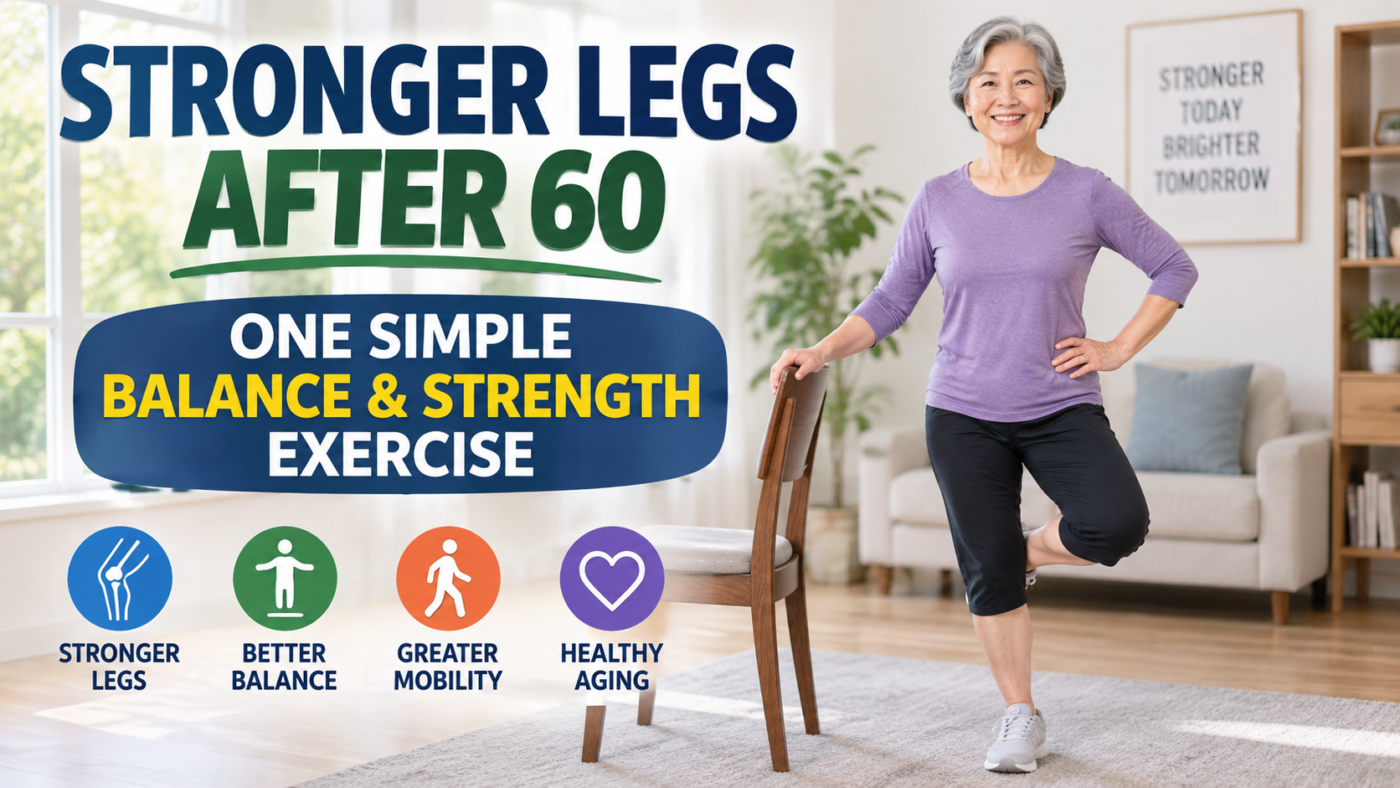
One-leg squat after 60 training can be a useful way to build lower-body strength, challenge balance, and support everyday mobility. As we age, declining leg strength, slower reactions, changes in vision and sensation, certain medications, and environmental hazards can all contribute to fall risk.Falls are one of the most serious threats to independence as we age. Reduced leg strength, declining balance, slower reactions, changes in vision and sensation, certain medications, and environmental hazards can all contribute to fall risk. The source material focuses especially on weakening legs and reduced stability as important age-related factors.
One exercise highlighted in the original routine is a supported one-leg squat. It combines lower-body strength work with a balance challenge, making it potentially useful for adults who already have enough strength and stability to perform it safely.
However, the original claim that one exercise can solve all of the causes of falls is too strong. No single movement can guarantee that someone will never fall. A safer, evidence-informed approach is to use exercises like this as one part of a broader strength, balance, mobility, vision, medication, footwear, and home-safety strategy.
Why Leg Strength Matters as You Age
Strong legs support nearly every part of independent daily life: standing up from a chair, climbing stairs, walking outdoors, recovering from a small loss of balance, and getting around without assistance.
The original routine emphasizes the quadriceps, glutes, calves, hips, knees, and the stabilizing muscles needed to maintain a single-leg position.
This is important because muscle mass, strength, and power can decline with aging, particularly when physical activity and resistance exercise decrease. The good news is that older adults can still improve strength and physical function through appropriately progressed resistance and balance training.
The goal is therefore not simply to “exercise the legs.” It is to preserve the physical capacity needed for everyday independence.
What Is a One-Leg Squat?
In this routine, you stand primarily on one leg while the other leg is positioned behind it. The supporting knee remains slightly bent. From there, you lower your body only as far as you can comfortably control before returning to standing.
The original demonstration specifically advises against locking the supporting knee and recommends keeping the movement slow and controlled.
This is considerably more demanding than ordinary two-leg standing because the supporting leg must simultaneously produce force and stabilize the body.
For many older adults, however, a full unsupported one-leg squat is unnecessarily difficult. A chair-supported or counter-supported version is a much better starting point.
How to Do the Safer Supported Version
Stand next to a sturdy kitchen counter, railing, or heavy chair that will not slide.
Place one hand on the support.
Shift most of your weight onto one leg while keeping the knee softly bent rather than rigidly locked.
Lift or lightly position the other foot so that it is no longer carrying your body weight. You do not need to copy an advanced leg position if it feels uncomfortable.
Keep your chest upright and your supporting foot firmly planted.
Slowly bend the supporting knee and hip, lowering yourself only a few inches.
Pause briefly.
Push through the supporting foot and return to the starting position under control.
The original routine recommends limiting the depth according to your ability to maintain balance and performing the movement slowly rather than rushing through repetitions.
That principle is more important than achieving a deep squat.
Start Easier Than You Think
The original demonstration suggests that beginners can hold a wall or chair until their balance improves.
That is an important modification.
For an older beginner, there is no reason to start with 10–15 unsupported repetitions or several sets every day. Begin with a level that feels stable and controlled—for example, a few shallow repetitions on each side while holding a secure support.
Progress gradually by increasing repetitions, range of motion, or reducing hand assistance only when the current version feels comfortable.
Quality matters more than quantity.
What Muscles Does It Train?
The supporting leg performs most of the work.
The quadriceps help control knee bending and straightening. The gluteal muscles contribute to hip extension and pelvic stability. The calf and ankle muscles help control the lower leg, while smaller stabilizing muscles continuously respond to changes in body position.
The source specifically describes muscular effort through the front of the thigh, buttocks, and calf during the lowering and rising phases.
Because only one leg is carrying most of the load, the exercise also introduces a meaningful balance challenge.
Why Single-Leg Training Challenges Balance
Standing on two feet gives the body a relatively large base of support.
Standing primarily on one foot makes that base much smaller.
Your nervous system must continuously integrate information from your eyes, inner ear, joints, muscles, and feet while making small muscular corrections to keep you upright.
The original routine describes these ongoing adjustments during single-leg standing and connects them with balance training.
That basic concept is sound: appropriately challenging balance is one way to train it.
But deliberately exercising close to the point of falling is unnecessary. Balance training works best when it is challenging enough to require control while still being safe.
Slow and Controlled Is Better
Avoid bouncing or dropping quickly into the squat.
The source repeatedly emphasizes slow movement and notes that moving too quickly can allow momentum to take over.
Think:
Lower slowly.
Stay controlled.
Keep the knee tracking comfortably over the foot.
Return smoothly.
Stop before technique deteriorates.
A shallow, controlled repetition is much more valuable than a deep repetition that causes you to wobble uncontrollably.
What About Bone Health?
Weight-bearing and resistance exercise can contribute to maintaining bone health because bone responds to mechanical loading.
The source connects muscular contractions and lower-body loading with skeletal stimulation.
That general principle is reasonable, although the original explanation that exercise simply helps calcium “enter the bones” is an oversimplification.
Bone health is influenced by several factors, including resistance and weight-bearing activity, adequate nutrition, vitamin D status, hormones, medications, smoking, alcohol use, and underlying health conditions.
Exercise is important, but it is one component of a larger strategy.
Traditional Wellness Perspective
Traditional movement practices often emphasize developing a stable “lower foundation” or 下盘.
In practical movement terms, this idea overlaps with strengthening the legs, improving control around the hips and ankles, developing balance, and becoming more confident when transferring body weight.
The original material describes stronger legs as a foundation for walking, going outside, and maintaining the ability to care for oneself.
That is a useful way to think about healthy aging: maintaining function is ultimately more important than performing an impressive exercise.
Who Should Not Start With an Unsupported One-Leg Squat?
This is not an ideal first exercise for everyone.
If you have frequent falls, severe balance problems, significant knee or hip pain, recent surgery, dizziness, fainting, substantial weakness, or difficulty standing safely on one leg, begin with a simpler exercise and consider professional assessment.
Good alternatives include sit-to-stand exercises, supported mini squats, heel raises, supported marching, and supported single-leg standing.
These movements can build the foundation required for more demanding single-leg exercises later.
A Simple Progression
A practical progression is:
Level 1: Sit-to-stand from a stable chair.
Level 2: Two-leg mini squat while holding a counter.
Level 3: Supported single-leg standing.
Level 4: Supported shallow one-leg squat.
Level 5: Gradually reduce hand support while maintaining excellent control.
There is no prize for reaching Level 5 quickly.
For healthy aging, consistency and safety matter far more than difficulty.
The Bottom Line
A one-leg squat can be an effective lower-body strength and balance exercise for people who are ready for it. It challenges the quadriceps, glutes, calves, ankles, hips, and the neuromuscular systems responsible for postural control.
But it should not be promoted as a miracle exercise that guarantees freedom from falls.
The better message is much more useful:
Build stronger legs. Train balance regularly. Progress gradually. Use support when necessary. Preserve the physical capacity that helps you remain active and independent as you age.
That is the real value of this exercise.
FAQ
Are one-leg squats good for older adults?
They can be, provided the person already has sufficient strength and balance. Beginners and people with increased fall risk should use a stable support or start with easier exercises.
How deep should I squat?
Only as deeply as you can while maintaining good alignment, comfort, and balance. A shallow controlled squat is perfectly acceptable.
Can this exercise prevent falls?
Strength and balance training can contribute to fall-prevention programs, but no single exercise can guarantee that someone will not fall.
Should I hold a chair?
Yes. If there is any uncertainty about balance, use a sturdy counter, railing, or secure chair. The original routine itself recommends wall or chair support for beginners.
Is shaking during the exercise normal?
Some muscular trembling can occur when an exercise is challenging, particularly when learning a new movement. But significant loss of balance, dizziness, sharp pain, or a feeling that the leg may give way is a reason to stop.
Medical Disclaimer
This article is for educational purposes only and is not medical advice. Exercise ability and fall risk vary considerably between individuals. People with osteoporosis, recurrent falls, significant balance impairment, joint disease, cardiovascular or neurological conditions, recent surgery, or other relevant medical concerns should seek appropriate professional guidance before beginning demanding single-leg exercises.
This article is for general education and does not replace individualized care from a qualified health professional. Seek appropriate advice for persistent, severe, or concerning symptoms.
Read the full medical disclaimer