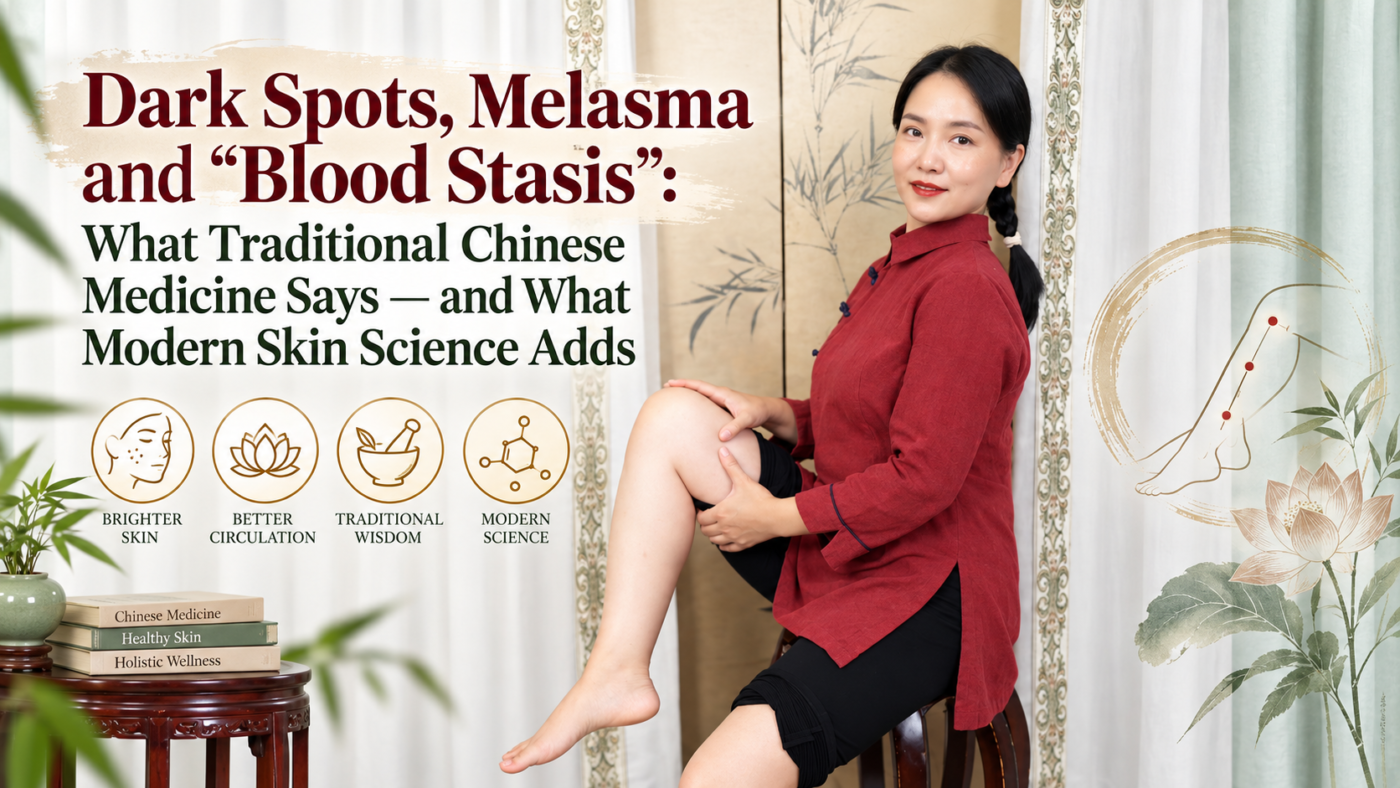
Blood stasis acupressure is a traditional Chinese medicine wellness approach sometimes discussed in connection with facial discoloration, dark spots and uneven-looking skin. However, melasma, freckles, age spots and post-inflammatory hyperpigmentation can develop for very different biological reasons.
Traditional Chinese medicine often interprets persistent facial discoloration through patterns involving qi movement and what is traditionally called blood stasis. Modern dermatology, however, explains pigmentation mainly through melanin production, ultraviolet exposure, hormones, inflammation, genetics and skin aging.Dark spots on the face are common, but they do not all have the same cause. Melasma, freckles, age spots, post-inflammatory hyperpigmentation and other forms of discoloration can look similar while developing for very different reasons.
Traditional Chinese medicine often interprets persistent facial discoloration through patterns involving circulation, qi movement and what is traditionally called “blood stasis.” Modern dermatology, however, explains pigmentation mainly through melanin production, ultraviolet exposure, hormones, inflammation, genetics and skin aging.
These two frameworks are not identical. Acupressure may be used as part of a traditional wellness routine, but it should not be presented as a proven treatment that removes melasma, age spots or other pigmentation disorders.
This guide explains the traditional idea of blood stasis, introduces five commonly used acupressure points, and shows how to practice them more safely without confusing traditional wellness concepts with established medical treatment.
Why Dark Spots Appear
Pigmentation develops when the skin produces or retains more melanin in certain areas.
Common forms include melasma, solar lentigines, freckles and post-inflammatory hyperpigmentation.
Melasma
Melasma usually appears as brown or gray-brown patches, most often on the cheeks, forehead, upper lip or nose.
It is influenced by several factors, including sun exposure, visible light, hormonal changes, pregnancy, some medications and genetic susceptibility.
Melasma can be persistent and often returns after sun exposure.
Solar Lentigines, or “Age Spots”
Age spots are flat brown marks that commonly appear on areas exposed to sunlight over many years, including the face, hands, shoulders and arms.
Despite the name, they are related more strongly to cumulative ultraviolet exposure than to aging alone.
Freckles
Freckles are usually genetically influenced and become darker with sun exposure.
Post-Inflammatory Hyperpigmentation
Dark marks may remain after acne, eczema, skin irritation, burns, cosmetic procedures, scratching or inflammation.
This is particularly common in darker skin tones.
Because different pigment problems require different approaches, persistent or changing spots should not automatically be treated as one condition.
What Does “Blood Stasis” Mean in Traditional Chinese Medicine?
In traditional Chinese medicine, blood stasis is a theoretical pattern describing impaired or obstructed movement of blood and qi.
Traditional practitioners may associate this pattern with signs such as a dull or darker complexion, persistent localized discomfort, fixed or stabbing pain, dark or purplish lips or tongue, and prominent veins beneath the tongue.
However, these observations should not be interpreted as proof of a medical blood-circulation disorder.
For example, visible veins under the tongue are common anatomical structures. Their size and color vary naturally between individuals and do not by themselves diagnose disease.
Similarly, facial pigmentation cannot be reliably diagnosed as blood stasis from tongue appearance alone.
Traditional pattern recognition may have cultural and historical value, but it should not replace medical assessment when symptoms are persistent, painful or unusual.
Can Acupressure Remove Dark Spots?
There is currently no strong evidence that pressing acupuncture points can reliably erase melasma, freckles, solar lentigines or other forms of hyperpigmentation.
Acupressure may still be useful as a gentle wellness practice because it can encourage relaxation, provide a calming daily ritual, increase body awareness, help some people manage tension and complement broader self-care practices.
But it is important to separate these possible benefits from claims that acupressure can directly clean the blood, remove internal toxins or make pigment disappear.
For pigmentation itself, sun protection and appropriate dermatologic care remain much more important.
A Traditional Five-Point Acupressure Routine
The routine can be organized into three traditional stages:
- Supporting qi movement
- Supporting blood circulation
- Supporting overall balance
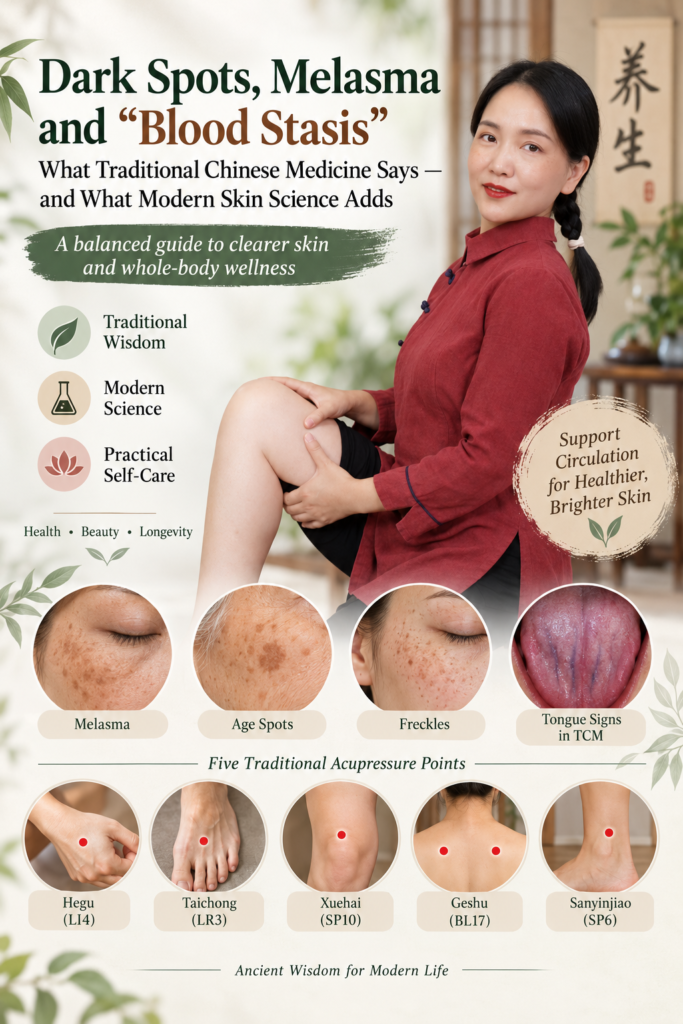
The five points commonly used are Hegu LI4, Taichong LR3, Xuehai SP10, Geshu BL17 and Sanyinjiao SP6.
The descriptions below are presented as traditional wellness practices rather than medical treatment.
Stage 1: Supporting Qi Movement
Traditional Chinese medicine often teaches that qi helps move blood through the body.
Two classic points frequently paired for this purpose are Hegu and Taichong.
Together, they are traditionally known as part of the “Four Gates” combination.
1. Hegu — LI4
Where It Is
Hegu is located on the back of the hand, between the thumb and index finger.
A practical way to find it is to bring the thumb and index finger together and look for the highest point of the muscle between them.
The point lies near the second metacarpal bone rather than directly in the center of the webbing.
How to Massage It
Use the thumb of the opposite hand.
Press gently toward the second metacarpal bone.
Massage in small circles for approximately 30 to 60 seconds per side.
The pressure should feel noticeable but comfortable.
A mild aching or heavy sensation can occur, but sharp pain is not necessary and should not be deliberately produced.
Traditional Use
Hegu has traditionally been used for head and facial discomfort, tension, general qi circulation and some pain-related complaints.
These traditional uses do not mean that LI4 has been proven to treat facial pigmentation.
Important Precaution
Strong stimulation of LI4 is traditionally avoided during pregnancy unless advised by a qualified professional.
2. Taichong — LR3
Where It Is
Taichong lies on the top of the foot.
Start between the big toe and second toe.
Move your finger upward along the space between the first and second metatarsal bones until you reach a slight depression.
How to Massage It
Use your thumb to apply moderate pressure.
Massage for 30 to 60 seconds per side.
You may repeat once or twice if comfortable.
There is no benefit to pressing until the pain becomes difficult to tolerate.
Traditional Use
Taichong is traditionally associated with smooth movement of qi, emotional tension, irritability, head discomfort and general relaxation.
Claims that stagnant qi leaves the body through this point should be understood as traditional metaphor rather than established physiology.
Stage 2: Supporting Traditional Blood Regulation
The next two points are traditionally connected with blood-related patterns.
They are Xuehai and Geshu.
3. Xuehai — SP10
The Chinese name Xuehai is often translated as “Sea of Blood.”
Where It Is
Xuehai is located on the inner front portion of the thigh, above the inner border of the kneecap.
A commonly used traditional location is approximately two cun above the upper-inner border of the patella.
Because traditional body-inch measurements vary with body size, beginners may find professional instruction useful.
How to Stimulate It
Rather than hitting the area forcefully, use the fingers or palm to apply gentle pressure.
Massage for 30 to 60 seconds on each side.
You can also use gentle circular rubbing.
Avoid Aggressive Bruising
If forceful tapping or massage produces a large bruise, swelling or dark-purple lump, that should not be interpreted as proof that blood stasis is leaving the body.
Bruising means that small blood vessels have been damaged and blood has leaked into surrounding tissues.
Stop the massage and allow the area to heal.
Repeatedly bruising the same area is not a therapeutic goal.
People taking anticoagulants, antiplatelet medications or those with bleeding disorders should be particularly cautious with strong pressure or percussion massage.
4. Geshu — BL17
Geshu is another important traditional point associated with blood.
Where It Is
BL17 lies on the back, on both sides of the spine, approximately at the level of the seventh thoracic vertebra.
Because accurately locating points on your own back is difficult, assistance from a trained practitioner or family member may be safer.
How to Practice
Gentle massage around the area is preferable to aggressive striking.
A soft massage tool may be used carefully if it does not cause pain or bruising.
Avoid hitting directly over the spine.
Traditional Use
Geshu is traditionally associated with blood-related patterns, upper-back tension and circulation concepts in TCM.
Again, these are traditional indications rather than proof that the point can clean stagnant blood or fade pigmentation.
Stage 3: Supporting Overall Balance
The final point is one of the most commonly used points in traditional Chinese medicine.
5. Sanyinjiao — SP6
The name Sanyinjiao refers to the traditional meeting point of three yin meridians associated with the spleen, liver and kidney.
Where It Is
Sanyinjiao is located on the inner side of the lower leg.
Find the highest point of the inner ankle bone.
Move approximately four finger-widths upward.
The point lies just behind the inner border of the tibia.
How to Massage It
Use the thumb or fingertip.
Apply comfortable pressure and massage slowly for 1 to 2 minutes per side.
You may practice once daily if it feels comfortable.
Traditional Use
SP6 is traditionally used in routines involving digestive wellness, menstrual wellness, relaxation, sleep and general body balance.
Pregnancy Warning
Strong stimulation of SP6 is traditionally avoided during pregnancy unless supervised by an appropriately trained healthcare professional.
A Safer 10-Minute Routine
If you enjoy acupressure and want to use these points as part of a relaxation routine, there is no need to press extremely hard.
A simple sequence could be:
Hegu: 30 to 60 seconds each hand
Taichong: 30 to 60 seconds each foot
Xuehai: 30 to 60 seconds each side
Geshu: gentle massage for 1 to 2 minutes
Sanyinjiao: 1 minute each side
Total time is approximately 8 to 10 minutes.
Comfort is more important than intensity.
You should not deliberately cause severe pain, swelling, numbness, bleeding or large bruises.
The idea that stronger pain means a point is more blocked is not a reliable medical principle.
What Actually Helps Prevent Dark Spots From Becoming Worse?
If your main goal is clearer and more even-looking skin, these measures have much stronger scientific support.
Daily Sun Protection
UV exposure is one of the most important drivers of pigmentation.
Use broad-spectrum sunscreen every day, especially on the face, neck and hands.
Reapply during prolonged outdoor exposure.
For melasma, visible light can also contribute to pigmentation, so tinted sunscreens containing iron oxides may be useful for some people.
Avoid Repeated Skin Irritation
Excessive exfoliation, aggressive rubbing and irritating cosmetic products can worsen inflammation and lead to additional pigmentation.
This is particularly important for people prone to post-inflammatory hyperpigmentation.
Consider Evidence-Based Skin-Care Ingredients
Depending on the type of pigmentation, dermatologists may recommend ingredients such as vitamin C, niacinamide, azelaic acid, retinoids, hydroquinone, tranexamic acid or other prescription treatments.
Not every ingredient is appropriate for every person, particularly during pregnancy.
Persistent pigmentation deserves individualized evaluation.
Dark Spots That Should Be Checked by a Dermatologist
Not every dark spot is simply cosmetic pigmentation.
Have a lesion professionally evaluated if it changes rapidly, becomes asymmetrical, develops irregular borders, contains several unusual colors, bleeds, crusts repeatedly, becomes painful, grows noticeably or looks very different from your other spots.
A changing pigmented lesion should not be treated only with massage or home remedies.
What About Purple Lips, Dark Tongue Color or Prominent Sublingual Veins?
These findings are often emphasized in traditional Chinese medicine discussions of blood stasis.
However, they should not be used alone to diagnose circulation problems.
A bluish or purple coloration of the lips, particularly if sudden or associated with shortness of breath, chest pain, dizziness or confusion, requires prompt medical assessment.
Similarly, sudden severe headaches, persistent chest pain or new joint swelling should not be attributed automatically to blood stasis.
Chest Pain Is Not an Acupressure Problem
Traditional discussions of blood stasis sometimes connect the concept with symptoms such as chest tightness, palpitations and chest pain.
This is an area where caution is essential.
New, severe or unexplained chest pain, especially when accompanied by shortness of breath, sweating, nausea, weakness or pain spreading to the arm, jaw or back, can represent a medical emergency.
Acupressure should never delay urgent medical evaluation.
Can This Routine Make Your Complexion Look Brighter?
Relaxation, better sleep, regular movement and consistent self-care can influence how energetic and refreshed someone looks.
Gentle facial and body massage may also temporarily change local blood flow.
However, that is very different from permanently reducing melanin.
A realistic goal for this routine is relaxation and traditional self-care rather than guaranteed removal of dark spots.
That distinction makes the practice both safer and more credible.
The Bottom Line
Traditional Chinese medicine describes persistent discoloration through concepts such as qi stagnation and blood stasis.
Points such as Hegu, Taichong, Xuehai, Geshu and Sanyinjiao have long histories in acupuncture and acupressure traditions.
Gentle stimulation of these points can be incorporated into a wellness routine if it feels comfortable.
But facial spots, including melasma, freckles and age spots, have complex biological causes, and current evidence does not support the claim that acupressure alone can eliminate them.
For long-term skin health, combine any traditional wellness practice with consistent sun protection, gentle skin care, appropriate pigmentation treatments and professional evaluation of suspicious or changing lesions.
That creates a much safer bridge between traditional Eastern wellness and modern skin science.
FAQ
Can acupressure remove melasma?
Acupressure has not been proven to remove melasma. Melasma is strongly influenced by sunlight, hormones, genetics and pigment-cell activity. Acupressure may be used for relaxation, but sun protection and evidence-based dermatologic treatment remain more important.
Are purple veins under the tongue a sign of blood stasis?
Prominent veins under the tongue are common and vary naturally between people. Traditional Chinese medicine may interpret them as part of a broader pattern, but they do not independently diagnose a circulation disorder.
Is bruising after acupressure normal?
Mild temporary tenderness can occur, but significant bruising means blood vessels have been damaged. Intentionally producing bruises is unnecessary and should not be used as evidence that stagnation has been released.
How hard should I press an acupressure point?
Use comfortable, moderate pressure. Mild tenderness or heaviness may occur, but sharp or intolerable pain is not necessary.
How often can I practice this routine?
A gentle routine can generally be practiced once daily if it causes no irritation, bruising or worsening symptoms.
What is the most important step for preventing facial pigmentation?
Consistent protection from ultraviolet exposure is one of the most important measures for preventing many forms of pigmentation from worsening.
Medical Disclaimer
This article is for educational and general wellness purposes only. Traditional Chinese medicine concepts such as qi, meridians and blood stasis reflect a traditional medical framework and should not be interpreted as established anatomical or physiological mechanisms. Acupressure is not a substitute for diagnosis or treatment by a qualified healthcare professional. Seek medical care for persistent pigmentation, changing skin lesions, severe headache, chest pain, shortness of breath or other concerning symptoms.
This article is for general education and does not replace individualized care from a qualified health professional. Seek appropriate advice for persistent, severe, or concerning symptoms.
Read the full medical disclaimer