Microplastics in hot food have become an emerging concern as researchers examine how heat, fat, acidity, and prolonged contact may affect the release of tiny plastic particles and plastic-associated chemicals from food packaging.Plastic has become almost invisible in modern life.
You may buy coffee in a paper cup, steep tea from a convenient tea bag, microwave lunch in a takeaway container, cover leftovers with plastic wrap, or bring home hot soup in disposable packaging without giving the container much thought.
Yet many of these products are not simply “paper” or “plastic.” They may contain polymer linings, adhesives, coatings, colorants, stabilizers, or other materials designed to make packaging waterproof, flexible, durable, or heat resistant.
This does not mean that every plastic container is dangerous or that occasional exposure will make you sick. It does mean that when food is very hot, oily, acidic, or stored for a long time, choosing an appropriate food-contact material becomes more important.
The practical goal is not to eliminate every molecule of plastic from your life. That would be nearly impossible.
A more realistic goal is to reduce unnecessary exposure, especially in situations where a reusable glass, stainless-steel, or food-grade ceramic container works just as well.
Microplastics and Plasticizers Are Not the Same Thing
One of the most important distinctions is between microplastics and plasticizers.
Microplastics are tiny physical particles of plastic. Nanoplastics are even smaller particles, generally measured on the nanometer scale.
Plasticizers, by contrast, are chemicals added to certain plastics to modify their flexibility and other properties. Phthalates are one well-known group of plasticizers, particularly associated with flexible PVC and some other applications.
These two topics are often discussed together, but they should not be treated as interchangeable.
A container can potentially release small plastic particles without necessarily releasing phthalates, while a person may be exposed to phthalates from sources that do not involve visible microplastic particles at all.
Scientists are actively investigating both forms of exposure.
Micro- and nanoplastics have now been detected in several human tissues, but researchers are still working to determine what levels of exposure have meaningful effects on long-term health.
For that reason, the scientifically responsible position is neither panic nor dismissal.
Reducing avoidable exposure is reasonable while the research continues.
Why Heat Deserves Special Attention
Heat can affect polymers and food packaging.
When plastic-containing materials are exposed to high temperatures, physical wear, chemical migration, or degradation may increase depending on the polymer, manufacturing process, temperature, contact time, and type of food.
This does not mean that microwaving food itself is inherently dangerous.
The microwave is not the main issue.
The container is.
A product specifically designed and tested for microwave use is different from a thin takeaway tub, disposable plastic bag, old scratched container, or packaging that was never intended to hold extremely hot food.
When reheating meals, transferring the food to glass or microwave-safe ceramic is a simple way to reduce uncertainty.
The Four Situations Worth Watching Most
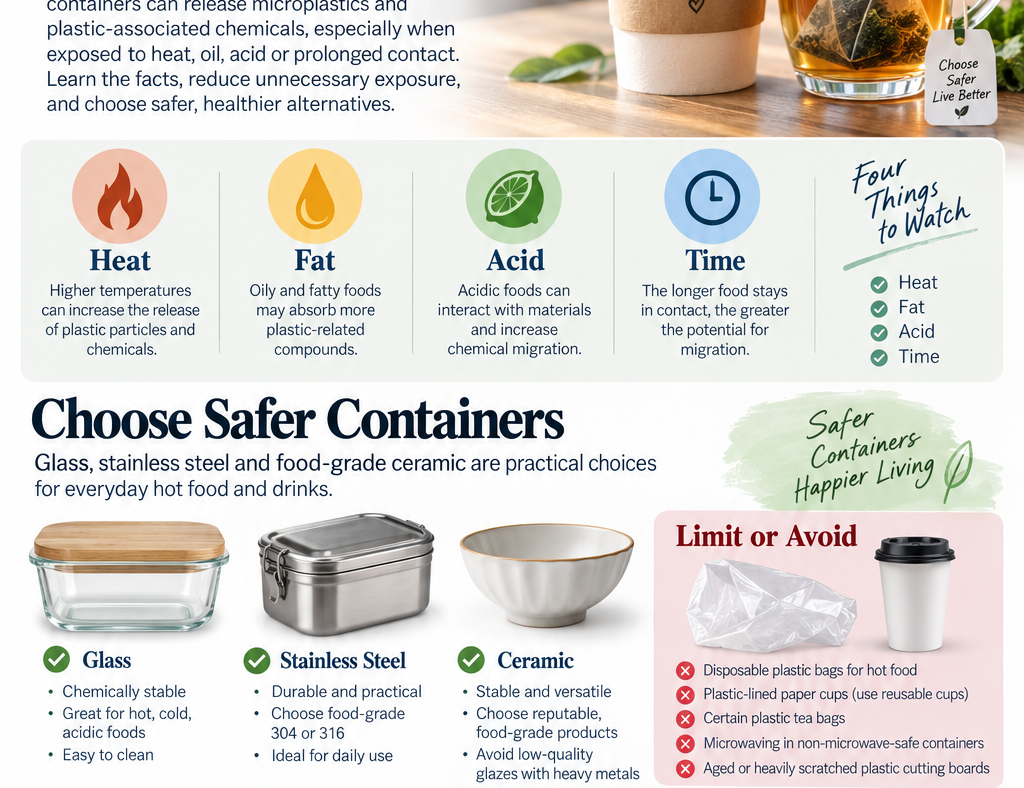
For everyday use, four conditions deserve particular attention.
1. Heat
Very hot liquids and foods create more demanding conditions for packaging materials.
Freshly boiled soup, hot coffee, tea, noodles, curry, and takeaway broth are therefore situations where using a durable reusable container can make sense.
2. Fat
Many chemical compounds are more likely to migrate into fatty foods than into plain water.
That makes foods such as oily soups, meat broths, curry, hotpot, fatty sauces, and fried dishes especially worth transferring to suitable containers.
3. Acid
Acidic foods can interact differently with cookware and packaging.
Tomato sauces, vinegar-based dishes, citrus foods, pickles, and strongly acidic soups should ideally be stored in materials designed for such use.
4. Time
Contact time matters.
Even when a package is suitable for brief food contact, leaving hot food in it for hours is different from using it for a short takeaway trip.
As a practical rule, heat, fat, acidity, and prolonged contact are good reasons to pay more attention to the container you are using.
What About Disposable Paper Cups?
A paper coffee cup often looks like a simple piece of cardboard, but many disposable cups require an inner waterproof layer so that liquid does not soak through the paper.
That layer is frequently polymer-based.
Laboratory studies have demonstrated that some plastic-lined paper cups can release microplastic particles when exposed to hot water.
However, the amount released can vary widely depending on the cup construction, analytical method, temperature, and contact time.
This is important because it means that statements such as “every paper cup releases exactly this many plastic particles” are too simplistic.
An occasional takeaway coffee should not become a source of anxiety.
If you drink hot beverages from disposable cups several times every day, however, carrying a reusable stainless-steel, glass, or ceramic-lined cup is an easy way to reduce disposable-material exposure while also reducing waste.
Plastic Tea Bags Are Another Special Case
One widely discussed laboratory experiment tested certain nylon- and PET-based tea bags in approximately 95°C water and detected billions of micro- and nanoscale plastic particles released during steeping.
That finding is real, but the detail matters.
The researchers studied specific plastic tea bags, not every tea bag ever manufactured.
Traditional paper tea bags, plant-based filter materials, nylon mesh bags, PET bags, and loose-leaf tea are different products.
If minimizing plastic contact is important to you, loose-leaf tea brewed in glass, ceramic, or stainless steel is one of the simplest options.
A reusable stainless-steel tea infuser is another practical alternative.
Is Drip Coffee a Problem?
Coffee brewing deserves a more nuanced answer.
Ordinary paper coffee filters can be extremely simple products. Others may use different manufacturing methods, seals, coatings, or structural materials.
Rather than assuming every coffee filter is a microplastic hazard, choose reputable food-grade products with clear material information.
A stainless-steel coffee filter is another option for people who want to minimize disposable materials.
The brewing method itself does not need to become complicated.
Glass: One of the Simplest Choices
For chemical stability, food-grade glass remains one of the easiest materials to recommend for everyday food storage.
It is useful for:
hot drinks
leftovers
soups
acidic foods
refrigerated foods
microwave reheating when the product is designed for microwave use
Glass also has limitations.
It is heavier, can break, and some containers use plastic lids, silicone seals, painted decorations, or other components.
The simplest approach is to keep very hot food from prolonged contact with plastic lids whenever possible.
For example, you can allow steaming food to cool slightly before sealing the container.
Stainless Steel: Durable and Practical
High-quality food-grade stainless steel is another excellent everyday material.
304 and 316 stainless steel are both widely used for food-contact applications.
For most households, there is little reason to obsess over the difference.
316 stainless steel contains additional alloying elements that improve corrosion resistance, which can be useful in demanding environments, but a well-made 304 stainless-steel lunchbox or pot is already a reasonable choice for routine food preparation.
Stainless steel works particularly well for:
water bottles
travel mugs
lunchboxes
stock pots
soup containers
tea infusers
cooking utensils
The more important issue is purchasing reputable food-grade products rather than choosing cookware based only on an impressive-sounding metal number.
Do You Need Titanium?
Titanium is lightweight, corrosion resistant, and useful for specialized cookware and drinkware.
But it is not necessary for most people trying to reduce plastic exposure.
A good glass container or food-grade stainless-steel container can accomplish the same practical goal at a much lower cost.
The safest product is often not the most expensive product.
It is the product made from an appropriate material and used correctly.
Ceramic Can Also Be Excellent
Food-grade ceramic is another useful choice, especially for bowls, mugs, plates, and ovenware.
The main concern is not “ceramic” itself but the quality of the glaze and decoration.
Poorly manufactured or non-food-grade ceramics may contain lead or other metals in certain glazes or pigments.
That does not mean brightly colored ceramic dishes are automatically toxic.
Modern food-contact standards regulate these substances, and reputable manufacturers test their products accordingly.
For regular use, choose food-grade ceramic from reliable manufacturers, particularly for dishes that will hold acidic or hot foods.
What About Plastic Cutting Boards?
Cutting boards are mechanically scraped by knives thousands of times.
Recent research has increased interest in whether cutting plastic boards may generate microplastic fragments.
For people who want to minimize this source, a well-maintained wooden cutting board is a reasonable alternative.
Wood does require proper care.
Wash it after use, allow it to dry thoroughly, avoid leaving it soaking in water, and replace a board that becomes badly cracked or impossible to clean.
Bamboo is another option, although bamboo boards are manufactured from smaller pieces bonded together, so construction quality matters.
There is no need to assume that one material is universally perfect.
Hygiene and maintenance remain as important as the material itself.
Plastic Wrap: Material and Use Matter
Plastic wraps are manufactured from several different polymers.
PE-based food wraps are widely available, and PVC-based wraps are also used in some markets.
Instead of trying to memorize every plastic abbreviation, follow one highly practical rule:
Do not allow ordinary plastic wrap to touch very hot or oily food unless the manufacturer specifically states that the product is suitable for that use.
For reheating, glass lids, ceramic plates, microwave-safe covers, or other reusable covers can reduce the need for disposable wrap.
Product labeling should always take priority over assumptions based solely on a recycling symbol.
Plasticizers and Breast Cancer: What Can We Actually Say?
This is an area where health information online frequently becomes exaggerated.
Certain phthalates and other endocrine-disrupting chemicals are biologically capable of interacting with hormonal pathways, and researchers continue to investigate whether long-term exposure contributes to breast cancer and other hormone-related diseases.
But it is not scientifically accurate to tell an individual that eating hot food from plastic containers automatically doubles her breast cancer risk.
Cancer develops through a complex interaction of age, genetics, hormones, reproductive history, lifestyle, environmental exposures, and chance.
Reducing unnecessary exposure to endocrine-disrupting chemicals is a sensible precaution.
It should not be presented as a guaranteed cancer-prevention strategy.
Personal-Care Products Are Another Exposure Route
Food packaging is only one part of the broader chemical-exposure picture.
Some phthalates have historically been used in fragrances, cosmetics, flexible plastics, adhesives, and other consumer products.
Formulations vary dramatically by product and country, however, so it would be inaccurate to say that every shampoo, soap, toothpaste, lotion, or fragrance contains dangerous levels of phthalates.
People who want to simplify their exposure can choose products with shorter ingredient lists or fragrance-free options when practical.
This is particularly easy for frequently used products such as body lotion, soap, shampoo, and household fragrances.
Again, the goal is not fear.
It is reducing unnecessary exposure where the substitution costs almost nothing.
Can You “Detox” Plasticizers by Sweating?
The word “detox” is often used too loosely.
Your body already has sophisticated systems for processing and eliminating many chemicals, primarily through the liver, kidneys, gastrointestinal tract, lungs, and other metabolic pathways.
Some environmental chemicals or metabolites are eliminated in urine and feces.
That does not mean sweating heavily in a sauna or exercising can reliably “flush microplastics out of your body.”
There is currently no established exercise, supplement, juice, probiotic, or detox protocol proven to remove accumulated microplastics from human tissues.
Exercise is still extremely valuable.
It supports cardiovascular fitness, metabolic health, insulin sensitivity, mood, sleep, and long-term disease prevention.
Those benefits are enough.
There is no need to attach an unsupported “microplastic detox” claim to them.
Does Drinking More Water Remove Plasticizers?
Adequate hydration supports normal kidney function, but drinking extreme amounts of water does not cleanse the body of every environmental contaminant.
Hydration needs vary according to body size, temperature, activity, diet, medications, pregnancy, kidney function, and medical conditions.
Rather than rigidly multiplying body weight by a universal number, most healthy adults can use thirst, urine color, climate, activity, and professional medical advice as practical guides.
People with heart failure, advanced kidney disease, or other conditions affecting fluid balance may require individualized fluid recommendations.
More water is not always better.
Vegetables Still Matter—But for Better Reasons
The original discussion highlights cruciferous vegetables and allium vegetables.
These are excellent foods, although describing them as a direct “plasticizer detox” is too strong.
Cruciferous vegetables include:
broccoli
cauliflower
cabbage
kale
Brussels sprouts
bok choy
Allium vegetables include:
onions
garlic
leeks
scallions
These foods provide fiber, vitamins, minerals, and a variety of phytochemicals.
Regularly eating diverse vegetables supports gastrointestinal health and is associated with better overall diet quality.
That is a strong enough reason to include them frequently.
You do not need to promise that broccoli will physically extract microplastics from your organs.
Probiotics Are Not a Proven Microplastic Detox
The gut microbiome is an important area of scientific research, and probiotics can be useful for certain specific gastrointestinal conditions.
But claims that probiotics reliably capture and eliminate microplastics or phthalates from humans remain premature.
A better strategy for gut health is broader:
eat enough fiber
include a variety of plant foods
exercise regularly
sleep adequately
avoid unnecessary antibiotics
maintain an overall balanced diet
Fermented foods can also be included if you tolerate them.
Supplements should solve a defined problem rather than function as a vague “detox insurance policy.”
A Practical Low-Plastic Kitchen
You do not need to replace everything in your kitchen tomorrow.
Start with the situations involving the most frequent contact with heat.
For example, you might gradually switch to:
glass containers for leftovers and microwave reheating
a stainless-steel travel mug for daily coffee
a stainless-steel or glass water bottle
food-grade ceramic bowls for hot meals
stainless-steel cookware
a wooden cutting board
loose-leaf tea with a metal infuser
reusable containers when ordering hot takeaway food
These changes are inexpensive when made gradually and can reduce dependence on disposable packaging for years.
The Most Important Principle: Reduce Exposure Before Worrying About “Detox”
When people become concerned about environmental chemicals, they often immediately search for supplements that claim to remove them.
That reverses the priorities.
The first step is reducing unnecessary exposure.
If you routinely pour boiling soup into thin plastic bags, microwave food in disposable containers, drink several hot beverages from disposable lined cups every day, and steep plastic mesh tea bags in boiling water, changing those habits makes more sense than purchasing an expensive detox supplement.
After that, focus on the fundamentals that support health regardless of environmental exposure:
eat a varied whole-food diet
stay physically active
maintain a healthy body weight
get adequate sleep
avoid tobacco
limit excessive alcohol
stay appropriately hydrated
use food-contact materials according to their instructions
These habits have far stronger evidence behind them than most commercial detox programs.
Final Takeaway
Plastic exposure is a real part of modern life, and research on microplastics, nanoplastics, and plastic-associated chemicals is developing rapidly.
Scientists have demonstrated that certain plastic tea bags and plastic-lined disposable cups can release particles when exposed to hot water. Micro- and nanoplastics have also been detected in human tissues, raising legitimate questions about long-term health effects. At the same time, researchers still do not have enough evidence to quantify the health risk from every everyday exposure or to claim that a particular container directly causes cancer.
That distinction matters.
You do not have to fear every plastic product.
Instead, follow a practical precautionary strategy: reduce unnecessary plastic contact with very hot, oily, or acidic foods; avoid prolonged storage in inappropriate disposable packaging; and use glass, stainless steel, or food-grade ceramic when those alternatives are convenient.
Small decisions repeated every day can substantially reduce unnecessary exposure without turning ordinary eating and drinking into a source of anxiety.
Medical Disclaimer
This article is for educational purposes only and is not medical advice. Research into microplastics, nanoplastics, phthalates, and human health is still evolving. Individual exposure and health risk cannot be determined from a single food container or consumer product. If you have concerns about environmental or occupational chemical exposure, pregnancy, cancer risk, kidney disease, or another medical condition, consult a qualified healthcare professional.
FAQ
Can hot food cause plastic containers to release chemicals or particles?
Heat can increase migration or physical degradation in some plastic materials, although the amount depends on the polymer, temperature, food composition, contact time and manufacturing quality.
Do paper coffee cups contain plastic?
Many disposable paper cups use a polymer lining to make them waterproof. Laboratory studies have shown that some lined cups can release microplastic particles into hot liquids.
Do tea bags release microplastics?
Some plastic-based nylon and PET tea bags have been shown to release micro- and nanoplastic particles during steeping. This does not apply equally to every tea bag material.
What is the safest container for hot food?
Food-grade glass, stainless steel and properly manufactured ceramic are all reasonable options. The best choice depends on how the container will be used.
Can exercise or supplements detox microplastics?
There is currently no clinically proven exercise, supplement or detox program that removes accumulated microplastics from human tissues.
Should I completely stop using plastic?
That is generally unnecessary and unrealistic. A practical approach is to reduce avoidable plastic contact with very hot, oily or acidic foods and use reusable alternatives when convenient.
This article is for general education and does not replace individualized care from a qualified health professional. Seek appropriate advice for persistent, severe, or concerning symptoms.
Read the full medical disclaimer