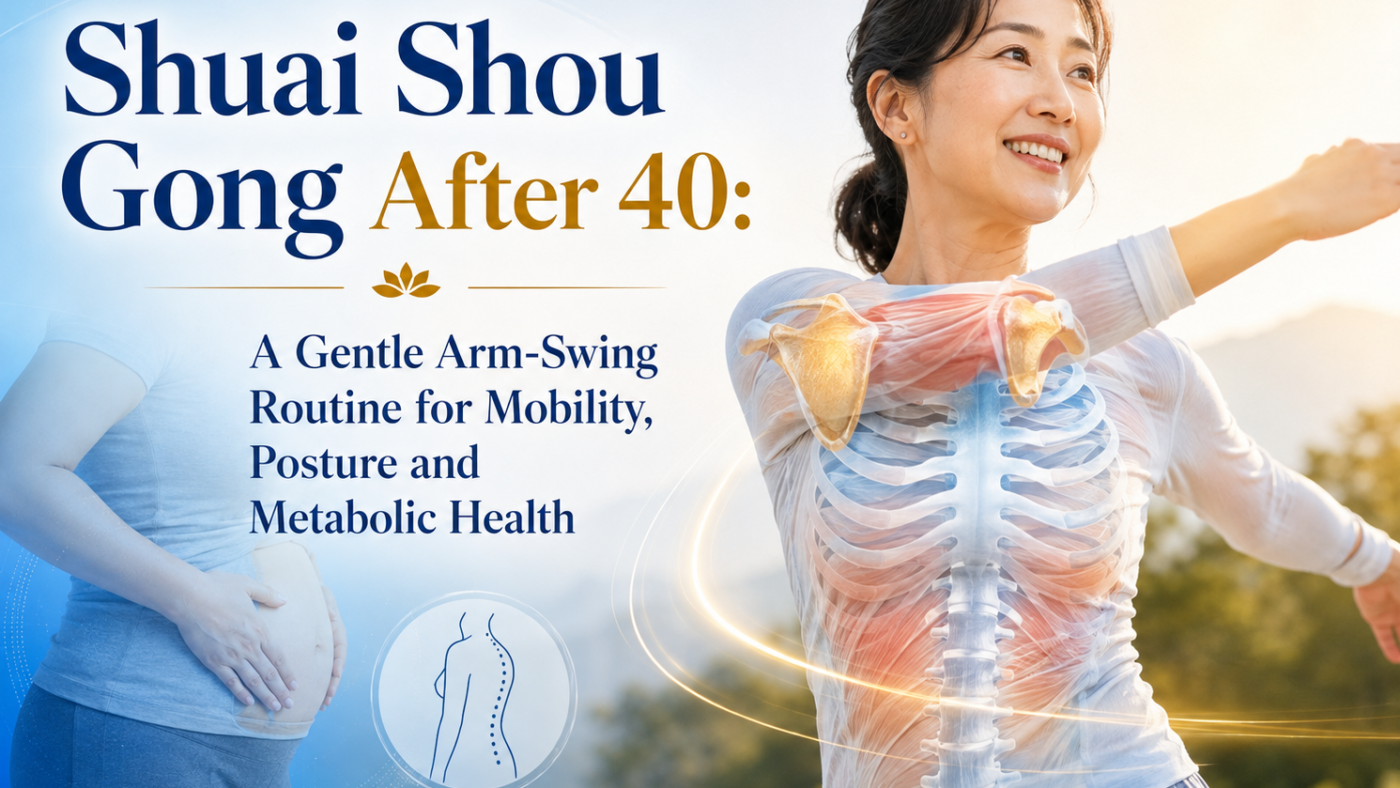
A simple arm-swinging exercise may look almost too easy to matter. There are no heavy weights, complicated machines, exhausting jumps, or intense floor exercises. You simply stand, relax your body, rotate through the torso, and allow your arms to swing.
Yet simple does not necessarily mean useless.
The traditional practice commonly known as Shuai Shou Gong, sometimes translated as arm-swing exercise, combines repetitive arm movements with relaxed trunk rotation, upright posture, breathing, and whole-body coordination. For people over 40 who find intense exercise difficult to maintain, this kind of gentle movement can be an approachable way to move more often, loosen stiff areas, and reconnect the upper and lower body.
It is sometimes promoted online with extraordinary promises, including claims that it can activate brown fat and make the body burn fat dozens of times faster. Those claims go beyond what current human research can establish.
The real benefits are both more believable and more useful.
Arm swinging can increase physical activity, encourage movement of the shoulders and upper back, involve the trunk and hips, and provide a low-barrier way to spend less time sitting still. When practiced regularly as part of a healthy lifestyle, it may contribute to better mobility, coordination, posture awareness and overall fitness.
For adults who have become increasingly stiff or sedentary with age, that can be meaningful.
Why Such a Simple Movement Can Feel Surprisingly Powerful
Many people approach weight management by concentrating entirely on the stomach.
They perform abdominal exercises, restrict food dramatically, or search for ways to burn belly fat directly.
But the appearance and movement of the midsection are influenced by more than body fat alone.
Your posture, rib-cage position, spinal mobility, abdominal muscle tone, pelvic position, breathing pattern and even temporary abdominal bloating can all change how the waist and abdomen look.
This does not mean that a poorly positioned rib cage literally forces the abdominal organs outward or that rotating the torso can mechanically remove belly fat.
It does mean that a stiff, collapsed posture may make the torso appear more compressed, while improving the way you stand and move can change how you carry your body.
Imagine two people with similar body compositions.
One stands with a relatively upright torso, relaxed shoulders and good control through the trunk.
The other spends much of the day sitting, with the chest collapsed, shoulders rounded and little movement through the thoracic spine.
Their abdominal profiles may look noticeably different even though posture alone has not changed their amount of body fat.
That is one reason mobility work can make people feel taller, lighter and more open almost immediately, even though genuine fat loss takes much longer.
The Rib Cage, Shoulder Blades and Upper Back Work Together
Your arms do not operate independently of the rest of your body.
When you walk naturally, the arms swing while the trunk rotates. The shoulder blades move over the rib cage, and the upper and lower body coordinate with one another.
Modern life often reduces this movement.
Hours spent at desks, driving, looking at phones or sitting on sofas can mean that the shoulders, upper back and rib cage move through a relatively narrow range for much of the day.
That is where a relaxed arm-swinging practice becomes interesting.
Instead of trying to isolate one muscle, you allow several regions to participate:
The shoulders move.
The shoulder blades glide.
The thoracic spine rotates.
The rib cage turns.
The abdominal muscles help control the torso.
The hips and legs respond to the rotational forces.
Your balance system continuously makes small adjustments.
The result is a rhythmic whole-body movement that can feel considerably more demanding after several minutes than it appears at first glance.
What About Brown Fat and the “70 Times Faster” Claim?
Brown adipose tissue, often called brown fat, is a real and metabolically active tissue.
Unlike white fat, whose main role is energy storage, brown fat can generate heat through a process called thermogenesis. Adults retain varying amounts of brown fat, particularly around the neck, collarbone and upper torso.
This has led to enormous interest in whether activating brown fat could help prevent obesity.
However, the science needs to be interpreted carefully.
Human brown fat does participate in energy expenditure, but there is no good evidence that simply swinging the arms around the shoulder blades makes someone burn body fat “70 times faster.”
Feeling warm during exercise also does not prove that stored body fat has suddenly begun melting away.
You feel warmer largely because working muscles require energy and produce heat, while circulation increases to meet the demands of movement.
That is still beneficial.
You simply do not need an exaggerated explanation to justify it.
The most practical way to think about this routine is that it adds physical activity to your day while involving a large portion of the body.
Do it consistently, combine it with walking and strength training, eat appropriately for your goals, and it can become one useful component of a healthy weight-management strategy.
A Realistic Weight-Loss Perspective
People sometimes report impressive weight changes after beginning a new exercise program.
For example, someone may say that they lost more than 20 pounds while practicing a series of exercise routines without following an extreme diet.
Personal experiences can be inspiring, but they are not proof that one particular movement caused the entire change.
Weight loss is influenced by total energy intake, total activity, initial body weight, sleep, medications, muscle mass, hormonal factors, diet composition and many other variables.
The best lesson from such stories is therefore not:
“This movement guarantees rapid weight loss.”
It is:
“A simple form of exercise that you genuinely enjoy may help you become consistently more active.”
Consistency usually matters much more than chasing one supposedly magical exercise.
Why Gentle Exercise Can Be Especially Valuable After 40
As the years pass, many adults notice that the body does not respond to prolonged inactivity as forgivingly as it once did.
Stiffness becomes more noticeable.
Muscle mass can gradually decline.
Daily movement may decrease.
Work becomes more sedentary.
Recovery from overly aggressive exercise may take longer.
Some people also become reluctant to exercise because previous workouts felt painful, exhausting or unsustainable.
This creates a difficult cycle.
The less you move, the stiffer movement may feel.
The stiffer you become, the less inclined you may be to exercise.
A gentle practice can help interrupt that cycle.
You do not have to begin with an hour of intense training.
Sometimes the better starting point is several minutes of movement that leaves you feeling more capable of moving again tomorrow.
That is one of the strengths of Shuai Shou Gong.
The Complete Gentle Arm-Swing Routine
The following sequence is adapted from the traditional arm-swing concept while emphasizing comfort, control and natural movement.
You do not need to force any position.
Move within a range that feels comfortable.
1. Begin With Rib-Cage Rotation
Stand with your feet approximately hip-width apart.
Keep your knees relaxed rather than locked.
Place your hands lightly around the sides of your rib cage.
Lengthen your spine comfortably without becoming rigid.
Now gently rotate your torso from one side to the other.
Instead of throwing the shoulders around, imagine the movement beginning through the center of the torso.
Let the feet and legs respond naturally if needed.
Keep the shoulders relaxed and away from your ears.
The purpose is not to achieve maximum rotation.
You are simply reminding your upper back and rib cage that they are designed to move.
Continue for approximately 30 to 60 seconds.
2. Let the Arms Begin to Swing
Now release your hands.
Continue the gentle rotation of the torso and allow the arms to swing forward and backward.
Do not aggressively fling them.
Think of the torso as the engine and the arms as passengers.
Your rib cage rotates first.
The relaxed arms then follow.
You may notice the shoulder blades beginning to move more freely across the back of the rib cage.
Keep your abdomen lightly engaged so the movement feels controlled rather than loose through the lower back.
Continue breathing normally.
After a minute or two, the body may begin to feel warmer.
That is a normal response to increased movement and muscle activity.
3. Ground the Feet and Stabilize the Center
For the next variation, keep your feet planted.
Soften the knees.
Maintain a comfortable upright posture.
Draw the lower abdomen inward gently—not as hard as possible, but enough to create a sense of support around the trunk.
Now continue swinging the arms while keeping the feet relatively still.
This changes the exercise.
Because the feet are no longer following the rotation as much, the trunk must manage more of the movement.
Stay within a comfortable range.
If the lower back feels compressed, reduce the rotation immediately.
The goal is mobility, not maximum twisting.
4. Bring the Hands Together and Move the Elbows
Bring your hands together in front of the chest.
Keep the shoulders relaxed.
Now rotate gently from side to side while allowing the elbows to travel with the movement.
Rather than trying to twist as far as possible, pay attention to the muscles across the upper and middle back.
You may feel movement around the shoulder blades.
You may also notice a wave-like quality through the torso as one side lengthens while the other side shortens.
Maintain smooth breathing.
5. Practice One-Arm Swinging
Return to a comfortable standing position.
Allow one arm to swing while keeping the other relatively relaxed.
Let the torso participate.
Continue for roughly 30 to 60 seconds, then change sides.
The movement may feel surprisingly different from one side to the other.
That information can be useful.
Most people are not perfectly symmetrical. One shoulder may be stiffer, one side of the torso may rotate more easily, or one arm may naturally swing farther.
Do not aggressively try to “correct” the difference during one session.
Simply move comfortably and gradually.
6. Extend the Fingers and Increase Body Awareness
Now straighten the fingers comfortably.
Keep them long rather than clenched.
Return to gentle torso rotation.
Traditional movement practices sometimes describe the lower abdominal region as the tanden or dantian, an important center of balance, breathing and body awareness.
You do not need to interpret this concept literally as a measurable anatomical energy organ to benefit from the practice.
A practical interpretation is simple:
Bring your attention toward the center of the body.
Notice your balance.
Notice the relationship between the feet, pelvis, torso, shoulders, hands and fingertips.
Let the movement travel outward from the center rather than being driven only by the arms.
This type of internal attention can make a very simple exercise feel much more coordinated.
7. Explore Gentle Lower-Torso Rotation
Place your hands near the waist or hips.
Stand tall.
Now rotate gently from side to side.
The movement should remain smooth and controlled.
Avoid forcing the lumbar spine into large ranges of rotation.
Ideally, the hips, upper back and feet should all contribute appropriately rather than asking the lower back to perform the entire movement.
For people who spend much of the day sitting, simply restoring comfortable movement through these regions can feel refreshing.
8. Open the Arms Diagonally
Bring the arms in front of you.
Turn the thumbs outward gently and open the arms on a diagonal.
Return to the center and repeat.
Keep the chest open without aggressively arching the lower back.
You may feel the muscles around the shoulders, upper back and chest becoming more active.
This variation introduces more deliberate muscular effort than completely relaxed arm swinging.
It is a useful reminder of an important principle after 40:
Muscles still respond to training.
Age does not make strengthening pointless.
Appropriate resistance training becomes increasingly important as we get older.
Arm swinging cannot replace strength training, but it can help prepare the body to move.
9. Finish With Relaxed Torso Swings
Now return to the simplest variation.
Relax your hands.
Relax your fingers.
Relax your shoulders.
Rotate the torso gently.
Allow the arms to follow naturally.
Instead of trying to create more force, gradually make the movement easier.
Think of this as the transition from exercise into recovery.
Notice how the body feels compared with the beginning of the session.
Is your upper back warmer?
Do your shoulders feel less restricted?
Does standing feel easier?
Are you breathing more freely?
Those immediate sensations are more useful than trying to determine whether you have “burned fat” during the last few minutes.
10. Slow Down and Breathe
Gradually reduce the rotation.
Come to a comfortable standing position.
Take several slow breaths.
Avoid holding your breath or forcing unusually deep inhalations.
Simply allow the breathing rhythm to settle.
Feel your feet against the floor.
Notice the position of your spine.
Notice whether there is any change in tension around your shoulders, back or waist.
That completes the routine.
Why Rhythmic Movement Can Feel Mentally Refreshing
Traditional descriptions of arm-swing exercises sometimes say that the movement releases “negative energy” from the fingers or head.
There is no established physiological mechanism showing that negative energy is physically expelled from the body in this way.
But there is a reasonable explanation for why people may nevertheless feel mentally lighter afterward.
Rhythmic exercise can temporarily redirect attention away from work, screens and repetitive thoughts.
Physical activity also influences circulation, breathing, nervous-system activity and mood.
The repetition itself can become meditative.
Instead of thinking about “releasing negative energy” as a literal detoxification mechanism, it may be more useful to treat the phrase as a traditional description of the subjective feeling of becoming calmer, warmer and less tense through movement.
Does It “Detox” the Body?
Another traditional explanation sometimes associated with swinging and rotational exercises is that centrifugal force squeezes waste products out of the body.
That should not be interpreted literally.
Your body removes metabolic waste primarily through organs and physiological systems including the liver, kidneys, lungs, gastrointestinal tract and circulatory system.
Twisting the torso does not mechanically squeeze toxins out of your tissues.
Exercise does, however, support many systems involved in long-term health.
It increases blood flow.
It challenges muscles.
It increases energy expenditure.
It can improve cardiovascular fitness when performed at sufficient intensity.
It can also contribute to better metabolic health when practiced regularly.
Those benefits are substantial enough without calling the exercise a detoxification procedure.
What This Routine Can and Cannot Do for Belly Fat
It is important to separate two different goals.
The first is changing how the body moves and carries itself.
The second is reducing stored abdominal fat.
This routine may help with the first goal relatively quickly.
After several minutes, you may stand more comfortably, move more freely and feel less stiff.
But abdominal fat cannot be selectively removed by rotating the waist, swinging the arms or exercising the muscles near the stomach.
Actual fat loss requires a sustained change in whole-body energy balance over time.
Physical activity is part of that process.
Nutrition matters.
Sleep matters.
Consistency matters.
Muscle-strengthening exercise matters.
Walking and other aerobic activity matter.
A short arm-swing routine can therefore be useful—but it should be understood as part of the larger picture rather than a shortcut around it.
A Better Exercise Strategy for Adults Over 40
If weight management and healthy aging are your goals, consider using this routine as an entry point rather than the entire program.
A practical weekly lifestyle might combine:
Regular walking or other moderate aerobic activity.
Two or more sessions of muscle-strengthening exercise.
Mobility work for stiff joints and movement patterns.
Simple routines such as arm swinging on days when motivation is low.
Adequate protein and balanced meals.
Enough sleep and recovery.
Most importantly, choose forms of movement you are willing to repeat for months and years.
A moderate routine performed consistently usually offers more value than an extreme routine abandoned after a few days.
How Long Should You Practice?
Beginners do not need a 15- or 20-minute session immediately.
Try three to five minutes.
If that feels good, gradually increase the duration.
Some people may enjoy 10 to 15 minutes of relaxed swinging and mobility work.
Others may prefer to use two or three minutes as a warm-up before walking or strength training.
There is no need to chase exhaustion.
The routine should leave you feeling more mobile, not injured.
How Hard Should It Feel?
A gentle arm-swing session generally belongs toward the lighter end of the exercise spectrum.
You should normally be able to breathe comfortably.
The shoulders should not be clenched.
The neck should not feel strained.
The lower back should not feel pinched.
You do not need maximum rotation.
You do not need to swing the arms as hard as possible.
You do not need to finish drenched in sweat.
If you want a greater cardiovascular training effect, walking faster, cycling, swimming or another appropriate aerobic exercise will usually be more efficient.
Think of Shuai Shou Gong primarily as a gentle movement practice that can complement those activities.
Safety Comes First
Stop if you develop sharp pain, chest pain, severe shortness of breath, dizziness, faintness, unusual weakness or loss of balance.
People with significant spinal problems, recent surgery, uncontrolled cardiovascular disease, severe osteoporosis, major balance disorders or other medical concerns should obtain individualized medical guidance before beginning an unfamiliar exercise program.
If rotating the torso aggravates back pain, reduce the range or discontinue the movement.
Do not force painful shoulders through large swings.
A smaller movement performed comfortably is better than an impressive-looking movement performed painfully.
The Most Important Lesson: Keep Moving
Perhaps the best idea behind this practice has little to do with brown fat, metabolism or complicated anatomy.
It is simply this:
Your body benefits from being used.
At 40, 50, 60, 70 and beyond, you can still improve physical capacity.
You can still strengthen muscles.
You can still practice balance.
You can still maintain and sometimes improve mobility.
You can still become more active than you were last year.
A short movement session today may look insignificant.
Repeated hundreds of times, it becomes a habit.
And habits are what eventually shape long-term health.
So relax the shoulders.
Soften the knees.
Stand comfortably.
Let the torso move.
Let the arms follow.
Breathe.
And rather than asking whether one exercise can transform your body overnight, ask a much more useful question:
Can I make movement part of my life again?
If the answer is yes, this simple routine may be a very good place to begin.
Frequently Asked Questions
Can Shuai Shou Gong help with weight loss?
It can contribute to daily physical activity and energy expenditure, but it should not be considered a stand-alone weight-loss treatment. Sustainable weight management usually depends on overall activity, nutrition, sleep, muscle mass and long-term lifestyle habits.
Does swinging the arms burn belly fat?
No exercise selectively burns fat from one specific area. Arm swinging may improve mobility and posture awareness, which can change how the torso feels and looks, but actual abdominal fat loss occurs through whole-body fat loss over time.
Does the exercise activate brown fat?
Brown fat exists in adults and contributes to heat production, but there is not sufficient evidence to claim that this particular arm-swing exercise substantially activates brown fat or produces dramatic fat-burning effects.
Can it improve posture?
It may help you practice upright positioning, thoracic rotation and shoulder movement. A brief mobility session can also temporarily make standing feel easier. Long-term posture and function depend on many factors, including strength, mobility, habitual positions and individual anatomy.
Is it suitable for people over 40?
For many healthy adults, gentle arm swinging can be an accessible form of movement. The intensity and range should always match individual ability.
Can beginners do it every day?
Gentle mobility-oriented versions can often be practiced frequently if they remain comfortable. More demanding exercise still requires appropriate recovery.
What is the tanden or dantian?
In East Asian movement traditions, the term generally refers to a center in the lower abdominal region associated with balance, breathing and internal body awareness. In a modern exercise context, it can be used as a cue to focus attention on the center of the body rather than moving only from the arms.
Final Thoughts
You do not need to punish your body to take care of it.
And exercise does not have to be complicated to have value.
Shuai Shou Gong offers a simple reminder that the shoulders, rib cage, spine, pelvis, arms and legs are designed to work together.
Its greatest strength may be accessibility.
You can stand up and begin.
You can adjust the range.
You can slow down.
You can stop when necessary.
Most importantly, you can return tomorrow.
For anyone over 40 trying to rebuild a healthier relationship with exercise, that consistency may ultimately matter far more than any spectacular fat-burning promise.
Medical Disclaimer:
This article is for educational and informational purposes only and is not intended as medical advice, diagnosis or treatment. Exercise responses vary between individuals. Stop any movement that causes pain, dizziness or other concerning symptoms, and consult a qualified healthcare professional if you have a medical condition, recent injury or concerns about beginning a new exercise program.
This article is for general education and does not replace individualized care from a qualified health professional. Seek appropriate advice for persistent, severe, or concerning symptoms.
Read the full medical disclaimer