Cold hands and feet. A lower back that tires easily. Heavy legs. Low energy. Waking several times during the night to urinate. A noticeable decline in sexual function.
In Traditional Chinese Medicine, or TCM, a cluster of symptoms like these may sometimes be interpreted through the concept of Yang deficiency, particularly when feelings of coldness, fatigue, weakness, and reduced vitality occur together.
That traditional interpretation has existed for centuries.
But it is important to understand what it does—and does not—mean.
“Yang deficiency” is a traditional diagnostic concept. It is not the same thing as low testosterone, poor circulation, kidney disease, erectile dysfunction, or any single modern medical diagnosis.
Cold extremities, fatigue, nocturia, lower-back discomfort, and changes in sexual function can have many causes. Persistent erectile dysfunction, for example, may be associated with diabetes, high blood pressure, high cholesterol, hormonal problems, medicines, psychological factors, or vascular disease. Frequent nighttime urination may also occur with prostate enlargement, urinary disorders, diabetes, sleep apnea, kidney or heart problems, and other conditions. nhs.uk
That does not mean traditional acupressure has no place in a wellness routine.
It means we should use it for what it is: a traditional self-care practice that may promote relaxation, warmth, body awareness, and comfort, rather than presenting it as a proven cure for sexual dysfunction or systemic disease.
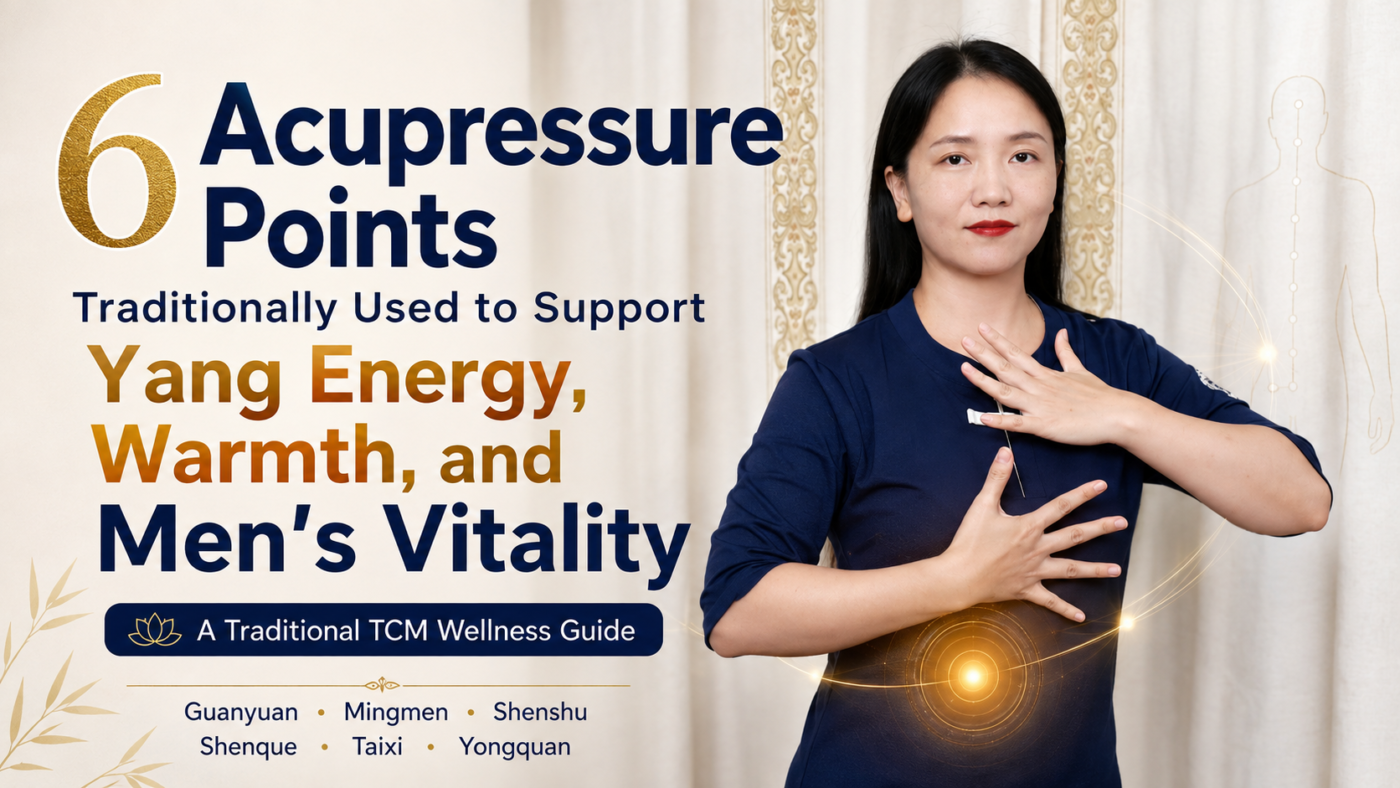
This guide explores six points traditionally associated with Kidney Yang, vitality, warmth, and foundational energy:
Guanyuan (CV4)
Mingmen (GV4)
Shenshu (BL23)
Shenque (CV8)
Taixi (KI3)
Yongquan (KI1)
Together, they form an interesting map of how classical Chinese medicine thought about the relationship between the lower abdomen, lower back, feet, warmth, aging, reproduction, and vitality.
What Does “Yang” Mean in Traditional Chinese Medicine?
The word Yang has a much broader meaning in TCM than the modern idea of “male hormones” or sexual performance.
Traditionally, Yang is associated with qualities such as:
warmth,
activity,
movement,
transformation,
circulation,
functional energy,
and the body’s ability to respond actively to its environment.
TCM texts often use the analogy of sunlight.
Just as sunlight warms the earth and supports activity, Yang was traditionally understood as providing warmth and functional momentum within the body.
Someone described as having abundant Yang might traditionally be characterized as energetic, warm, physically active, and resilient.
A pattern interpreted as deficient Yang might include sensations of coldness, fatigue, weakness, reduced drive, or certain urinary and reproductive symptoms.
These are traditional pattern descriptions—not laboratory measurements.
There is no biomedical test that measures “Yang energy.”
Acupressure Is Not the Same as Acupuncture
Another distinction matters.
Acupuncture inserts thin needles into defined points.
Acupressure uses fingers, palms, or massage to stimulate an area without penetrating the skin.
Research on acupuncture is substantially larger than research on self-administered acupressure.
The U.S. National Center for Complementary and Integrative Health notes that acupuncture has evidence for some pain-related conditions, while evidence for many other uses remains limited or uncertain. Its mechanisms are also not fully understood and may involve nervous-system effects, local tissue effects, and nonspecific effects such as expectation and therapeutic context. NCCIH
Therefore, claims made for acupuncture cannot automatically be transferred to rubbing or pressing the same point at home.
That distinction is particularly important when discussing sexual function.
A 2026 systematic review of acupuncture for erectile dysfunction found possible improvements in several outcomes, but the certainty of evidence ranged from very low to moderate, and the authors concluded that the evidence was still too weak for definitive conclusions. PubMed
So these six points are best approached as a TCM-inspired wellness routine, not a replacement for appropriate medical evaluation or established treatment.
1. Guanyuan — CV4
The Traditional “Gate of Origin”
Guanyuan is one of the most frequently discussed points in classical discussions of vitality.
The Chinese name 关元, Guānyuán, is often translated as “Gate of Origin” or “Pass of the Primordial.”
In traditional theory, it is associated with the Conception Vessel and with foundational vitality, reproductive health, lower-abdominal function, and the Kidney system.
For this reason, traditional practitioners may include Guanyuan when addressing patterns described as weakness of Kidney Yang or depleted constitutional energy.
Where Is Guanyuan?
Guanyuan lies on the midline of the lower abdomen, below the navel.
In formal acupuncture location systems it is approximately 3 proportional body-inches, or cun, below the center of the umbilicus.
Because cun is proportional to the individual’s body rather than a fixed centimeter measurement, self-location by ordinary finger widths is only approximate.
For gentle home massage, pinpoint precision is usually less important than staying comfortably within the lower-abdominal region.
Traditional Uses
Within TCM, Guanyuan has historically been associated with:
supporting constitutional vitality,
warming deficiency patterns,
lower-abdominal wellness,
urinary and reproductive function,
and strengthening what traditional texts call Yuan Qi, or original Qi.
These are traditional indications rather than confirmed biomedical effects.
Gentle Self-Massage
Lie comfortably on your back.
Relax the abdomen.
Warm your hands by rubbing the palms together.
Place one palm over the lower abdomen around the Guanyuan region.
Massage slowly in comfortable circles.
There is no need to press deeply.
A gentle routine of 2–5 minutes is sufficient.
The sensation should be calming and comfortable.
Some people notice warmth simply because rubbing the skin and underlying tissues increases local sensory stimulation.
If your abdomen feels painful, tender, swollen, or otherwise abnormal, do not try to “massage through it.”
Does Guanyuan Increase Testosterone or Treat Erectile Dysfunction?
There is not good evidence that manually massaging Guanyuan directly raises testosterone or reliably treats erectile dysfunction.
It should not be marketed as a natural replacement for medical treatment.
Persistent erectile problems deserve evaluation because ED can sometimes be associated with cardiovascular, metabolic, hormonal, medication-related, or psychological factors.
2. Mingmen — GV4
The Traditional “Gate of Life”
The second point is Mingmen, written 命门 and commonly translated as “Gate of Life.”
Its name alone explains why it occupies such an important place in traditional wellness practices.
Mingmen lies on the Governing Vessel in the lower back.
Within TCM theory, it became closely associated with Kidney Yang, constitutional warmth, vitality, the lower back, and reproductive energy.
Where Is Mingmen?
Mingmen is located on the posterior midline of the lower back, in the depression below the spinous process of the second lumbar vertebra, L2.
Traditional descriptions sometimes simplify this by saying that it lies roughly opposite the level of the navel on the back.
That is useful as a general orientation, but spinal anatomy varies between individuals, so it should not be treated as an exact diagnostic landmark.
A Gentle Warming Method
Rub both palms together until warm.
Place one or both hands over the center of the lower back.
Rather than aggressively pressing directly on the spine, use broad, gentle rubbing around the lower-back area.
Move slowly.
Continue for approximately 2–5 minutes, or simply until the area feels pleasantly warm.
The objective is comfort.
There is no reason to create bruising, pain, or intense pressure.
What Can the Warmth Mean?
Feeling warmer after rubbing the lower back does not prove that “Kidney Yang has increased.”
Friction warms the skin, touch activates sensory nerves, and local movement changes how the area feels.
That may still be relaxing and useful.
A traditional explanation and a physiological explanation can coexist without pretending they are identical.
3. Shenshu — BL23
The Kidney Back-Shu Point
Beside Mingmen are two points called Shenshu, or BL23.
The name 肾俞 means approximately “Kidney Transporting Point.”
In the classical Back-Shu system, different points along the Bladder meridian were traditionally associated with internal organ systems.
Shenshu was associated with the Kidney system.
Remember, however, that the “Kidney” in TCM is a functional theoretical system much broader than the anatomical kidneys recognized in modern medicine.
Where Is Shenshu?
Shenshu lies on both sides of the lower back at approximately the level of L2, lateral to the spinal midline.
Traditional acupuncture measurement places each point approximately 1.5 cun lateral to the lower border of the L2 spinous process.
For a simple home wellness massage, you do not need to aggressively hunt for an exact spot.
The safer approach is broad rubbing of the muscles on either side of the lumbar spine.
How to Massage the Area
Warm your palms.
Place both hands on the lower back, one on each side.
Rub gently upward and downward.
Alternatively, use the thumbs to make small comfortable circles in the muscles beside the spine.
Avoid hard pressure directly onto the vertebrae.
The original practice suggests continuing until warmth develops.
A few minutes is enough.
Traditional Interpretation
In TCM, Shenshu has traditionally been used in patterns involving:
lower-back weakness,
fatigue,
certain urinary complaints,
reproductive concerns,
and Kidney deficiency patterns.
It is misleading, however, to say that pressing BL23 literally “adds heat to the kidneys.”
Your kidneys are internal organs located deeper and higher in the body than many people imagine.
Surface massage does not mechanically heat or recharge them.
4. Shenque — CV8
The Navel Point
Shenque is one of the easiest points in the entire system to locate.
It is the center of the navel.
The name 神阙 is commonly translated as “Spirit Gate.”
Within traditional Chinese medicine, the umbilical region has symbolic importance because the umbilical cord connected a developing fetus to the placenta before birth.
This historical observation contributed to traditional ideas linking the navel with foundational vitality.
Traditional Role
Shenque has traditionally been discussed in connection with:
warming the middle,
supporting digestive function,
certain cold or deficiency patterns,
and general constitutional support.
Again, these are traditional functions rather than statements about proven physiology.
Gentle Abdominal Massage
Instead of pushing directly into the navel, place the palm gently over the surrounding abdominal area.
Massage slowly in broad circles.
Keep the abdominal wall relaxed.
Two to five minutes is adequate.
If massage feels uncomfortable, stop.
What About Moxibustion on the Navel?
Traditional practitioners sometimes use moxibustion, in which burning dried mugwort is used to warm an acupuncture point.
This should not be treated as casual home advice.
Moxibustion can cause burns, smoke exposure, skin injury, and other complications when performed incorrectly.
Do not place burning material directly on the navel.
If someone wishes to explore traditional moxibustion, professional instruction and appropriate safety precautions are preferable.
NCCIH likewise emphasizes that complementary techniques are not risk-free simply because they are traditional. Improperly performed acupuncture, for example, can cause infections and serious injuries. NCCIH
5. Taixi — KI3
A Major Kidney Meridian Point
The fifth point is Taixi, KI3.
太溪 is commonly translated as “Great Stream.”
Within traditional acupuncture theory, it is the Yuan-Source point of the Kidney meridian.
That makes it particularly important in traditional discussions of Kidney deficiency.
Where Is Taixi?
Look at the inside of the ankle.
Find the highest point of the medial malleolus, the bony prominence on the inner ankle.
Then locate the Achilles tendon behind it.
Taixi lies in the depression between those two structures.
There is one point on each ankle.
How to Apply Pressure
Sit comfortably.
Use your thumb to apply mild, steady pressure to the depression.
Massage with small circles for approximately 30–60 seconds.
Release.
Repeat several times.
Then change feet.
There is no need to create strong pain.
A mild pressure sensation is enough.
The original routine recommends several minutes on each side, but longer does not necessarily mean better.
Traditional Uses
Within TCM, Taixi is traditionally associated with:
Kidney deficiency patterns,
lower-back and knee weakness,
certain ear symptoms,
constitutional fatigue,
and reproductive health.
Some historical descriptions also associate the Kidney system with the bones, teeth, ears, and aging.
That does not mean pressing KI3 treats loose teeth, tinnitus, kidney failure, hormonal deficiency, or erectile dysfunction.
Those conditions deserve appropriate diagnosis.
6. Yongquan — KI1
The “Bubbling Spring”
The sixth point is Yongquan, KI1.
Its name 涌泉 means “Bubbling Spring.”
It is the first point of the Kidney channel in traditional meridian theory and sits on the sole of the foot.
Because of its location, it is sometimes described poetically as a point connecting the body with the earth.
Where Is Yongquan?
Curl the toes slightly.
A depression usually becomes visible in the front portion of the sole.
Yongquan is located approximately around the junction of the front one-third and rear two-thirds of the sole, between the second and third metatarsal regions.
You do not need millimeter precision for gentle foot massage.
Massage Technique
Sit comfortably and bring one foot within reach.
Use the thumb to massage the area in slow circles.
Another traditional method is gentle rubbing with the knuckles or palm.
Massage for approximately 1–2 minutes per foot.
Then change sides.
A warm foot bath afterward may feel relaxing, although it should be understood as comfort care rather than a way to “activate the Kidney meridian.”
Be particularly careful with hot water if you have diabetes, neuropathy, poor sensation, or impaired circulation because burns can occur without being immediately noticed.
Can Yongquan “Pull Fire Down”?
In TCM terminology, Yongquan may be used in patterns described as “Yang rising,” “deficiency fire,” agitation, or disturbed sleep.
The traditional phrase “drawing fire downward” is metaphorical.
It should not be interpreted as literal heat moving through anatomical channels.
A modern explanation for why foot massage may feel calming is much simpler: pressure, warmth, repetitive touch, relaxation, and attention to breathing can change sensory and emotional experience.
That can still be worthwhile.
How to Combine the Six Points
The original traditional routine divides the points into two groups.
This is actually one of the most interesting aspects of the practice because it reflects TCM pattern-based thinking rather than simply pressing every point indiscriminately.
Group A: Guanyuan + Taixi + Yongquan
CV4 + KI3 + KI1
Traditional interpretation:
This combination emphasizes the lower abdomen and Kidney meridian and is traditionally used when the pattern is characterized more by weakness, fatigue, lower-back or knee weakness, and depleted vitality.
A simple routine could be:
Guanyuan — 2–3 minutes
Taixi — 1 minute per side
Yongquan — 1–2 minutes per side
Total time: approximately 6–9 minutes.
Group B: Mingmen + Shenshu + Shenque
GV4 + BL23 + CV8
Traditional interpretation:
This combination emphasizes warmth and the lower trunk.
It is traditionally favored for people whose pattern includes sensations of coldness, cold hands and feet, or a chilly lower back.
A simple routine could be:
Mingmen/lower-back warming — 2–3 minutes
Shenshu region — 2–3 minutes
Shenque/abdominal massage — 2–3 minutes
Total time: approximately 6–9 minutes.
The Simplest Version: Guanyuan + Mingmen
If six points feel unnecessarily complicated, the traditional routine can be simplified to two regions:
Guanyuan in front
and
Mingmen in back.
This front-and-back pairing has long been interpreted within TCM as supporting the body’s lower “center” from both the Ren and Du vessel perspectives.
From a modern wellness perspective, it is simply a gentle lower-abdominal and lower-back self-massage routine.
That is a perfectly reasonable way to approach it.
A 10-Minute Evening Routine
If you enjoy the practice, there is no need to treat it like a medical procedure.
Try this gentle version.
Minute 1–2: Warm your hands and breathe slowly.
Minute 2–4: Massage the lower abdomen around Guanyuan.
Minute 4–6: Rub the lower back around Mingmen and Shenshu.
Minute 6–7: Gently massage Taixi on the left ankle.
Minute 7–8: Massage Taixi on the right ankle.
Minute 8–9: Massage Yongquan on the left foot.
Minute 9–10: Massage Yongquan on the right foot.
Then stop.
There is no evidence that pressing longer or harder produces greater health benefits.
Comfort and consistency are more sensible than intensity.
Cold Hands and Feet Do Not Automatically Mean “Yang Deficiency”
This is one of the most important corrections to the original claim.
Feeling cold can occur for many reasons.
Environmental temperature and individual physiology matter, but persistent cold intolerance may also occur with medical problems such as thyroid disease, anemia, vascular conditions, medication effects, or other disorders.
If coldness is new, severe, one-sided, associated with changes in skin color, pain, numbness, unexplained weight change, severe fatigue, or other symptoms, it deserves medical assessment.
Do not assume every case is simply “low Yang.”
Nighttime Urination Needs Its Own Explanation
Getting up once occasionally is not necessarily concerning.
But repeated nighttime urination—nocturia—has many potential causes.
In men, an enlarged prostate is one possibility. Other contributors may include urinary disorders, diabetes, medications, excessive evening fluids, sleep disorders, kidney disease, heart conditions, or overactive bladder. NIDDK specifically lists nocturia among common symptoms associated with prostate enlargement and other lower urinary tract disorders.
Acupressure should therefore not delay evaluation of persistent urinary symptoms.
Particularly important warning signs include:
blood in the urine,
painful urination,
fever,
difficulty starting urination,
a very weak stream,
inability to empty the bladder,
or inability to urinate at all.
Urinary retention can require urgent medical attention.
What About Male Sexual Function?
This subject deserves the same caution.
Occasional erectile difficulty can happen because of stress, fatigue, alcohol, relationship factors, or temporary circumstances.
Persistent erectile dysfunction is different.
Common contributors include:
vascular disease,
high blood pressure,
high cholesterol,
diabetes,
certain medications,
hormonal problems,
anxiety,
depression,
and other health conditions.
Modern treatments can be highly effective, and persistent symptoms should not be hidden because of embarrassment.
The evidence for acupuncture is still developing.
A 2026 systematic review and meta-analysis including 21 randomized trials found signals of benefit for erectile-function measures, but evidence certainty ranged from very low to moderate. The investigators explicitly concluded that the evidence remained too weak for definitive claims.
And remember: those studies examined acupuncture, not simply pressing CV4 or KI3 with a thumb at home.
Therefore, it would be scientifically inappropriate to promise that these six acupressure points will restore erections, increase testosterone, or “boost male power.”
Respect the Traditional System Without Turning It Into a Miracle Claim
There is a useful middle ground between dismissing traditional medicine and exaggerating it.
Traditional Chinese medicine developed a sophisticated conceptual vocabulary for discussing patterns of warmth, weakness, aging, digestion, sleep, reproduction, and vitality.
Terms such as:
Kidney Yang,
Mingmen fire,
Yuan Qi,
meridians,
and deficiency
belong to that framework.
They remain culturally and historically important.
But they should not be casually translated into modern statements such as:
“Kidney Yang equals testosterone.”
“Qi equals blood circulation.”
“Pressing an acupoint recharges the kidneys.”
“Yongquan fixes erectile dysfunction.”
Those equivalences are not scientifically established.
NCCIH notes that traditional Chinese medicine encompasses several approaches and that the evidence differs substantially between conditions and therapies. Acupuncture may have value for some types of pain, but many other traditional claims remain inadequately established.
A responsible Eastern Wellness approach can preserve the traditional framework while being transparent about those limits.
Who Should Be More Careful With Acupressure?
Gentle self-massage is generally low risk, but avoid strong pressure over:
open wounds,
infected skin,
recent surgical sites,
fractures,
severe bruising,
areas of unexplained swelling,
or painful masses.
People taking anticoagulants or who bruise easily should avoid aggressive pressure.
Pregnant people should seek professional guidance before using traditional acupressure protocols designed to strongly stimulate specific points.
People with diabetes or peripheral neuropathy should be particularly careful with hot foot baths and heating methods because reduced sensation increases burn risk.
And if you develop persistent sexual, urinary, neurological, cardiovascular, or systemic symptoms, use acupressure only as an adjunct—not as a substitute for diagnosis.
The Bigger Lesson
The strongest idea in this traditional routine may not be that six hidden “switches” can suddenly restore youth.
It is the reminder to pay attention to the body.
Warm your hands.
Slow your breathing.
Massage the abdomen.
Relax the lower back.
Touch the feet.
Notice tension.
Notice temperature.
Notice discomfort.
Then recognize when a symptom deserves more than self-care.
Traditional practices are at their most useful when they encourage awareness and healthy routines without discouraging appropriate medical care.
If massaging Guanyuan makes your abdomen feel relaxed, enjoy it.
If rubbing Mingmen makes your lower back feel pleasantly warm, enjoy it.
If Taixi or Yongquan foot massage becomes part of a calming evening ritual, that can have value too.
Just do not require those experiences to prove an invisible physiological claim.
You can respect a tradition without overstating the evidence.
And that may be the best way to bring an ancient wellness practice into modern life.
Frequently Asked Questions
What are the six acupressure points traditionally associated with Yang energy?
They are Guanyuan (CV4), Mingmen (GV4), Shenshu (BL23), Shenque (CV8), Taixi (KI3), and Yongquan (KI1). Their traditional indications differ, but all appear in classical discussions related to vitality, Kidney-system patterns, warmth, or constitutional support.
Can these points increase testosterone?
There is no convincing evidence that manually pressing these six points reliably increases testosterone.
Can acupressure treat erectile dysfunction?
Evidence is insufficient to make that claim. Some acupuncture studies have suggested possible benefits for ED, but even a 2026 systematic review concluded that the evidence remains too uncertain for definitive conclusions. Acupuncture research also cannot automatically be applied to self-acupressure.
Does frequent nighttime urination mean Kidney Yang deficiency?
Not necessarily. That is one possible interpretation within TCM, but modern medicine recognizes many potential causes of nocturia, including prostate enlargement, bladder disorders, diabetes, sleep apnea, medicines, and other medical conditions.
How hard should I press an acupressure point?
Gentle to moderate pressure is enough. You should not need sharp pain, bruising, numbness, or forceful pressure.
How long should I massage each point?
Around 30 seconds to several minutes is adequate for a wellness routine. There is no established evidence that longer sessions produce stronger medical effects.
Is feeling warmth after massage proof that Qi is moving?
Warmth after rubbing or massage can arise from friction, sensory stimulation, muscle relaxation, and local physiological responses. TCM may interpret the sensation differently, but warmth itself does not prove a specific meridian mechanism.
Can I use moxibustion on Shenque at home?
Because burning moxa can cause burns and other injuries, professional guidance is preferable. Do not place burning material directly on the skin or navel.
Medical Disclaimer
This article discusses Traditional Chinese Medicine concepts for educational and cultural purposes. Traditional concepts such as Yang, Qi, Kidney deficiency, meridians, and acupoints should not be interpreted as direct equivalents of biomedical anatomy or physiology. Acupressure is not a proven treatment for erectile dysfunction, hormonal deficiency, urinary disease, kidney disease, cardiovascular disease, or other medical conditions.
Seek professional medical evaluation for persistent erectile dysfunction, frequent nocturia, urinary difficulty, severe fatigue, unexplained cold intolerance, blood in the urine, significant pain, sudden weakness, or other concerning symptoms.
This article is for general education and does not replace individualized care from a qualified health professional. Seek appropriate advice for persistent, severe, or concerning symptoms.
Read the full medical disclaimer