As we move through our 50s, 60s, and beyond, the exercises that matter most are not always the most complicated ones.
You do not necessarily need heavy equipment, an elaborate workout plan, or an hour at the gym.
Sometimes a deceptively simple movement can challenge several abilities at once: ankle strength, calf endurance, shoulder mobility, balance, posture, rhythm, and coordination between the upper and lower body.
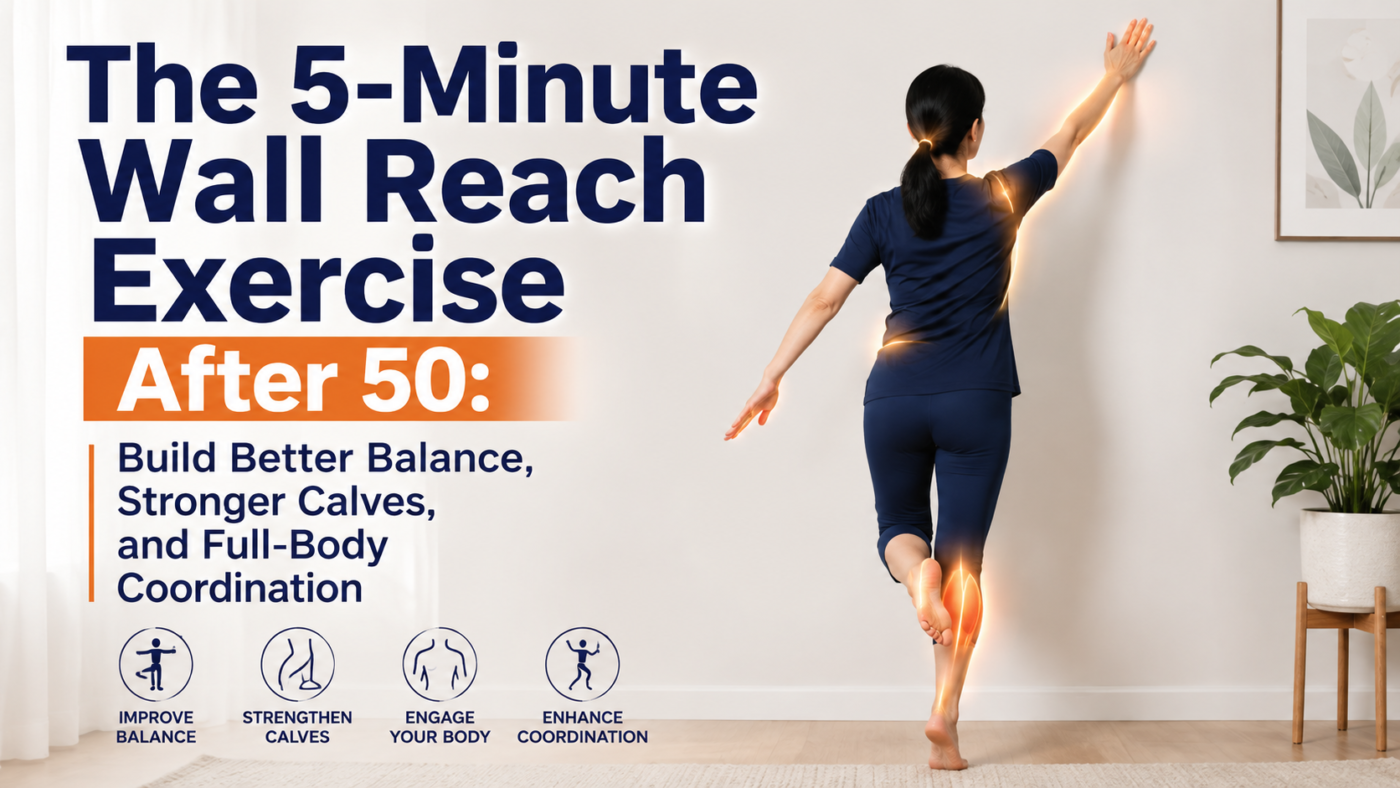
One useful example is a simple wall-based exercise that combines alternating overhead reaches with heel raises.
Stand close to a wall. Reach upward with one arm while rising onto the balls of your feet. Lower your heels as the arm comes down, then repeat with the opposite arm.
It sounds easy.
Try it continuously for a minute, however, and you may discover something interesting: your calves begin working, your balance has to adjust, your arms and legs must coordinate, and your entire body becomes more involved than you expected.
For adults over 50, that combination can make this simple drill a practical addition to a daily movement routine.
It is not a miracle treatment. It cannot replace medical care, and there is no evidence that five minutes of this particular exercise can prevent a blood clot or stroke.
But it can help you practice several physical capacities that become increasingly important with age.
Why Simple Movements Matter More After 50
Many age-related changes happen gradually.
You may notice that your ankles no longer feel as strong as they once did. Standing on your toes may become harder. Reaching overhead may feel stiff. You may feel less steady when changing direction or walking over uneven ground.
Sometimes the problem is not that the body has suddenly become incapable.
It is that we stop asking the body to perform certain movements regularly.
Modern life encourages sitting.
We sit while working, driving, eating, watching television, reading, and using computers or phones. Meanwhile, movements such as reaching overhead, rising onto the toes, balancing, squatting, rotating, and coordinating the arms and legs may appear less frequently in daily life.
This matters because physical abilities respond to use.
The World Health Organization notes that regular physical activity in adults and older adults is associated with better muscular and cardiorespiratory fitness, improved functional health, a lower risk of falls, and lower risks of several chronic diseases.
That does not mean one exercise solves everything.
It means small amounts of meaningful movement can become part of a much larger strategy for healthy aging.
Meet the Wall Reach and Heel Raise
The movement is simple:
Stand facing a wall.
Place your toes approximately 10–15 centimeters, or about 4–6 inches, from the wall. Adjust the distance if necessary so that you feel stable.
Raise both hands to approximately shoulder height.
Then reach one arm upward.
At the same time, slowly lift your heels and rise onto the balls of your feet.
Lightly touch the wall with your fingertips.
Lower the arm and heels.
Then reach with the opposite arm and repeat.
The pattern becomes:
Reach — rise — lower.
Other side — rise — lower.
Continue alternating sides at a comfortable rhythm.
The wall is not there for you to slap or push.
It serves primarily as a visual and tactile reference point that can help you maintain direction and reduce unnecessary leaning from side to side.
Why the Wall Makes the Exercise Easier to Learn
Try the movement without a wall and you may notice that your arms gradually drift forward, outward, or sideways.
You may begin leaning.
Your timing may become inconsistent.
The wall creates a simple target.
Every time your fingers gently reach toward approximately the same area, your nervous system receives immediate feedback about where your body is in space.
This is one reason the exercise is useful as a coordination drill.
You are simultaneously managing:
- arm movement,
- shoulder position,
- ankle movement,
- calf contraction,
- balance,
- posture,
- timing,
- breathing,
- and left-right alternation.
No single component is especially complicated.
Putting them together is what creates the challenge.
Benefit 1: It Strengthens the Calves
Every time you rise onto your toes, your calf muscles must lift and control your body weight.
The gastrocnemius and soleus muscles at the back of the lower leg are heavily involved in plantarflexion—the movement that lifts the heel.
These muscles are important for ordinary activities such as walking, climbing stairs, pushing off the ground, and controlling the ankle.
If you rarely perform heel raises, it is common for the calves to fatigue surprisingly quickly.
That is why someone performing this exercise for the first time may feel substantial calf fatigue after only a minute or two.
Fatigue is not necessarily a sign that the exercise is harmful.
It may simply indicate that those muscles are being asked to perform repeated work to which they are not accustomed.
Start slowly rather than trying to force yourself through five minutes immediately.
Benefit 2: It Challenges Ankle Control
Strong legs alone do not guarantee good balance.
Your ankles constantly make small adjustments to keep your center of mass over your base of support.
Rising onto the balls of the feet temporarily reduces stability and requires the ankles, calves, feet, and nervous system to work together.
This becomes particularly relevant as we age.
WHO recommendations specifically encourage older adults—particularly those with reduced mobility—to include activities that improve balance, because physical activity and balance-focused exercise contribute to fall prevention and functional independence.
The wall-reach exercise should not be considered a complete fall-prevention program, but the combination of controlled heel raises and postural control makes it a useful component of one.
Benefit 3: It Trains Upper- and Lower-Body Coordination
Here is where the exercise becomes more interesting.
Try performing the heel raise alone.
Then perform an overhead reach alone.
Both are relatively straightforward.
Now combine the two while alternating arms.
Suddenly the brain has to organize several movements simultaneously.
You must determine:
Which arm goes up?
When do the heels rise?
When do they lower?
Where should the fingertips go?
Is the trunk remaining upright?
Am I breathing normally?
This is a simple example of motor coordination.
If you initially feel awkward or your arms and feet seem unable to find the same rhythm, there is no reason to be embarrassed.
Slow the exercise down.
Coordination improves through repetition.
Benefit 4: It Encourages Overhead Shoulder Movement
Many adults gradually lose comfortable overhead movement because daily life rarely requires the arms to reach fully above the head.
This exercise repeatedly encourages shoulder elevation while asking the trunk to remain relatively controlled.
The important word is comfortably.
Your goal is not to force the arm into the highest possible position.
Reach only as far as your shoulder allows without sharp pain.
People with shoulder injuries, rotator-cuff problems, frozen shoulder, recent surgery, or significant pain may need a modified range or professional guidance.
Benefit 5: It Gets the Whole Body Moving
The original traditional explanation for exercises like this sometimes describes the movement as “opening the meridians” or improving the circulation of qi and blood.
Those ideas belong to the conceptual framework of traditional Chinese medicine.
They can be discussed as part of traditional wellness history, but they should not be confused with established vascular physiology.
From a modern exercise perspective, there is a simpler explanation for why you may feel warmer after several minutes.
Your muscles are contracting repeatedly.
Your heart and circulation respond to physical activity.
Your calves are working.
Your shoulders and arms are moving.
Your body is producing heat.
That can create sensations of warmth in the calves, feet, back, shoulders, and other areas.
Regular physical activity, considered across a person’s lifestyle, is associated with significant cardiovascular benefits. WHO identifies physical inactivity as an important modifiable cardiovascular risk factor and reports that regular activity is associated with reduced cardiovascular disease and stroke risk.
But that is different from claiming that this particular movement “cleans the blood vessels.”
It does not.
Can This Exercise Prevent Stroke or Blood Clots?
This point deserves special attention.
No good clinical evidence shows that performing this wall exercise for five minutes a day will prevent a stroke, dissolve a blood clot, remove deposits from blood vessel walls, or reduce stroke risk “to the lowest possible level.”
Stroke prevention is much more complex.
Major modifiable factors include blood pressure, tobacco exposure, physical inactivity, diabetes, cholesterol and lipid disorders, diet, body weight, cardiovascular conditions such as atrial fibrillation, and other individual medical risks.
The American Heart Association’s 2024 guideline for primary stroke prevention emphasizes regular physical activity and reducing prolonged sedentary behavior as part of cardiovascular and stroke-risk reduction, while also emphasizing the critical importance of blood-pressure management and other established risk factors. professional.heart.org
Therefore, use this movement for what it can reasonably offer:
more activity,
better calf endurance,
balance practice,
coordination,
and mobility.
Do not use it as a substitute for proven stroke-prevention strategies or prescribed medication.
How to Perform the Exercise Correctly
Step 1: Find a Stable Wall
Choose a clear section of wall with enough space to stand safely.
Avoid slippery floors.
Wear supportive shoes if barefoot practice feels unstable.
If you have poor balance, place a sturdy chair, countertop, or another stable support nearby.
Step 2: Face the Wall
Stand approximately 4–6 inches, or 10–15 centimeters, from the wall.
This is only a starting point.
Adjust your distance according to your body proportions and shoulder mobility.
Your feet should feel comfortable rather than artificially narrow.
Step 3: Establish Your Posture
Stand tall without becoming rigid.
Keep your knees relaxed.
Allow the ribs to remain reasonably stacked above the pelvis.
Avoid pushing your abdomen dramatically forward or arching the lower back.
Bring your hands to approximately shoulder height.
Step 4: Reach With One Arm
Slowly extend one arm upward.
Keep the movement controlled.
Gently touch the wall with your fingertips.
Do not slap the wall.
Do not push forcefully against it.
The wall is simply your reference point.
Step 5: Add the Heel Raise
As the arm moves upward, slowly rise onto the balls of both feet.
Lift the heels only as high as you can while remaining stable.
Then lower the heels gently back to the floor as the arm returns.
Avoid dropping the heels abruptly.
Step 6: Change Arms
Repeat with the opposite arm.
Find a comfortable alternating rhythm:
Right arm up — heels rise.
Lower.
Left arm up — heels rise.
Lower.
Right.
Left.
Continue.
Start With Your Feet If Coordination Is Difficult
Some beginners immediately discover that combining the arms and feet is confusing.
That is completely acceptable.
Break the movement into pieces.
First, practice only the heel raises.
Hold the wall or a sturdy support.
Rise slowly.
Lower slowly.
Repeat.
Once the movement feels controlled, add both arms moving upward together.
Only after that feels comfortable do you begin alternating one arm at a time.
A useful progression is:
Level 1: Supported heel raises only.
Level 2: Heel raises with both arms reaching.
Level 3: Alternating overhead reaches with heel raises.
Level 4: Longer continuous sets while maintaining control.
You do not need to progress quickly.
How Long Should You Practice?
The original routine suggests one to five minutes.
That is a reasonable range for a simple home movement drill, but five minutes should be considered an upper goal rather than a requirement for beginners.
Try this progression:
Week 1: 30–60 seconds.
Week 2: 1–2 minutes.
Week 3: 2–3 minutes.
Week 4: Gradually work toward 3–5 minutes if comfortable.
You can also divide the exercise into several shorter sets.
For example:
60 seconds of movement,
30–60 seconds of rest,
then another 60 seconds.
There is no special medical benefit to suffering through five continuous minutes.
Quality matters more than duration.
Do Not Chase Speed
The movement may eventually become rhythmic, but speed should not be your first goal.
When people move too quickly, several compensations often appear.
The lower back begins arching.
The torso bends sideways.
The heels bounce rather than rise under control.
The arms stop reaching vertically.
Balance becomes less stable.
Instead, learn the movement slowly.
Once your technique feels natural, you can gradually increase the rhythm while remaining controlled.
Keep the Lower Back Quiet
One of the most important details occurs when the arm reaches overhead.
You are trying to move the shoulder and arm.
You are not trying to create the illusion of more shoulder mobility by excessively arching your lower back.
Imagine keeping your ribs relatively quiet while the arm travels upward.
If you cannot reach very high without leaning backward, reduce your range.
A smaller controlled reach is better than a larger compensated one.
The same applies to sideways leaning.
When your right arm reaches upward, do not collapse dramatically toward the left.
Use the wall to help you recognize whether you are drifting.
What About Breathing?
Do not hold your breath.
For a slow version of the movement, you can try:
Inhale gently as you reach upward.
Exhale as you lower.
However, there is nothing physiologically magical about that exact pattern.
The more important principle is to breathe continuously and comfortably.
If you notice yourself straining, grimacing, or holding your breath, slow down.
This is especially important for people who have cardiovascular conditions or blood-pressure concerns.
What If You Have High Blood Pressure?
Regular physical activity is generally an important part of cardiovascular health, and physical activity can contribute to the prevention and management of hypertension.
However, people with poorly controlled hypertension, cardiovascular disease, dizziness, fainting, or other relevant medical conditions should not assume that every exercise is automatically appropriate.
Move slowly.
Avoid breath-holding and straining.
Stop if you experience dizziness, unusual shortness of breath, chest discomfort, faintness, or other concerning symptoms.
If your blood pressure is significantly elevated or you have been given specific exercise restrictions, follow your clinician’s recommendations.
What If Your Calves Become Sore?
If you are not accustomed to repeated heel raises, calf soreness can occur after introducing them.
That does not mean that day two and day three must be endured regardless of symptoms.
Exercise should not become a test of stubbornness.
Mild muscular fatigue or delayed soreness can be normal after unfamiliar activity.
Sharp pain, significant swelling, marked weakness, redness, unusual one-sided calf pain, or symptoms that concern you should not simply be attributed to exercise.
This distinction is particularly important because sudden unilateral calf swelling or pain can sometimes require medical assessment.
Do not “push through” symptoms that seem abnormal.
A Better Four-Week Progression
Rather than promising that one month will somehow “beat ten years of Tai Chi,” use the month to build a realistic habit.
Week 1: Learn
Practice slowly for 30–60 seconds.
Focus on heel control and balance.
Use the wall freely.
Week 2: Coordinate
Add alternating arms.
Practice for one to two minutes.
Rest whenever the movement becomes sloppy.
Week 3: Build Endurance
Increase the duration gradually.
Try several controlled sets.
Continue using the wall.
Week 4: Integrate
Aim for three to five minutes if appropriate.
You may occasionally try the movement slightly farther from the wall, but there is no reason to remove the wall if it improves safety.
The goal is not to prove that you no longer need support.
The goal is to move well.
Why Tai Chi Should Not Be Treated as the Competition
Claims that this one exercise is “better than ten years of Tai Chi” are not supported by evidence.
They also miss the point.
Tai Chi is a much broader practice involving weight shifting, postural control, coordination, attention, breathing, repeated movement patterns, and balance.
A wall reach with heel raises is one simple exercise.
They are not equivalent interventions.
In fact, the most sensible approach to healthy aging is rarely to search for one “best” movement.
Walking, resistance exercise, balance training, mobility work, Tai Chi, recreational activities, and simple home exercises can complement one another.
Variety is an advantage.
Traditional Chinese Medicine Perspective
In traditional Chinese medicine, upward arm movements may be discussed in relation to channels running through the upper limbs, while stimulation of the sole of the foot may be associated with the Kidney meridian and Yongquan (KI1).
These ideas have long existed within traditional East Asian health practices.
They can provide cultural and historical context for movement.
However, claims such as “stretching the Heart meridian clears the blood vessels” or “stimulating Yongquan prevents blood clots” should not be presented as established biomedical facts.
There is no good evidence that activating a particular acupuncture channel through this movement mechanically removes arterial plaque or prevents thrombosis.
A responsible modern interpretation can respect traditional concepts while also recognizing the limits of current scientific evidence.
You can appreciate the traditional language of circulation and vitality while understanding the exercise physiologically as a combination of muscular contraction, balance practice, mobility, coordination, and general physical activity.
Those two perspectives do not need to be confused in order for the exercise to remain useful.
The Most Important Benefit May Be Consistency
There is an understandable temptation to search for dramatic health hacks.
One exercise to unclog the arteries.
One food to reverse aging.
One movement to eliminate pain.
One routine to prevent every disease.
Human physiology does not work that way.
Healthy aging is cumulative.
It comes from the things you repeatedly do:
walking,
strengthening your muscles,
maintaining balance,
remaining socially and mentally active,
sleeping adequately,
eating well,
not smoking,
managing blood pressure and other cardiovascular risks,
and continuing to move your body in different ways.
The wall reach is valuable precisely because it is simple enough to become one of those repeated behaviors.
You need only a wall.
No equipment.
No gym membership.
No complicated sequence to memorize.
And even one minute is a reasonable place to begin.
The Bottom Line
After 50, maintaining the ability to move confidently may matter more than performing impressive exercises.
This simple wall-reach and heel-raise drill combines several useful elements in one movement:
calf strengthening,
ankle control,
balance,
shoulder mobility,
posture,
upper- and lower-body coordination,
and light whole-body activity.
It will not guarantee freedom from stroke.
It will not dissolve blood clots.
It will not “clean” your arteries.
And there is no scientific basis for claiming that one month of practice replaces years of Tai Chi.
But performed regularly and safely, it can become one small, practical part of a physically active lifestyle—and regular physical activity is strongly associated with better cardiovascular and functional health as we age.
Start slowly.
Touch the wall gently.
Rise onto your toes under control.
Reach without arching your back.
Breathe.
And repeat.
The objective is not to force your body to feel young.
It is to keep giving your body reasons to remain capable.
Frequently Asked Questions
Is this exercise good for people over 50?
For many generally healthy adults, it can be a useful low-equipment exercise for calf endurance, coordination, ankle control, shoulder movement, and balance. Individual health conditions and balance ability should determine how the movement is modified.
How many minutes should I do?
Beginners can start with 30–60 seconds. Gradually progress toward several minutes if the exercise remains comfortable and controlled. There is no requirement to immediately perform five continuous minutes.
Does standing on the toes improve balance?
Heel raises challenge ankle control and calf strength, both of which contribute to lower-limb function. Effective fall prevention usually involves a broader program of balance and functional exercise rather than one movement alone. Evidence reviews support exercise-based approaches for reducing fall risk in older adults.
Can this exercise prevent a stroke?
There is no evidence that this specific exercise prevents stroke. Regular physical activity is one component of stroke-risk reduction, along with appropriate management of blood pressure, smoking, diabetes, lipids, diet, weight, heart conditions, and other risk factors.
Does it prevent blood clots?
It should not be promoted as a treatment or prevention method for thrombosis. Anyone with symptoms suggestive of a blood clot or known clotting risk should seek appropriate medical care rather than relying on exercise.
Why do my calves become tired so quickly?
Heel raises repeatedly load the calf muscles. If you rarely train them, fatigue may occur quickly. Reduce the duration, rest, and gradually build endurance rather than forcing longer sets.
Should my fingertips hit the wall?
No. A light touch is enough. The wall serves as a positioning and coordination reference.
What if I cannot coordinate my arms and legs?
Practice heel raises by themselves first. Once those are comfortable, add both arms, and finally progress to alternating arm reaches.
Should I do the movement quickly?
Begin slowly. Technique, balance, and control are more important than speed.
Can I practice without the wall?
You can once the movement becomes familiar, but there is no particular benefit to abandoning the wall. People with balance concerns should continue using stable support.
Medical Disclaimer
This article is for educational purposes only and is not medical advice. Exercise should be adapted to your current mobility, balance, cardiovascular health, and medical history. Stop exercising and seek appropriate medical attention if you develop chest pain, fainting, severe shortness of breath, sudden neurological symptoms, unusual one-sided calf swelling or pain, or other concerning symptoms. People with cardiovascular disease, uncontrolled hypertension, significant balance disorders, recent surgery, musculoskeletal injuries, or other major health conditions should consult an appropriately qualified healthcare professional before beginning a new exercise program.
This article is for general education and does not replace individualized care from a qualified health professional. Seek appropriate advice for persistent, severe, or concerning symptoms.
Read the full medical disclaimer