Type 1 diabetes can appear suddenly in children and adolescents. A previously healthy child may begin drinking excessively, urinating frequently, losing weight and feeling increasingly unwell. In more severe cases, the first presentation may be diabetic ketoacidosis, or DKA, which can require emergency treatment.
For families, the diagnosis can feel overwhelming. Parents may immediately worry about injections, food restrictions, school, exercise, long-term complications and whether their child will be able to live normally.
But diabetes technology has changed dramatically.
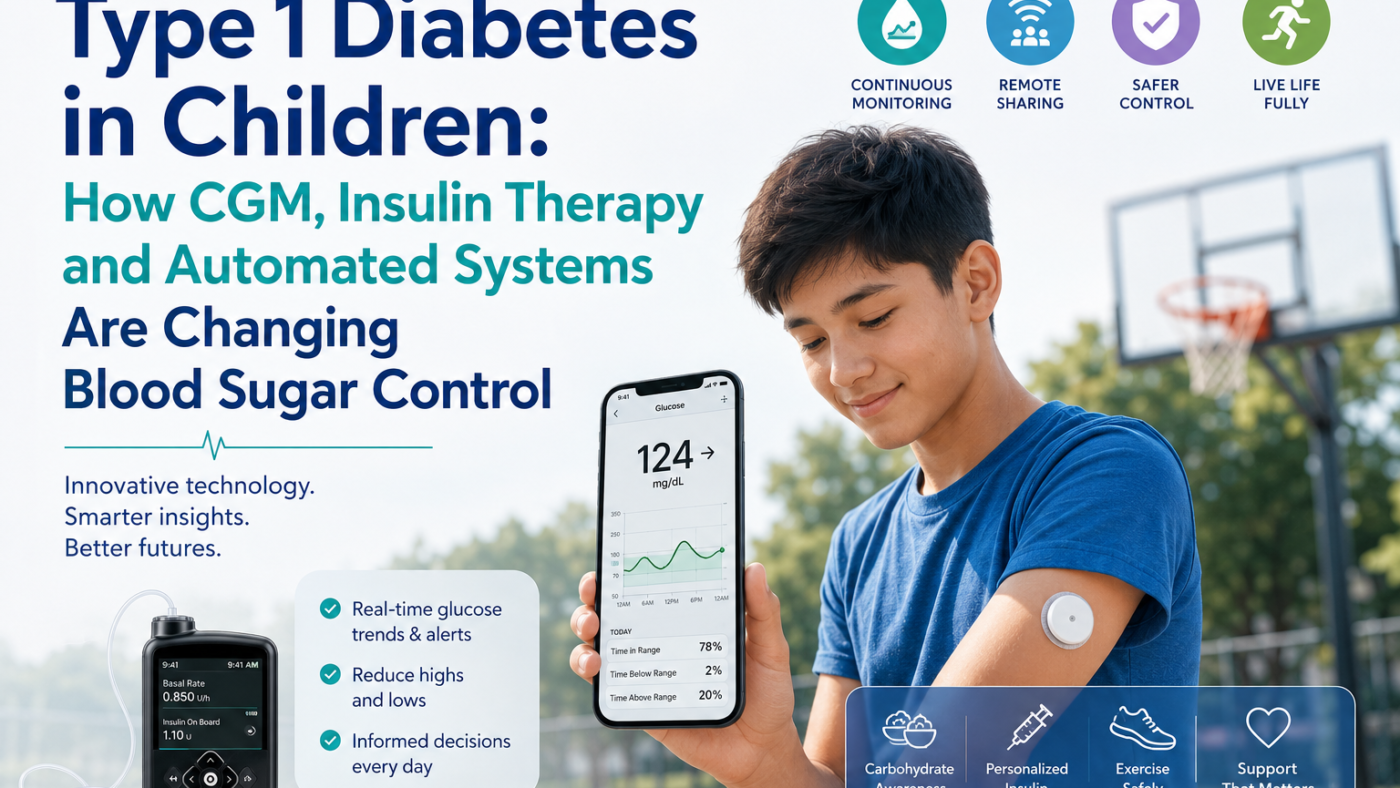
Continuous glucose monitors, or CGMs, now allow families to see glucose trends throughout the day and night without relying only on repeated finger-stick testing. Remote sharing lets parents and, in some situations, healthcare teams follow glucose patterns from a distance. Automated insulin delivery systems can combine CGM data with an insulin pump to adjust insulin delivery throughout the day.
These technologies do not make type 1 diabetes disappear, but they can make diabetes management more precise, safer and more manageable.
Type 1 and Type 2 Diabetes Are Different Diseases
Diabetes is often divided broadly into type 1 and type 2 diabetes, but the underlying mechanisms and treatment strategies are very different.
Type 1 diabetes is especially important in pediatrics.
In type 1 diabetes, the body’s immune system damages the pancreatic beta cells responsible for producing insulin. As insulin production becomes insufficient, blood glucose rises and the body can no longer use glucose normally.
Children with established type 1 diabetes generally require lifelong insulin replacement.
Type 2 diabetes, by contrast, is primarily characterized by insulin resistance together with progressive impairment in insulin secretion. Treatment options may include lifestyle intervention, oral medications, injectable medications and, in some cases, insulin.
This distinction matters because advice designed for an older adult with type 2 diabetes should not automatically be applied to a growing child with type 1 diabetes.
Why Traditional Finger-Stick Testing Can Be Difficult
Before continuous glucose monitoring became widely available, many people with type 1 diabetes depended heavily on capillary glucose testing.
This meant repeatedly pricking a fingertip to obtain a blood sample.
Some patients may need multiple checks throughout the day. The source discussion describes situations in which glucose testing could occur as often as seven times daily.
For an adult, repeated finger sticks can already be frustrating.
For a four- or five-year-old child, they can become a major source of fear and resistance.
Finger-stick testing also provides only isolated snapshots.
A reading taken at 8:00 a.m. tells you what the glucose level was at that moment. It does not automatically show whether glucose was rapidly rising, gradually falling or fluctuating overnight.
CGM adds that missing context.
What Is a Continuous Glucose Monitor?
A continuous glucose monitor uses a small sensor placed under the skin to estimate glucose levels in the interstitial fluid.
Most systems transmit readings to a smartphone, receiver or compatible insulin pump.
A CGM can provide:
- frequent glucose measurements
- trend arrows
- high-glucose alerts
- low-glucose alerts
- overnight monitoring
- patterns after meals
- patterns during exercise
- remote data sharing
Insertion may briefly cause a small amount of discomfort, but many users report little sensation once the sensor is in place.
The device usually sits on the skin somewhat like a small adhesive patch.
CGM Can Reduce the Burden of Repeated Finger Sticks
One of the clearest practical advantages of CGM is reducing dependence on repeated manual testing.
This may be especially meaningful for young children who are frightened of finger pricks.
The source discussion describes a 15-year-old student who had been living with type 1 diabetes for about two years and had used CGM throughout that period.
He described a brief stinging sensation at insertion, followed by little ongoing discomfort.
For him, the sensor became part of ordinary life rather than a constant reminder of illness.
CGM Shows What Food Does to Glucose
One of the most valuable features of CGM is that it turns glucose into visible feedback.
A person can observe what happens after:
- rice
- noodles
- cake
- chocolate
- sweet drinks
- exercise
- stress
- sleep
- illness
Instead of hearing only:
“Sugar is bad.”
a child can begin to see:
“This food raises my glucose this much, and this is how long the rise lasts.”
That makes diabetes education more individualized.
Two children can eat similar meals and experience different glucose responses.
CGM helps families understand those patterns.
CGM Can Help During School
Managing type 1 diabetes at school is a major concern for parents.
A child may:
- exercise during physical education
- play sports
- eat unexpectedly
- delay meals
- experience stress
- develop hypoglycemia
The source discussion describes parents using remote CGM data to recognize low glucose while a child is at school and then contacting a teacher so the child can receive fast-acting carbohydrate.
This can provide an additional layer of safety, particularly for younger children.
But schools should still have a written diabetes management plan and staff who understand how to respond to low and high glucose.
Technology should support that plan, not replace it.
Can Children Exercise While Wearing CGM?
Usually, yes.
The discussion describes patients participating in activities such as:
- running
- basketball
- cycling
- resistance training
- even certain water activities, depending on the device
Placement matters.
For sports involving physical contact, the sensor can sometimes be positioned in an approved site that is less likely to be struck or rubbed.
Different CGM systems have different approved insertion sites and water-resistance specifications, so patients should follow the manufacturer’s instructions and their diabetes team’s recommendations.
Skin Irritation Can Be a Problem
Not every child tolerates CGM adhesive perfectly.
Some develop:
- redness
- itching
- contact dermatitis
- irritation from repeated adhesive use
Families may need to discuss barrier films, alternative adhesives, sensor placement or other skin-protection strategies with the diabetes care team.
A child who reacts to one adhesive product may still be able to use CGM successfully with adjustments.
Type 1 Diabetes Does Not Mean a Child Must Stop Living Normally
One of the most powerful messages in the source discussion comes from the adolescent living with type 1 diabetes.
He describes support from:
- parents
- relatives
- classmates
- teachers
- school staff
Rather than being ridiculed, he felt understood and supported.
That social environment matters.
A child with type 1 diabetes should not be made to feel fragile, abnormal or incapable.
With appropriate management, children with type 1 diabetes can:
- study
- exercise
- play sports
- travel
- participate in school life
- plan careers
- live active adult lives
The goal is not to create a life organized entirely around diabetes.
It is to manage diabetes well enough that the child can get on with life.
Hypoglycemia Is One of the Biggest Daily Concerns
Insulin is essential in type 1 diabetes, but too much insulin relative to food intake or activity can lower glucose excessively.
Hypoglycemia may occur:
- during exercise
- after exercise
- overnight
- after insulin dosing
- when meals are delayed
- after unexpected changes in activity
Young children may not always recognize or describe symptoms clearly.
CGM alarms can therefore be particularly valuable.
Some systems can alert the wearer and connected caregivers when glucose falls below a preset threshold or is predicted to fall.
However, families should still know how to recognize and treat hypoglycemia and when a confirmatory blood glucose test may be needed.
Understanding Carbohydrate Counting
Type 1 diabetes management is not simply about avoiding sugar.
A more useful concept is understanding carbohydrate intake and matching insulin appropriately.
If a child knows they are going to eat a piece of cake, the care plan may involve estimating its carbohydrate content and using an individualized insulin-to-carbohydrate ratio.
This is one reason diabetes education is so important.
Children gradually learn to understand:
- carbohydrate portions
- insulin dosing
- glucose trends
- correction doses
- exercise effects
- delayed glucose changes
Younger children naturally require more help from adults.
The exact timing and amount of insulin should always follow the patient’s personalized medical plan rather than generic rules.
A Child With Type 1 Diabetes Still Needs Enough Food to Grow
This point deserves particular emphasis.
Parents sometimes respond to a new diagnosis by dramatically restricting:
- rice
- bread
- noodles
- fruit
- desserts
- calories
That may reflect understandable fear, but excessive restriction can be harmful.
A child is still growing.
Adequate energy, protein and micronutrients remain essential.
The source discussion strongly warns against taking dietary concepts commonly used for older adults with type 2 diabetes and applying them rigidly to children with type 1 diabetes.
The better goal is:
healthy food + appropriate carbohydrate understanding + appropriate insulin management.
Not starvation.
Skipping Meals Is Not a Safe Way to Control Type 1 Diabetes
Some children become frightened by high glucose readings and begin eating less.
They may believe:
“If I don’t eat, my glucose won’t rise.”
This can be dangerous.
Children with type 1 diabetes still require adequate nutrition and individualized insulin therapy.
Poor intake combined with inadequate insulin can contribute to metabolic instability, weight loss and, in severe situations, ketoacidosis.
The treatment objective is not to eliminate food.
It is to safely coordinate nutrition and insulin.
What Is Diabetic Ketoacidosis?
Diabetic ketoacidosis, or DKA, is a serious complication caused by severe insulin deficiency.
Without enough insulin, the body cannot use glucose normally and begins breaking down fat rapidly.
This produces ketones and metabolic acidosis.
DKA can occur when type 1 diabetes first develops or when insulin delivery becomes inadequate.
It can become life-threatening.
Warning Signs of DKA
The discussion describes symptoms including:
- excessive thirst
- frequent urination
- weight loss
- dehydration
- abdominal pain
- vomiting
- rapid or deep breathing
- severe weakness
- altered consciousness
- coma in extreme cases
One useful distinction raised in the discussion is that a child with gastroenteritis often becomes dehydrated and urinates less, while a child developing diabetes may continue to urinate excessively because glucose is pulling water into the urine.
This is not a diagnostic rule, but it can be an important clue.
A child with unexplained weight loss, excessive thirst and frequent urination should be medically evaluated promptly.
How Diabetes Is Diagnosed
The source discussion mentions several commonly used diagnostic thresholds.
Diabetes may be diagnosed when appropriate testing shows findings such as:
Fasting plasma glucose:
126 mg/dL or higher
Random plasma glucose:
200 mg/dL or higher in a person with classic symptoms
Two-hour glucose during an oral glucose tolerance test:
200 mg/dL or higher
HbA1c:
6.5% or higher
In many cases, confirmatory testing is required when classic symptoms and unequivocal hyperglycemia are absent.
Additional testing can help distinguish type 1 from type 2 diabetes.
This may include:
- diabetes-related autoantibodies
- C-peptide
- clinical presentation
- age
- body composition
- family history
Why C-Peptide Can Be Useful
C-peptide is released when the pancreas produces endogenous insulin.
Measuring it can help clinicians estimate how much insulin the pancreas is still making.
Very low endogenous insulin production can support the diagnosis of type 1 diabetes, although interpretation depends on the clinical context.
Autoantibody testing is also important when autoimmune type 1 diabetes is suspected.
HbA1c Is Important, but It Is Not the Whole Story
HbA1c reflects average glucose exposure over roughly the preceding two to three months.
It remains a fundamental diabetes management marker.
But averages can hide very different glucose patterns.
Consider two people with the same average glucose.
One has relatively stable readings.
The other repeatedly swings between:
60 → 220 → 60 → 220 mg/dL
The average may look similar, but the daily experience is very different.
This is why CGM has introduced additional metrics that complement HbA1c.
Time in Range Has Become a Key CGM Metric
One of the most important CGM measurements is Time in Range, commonly abbreviated TIR.
For many people with type 1 diabetes, the commonly used target range is:
70–180 mg/dL
The source discussion emphasizes a goal of spending at least approximately:
70% of the day within that range.
That corresponds to roughly 17 hours per day.
Targets must be individualized, particularly for very young children, pregnancy, older adults or people with recurrent hypoglycemia.
But the broader principle is important:
Good diabetes management is not only about the average glucose. It is also about reducing extreme highs and lows.
Time Below Range Also Matters
Avoiding hypoglycemia remains essential.
CGM makes it possible to quantify how much time glucose spends below target.
Clinical targets often aim to keep time below 70 mg/dL limited, with even stricter limits for more significant hypoglycemia.
Rather than memorizing one number in isolation, families should review TIR, time below range and time above range with their diabetes team.
Why Glucose Variability Matters
A stable glucose pattern is generally preferable to repeated extreme swings.
Large fluctuations can:
- make insulin management harder
- increase hypoglycemia risk
- impair daily functioning
- complicate exercise and school
- increase caregiver anxiety
CGM gives families something traditional HbA1c testing cannot provide: a picture of those fluctuations.
That allows treatment to become increasingly personalized.
Type 1 Diabetes Is Not Caused by Eating Too Much Sugar
Parents often blame themselves after a child’s diagnosis.
They may ask:
“Did I let my child eat too much sugar?”
Type 1 diabetes is not caused by parents allowing a child to eat too much candy, rice or noodles.
It is primarily an autoimmune disease in which pancreatic beta cells are progressively damaged.
Genetics influence susceptibility, but inheritance is complex.
Environmental triggers are also being studied.
What About Viral Infections?
The source discussion mentions possible associations between type 1 diabetes and viral infections, including enteroviruses and infections occurring during the COVID era.
This is an active research area.
Certain viral exposures have been investigated as potential contributors to autoimmune processes in genetically susceptible individuals.
But it would be inaccurate to say that a specific viral infection normally “causes” type 1 diabetes in a simple one-to-one way.
The disease likely results from interactions between:
- genetic susceptibility
- immune regulation
- environmental exposures
- other biological factors
Parents should not blame themselves for a child’s diagnosis.
Family History Is Different in Type 1 and Type 2 Diabetes
Type 1 diabetes can occur in families, but many children with type 1 diabetes have no close relative with the disease.
Type 2 diabetes often shows a much stronger pattern of clustering among parents, grandparents and other relatives.
That does not make type 2 diabetes purely genetic either.
It simply means the hereditary pattern differs.
What Is the “Honeymoon Phase” of Type 1 Diabetes?
Shortly after diagnosis and the start of insulin therapy, some patients temporarily need less insulin.
This is commonly called the honeymoon phase or partial remission.
The source discussion explains it with a helpful analogy.
At diagnosis, not every beta cell is necessarily completely destroyed.
Once external insulin reduces the metabolic stress on the remaining cells, they may temporarily recover some insulin production.
Glucose control improves.
Insulin needs may fall.
Families sometimes think:
“The diabetes is gone.”
Unfortunately, that is generally not the case.
The Honeymoon Phase Does Not Mean Type 1 Diabetes Has Been Cured
Autoimmune destruction can continue.
Over time, remaining beta-cell function usually declines further.
The honeymoon phase may last months or longer, and its duration varies substantially from person to person.
The source describes a tendency for remission to progress faster in children than in some adults.
But no family should stop insulin or follow-up care simply because glucose has temporarily become easier to control.
Insulin adjustments during this period should be guided by the diabetes team.
Adolescence Can Make Diabetes Harder to Control
Puberty is challenging even without diabetes.
Hormonal changes during adolescence can increase insulin resistance.
Growth hormone and sex hormones are among the physiological factors contributing to changing insulin requirements.
At the same time, teenagers may experience:
- irregular schedules
- late-night studying
- snacks
- social activities
- less parental supervision
- increased independence
The result can be more variable glucose control.
This is one reason diabetes self-management education should begin well before adolescence.
Children Should Gradually Learn to Manage Their Own Diabetes
The source discussion strongly supports early development of self-management skills.
Even a young child can gradually learn age-appropriate tasks such as:
- looking at CGM values
- recognizing arrows
- identifying low-glucose alerts
- telling an adult when something feels wrong
- learning basic carbohydrate concepts
As the child grows, responsibility can gradually expand.
By adolescence, the ideal goal is not for parents to suddenly “let go.”
It is for the teenager to have spent years learning how to manage diabetes safely.
Remote Monitoring Changes the Role of Parents and Clinicians
Modern CGM systems may allow glucose data to be shared with:
- parents
- caregivers
- clinicians
- diabetes educators
A parent can sometimes follow a child’s glucose while the child is at school.
A clinic may review patterns remotely.
A diabetes educator may identify recurring highs or lows before the next appointment.
This can make diabetes care more continuous rather than being limited to brief clinic visits.
However, remote monitoring should be used thoughtfully.
Older children and teenagers also need appropriate privacy, independence and trust.
What Is an Automated Insulin Delivery System?
The next major step beyond CGM is automated insulin delivery, or AID.
These systems combine:
- a continuous glucose monitor
- an insulin pump
- an algorithm
The CGM measures glucose.
The algorithm analyzes the readings.
The pump automatically adjusts insulin delivery.
If glucose is rising, the system may increase insulin delivery.
If glucose is falling or predicted to fall, it may reduce or suspend insulin.
This is sometimes informally described as an artificial pancreas, although current systems still require user involvement.
Automated Systems Are Not Completely Hands-Off
The original discussion describes these systems as reducing much of the manual burden of diabetes management.
That is true, but “automatic” does not mean completely independent.
Many current systems still require users to:
- announce meals
- estimate carbohydrates
- change infusion sets
- refill insulin
- replace sensors
- respond to alerts
- manage exercise
- troubleshoot equipment
The technology can substantially reduce workload, but diabetes education remains essential.
Can Automated Insulin Delivery Produce Near-Normal Glucose?
Some individuals using advanced AID systems can achieve excellent glucose control.
The source discussion describes patients reaching HbA1c levels close to the non-diabetic range.
That is possible for selected individuals, but it should not be presented as a guaranteed result.
Targets should always balance:
- glucose control
- hypoglycemia risk
- treatment burden
- quality of life
A lower HbA1c is not automatically better if it is achieved through frequent dangerous hypoglycemia.
The strongest benefit of modern systems is not simply achieving the lowest possible number.
It is achieving safer, more stable glucose with less daily burden.
The Cost of Diabetes Technology Still Matters
CGMs and automated insulin delivery systems can improve management, but affordability remains an important issue.
Costs vary widely by:
- country
- insurance coverage
- healthcare system
- device
- sensor replacement interval
- pump supplies
For many families, ongoing consumable costs can be substantial.
This means the newest device is not automatically the best choice for every patient.
Technology should be selected according to medical need, accessibility, affordability and the family’s ability to use it effectively.
Technology Is a Tool, Not the Treatment by Itself
The source discussion repeatedly returns to one important lesson.
A CGM is extremely useful.
An insulin pump can be extremely useful.
An automated insulin delivery system can be transformative.
But successful type 1 diabetes management still depends on understanding:
- insulin
- food
- carbohydrates
- exercise
- illness
- hypoglycemia
- hyperglycemia
- device troubleshooting
- emergency plans
Technology works best when paired with good education.
A Child With Type 1 Diabetes Can Still Have a Full Future
A new diagnosis often changes how a child imagines the future.
They may think:
“I will have to inject insulin forever.”
“I cannot eat anything I like.”
“I cannot exercise.”
“I will always be sick.”
These fears deserve to be addressed directly.
Type 1 diabetes requires daily management.
But it does not remove a child’s future.
The source discussion compares diabetes care to maintaining a car: one part of the system needs additional support, so it requires regular monitoring and appropriate “fuel.”
The analogy is imperfect medically, but psychologically it makes a useful point:
A chronic condition can require maintenance without defining the entire person.
With appropriate insulin therapy, CGM, education, family support and regular medical follow-up, children with type 1 diabetes can grow, learn, exercise and plan for adulthood.
Frequently Asked Questions
What is CGM?
CGM stands for continuous glucose monitoring. A small sensor under the skin measures interstitial glucose repeatedly and sends readings to a compatible device.
Does CGM completely eliminate finger-stick testing?
Many modern CGMs substantially reduce routine finger-stick testing, but confirmatory blood glucose checks may still be needed in certain circumstances depending on the device and symptoms.
Can a child exercise while wearing CGM?
Usually yes. Sensor placement and device-specific precautions should be considered for contact sports and water activities.
What is Time in Range?
Time in Range is the percentage of time glucose remains within a specified target range. For many people with type 1 diabetes, 70–180 mg/dL is commonly used.
Is HbA1c still important if someone uses CGM?
Yes. HbA1c and CGM metrics provide complementary information. HbA1c reflects average glucose, while CGM shows variability, time in range and hypo- or hyperglycemic exposure.
Can children with type 1 diabetes eat carbohydrates?
Yes. Children need adequate nutrition for growth. Carbohydrate intake should be understood and matched appropriately with individualized insulin therapy rather than universally eliminated.
Did eating too much sugar cause my child’s type 1 diabetes?
No. Type 1 diabetes is primarily an autoimmune disease and is not simply caused by eating sugar.
What is the honeymoon phase?
It is a temporary period after diagnosis when remaining beta cells may produce enough insulin that external insulin requirements decrease. It does not usually mean the diabetes has disappeared.
What is an artificial pancreas?
The term usually refers to an automated insulin delivery system combining CGM, an insulin pump and software that automatically adjusts insulin delivery.
Can automated insulin delivery replace diabetes education?
No. Patients and families still need to understand insulin, carbohydrates, exercise, hypoglycemia, device care and emergency management.
Medical Disclaimer
This article is for general educational purposes only and is not a substitute for individualized medical advice. Type 1 diabetes requires ongoing care from qualified healthcare professionals. Insulin doses, glucose targets, carbohydrate ratios and treatment plans should never be changed solely on the basis of general online information. Symptoms of diabetic ketoacidosis, severe hypoglycemia, altered consciousness or serious illness require urgent medical assessment.
This article is for general education and does not replace individualized care from a qualified health professional. Seek appropriate advice for persistent, severe, or concerning symptoms.
Read the full medical disclaimer