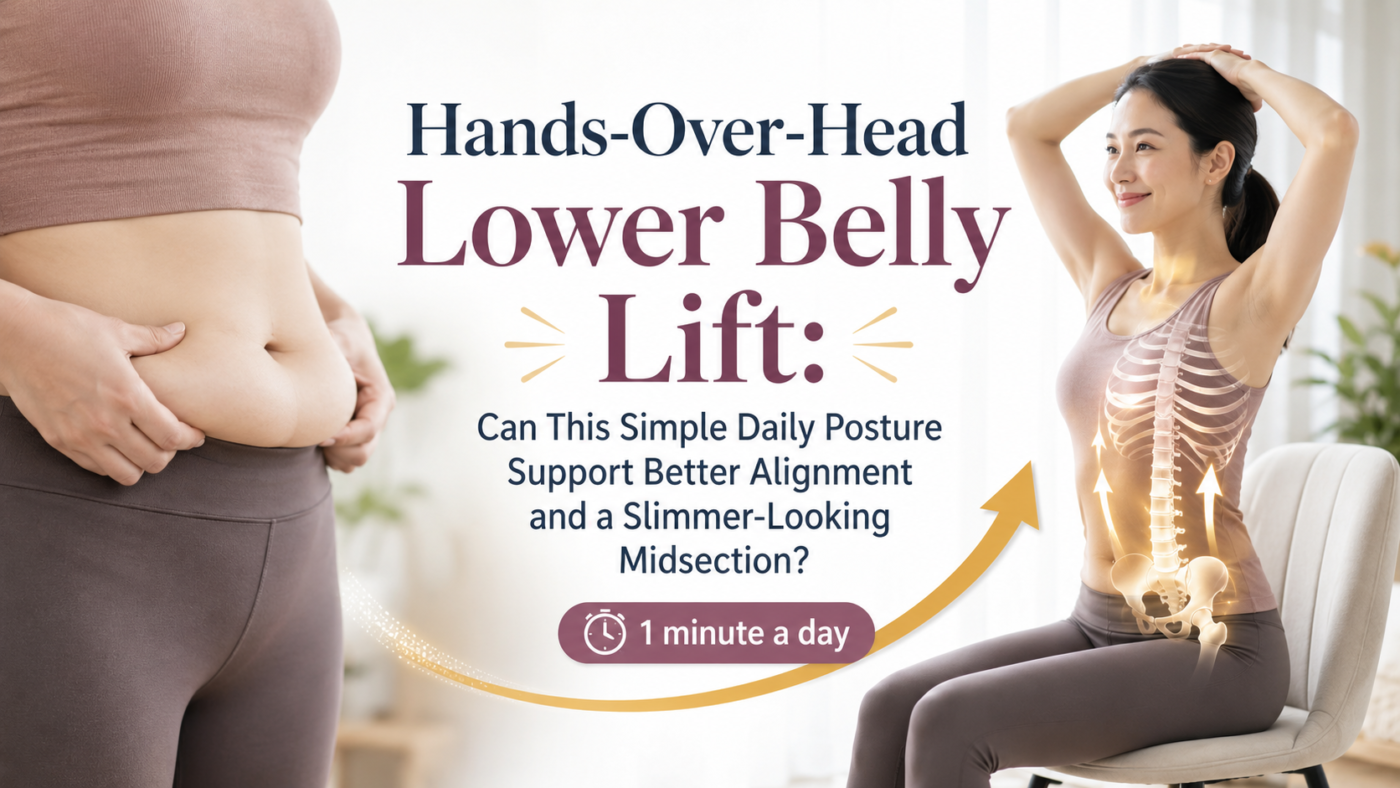
A seated pelvic floor exercise can help improve core awareness, posture and lower-belly control, especially after 40. A lower belly that appears more prominent is not always explained by body fat alone.
Posture, rib-cage position, pelvic orientation, abdominal-wall tension and breathing can all influence how the abdomen looks from moment to moment.
That is why some seated posture exercises seem to make the lower belly look flatter immediately. The effect can be real, but it is usually caused by changes in posture and muscle engagement—not instant fat loss or internal organs being physically “lifted” back into place.
Posture, rib-cage position, pelvic orientation, abdominal-wall tension and breathing can all influence how the abdomen looks from moment to moment.
That is why some seated posture exercises seem to make the lower belly look flatter immediately.
The effect can be real.
But it is usually caused by changes in posture and muscle engagement—not instant fat loss or internal organs being physically “lifted” back into place.
This distinction matters.
A well-designed seated routine can still be useful for improving core awareness, pelvic-floor coordination, hip control and upright posture, especially for adults over 40.
Why the Lower Belly Can Look Different With Posture
Stand or sit with the pelvis rolled backward, the spine collapsed and the ribs compressed.
The abdomen may bunch forward.
Now sit taller.
Bring the rib cage more comfortably over the pelvis.
Gently engage the abdominal wall.
The lower belly may look flatter.
Nothing has disappeared.
The body has simply changed shape.
That is one reason posture exercises can produce dramatic-looking before-and-after images within seconds.
Does Poor Posture Make Internal Organs Sag?
Not in the simple way often described online.
Internal organs are supported by multiple structures, including connective tissues, fascia, the pelvic floor, ligaments and surrounding anatomy.
Posture can alter pressure distribution inside the trunk.
But sitting slouched does not simply cause the organs to drop downward like loose objects in a bag.
True pelvic organ prolapse is a medical condition involving support structures and should not be equated with ordinary posture.
The Pelvic Floor Is More Relevant Than “Lifting the Organs”
The pelvic floor is a group of muscles and connective tissues forming the base of the pelvis.
These structures contribute to:
Urinary continence.
Bowel control.
Support of pelvic organs.
Sexual function.
Management of abdominal pressure.
Coordination with breathing and core muscles.
Pelvic-floor exercise can be clinically useful.
But it works by improving muscular function—not by instantly repositioning the uterus or bladder.
Can Pelvic-Floor Training Help Urinary Leakage?
Yes, particularly for certain forms of stress urinary incontinence.
Pelvic-floor muscle training is one of the best-established conservative treatments for leakage associated with coughing, sneezing or physical effort.
However, urinary frequency is more complex.
Frequent urination can result from many causes including bladder habits, fluid intake, infection, overactive bladder, medications, diabetes and other medical conditions.
A seated exercise should not be presented as a universal cure.
What About Pelvic Organ Prolapse?
Pelvic-floor training can help symptoms in some people with mild to moderate prolapse.
But it cannot guarantee prevention or reversal.
Prolapse risk can be influenced by:
Pregnancy and childbirth.
Age.
Menopause.
Connective-tissue characteristics.
Chronic constipation.
Repeated heavy straining.
Body weight.
Surgery.
Genetics.
Anyone with pelvic heaviness, vaginal bulging or bladder-emptying problems should seek medical evaluation.
Start With Gentle Leg Shaking
Before the main seated work, loosen the legs.
Sit comfortably.
Shake one leg lightly.
Then the other.
Keep the movement relaxed.
This is simply a warm-up.
It helps reduce unnecessary tension before the core exercises.
Hip and Waist Circles
Place the hands on the waist or hips.
Make small circles.
Move clockwise.
Then counterclockwise.
Breathe naturally.
These movements can help the hips and lower back feel less stiff.
They do not “realign” the pelvis permanently.
Think mobility, not correction.
Can Waist Rotation Prevent Back Pain?
Not guaranteed.
Movement can help reduce stiffness and maintain function.
But lower-back pain has many causes.
One mobility drill cannot prevent every form of back pain.
Persistent or severe pain deserves proper assessment.
Seated Pelvic Flexion and Extension
Place your hands on your knees.
Inhale and gently move the chest forward.
Allow the pelvis to tilt slightly forward.
Exhale and round the spine slightly.
Allow the pelvis to roll backward.
Move slowly.
This is essentially a seated pelvic and spinal mobility exercise.
It helps you feel how the pelvis and spine move together.
The Main Posture: Knees Together
Sit upright.
Bring the knees toward each other.
Do not force them together painfully.
Keep the feet grounded at first.
Place the hands gently on top of the head or overhead if comfortable.
Keep the spine tall.
Avoid collapsing forward.
Should You Squeeze the Knees Hard?
Not necessarily.
Light adductor activation can help engage the inner thighs.
But maximal squeezing is unnecessary.
Too much effort can cause you to hold your breath or brace excessively.
A moderate contraction is enough.
Add the Glutes Gently
Contract the buttocks lightly.
Hold for one or two seconds.
Release.
This adds pelvic stability.
Again, the goal is coordination.
Not maximal force.
A Better Pelvic-Floor Cue
Instead of “tighten the anus and urethra as hard as possible,” use a gentler cue.
Imagine a subtle inward-and-upward lift through the pelvic floor.
Keep breathing.
Do not squeeze the buttocks or thighs excessively.
Then relax completely.
That release is important.
Why Pelvic-Floor Relaxation Matters
A healthy pelvic floor needs to do more than contract.
It also needs to relax and lengthen.
Some people with pelvic pain already have overly tense pelvic-floor muscles.
For them, more squeezing can worsen symptoms.
This is why “stronger is always better” is not a good rule.
Add Abdominal Engagement
Sit tall.
Exhale.
Gently engage the lower abdominal wall.
Do not suck the belly inward as hard as possible.
Do not hold the breath.
Think of the abdominal wall becoming supportive rather than rigid.
Why the Belly May Look Flatter Here
With the ribs stacked over the pelvis, the spine lengthened and the abdominal wall engaged, the lower belly may look smaller.
That is a posture effect.
It does not mean fat has disappeared.
Progression: Lift the Feet
Once the seated posture feels stable, lift one or both feet slightly from the floor.
Keep the knees together only if it remains comfortable.
Do not lean backward excessively.
Use the trunk to stabilize the body.
This increases the demand on the hip flexors and abdominal muscles.
Does Leg Lifting “Double the Effect”?
There is no meaningful universal doubling.
Leg lifting simply increases exercise difficulty.
The hip flexors and trunk muscles must work harder.
That can provide a stronger training stimulus.
But there is no precise twofold physiological effect.
Do Leg Lifts Lift Internal Organs?
No.
You may feel increased lower-abdominal tension.
That does not mean the organs have physically moved upward into a permanently improved position.
The sensation comes from muscular contraction and pressure changes.
Small Forward-and-Back Leg Movements
Lift the feet slightly.
Move them forward a little.
Then back.
Keep the torso stable.
Use small movements.
If the lower back begins to strain, lower the feet.
This is a more demanding seated core exercise.
Side-to-Side Variation
Move the feet slightly toward one side.
Return.
Move toward the other.
Keep the range small.
The goal is controlled trunk stability.
Do not twist aggressively.
Sacrum Awareness
The sacrum sits at the back of the pelvis.
In seated posture, you can think of the pelvis as being upright rather than collapsed backward.
But the phrase “make your sacrum vertical” should not be treated as an exact anatomical target.
Pelvic shape varies.
Use it as a cue for sitting taller.
A Better Cue Than “Stand the Sacrum”
Try:
Sit on your sitting bones and let the spine rise upward.
That is easier to understand and less likely to encourage overcorrection.
Overhead Reach
Bring the hands together.
Raise them overhead.
Keep the ribs controlled.
Do not excessively arch the lower back.
Exhale.
Reach upward.
Imagine length through the spine.
Then release.
Does Reaching Stretch Every Vertebra?
Not literally.
But it can create a sensation of axial elongation.
The spine may feel taller.
The shoulders and trunk are working.
That can be useful for posture awareness.
Combine the Reach With Breathing
Inhale comfortably.
Exhale and gently engage the abdominal wall.
Reach upward.
Keep the pelvic floor lightly active if appropriate.
Then relax.
Repeat.
This is more useful than trying to force the body into a rigid shape.
Why Breathing Matters
The diaphragm, abdominal wall and pelvic floor work together to manage pressure.
During inhalation, the diaphragm descends.
During exhalation, the abdominal wall and pelvic floor may contribute to controlled pressure regulation.
Holding the breath increases intra-abdominal pressure.
That is not always desirable, especially for people with pelvic-floor symptoms.
Do Not “Never Loosen the Belly”
The abdominal muscles do not need to stay contracted continuously.
A better pattern is:
Engage during effort.
Relax between repetitions.
Continue breathing.
Good core function involves adaptability.
What About Frequent Urination?
Pelvic-floor weakness can contribute to some bladder symptoms.
But urinary frequency is not automatically caused by weak pelvic muscles.
If you urinate unusually often, especially with urgency, pain, nighttime waking or leakage, medical evaluation may be appropriate.
Can This Prevent Uterine Prolapse?
It is more accurate to say:
Pelvic-floor training may support pelvic function and reduce symptoms in some people.
It cannot guarantee prevention.
The phrase “prevent uterine prolapse” is too strong for a generic exercise routine.
Can This Slim the Lower Belly Over Time?
Not directly through spot reduction.
Core training can improve muscle endurance and posture.
That may change how the abdomen looks.
But long-term fat loss requires overall energy balance.
A seated core routine alone cannot selectively remove lower-abdominal fat.
What Actually Helps Reduce Belly Fat?
A more complete strategy includes:
Regular aerobic activity.
Resistance training.
Adequate protein.
A sustainable eating pattern.
Sufficient sleep.
Long-term consistency.
Where fat comes off first depends heavily on genetics and hormones.
Why Seated Core Training Is Still Valuable
Even if it does not “burn lower-belly fat,” seated core training can improve:
Trunk control.
Hip-flexor strength.
Postural awareness.
Pelvic-floor coordination.
Breathing control.
Balance in seated positions.
Those are meaningful benefits.
A Simple 10-Minute Routine
Minute 1: Leg Shakes
Relax the legs.
Minute 2: Hip Circles
Both directions.
Minutes 3–4: Seated Pelvic Tilts
Forward and backward.
Minute 5: Knees-Together Hold
Light inner-thigh engagement.
Minute 6: Pelvic-Floor and Core Coordination
Gentle contraction with breathing.
Minutes 7–8: Seated Foot Lifts
Small controlled lifts.
Minute 9: Overhead Reach
Tall posture and breathing.
Minute 10: Arm Swings and Relaxation
Release shoulder and back tension.
Finish With Arm Swings
Let the arms move loosely.
Allow the shoulders to relax.
Breathe slowly.
This can help reduce residual tension after the more demanding seated work.
What Results Can You Expect Immediately?
You may notice:
A taller seated posture.
A flatter-looking lower belly.
Better awareness of the pelvic floor.
More trunk activation.
Improved hip mobility.
Those are realistic short-term effects.
What Will Not Happen Immediately?
You will not lose abdominal fat.
Your internal organs will not permanently relocate upward.
Your sacrum will not be “reset.”
Your uterus will not be mechanically lifted by one exercise.
That distinction keeps the routine honest.
Who Should Be Careful?
Modify or seek individualized advice if you have:
Pelvic pain.
Significant prolapse.
Recent abdominal or pelvic surgery.
Pregnancy complications.
Severe back pain.
Urinary retention.
Pain during pelvic-floor contractions.
Persistent bladder symptoms.
A pelvic-health physical therapist can help determine whether you need strengthening, relaxation or both.
Final Takeaway
A seated pelvic-floor and lower-belly routine can be useful for posture, trunk control, breathing and pelvic awareness after 40.
Bringing the knees together, lifting the feet, reaching overhead and coordinating the pelvic floor with breathing can create a meaningful muscular challenge.
It can also make the lower belly look flatter immediately because posture changes.
But the correct explanation is important.
You are training the body.
You are not lifting internal organs into place or melting lower-belly fat.
The better goal is:
Sit taller. Breathe naturally. Engage the core gently. Train the pelvic floor without over-squeezing. And use posture exercise as part of a larger healthy-aging routine.
Frequently Asked Questions
Can posture make the lower belly look bigger?
Yes. Pelvic position, rib position and abdominal-wall tension can change the appearance of the abdomen.
Can this exercise flatten the belly immediately?
It may make the belly look flatter by changing posture and muscle engagement, but it does not remove fat immediately.
Does raising the legs lift internal organs?
No. It increases muscular demand but does not permanently reposition internal organs.
Can pelvic-floor exercise help urinary leakage?
Yes, especially for some forms of stress urinary incontinence.
Can it help urinary frequency?
Sometimes pelvic-floor coordination may help certain symptoms, but urinary frequency has many possible causes.
Can this prevent uterine prolapse?
Pelvic-floor training may support pelvic function but cannot guarantee prevention.
Should I squeeze the pelvic floor as hard as possible?
No. Gentle, controlled contraction and full relaxation are usually better.
Is seated leg lifting good for the core?
Yes. It challenges hip flexors and trunk stabilizers.
Can this reduce lower-belly fat?
Not directly. Spot reduction is not supported by evidence.
Is it suitable after 40?
For many healthy adults, yes, especially when modified to comfort and ability.
Medical and Fitness Disclaimer
This article is for educational purposes only and is not medical diagnosis, pelvic-floor therapy or individualized exercise advice. Persistent urinary problems, pelvic pain, prolapse symptoms, unexplained abdominal swelling or severe back pain should be evaluated by an appropriate healthcare professional.
This article is for general education and does not replace individualized care from a qualified health professional. Seek appropriate advice for persistent, severe, or concerning symptoms.
Read the full medical disclaimer