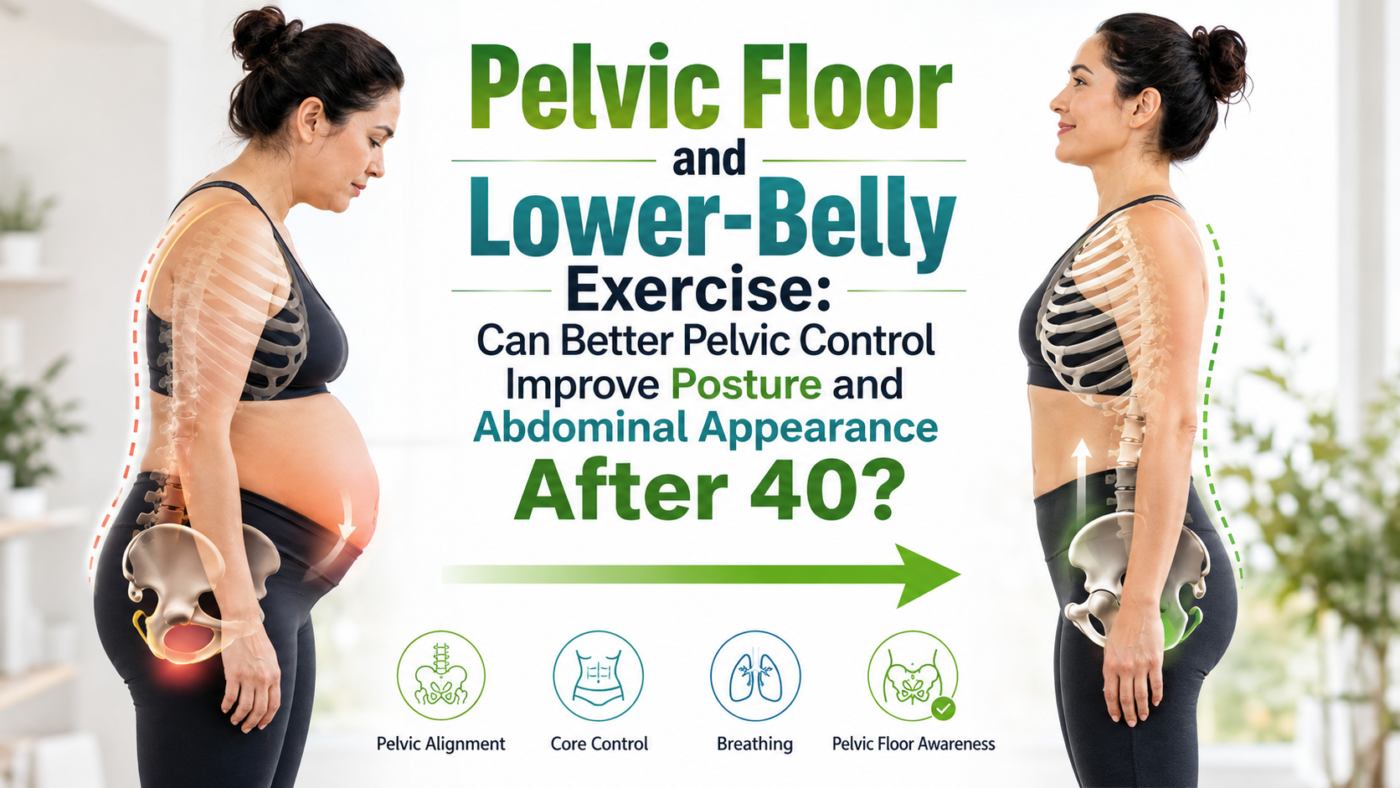
Pelvic floor exercise for lower belly can help improve posture, core control, breathing coordination and pelvic-floor awareness after 40. It will not instantly burn abdominal fat, but these gentle movements can change how the midsection looks by improving the way the ribs, pelvis and abdominal wall work together.A protruding lower belly does not always tell the whole story about body fat.
Two people can have similar body composition yet look quite different depending on how they stand, breathe and position their rib cage and pelvis.
That is one reason exercises focusing on pelvic awareness, abdominal control and posture can produce an immediate visual difference.
Stand with the lower back excessively arched and the ribs pushed forward, and the abdomen may appear more prominent.
Bring the ribs into a more comfortable position over the pelvis, gently engage the abdominal wall and stand taller, and the belly may immediately look flatter.
But this is an important distinction:
The fat has not disappeared.
The change comes primarily from posture, muscular engagement and how the abdominal wall is being held.
This article explores a simple movement routine centered on the pelvis, pelvic floor, breathing and trunk control—and explains what these exercises can realistically do.
Why the Pubic Bone Matters
The pubic bones form the front portion of the pelvis.
The left and right sides meet at the pubic symphysis, while the pelvis as a whole provides attachment points for numerous muscles and connective tissues.
The pelvic floor spans the bottom of the pelvis and helps support the bladder, bowel and, in women, the uterus and vaginal structures.
For movement practice, the pubic bone can therefore be useful as an anatomical landmark.
Becoming aware of its relationship to the sacrum, rib cage and abdominal wall may help someone understand pelvic position.
What the pubic bone is not is a reset button.
Pressing or thinking about the pubic bone does not mechanically realign the entire pelvis.
Can Pelvic Tilt Make the Belly Look Bigger?
Yes, posture can affect appearance.
One common pattern is an exaggerated anterior pelvic tilt combined with increased lumbar extension.
In this position, the lower back arches more prominently and the abdominal wall may project forward.
But anterior pelvic tilt is not automatically a disease.
Human pelvic posture varies considerably.
Some degree of pelvic tilt is normal, and there is no single perfect pelvic angle that everyone must achieve.
Rather than attempting to “fix” the pelvis into one ideal position, a better goal is to develop the ability to move between positions and maintain comfortable control.
Why the Belly Can Look Flatter Immediately
Try this experiment.
Stand normally and look at your abdominal profile.
Now gently exhale.
Allow the ribs to settle without collapsing the chest.
Engage the abdominal muscles lightly.
Bring the pelvis into a comfortable neutral position instead of excessively arching the lower back.
Stand tall.
Your abdomen may immediately look smaller.
This is a genuine change in appearance, but it should not be confused with fat loss.
You have changed the shape and tension of the abdominal wall.
That is why some posture exercises produce dramatic “before and after” images within seconds.
Does Raising the Arms Lift the Internal Organs?
Not in the literal way often claimed.
When you raise your arms overhead and lengthen the torso, the position of the rib cage, diaphragm and abdominal wall changes.
You may feel taller.
The abdomen may appear elongated.
Breathing mechanics may change.
The abdominal contents are also continuously affected by breathing, gravity, pressure and movement.
But an overhead stretch does not permanently lift sagging internal organs back into place.
True pelvic organ prolapse is a medical condition involving the support structures of the pelvic floor and cannot be corrected simply by reaching upward.
The Pelvic Floor Is More Important Than the Pubic Bone Alone
The pelvic floor is a group of muscles and connective tissues located at the base of the pelvis.
These structures contribute to:
Bladder and bowel control.
Support of pelvic organs.
Sexual function.
Management of intra-abdominal pressure.
Coordination with breathing and abdominal muscles.
Pelvic-floor training can be clinically useful, particularly for certain forms of urinary incontinence.
It can also play a role in conservative management of some pelvic organ prolapse symptoms.
But the correct approach is more sophisticated than simply “tightening the urethra” as hard as possible.
A Better Pelvic-Floor Cue
Instead of thinking only about the urethra, imagine gently lifting the muscles around the openings of the pelvis.
Some people find this cue helpful:
Imagine stopping gas and gently lifting upward inside the pelvis.
The contraction should be subtle.
Your buttocks and thighs should not need to squeeze maximally.
You should still be able to breathe.
Then completely relax the muscles.
Relaxation is just as important as contraction.
Do Not Practice by Repeatedly Stopping Urine Flow
Trying to stop urine midstream can help some people identify the pelvic floor once.
But repeatedly using urination itself as pelvic-floor training is generally not recommended because it may interfere with normal bladder emptying.
Practice the contraction away from the toilet instead.
Can Pelvic-Floor Exercise Prevent Urinary Incontinence?
Pelvic-floor muscle training has good evidence for improving certain forms of urinary incontinence, particularly stress urinary incontinence.
For example, someone who leaks urine when coughing, sneezing or exercising may benefit from appropriately performed pelvic-floor training.
Results usually require consistent practice over weeks or months.
One session does not permanently strengthen the pelvic floor.
Technique also matters.
Some people actually have pelvic-floor muscles that are overly tense rather than weak, in which case repeatedly squeezing harder may worsen symptoms.
Persistent problems are best evaluated by a pelvic-health professional.
What About Pelvic Organ Prolapse?
Pelvic-floor exercise may help reduce symptoms and improve muscular support in some people with mild to moderate prolapse.
However, it should not be described as guaranteed prevention or a cure.
Prolapse risk is influenced by multiple factors including childbirth history, aging, menopause, connective-tissue characteristics, chronic straining and other conditions.
People who experience vaginal pressure, heaviness, a visible bulge or difficulty emptying the bladder or bowel should seek medical assessment.
Does This Exercise Improve Lymphatic Flow?
Movement in general supports circulation and normal fluid movement throughout the body.
Muscular contractions and breathing contribute to venous and lymphatic return.
But there is no good evidence that placing the pelvis in a particular position specifically “flushes waste” from the abdomen and thereby removes belly fat.
The lymphatic system is not a fat-loss drainage pipe.
Fat loss occurs when stored energy is mobilized and used over time, not because toxins are pushed out of the abdomen.
Does Pelvic Exercise Boost Metabolism?
Every movement uses some energy.
Marching, stretching and muscle contractions therefore slightly increase energy expenditure while you perform them.
But pelvic-position exercises do not create a special metabolic state that rapidly burns abdominal fat.
Meaningful long-term fat loss depends on overall energy balance, physical activity, nutrition, sleep and individual biology.
A short pelvic routine can contribute to a healthy lifestyle.
It cannot replace those factors.
Traditional Eastern Concepts and the Lower Abdomen
Traditional Asian movement systems often place special emphasis on the lower abdomen and pelvic region.
Concepts such as the dantian or tanden describe a center of balance, breathing and internal awareness in the lower torso.
These concepts can remain valuable as traditional movement cues.
For example, focusing attention on the lower abdomen may improve body awareness, balance and controlled breathing.
What should be avoided is translating traditional “energy flow” language directly into unproven biological claims such as automatic autonomic nervous system correction or enhanced fat metabolism.
Traditional frameworks and modern physiology can coexist without pretending they are identical.
A Gentle Pelvic Mobility Routine
The following sequence preserves the useful movements from the original routine while using safer anatomical cues.
1. Hip Circles
Stand comfortably.
Place your hands on your hips.
Keep the knees slightly relaxed.
Slowly circle the pelvis in one direction.
Let the movement be smooth rather than exaggerated.
Breathe naturally.
After several repetitions, change direction.
You may feel movement through the hips and lower back.
The goal is mobility, not forcing the joints to their maximum range.
Can Hip Circles Prevent Back Pain?
Hip and trunk movement may reduce stiffness and feel helpful for some people.
But no single exercise can guarantee prevention of lower-back pain.
Back pain is influenced by many factors, and persistent or severe symptoms require appropriate evaluation.
Think of hip circles as a movement option rather than a medical treatment.
2. Pelvic Rounding and Release
Place your hands on your thighs or knees.
Gently round the lower back.
Allow the pelvis to rotate underneath you.
Feel the abdominal muscles engage.
Then return to a comfortable neutral position.
Repeat slowly.
This movement teaches the difference between pelvic flexion and extension.
Do not force the pubic bone toward the forehead.
Move only within a comfortable range.
3. Pelvic Tilt With Hands on the Sacrum
Place one or both hands over the sacrum at the back of the pelvis.
Gently tilt the pelvis forward and backward.
Notice how the lower-back curve changes.
The sacrum itself is not being pushed into a new permanent alignment.
Your hands are simply helping you feel the movement.
4. Add the Glutes
During a gentle posterior pelvic tilt, lightly contract the buttocks.
Feel how the pelvis changes position.
Release completely.
Repeat.
Do not squeeze maximally.
The goal is coordination rather than brute force.
5. Find a Comfortable Neutral Position
Now stop between the extremes.
Avoid excessive arching.
Avoid excessive tucking.
Let the ribs sit approximately over the pelvis.
Keep the knees relaxed.
This middle position may feel surprisingly unfamiliar if you habitually stand with the lower back strongly arched.
6. Practice 360-Degree Breathing
Place one hand on the lower abdomen and the other around the lower ribs.
Breathe slowly.
Rather than pushing only the belly forward, imagine the lower ribs and abdominal wall expanding in several directions.
The diaphragm descends during inhalation and the pelvic floor normally responds dynamically with breathing.
On exhalation, the abdominal wall and pelvic floor can gently recoil.
The goal is coordination—not holding everything tight.
7. Add an Overhead Reach
From the neutral standing position, raise both arms overhead.
Do not excessively arch the lower back to reach higher.
Keep the ribs controlled.
Exhale gently.
Allow the abdominal muscles to engage.
Imagine growing taller through the spine.
This may make the abdomen appear more elongated immediately.
Again, that is posture—not instant fat reduction.
8. Add a Gentle Pelvic-Floor Contraction
During the exhalation, lightly lift the pelvic floor.
Think of a gentle inward-and-upward contraction.
Do not squeeze as hard as possible.
Hold briefly while continuing to breathe if you can.
Then release fully.
You should feel a clear difference between contraction and relaxation.
9. Overhead Reach With Breathing
Bring the hands together overhead if that position feels comfortable.
Exhale.
Gently engage the abdominal wall and pelvic floor.
Reach upward without flaring the ribs.
Then inhale and relax.
Repeat several times.
The exercise combines:
Postural control.
Shoulder mobility.
Breathing.
Abdominal engagement.
Pelvic-floor awareness.
Those are useful training goals even without any promise of “lifting the organs.”
10. March in Place
Maintain comfortable upright posture.
Raise one knee.
Lower it.
Raise the other.
Continue marching slowly.
If comfortable, keep the arms overhead for part of the exercise.
This increases balance and trunk-control demands.
Does Marching Activate the Psoas?
Yes.
The iliopsoas group is one of the major contributors to hip flexion, so lifting the thigh during marching recruits the hip flexors.
But activating the psoas does not physically lift belly fat upward.
Body fat is not attached to the psoas in a way that allows the muscle to pull it into a flatter position.
Marching is useful because it trains hip flexion, balance and trunk stability.
That is enough.
Should You “Keep the Belly Tight” the Whole Time?
No.
The abdominal muscles need to contract when appropriate, but constantly pulling the belly in as hard as possible is unnecessary.
A useful pattern is:
Engage during the demanding portion of the movement.
Continue breathing.
Then allow the abdomen to relax.
Muscles need both contraction and relaxation.
Why Breathing Matters
The diaphragm, abdominal wall and pelvic floor work together to manage pressure inside the trunk.
When you inhale, the diaphragm descends.
The pelvic floor normally accommodates this pressure change.
During exhalation and effort, the abdominal wall and pelvic floor can contribute to stabilization.
This coordination is one reason breathing is important during pelvic-floor exercise.
Holding the breath while straining can substantially increase intra-abdominal pressure.
That may be counterproductive for people with pelvic-floor problems.
Does Deeper Breathing Mean the Pelvis Has Been Realigned?
No.
After mobility and breathing exercises, a person may feel that breathing is easier.
That can happen because muscular tension has changed or because they are paying more attention to breathing.
It does not prove that the pubic bone or sacrum was previously out of place and has now been reset.
Can This Make the Lower Belly Look Smaller?
Yes, sometimes immediately.
But the mechanism matters.
You may see a change because of:
Improved rib-pelvis alignment.
Reduced excessive lumbar arching.
Greater abdominal-wall engagement.
A taller posture.
Changes in breathing.
Those are useful effects.
What you have not done is instantly remove abdominal fat.
What Actually Reduces Belly Fat?
There is no exercise that selectively removes fat from the lower abdomen.
Long-term fat loss generally requires a sustained energy deficit.
Helpful strategies include:
Regular physical activity.
Resistance training.
Adequate protein.
A nutritious eating pattern.
Sufficient sleep.
Managing overall calorie intake.
Consistency over time.
Where the body loses fat first is influenced heavily by genetics, hormones, sex and individual biology.
Why Strength Training Matters After 40
If the goal is a firmer-looking midsection, pelvic exercises should ideally be combined with whole-body resistance training.
Strengthening the legs, glutes, back and abdominal muscles improves physical function and helps preserve lean mass.
Useful exercises may include squats, hinges, rows, presses, carries and appropriately scaled core exercises.
The pelvic-floor routine can complement this training.
It should not replace it.
Who May Benefit Most From This Routine?
This sequence may be particularly useful for people who:
Spend many hours sitting.
Feel stiff around the hips.
Habitually stand with excessive lower-back arching.
Want to improve pelvic awareness.
Want a gentle introduction to pelvic-floor coordination.
Need a low-impact movement break.
The cosmetic effect on abdominal appearance should be considered secondary.
Who Should Be More Careful?
Pelvic-floor exercise is not one-size-fits-all.
Seek individualized guidance if you have:
Pelvic pain.
Pain during intercourse.
Difficulty emptying the bladder.
Difficulty starting urination.
Persistent urinary leakage.
A sensation of vaginal heaviness or bulging.
Recent pelvic surgery.
Pregnancy or recent childbirth with symptoms.
Significant prolapse.
Chronic constipation with pelvic symptoms.
A pelvic-floor physical therapist can assess whether the muscles need strengthening, relaxation or better coordination.
More Tightness Is Not Always Better
This is especially important.
Some people with pelvic pain have pelvic-floor muscles that are already excessively tense.
For them, repeated maximal contractions can make symptoms worse.
A healthy pelvic floor must be able to:
Contract.
Relax.
Lengthen.
Respond to breathing.
Adapt to pressure.
Strength without relaxation is not optimal function.
What Results Can You Realistically Expect?
Immediately after the routine, you might notice:
A more upright posture.
Better awareness of the pelvis.
A less exaggerated lower-back arch.
A temporarily flatter-looking abdomen.
Easier hip movement.
A feeling of greater trunk control.
Over weeks of consistent practice, you may improve coordination and pelvic-floor strength if the exercises are appropriate for you.
Substantial fat loss, however, requires a broader lifestyle approach.
The Most Important Correction
The pubic bone is important anatomy.
But it is not a secret fat-burning button.
You cannot press it and drain away abdominal fat.
You cannot stretch upward and permanently lift all your internal organs.
And you do not need to flush mysterious “waste” from your abdomen to become leaner.
What you can do is learn how the pelvis, abdominal wall, diaphragm and pelvic floor work together.
That knowledge can improve movement.
It can improve posture.
And for the right person, pelvic-floor training can meaningfully improve function.
Those benefits are far more useful than an instant-flat-belly promise.
A pelvic floor exercise for lower belly control should focus on coordination rather than maximal tension.
The goal of a pelvic floor exercise for lower belly appearance is not spot fat reduction, but better posture, breathing and muscular control.
Final Takeaway
A lower belly that appears prominent is influenced by more than body fat alone.
Pelvic position, rib-cage orientation, breathing and abdominal muscle activity can all change how the midsection looks.
Exercises involving pelvic tilts, hip mobility, overhead reaching, marching and gentle pelvic-floor contractions may improve body awareness, posture and trunk control.
They can even create an immediate visual difference.
But that difference is not instant fat loss.
The most effective approach is to combine pelvic control with regular strength training, aerobic activity, healthy nutrition and appropriate pelvic-floor care.
Move the pelvis. Control the ribs. Breathe naturally. Train the pelvic floor gently. And aim for function before chasing a perfectly flat abdomen.
Frequently Asked Questions
Can pelvic tilt make your belly look bigger?
Yes. An exaggerated lower-back arch and rib flare can make the abdomen project forward, although pelvic tilt is only one of many factors affecting abdominal appearance.
Can pelvic exercises flatten the belly immediately?
They can sometimes make the abdomen look flatter immediately by changing posture and abdominal muscle engagement. They do not remove fat immediately.
Does pressing the pubic bone correct pelvic misalignment?
No. The pubic bone can be used as an anatomical awareness cue, but manual pressure does not reset the entire pelvis.
Can raising your arms lift your internal organs?
No evidence shows that overhead stretching permanently lifts internal organs. It can change posture and the way the torso feels and looks.
Are pelvic-floor exercises useful for urinary incontinence?
Yes. Appropriately performed pelvic-floor muscle training has good evidence for some forms of urinary incontinence.
Can pelvic-floor training prevent prolapse?
It may improve pelvic support and reduce symptoms in some people, but it cannot guarantee prevention of pelvic organ prolapse.
Does pelvic-floor exercise reduce belly fat?
No. It strengthens and coordinates muscles but does not selectively burn abdominal fat.
Does marching activate the psoas?
Yes. Hip-flexor muscles including the iliopsoas contribute to lifting the thigh during marching.
Should I pull my stomach in all day?
No. Constant maximal abdominal contraction is unnecessary. The muscles should engage when needed and relax at other times.
How often should I train the pelvic floor?
The ideal program depends on individual function. People with continence or prolapse concerns may benefit from personalized assessment rather than simply performing as many contractions as possible.
Medical and Fitness Disclaimer
This article is for educational purposes only and is not medical diagnosis, pelvic-floor therapy or individualized exercise advice. Pelvic pain, persistent urinary leakage, difficulty emptying the bladder or bowel, vaginal bulging, unexplained bleeding, significant back pain or other concerning symptoms should be evaluated by an appropriate healthcare professional. Pelvic-floor exercises are not suitable for every condition; some people require relaxation rather than additional strengthening.
This article is for general education and does not replace individualized care from a qualified health professional. Seek appropriate advice for persistent, severe, or concerning symptoms.
Read the full medical disclaimer