Forehead tension is surprisingly common. Hours of concentrating on screens, squinting, raising the eyebrows, frowning, stress and habitual facial expressions can leave the forehead feeling tight or tired by the end of the day.
That is why a simple one-minute forehead massage can feel so satisfying.
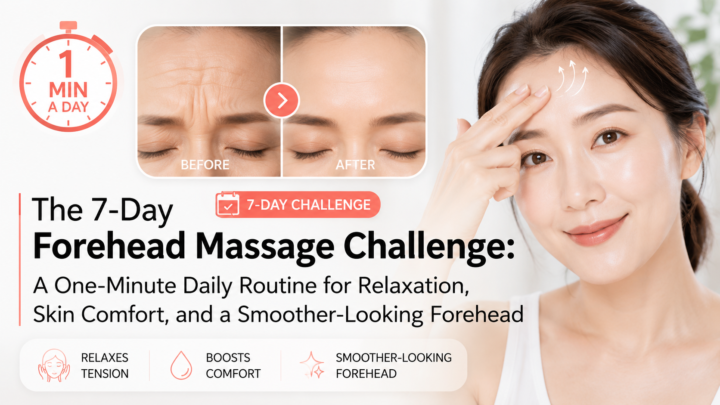
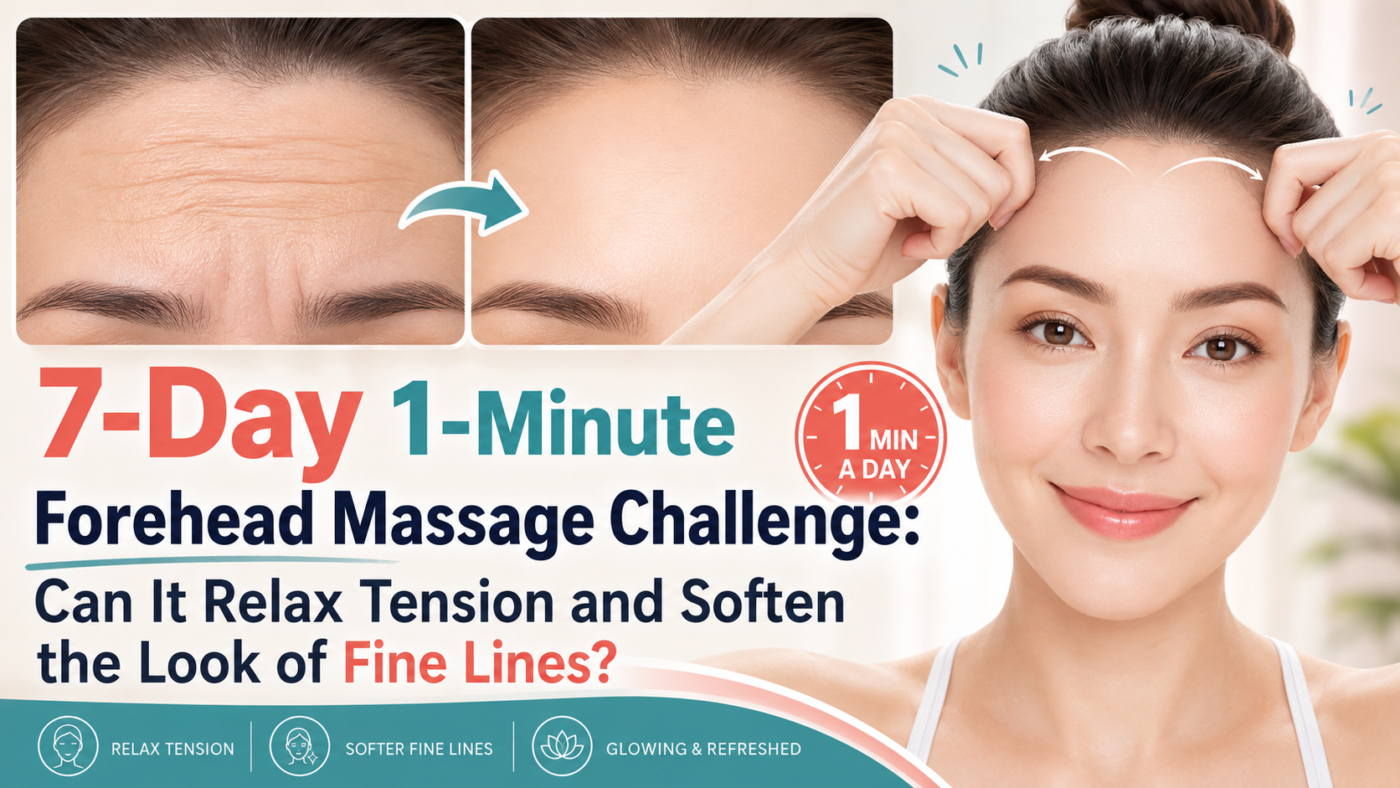
The idea behind this seven-day challenge is straightforward: use your fingers or knuckles to gently massage the forehead for approximately one minute each day, paying attention to areas that feel tense.
Some beauty routines go much further, claiming that forehead massage can restore collagen, lift the entire face, eliminate wrinkles or even work better than Botox.
Those promises go beyond the evidence.
Forehead massage cannot reproduce the biological effect of botulinum toxin injections, and there is no good evidence that one minute of massage for seven days can erase established wrinkles. What massage can realistically do is temporarily increase local circulation, reduce the sensation of muscular tension, improve relaxation and make the skin feel more comfortable.
For people who enjoy facial massage, that can still make the ritual worthwhile.
The key is using the technique gently rather than assuming that more pain means better results.
Why Does the Forehead Feel Tight?
The forehead contains the frontalis muscle, a thin sheet of facial muscle that plays an important role in raising the eyebrows and creating horizontal forehead lines.
Unlike large skeletal muscles in the arms and legs, facial muscles attach closely to the skin and contribute directly to facial expression.
Every time you raise your eyebrows, the frontalis contracts.
Repeated facial expression is completely normal. Over time, however, dynamic expression lines may gradually become more visible even when the face is at rest.
Several other factors influence how noticeable forehead lines become, including age, genetics, cumulative sun exposure, skin thickness, smoking history, hydration, collagen changes and habitual facial expressions.
None of this means the forehead muscles are “blocked” or diseased.
They may simply feel tense because they have been repeatedly contracting throughout the day.
Does Pain When Pressing the Forehead Mean Poor Blood Flow?
No reliable medical test works that way.
If pressing the forehead with your knuckles feels uncomfortable, that does not prove that blood circulation is restricted.
Pressure can hurt for many ordinary reasons.
You may be pressing too hard. The skin and underlying tissues may be sensitive. The muscles may feel tense. You may have a tension-type headache, irritated skin, sinus discomfort or simply a low tolerance for pressure in that area.
Tenderness should therefore not be treated as proof that the forehead has inadequate circulation.
More importantly, massage should not be intentionally painful.
A facial massage does not need to “hurt like crazy” to work.
If anything, excessive rubbing may irritate the skin and make redness, sensitivity or inflammation worse.
What Happens to Blood Flow During Massage?
Massage and mechanical stimulation can temporarily increase superficial skin blood flow.
This helps explain why the forehead may feel warmer or look slightly pink immediately afterward.
That response is normal.
It may create a temporary sense of freshness or relaxation, but increased circulation should not be confused with permanent skin rejuvenation.
There is no established evidence that a brief increase in local blood flow permanently tightens forehead skin or reverses aging.
Think of circulation as a short-term physiological response rather than an anti-aging switch.
Can Forehead Massage Stimulate Collagen?
This claim requires more caution.
Collagen is a structural protein that contributes to skin strength and firmness. Aging, ultraviolet exposure and other biological processes gradually alter collagen production and breakdown.
Mechanical stimulation is an active area of dermatologic and cosmetic research, and certain professionally administered procedures—such as microneedling and some energy-based treatments—can trigger controlled tissue-remodeling responses.
Ordinary hand massage is not equivalent to those procedures.
There is currently insufficient evidence to say that rubbing the forehead for one minute a day meaningfully restores lost collagen or reverses established wrinkles.
Massage may improve how the skin temporarily feels and appears, especially if it is combined with a moisturizer or oil that reduces dryness.
That is different from rebuilding the deeper structure of aging skin.
Can Forehead Massage Reduce Wrinkles?
The answer depends on what “reduce” means.
Immediately after massage, skin may look temporarily smoother because of hydration, mild swelling, relaxation of facial tension or improved surface appearance.
Very fine dehydration lines may also look less noticeable after applying a moisturizer.
But established forehead wrinkles are influenced by deeper structural changes and repeated muscle activity.
Massage cannot reliably erase them.
If someone photographs their forehead before and immediately after massage, lighting, facial expression, hydration and camera angle can easily exaggerate the apparent difference.
For that reason, dramatic before-and-after claims should be interpreted carefully.
Is Forehead Massage Better Than Botox?
No evidence supports that comparison.
Botox is a brand name commonly associated with botulinum toxin type A, a prescription treatment that works by temporarily reducing the nerve signals that cause selected muscles to contract.
When injected appropriately into muscles responsible for dynamic forehead or frown lines, botulinum toxin can reduce muscle contraction and soften the appearance of those lines for a period of time.
Forehead massage works through an entirely different mechanism.
Massage does not block neuromuscular signaling and therefore cannot be considered a natural equivalent of Botox.
That does not mean everyone needs cosmetic injections.
Many people prefer noninvasive skincare and massage.
The important point is simply that the two approaches should not be presented as interchangeable.
Can Relaxing the Forehead Make the Face Look Different?
Possibly, although usually in a subtle way.
When people are stressed or concentrating, they may unconsciously raise their eyebrows, narrow their eyes or tense facial muscles.
Relaxing those expressions can make the face appear softer.
After massage, someone may therefore feel that the forehead looks calmer or the eyes appear less strained.
This is plausible as an expression and relaxation effect.
But claims that massaging the forehead physically “lifts the entire face” are exaggerated.
The forehead is connected functionally to the eyebrow region, but manual massage cannot permanently reposition facial tissues.
What About Droopy Eyelids and Crow’s Feet?
Forehead massage should not be marketed as a treatment for true eyelid drooping.
Persistent eyelid droop, medically called ptosis, can have multiple causes involving the eyelid muscles, nerves, aging tissues or other medical conditions.
A new or one-sided drooping eyelid deserves proper medical evaluation, especially if it appears suddenly or is accompanied by double vision, weakness, severe headache or other neurological symptoms.
Crow’s feet around the eyes are primarily influenced by repeated contraction of the orbicularis oculi muscle, along with aging and sun exposure.
Forehead massage alone is unlikely to substantially alter them.
What About Headaches?
A gentle forehead or scalp massage may feel soothing during some tension-type headaches.
Relaxation, slower breathing and reduced muscle tension may contribute to that effect.
But headaches should not automatically be blamed on “blocked circulation” in the forehead.
Frequent, severe, worsening or unusual headaches should be evaluated appropriately rather than repeatedly treated with increasingly intense massage.
The Better Way to Do the 7-Day Challenge
The most useful version of this challenge is not painful.
It is gentle, controlled and focused on relaxation.
You need only one minute.
Wash your hands first and make sure the forehead is clean.
If your skin is dry, apply a small amount of moisturizer or a facial oil that you already know your skin tolerates.
The purpose of the product is primarily to reduce friction.
It does not need to be expensive.
Step 1: Relax Your Face
Before touching your forehead, notice what your face is doing.
Are you raising your eyebrows?
Are you squinting?
Are you clenching your jaw?
Allow the eyebrows to settle naturally.
Relax the jaw.
Take one slow breath.
This may sound trivial, but facial awareness is one of the most valuable parts of the routine.
Step 2: Place Your Knuckles Gently on the Forehead
Make a loose fist.
Use the flat surface of your knuckles rather than a sharp point.
Place them against the forehead using light to moderate pressure.
The sensation should feel comfortable.
You do not need to push deeply into the skull or attempt to “break up” hard tissue.
If it hurts, reduce the pressure.
Pain is not the goal.
Step 3: Massage From the Center Outward
Begin near the center of the forehead.
Use small, slow circular movements.
Gradually work outward toward the temples.
Spend several seconds on each region instead of aggressively scrubbing back and forth.
Keep breathing normally.
Your facial muscles should be relaxing rather than fighting against the pressure.
Step 4: Try Gentle Vertical Movements
Next, move the fingers or knuckles gently upward and downward across the forehead.
Do not drag dry skin aggressively.
If there is too much friction, add a small amount of moisturizer.
Again, think gliding, not scrubbing.
The skin of the face is not something that needs to be sanded into smoothness.
Step 5: Switch to Your Fingertips
For the final part of the minute, place the pads of your fingers across the forehead.
Massage gently from the center outward.
You can finish by holding the fingertips lightly against the forehead and making a very small, comfortable vibration or rocking movement.
Then release.
Your forehead may feel warm, relaxed or slightly tingly.
That sensation usually reflects mechanical stimulation of the skin and sensory nerves rather than evidence that a blockage has been removed.
Your 7-Day Forehead Massage Plan
Day 1: Learn the Pressure
Your first goal is simply to discover how little pressure you actually need.
Avoid chasing tenderness.
The forehead should feel relaxed when you finish, not sore.
Day 2: Slow Down
Perform smaller circular movements.
Many people rush facial massage because they assume stronger and faster must be better.
It usually is not.
Slower movements are easier to control.
Day 3: Notice Facial Habits
Pay attention during the day to how frequently you raise your eyebrows or tense the forehead.
Awareness itself can sometimes reduce unnecessary habitual muscle contraction.
Day 4: Add Relaxed Breathing
Take slow breaths while massaging.
This turns the minute into a brief stress-management routine rather than simply a cosmetic exercise.
Day 5: Protect the Skin
Pay attention to friction.
If the skin moves roughly under your fingers, use a moisturizer or reduce the pressure.
Massage should never leave abrasions or persistent redness.
Day 6: Include the Temples
Finish the outward movement near the temples with gentle circular pressure.
Avoid pressing aggressively near the eyes.
Day 7: Compare How Your Forehead Feels
Rather than asking whether seven days “erased” your wrinkles, ask better questions.
Does your forehead feel less tense?
Have you become more aware of habitual eyebrow raising?
Does the skin feel more comfortable after moisturizing?
Was the routine relaxing enough that you want to continue it?
These are realistic outcomes worth noticing.
What Results Can You Expect After Seven Days?
Seven days is a very short period in terms of skin biology.
You should not expect major collagen remodeling or permanent disappearance of established wrinkles.
You may notice that your forehead feels more relaxed.
You may become more aware of how often you tense the muscles.
Skin that was dry may look smoother if massage encouraged you to use moisturizer regularly.
Temporary redness or warmth after massage may also make the skin look slightly more vibrant for a short period.
These effects can still make the routine enjoyable.
They simply should not be confused with structural rejuvenation.
What Actually Helps Prevent Forehead Aging?
If your long-term goal is healthier-looking forehead skin, several measures have substantially better evidence than aggressive massage.
Daily Sun Protection
Ultraviolet exposure is one of the most important preventable contributors to premature skin aging.
Regular use of broad-spectrum sunscreen, combined with shade and protective clothing, is foundational.
Retinoids
Topical retinoids have much stronger evidence for improving photoaging and fine wrinkles than facial massage.
Prescription tretinoin has the most established evidence, while over-the-counter retinol products offer milder alternatives.
Because retinoids can cause irritation and are not appropriate for everyone, individual circumstances matter.
Moisturizer
Moisturizers improve the skin barrier and can temporarily make fine lines less visible by increasing hydration.
This is simple but useful.
Avoid Smoking
Smoking accelerates several aspects of skin aging and collagen degradation.
Adequate Sleep and General Health
Sleep, nutrition, stress management and overall health influence how skin looks and feels, although none should be marketed as an instant wrinkle cure.
Can You Combine Massage With Skincare?
Yes.
A simple moisturizer can make facial massage more comfortable by reducing friction.
Some people prefer a facial oil.
Choose products appropriate for your skin type and discontinue anything that causes burning, itching, swelling or persistent redness.
If you use potent skincare ingredients such as retinoids, exfoliating acids or acne treatments, aggressive massage immediately after application may increase irritation.
Gentleness matters.
When Should You Avoid Forehead Massage?
Skip the massage over broken skin, active infection, severe acne inflammation, sunburn, fresh wounds or significant dermatitis.
Use extra caution after cosmetic procedures.
If you recently had Botox, fillers, laser treatment, microneedling or another professional facial procedure, follow the specific aftercare instructions from your treating clinician rather than beginning an intensive massage routine on your own.
Also stop if massage causes persistent pain, bruising, swelling, numbness or worsening headaches.
The Most Important Rule: More Pain Does Not Mean More Benefit
This may be the biggest correction to many viral facial-massage routines.
You do not need to suffer through extreme pain to release the forehead.
You are not breaking scar tissue.
You are not forcing blood through a blocked muscle.
And you are not squeezing toxins out of the face.
The objective is gentle sensory stimulation and relaxation.
If the technique makes your forehead feel worse, reduce the pressure or stop.
A Better Way to Think About This Challenge
The appeal of a one-minute routine is that it is easy to repeat.
That matters.
A complicated 30-minute beauty ritual often disappears after a few days, while a one-minute routine can become part of brushing your teeth, applying moisturizer or preparing for sleep.
The value is therefore partly behavioral.
One minute becomes a cue to stop squinting, unclench the jaw, relax the eyebrows and pay attention to the skin.
Those benefits are modest.
But modest benefits are still real benefits.
Final Takeaway
A seven-day forehead massage challenge can be a simple and enjoyable self-care routine.
Gentle massage may temporarily increase superficial circulation, reduce the sensation of forehead tension and help the face feel more relaxed.
Used with moisturizer, it may also make dry skin look temporarily smoother.
But it is not Botox.
It does not reliably rebuild collagen in seven days, permanently lift the entire face, prove that painful areas have poor circulation or erase established forehead wrinkles.
The safest and most useful version is therefore simple:
Use gentle pressure. Avoid pain. Reduce friction. Relax your expression. Continue only if the technique feels good.
You may not have a completely different forehead after seven days.
But you may have a more relaxed one—and a much better understanding of how often you hold tension in your face.
Frequently Asked Questions
Can forehead massage really reduce wrinkles?
It may temporarily soften the appearance of very fine lines through hydration, relaxation and changes in superficial circulation, but there is insufficient evidence that brief massage permanently removes established wrinkles.
Is forehead massage better than Botox?
No. Botulinum toxin temporarily reduces targeted muscle contraction through a specific neurological mechanism. Massage does not reproduce this effect.
Should forehead massage hurt?
No. Mild pressure may feel tender in some areas, but intentionally painful massage is unnecessary and may irritate or bruise the skin.
Does pain in the forehead mean poor blood circulation?
No. Tenderness during pressure is not a reliable diagnostic sign of impaired blood flow.
Can forehead massage stimulate collagen?
There is insufficient evidence that a one-minute manual forehead massage meaningfully increases collagen enough to reverse wrinkles.
Can forehead massage lift droopy eyelids?
It cannot reliably treat true eyelid ptosis. Persistent or new eyelid drooping should be medically evaluated.
Can massage help a tension headache?
Some people find gentle massage relaxing during tension-type headaches, but persistent, severe or unusual headaches should be appropriately evaluated.
How often can I do the massage?
For healthy, non-irritated skin, a short gentle massage once daily is generally reasonable if it feels comfortable. Stop or reduce frequency if irritation develops.
Medical and Skincare Disclaimer
This article is for educational and informational purposes only and is not medical diagnosis, treatment or individualized dermatologic advice. Facial massage should be gentle and should not cause significant pain, bruising or persistent irritation. New eyelid drooping, severe or unusual headache, facial weakness, vision changes or other neurological symptoms require appropriate medical evaluation. Follow the advice of your own healthcare professional after cosmetic procedures such as botulinum toxin injections, fillers, laser treatment or microneedling.
This article is for general education and does not replace individualized care from a qualified health professional. Seek appropriate advice for persistent, severe, or concerning symptoms.
Read the full medical disclaimer