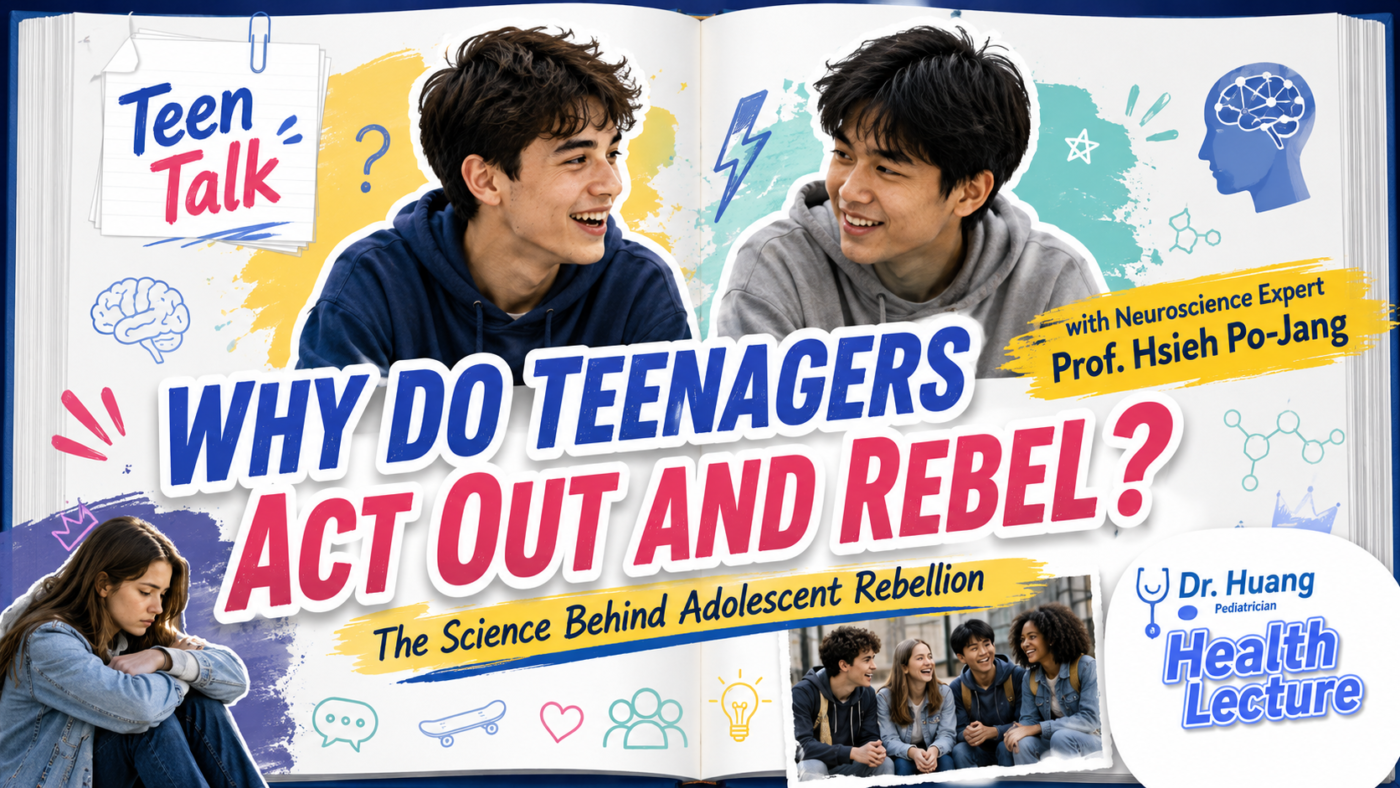
Teen rebellion is often treated as a sign that something has gone wrong, but adolescent brain development tells a more complicated story.Teen rebellion and adolescent brain development are often discussed as if something has suddenly gone wrong with a young person. A child who once listened closely to parents may begin challenging rules, caring intensely about friends, taking risks, arguing more often, or making choices that seem irrational to adults. For generations, these behaviors were often interpreted as disrespect, immaturity or a phase that simply had to be controlled.
Modern developmental neuroscience offers a more useful picture. Adolescence is not merely a period of defective judgment waiting for the adult brain to “switch on.” It is a major developmental transition in which the brain is still being refined, social relationships become more important, sensation seeking can increase, and young people gradually practice making independent decisions.
The prefrontal cortex—important for planning, prioritizing, inhibiting impulses and decision-making—is among the brain regions that continue maturing into the mid-to-late 20s. At the same time, adolescent brain development is strongly shaped by social experiences, and peer relationships become especially salient.
The goal for parents, therefore, should not be to eliminate every sign of independence. It is to help teenagers develop judgment while keeping them connected to supportive adults and healthier peer environments.
Key Takeaways
- Teen rebellion is not inevitable in the form of severe conflict, but increasing independence is a normal part of adolescence.
- The adolescent prefrontal cortex is still developing, but saying that it simply “does not mature until exactly age 25” is an oversimplification.
- Sensation seeking and responsiveness to rewards can become stronger during adolescence.
- Teenagers often become more sensitive to peer opinions and social belonging.
- Peer influence is not automatically harmful; peers can encourage healthy, prosocial behavior as well as risky behavior.
- Harsh punishment alone may fail to teach the judgment teenagers need when adults are absent.
- Parents can be more effective by maintaining connection, setting clear boundaries and helping teenagers choose healthier social environments.
- Changing a harmful environment can sometimes be appropriate, but changing schools is not a universal solution.
- Positive peer leaders can be powerful messengers for healthier norms.
- Adolescence should be viewed as a period of adaptation, learning and increasing autonomy—not simply as a neurological defect.
Table of Contents
- Is Teen Rebellion Inevitable?
- What Is Happening in the Adolescent Brain?
- Does the Brain Really Mature at 25?
- Why Sensation Seeking Increases
- Why Friends Suddenly Matter So Much
- Peer Pressure Is Not Always Negative
- Why Punishment Alone Often Falls Short
- How Parents Can Guide Without Controlling
- When the Social Environment Becomes Harmful
- The Power of Positive Peer Influence
- What Parents Should Watch For
- When Rebellion May Signal a Deeper Problem
- Frequently Asked Questions
Teen Rebellion and the Developing Brain
Parents sometimes hear that every teenager must become rebellious.
That is too simple.
Many teenagers challenge rules, seek privacy, disagree with parents and test boundaries. Those behaviors can be part of normal development toward independence.
But adolescence does not require:
- constant hostility
- dangerous risk-taking
- violence
- substance use
- severe family breakdown
- chronic school refusal
- persistent deception
- criminal behavior
There is enormous individual variation.
A teenager can become more independent while maintaining a close relationship with parents.
In fact, one of the healthiest developmental outcomes is not complete obedience and not complete separation, but increasing autonomy within a secure relationship.
The teenager gradually learns:
“I can make decisions.”
“I can disagree.”
“I can choose my friends.”
“I can take responsibility.”
“And my family remains a safe base when I need support.”
That is very different from either authoritarian control or complete lack of boundaries.
What Is Happening in the Adolescent Brain?
The teenage brain is undergoing substantial remodeling.
By early adolescence, the brain is already close to adult size, but its networks continue to become more specialized and efficient.
The National Institute of Mental Health notes that the brain continues developing and maturing into the mid-to-late 20s, with the prefrontal cortex among the last areas to mature. This region contributes to functions such as planning, prioritizing and making decisions.
But brain development does not occur in isolation.
Adolescence also involves changes in networks involved in:
- reward
- motivation
- emotional processing
- social cognition
- cognitive control
Recent neuroscience increasingly emphasizes the interaction between these systems rather than blaming teenage behavior on one “unfinished” brain region.
This is important because the popular story—
“Teenagers make bad decisions because their prefrontal cortex is not finished.”
—is incomplete.
Teenagers can reason very well in many situations.
What changes is that judgment can become more vulnerable to:
- emotional arousal
- immediate rewards
- social acceptance
- peer presence
- novelty
- excitement
That helps explain why a teenager may make a thoughtful decision at home and a very different decision when surrounded by friends.
Does the Brain Really Mature at 25?
The statement that the brain “finishes developing at age 25” has become extremely popular.
There is some truth behind it, but it should not be treated as a biological deadline.
Brain maturation does continue through adolescence and into young adulthood, and NIMH describes overall maturation as extending into the mid-to-late 20s.
But there is no magical birthday on which the prefrontal cortex suddenly becomes fully functional.
Development differs:
- between individuals
- between brain regions
- between cognitive abilities
- across environments and experiences
A 17-year-old is not operating without a prefrontal cortex.
A 26-year-old is not automatically rational.
Development is gradual.
A scientifically better way to describe adolescence is:
Cognitive-control systems continue to mature while motivational and social systems are also changing, creating a developmental period in which context can strongly influence behavior.
Why Sensation Seeking Increases During Adolescence
Many adolescents seek novelty.
They may become more interested in:
- fast sports
- travel
- intense experiences
- new relationships
- unfamiliar environments
- competition
- social experimentation
- rule testing
Psychologists often refer to part of this tendency as sensation seeking.
This should not automatically be interpreted as pathology.
A willingness to explore has potential developmental advantages.
Human beings eventually need to leave the security of childhood, interact with unfamiliar people, learn new skills, form adult relationships and function independently.
A young person who never tolerates uncertainty may have difficulty doing those things.
The problem arises when novelty seeking combines with:
- weak safety judgment
- substance use
- dangerous driving
- harmful online challenges
- aggressive peer groups
- inadequate adult supervision
The developmental goal should therefore not be:
“Eliminate sensation seeking.”
A better goal is:
“Redirect sensation seeking toward safer and constructive challenges.”
That can include:
- sports
- travel
- outdoor activities
- performance
- volunteering
- entrepreneurship
- creative projects
- competitions
- challenging academic experiences
The appetite for excitement can become an asset when the environment gives it productive outlets.
Why Friends Suddenly Matter So Much
One of the biggest changes parents notice is that the teenager begins caring enormously about peers.
A parent says:
“I’ve been telling him this for years and he ignores me. His friend says it once and suddenly he listens.”
That can feel insulting.
But it is developmentally understandable.
NIMH notes that changes in brain systems involved in social processes can increase adolescents’ focus on peer relationships and social experiences.
Recent developmental neuroscience similarly describes adolescence as a period in which peer contexts become increasingly important to social, emotional and cognitive development.
This increased orientation toward peers serves a developmental purpose.
Children eventually need to learn how to function outside their family.
They have to understand:
- trust
- cooperation
- reputation
- group membership
- friendship
- disagreement
- attraction
- social hierarchy
- belonging
Peers become a kind of training ground for adult social life.
So when a teenager begins caring more about what friends think, parents do not necessarily need to interpret that as rejection.
It can be a sign of developmental movement toward a wider social world.
Peer Influence Can Increase Risk-Taking
There is another side to this process.
Social acceptance can become so valuable that a teenager may take risks they would avoid alone.
A teenager may think:
“Everyone else is doing it.”
“If I refuse, I’ll look weak.”
“They won’t invite me again.”
“I don’t want to be the strange one.”
Peer-related social rewards can therefore alter decision-making.
Research has long suggested that peer contexts can increase adolescent risk-taking under some circumstances, partly through heightened sensitivity to rewards and social cues.
More recent research continues to examine adolescents’ heightened sensitivity to peer influence and the neural mechanisms involved.
This helps explain why simply saying:
“Don’t care what other people think.”
is usually unrealistic.
Humans are social animals.
Teenagers may be especially sensitive to belonging.
A more useful lesson is:
“Other people’s opinions matter—but you still get to choose whose opinions deserve influence over your life.”
Peer Pressure Is Not Always Negative
Parents often hear “peer pressure” and immediately imagine:
- smoking
- alcohol
- drugs
- reckless driving
- bullying
- dangerous online challenges
But peers can also influence one another toward:
- studying
- exercising
- volunteering
- avoiding substances
- joining clubs
- applying to university
- creative achievement
- community involvement
A 2024 review argued that adolescent peer relationships and risk-taking have often been framed too negatively and that strong peer relationships can have important adaptive developmental functions.
A large 2026 meta-analysis involving more than 9,500 participants also found an overall peer-influence effect across experimental research, with peer norms particularly influential.
That gives parents a powerful idea:
Do not only fight peer influence. Help shape the peer environment.
Instead of asking:
“How can I stop my teenager listening to friends?”
ask:
“How can I increase the likelihood that the friends around my teenager reinforce healthy behavior?”
That is a much more realistic strategy.
Why Punishment Alone Often Falls Short
Historically, difficult adolescent behavior was often managed through increasingly strict control.
Disobey?
Punish harder.
Break curfew?
Remove privileges.
Choose the wrong friends?
Forbid contact.
Talk back?
Demand submission.
Consequences still matter. Teenagers need boundaries.
But punishment alone cannot teach everything adolescents need.
A teenager eventually needs to make safe decisions when the parent is not present.
That requires:
- judgment
- self-control
- understanding consequences
- values
- resistance to social pressure
- ability to evaluate friends
- emotional regulation
Those abilities develop through practice.
If every decision is made through fear of parental punishment, the teenager may remain dependent on external control.
That is why effective parenting gradually moves from:
control
toward
coaching.
How Parents Can Guide Without Controlling
The brain-development perspective does not mean:
“Teenagers cannot control themselves, so let them do whatever they want.”
That would be equally misguided.
Development requires both autonomy and structure.
1. Keep Boundaries Clear
Teenagers benefit from knowing that certain rules are not negotiable.
Examples might involve:
- driving safety
- violence
- substance use
- school attendance
- dangerous online behavior
Explain the reason behind important boundaries.
Rules are more educational when teenagers understand what the rule protects.
2. Give Real Choices Where Possible
Instead of controlling every detail, give choices within safe limits.
For example:
“You need to be home by 11. You can decide whether you want me to pick you up or whether your friend’s parent drives you.”
That communicates:
You have autonomy, and safety still matters.
3. Ask Questions That Build Judgment
Rather than:
“Those friends are bad. Stop seeing them.”
try:
“What do you like about being with them?”
“How do you feel after spending time with them?”
“Do they pressure you into things you wouldn’t normally do?”
“Would they respect you if you said no?”
“Do you like who you become when you’re around them?”
Those questions help teenagers develop their own internal evaluation system.
4. Do Not Mock the Importance of Friends
Telling a teenager:
“Those friendships won’t matter in five years.”
may be factually possible and emotionally useless.
Right now, those relationships matter enormously.
Respecting their importance makes it easier to discuss them.
When the Social Environment Becomes Harmful
The original discussion raises an important question:
What if the peer environment itself is seriously unhealthy?
Sometimes a teenager is embedded in a setting with:
- persistent bullying
- drug availability
- violence
- coercive peer groups
- severe social exclusion
- dangerous norms
In those circumstances, changing the environment can be worth considering.
That could involve:
- another class
- different activities
- different supervision
- another sports team
- counseling
- stronger extracurricular communities
- in selected cases, changing schools
But moving a child should not be presented as a universal “Mengzi’s mother moved three times” solution.
Changing environments carries costs.
A teenager may lose supportive friendships, trusted teachers and stability.
Parents should first understand what is actually happening.
If bullying, violence or serious safety problems are involved, work with the school and relevant professionals rather than relying only on informal assumptions about “bad friends.”
The Power of Positive Peer Leaders
One especially valuable insight from the source material is using adolescents’ peer sensitivity constructively.
If teenagers listen closely to peers, then credible peers can become powerful health messengers.
Instead of every anti-smoking, anti-drug or health message coming from adults, schools can involve respected students.
For example:
- team captains
- student leaders
- club organizers
- peer mentors
- influential students from different social groups
The underlying principle is sound:
social norms matter.
If adolescents believe:
“Everyone smokes,”
smoking may appear normal.
If their peer network communicates:
“Most of us don’t want this,”
the social meaning changes.
Peer influence is therefore not merely something adults must defend against.
It can be used to strengthen healthier cultures.
Positive Peer Influence Can Be Deliberately Built
Parents can also support this outside school.
Encourage environments where young people meet peers who are:
- interested in sport
- curious about learning
- building creative projects
- volunteering
- pursuing music
- practicing martial arts
- interested in technology
- working toward academic goals
The objective is not to engineer every friendship.
Teenagers need freedom to choose relationships.
But adults have considerable influence over the environments in which relationships become possible.
A teenager who spends time in a strong music program encounters one peer network.
A teenager who joins a volunteer organization encounters another.
A teenager who participates in competitive sport encounters another.
Environment does not determine behavior, but it changes the social options available.
Why “Rebellion” Can Actually Be Part of Maturation
Imagine a 10-year-old who believes almost everything a parent says.
Now imagine the same person at 17.
If nothing had changed, adulthood would be difficult.
Healthy adults eventually need the capacity to say:
“I disagree.”
“I have different values.”
“I want to choose my own career.”
“I don’t want to participate in that.”
“I need privacy.”
“I want to live independently.”
Adolescence is partly where those abilities are practiced.
What parents call rebellion may sometimes actually be:
- boundary testing
- identity formation
- autonomy seeking
- social exploration
- moral questioning
The challenge is helping teenagers practice independence without allowing preventable harm.
What Parents Should Watch For
Ordinary autonomy should be distinguished from serious behavioral or mental-health concerns.
Pay closer attention when changes involve:
- persistent severe aggression
- repeated dangerous risk-taking
- substance misuse
- dramatic decline in school functioning
- complete withdrawal
- severe sleep disruption
- persistent depression
- disabling anxiety
- self-harm
- suicidal thoughts
- serious eating problems
- repeated running away
- major personality change
These should not simply be dismissed as:
“It’s adolescence.”
Mental-health conditions often emerge during adolescence, and significant changes warrant evaluation.
When Rebellion May Signal a Deeper Problem
A teenager who argues about curfew is very different from a teenager who:
stops attending school,
withdraws from every friend,
sleeps throughout the day,
becomes persistently hopeless,
uses substances heavily,
and talks about dying.
The first situation may largely involve ordinary autonomy conflict.
The second requires professional attention.
Parents should consider consultation with a pediatrician, family physician or qualified mental-health professional when behavior becomes persistent, severe or substantially interferes with everyday functioning.
If a teenager expresses suicidal intent, has attempted self-harm, or presents an immediate danger to themselves or another person, seek urgent professional or emergency assistance.
A Better Way to Think About the Teen Brain
The most important scientific correction to the old story of adolescent rebellion is this:
The adolescent brain is not simply a bad adult brain.
It is a brain adapted to a particular developmental stage.
It is becoming:
more independent,
more socially aware,
more exploratory,
more responsive to new experiences,
and increasingly capable of navigating life outside the family.
These same developmental characteristics can sometimes increase vulnerability to risk.
But they also support:
learning,
creativity,
friendship,
exploration,
courage,
identity formation,
and adaptation.
That is why adolescence contains both vulnerability and extraordinary potential.
Frequently Asked Questions
Is teen rebellion inevitable?
No. Increasing independence and some boundary testing are common, but severe conflict or dangerous behavior is not required for healthy adolescent development.
Does the prefrontal cortex mature at exactly 25?
No. Brain development continues into young adulthood, and NIMH describes maturation as extending into the mid-to-late 20s. Twenty-five should not be treated as an exact neurological deadline.
Why do teenagers care so much about friends?
Adolescence involves major changes in social development, and peer relationships become increasingly important. Brain systems involved in social processing also undergo developmental changes during this period.
Do friends make teenagers take risks?
Sometimes. Peer presence and peer norms can influence adolescent decisions, including risk-taking. But peers can also encourage positive behavior.
Is sensation seeking abnormal?
No. Novelty and sensation seeking can be normal aspects of adolescence. The concern is whether they lead to dangerous or substantially harmful behavior.
Should parents ban friends they dislike?
Not automatically. First understand the relationship and specific risks. If there is serious danger, bullying, violence, coercion or substance exposure, stronger intervention may be warranted.
Can positive friends improve a teenager’s behavior?
Yes. Peer norms can influence both risky and prosocial behavior, which is why supportive peer environments can be valuable.
Should parents punish rebellion?
Reasonable consequences and boundaries remain important, but punishment alone is not an adequate strategy. Adolescents also need coaching, communication, opportunities to make decisions and chances to learn from consequences.
References
National Institute of Mental Health — The Teen Brain: 7 Things to Know. NIMH explains that adolescence is an important period of brain development, that maturation continues into the mid-to-late 20s and that peer relationships become increasingly salient during this stage.
Capella J, Telzer EH. A Framework for Integrating Neural Development and Social Networks in Adolescence. This 2024 review describes interactions among adolescent neural development, identity, peer sensitivity and social networks.
Venticinque JS, McMillan SJ, Guyer AE. Expanding Understanding of Adolescent Neural Sensitivity to Peers. This 2024 review examines peer influence through social-developmental and neuroscience frameworks.
Allen JP. Rethinking Peer Influence and Risk Taking. This 2024 review emphasizes that strong peer relationships and adolescent risk-taking can have adaptive as well as potentially harmful dimensions.
2026 Meta-analysis of Susceptibility to Peer Influence. Across 79 independent reports and more than 9,500 participants, peer influence showed a significant overall effect, with peer norms particularly important.
Medical Disclaimer
This article is intended for general educational purposes and is not a substitute for individualized medical, psychological or psychiatric advice. Adolescent behavior exists on a wide developmental spectrum. Persistent, severe or dangerous behavioral changes should be evaluated by a qualified healthcare or mental-health professional. If a young person may immediately harm themselves or another person, seek emergency assistance.
This article is for general education and does not replace individualized care from a qualified health professional. Seek appropriate advice for persistent, severe, or concerning symptoms.
Read the full medical disclaimer