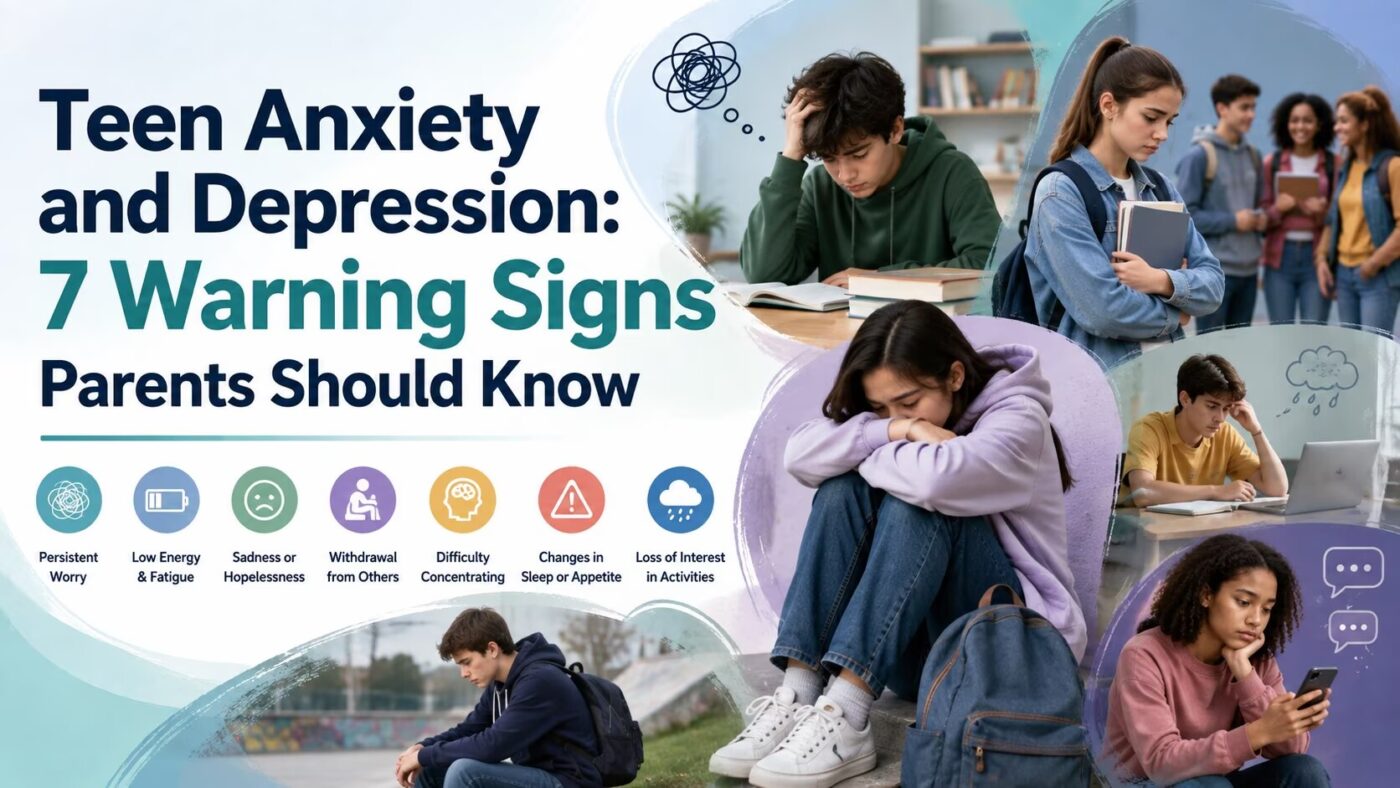
Adolescence is a period of remarkable physical, emotional and social change. Teenagers are developing independence, navigating friendships, coping with academic expectations, thinking about their future and becoming increasingly aware of their appearance and identity. Mood changes, occasional worry and conflict with parents can all occur during normal development. But teen anxiety and depression can look similar at first, making it difficult for parents to know when ordinary teenage stress has become something more serious.
The most important question is not simply whether a teenager feels sad, anxious or irritable. Parents should look at the pattern, persistence, severity and impact of those changes. Mental health professionals pay particular attention to whether symptoms are interfering with school, relationships, sleep, eating, daily activities or personal safety.
According to the National Institute of Mental Health (NIMH), parents should consider seeking professional help when emotional or behavioral symptoms persist for weeks or longer, cause significant distress, or interfere with functioning at home, school or with friends. Unsafe behavior or talk about harming oneself or another person requires immediate attention.
Key Takeaways
- Teen anxiety and depression are more than occasional sadness, worry or moodiness.
- Persistent changes in mood, sleep, appetite, school performance, friendships and daily functioning deserve attention.
- Irritability can be an important manifestation of emotional distress in adolescents.
- Withdrawal from previously enjoyable activities can be particularly concerning.
- A sudden decline in school attendance or academic performance may signal a deeper problem.
- Duration matters, but there is no single universal “two-week rule” for every mental health condition.
- Depression and generalized anxiety disorder have different diagnostic criteria and should not be self-diagnosed from a checklist.
- Any suicidal thoughts, self-harm, suicide planning or threats of serious harm require urgent professional assessment.
- Anxiety and depression are treatable, and early recognition can help young people receive appropriate support.
Table of Contents
- Teen Mental Health: Normal Changes or a Warning Sign?
- Warning Sign 1: Persistent Sadness or Irritability
- Warning Sign 2: Excessive and Difficult-to-Control Worry
- Warning Sign 3: Withdrawal From Friends and Activities
- Warning Sign 4: Major Changes in Sleep or Appetite
- Warning Sign 5: Falling Grades or School Avoidance
- Warning Sign 6: Concentration Problems, Fatigue or Restlessness
- Warning Sign 7: Self-Harm or Suicidal Thoughts
- Anxiety and Depression Can Overlap
- Why Daily Functioning Matters
- What Parents Can Do
- When to Seek Professional Help
- How Teen Anxiety and Depression Are Treated
- Emergency Warning Signs
- Frequently Asked Questions
Teen Mental Health: Normal Changes or a Warning Sign?
Understanding teen anxiety and depression begins with recognizing that not every difficult emotion is a mental disorder.
Teenagers can have bad days.
They may become upset after an argument with a friend, feel anxious before an important examination, worry about appearance, become frustrated with their parents or temporarily lose confidence after a disappointment.
These reactions can be normal.
The distinction becomes more important when emotional or behavioral changes become persistent, severe or disruptive.
NIMH recommends considering professional evaluation when concerning behaviors or emotions last for weeks or longer, cause distress, or interfere with functioning at home, school or with friends.
A useful way for parents to think about the situation is:
Symptoms + Persistence + Functional Impact + Safety
No single element provides a diagnosis. Together, however, they can help parents recognize when it is time to ask for professional help.
Normal Teenage Ups and Downs vs. Possible Warning Signs
| Common Teenage Experience | More Concerning Pattern |
|---|---|
| Feeling upset after a difficult day | Persistent sadness or irritability |
| Worrying before an examination | Worry that becomes excessive and difficult to control |
| Wanting occasional privacy | Increasing isolation from family and friends |
| Sleeping late occasionally | Major or persistent sleep changes |
| One disappointing grade | Sustained academic decline |
| Temporary loss of motivation | Losing interest in most previously enjoyable activities |
| Argument with parents | Persistent conflict combined with other behavioral changes |
| Feeling tired after a busy week | Ongoing fatigue and impaired functioning |
| Ordinary frustration | Expressions of hopelessness, self-harm or suicidal thoughts |
Parents should therefore look for changes from the teenager’s usual baseline, rather than expecting every teenager to behave in exactly the same way.
1. Persistent Sadness or Irritability
One of the most recognizable signs of depression is persistent low mood.
But adolescent depression does not necessarily look like an obviously sad teenager crying every day.
Some teenagers become unusually irritable.
They may appear angry, frustrated, impatient or unusually sensitive. Small disagreements can trigger intense reactions. Parents may initially interpret the behavior as defiance or ordinary adolescence.
Context matters.
A teenager who becomes upset after an argument but returns to their usual mood relatively quickly is different from someone whose personality and emotional state appear to have changed substantially for an extended period.
Parents might notice:
- persistent sadness
- frequent crying
- unusual irritability
- increased anger
- hopelessness
- emotional numbness
- excessive guilt
- negative statements about themselves
- unusually strong reactions to minor setbacks
Major depressive disorder involves more than sadness alone. Clinical assessment considers a combination of emotional, cognitive, behavioral and physical symptoms as well as impairment. The American Academy of Pediatrics’ adolescent depression guidance describes major depressive episodes as lasting at least two weeks, although symptoms can continue considerably longer.
That two-week threshold applies to major depressive episodes. It should not be treated as a universal diagnostic rule for every adolescent mental health problem.
2. Excessive and Difficult-to-Control Worry
Anxiety itself is not inherently abnormal.
It is part of the body’s natural response to uncertainty, perceived danger and challenging situations.
A teenager may understandably worry before:
- an examination
- a sports competition
- speaking in front of a class
- applying to college
- meeting new people
- going on a first date
- receiving academic results
The concern becomes more significant when worry seems disproportionate, spreads across many areas of life or becomes difficult for the teenager to control.
A teenager experiencing problematic anxiety might repeatedly worry about school, friendships, appearance, health, family problems, future events or situations that other people consider relatively minor.
Parents may hear repeated questions such as:
“What’s going to happen?”
“What if I fail?”
“What if everyone thinks I’m stupid?”
“What if something bad happens?”
“Are you sure everything is okay?”
Anxiety can also appear physically.
Some teenagers experience:
- muscle tension
- restlessness
- fatigue
- headaches
- stomach discomfort
- difficulty sleeping
- difficulty concentrating
- irritability
It is important not to diagnose generalized anxiety disorder simply because several symptoms are present.
The original source material associated generalized anxiety disorder with a two-week duration. That needs scientific correction: two weeks is not the standard duration criterion for generalized anxiety disorder.
Professional diagnosis requires a much more specific assessment.
3. Withdrawal From Friends and Activities
One of the most important behavioral changes parents can observe is withdrawal.
Teenagers naturally become more independent from their parents, and spending more time with friends or alone does not automatically indicate depression.
The more concerning change is loss of interest in things that previously mattered to them.
For example, a teenager who once loved basketball may stop attending practice.
Someone who talked constantly with friends may stop responding to messages.
A teenager who loved music, drawing, gaming, dancing or another hobby may suddenly seem indifferent toward it.
Parents might notice:
- quitting extracurricular activities
- refusing invitations
- avoiding friends
- spending most of the day alone
- abandoning hobbies
- avoiding family activities
- no longer enjoying favorite experiences
Clinicians sometimes describe the loss of interest or pleasure as anhedonia, and it is an important symptom in depression.
The question parents can ask themselves is:
“Is my teenager simply changing interests, or are they losing interest in almost everything?”
Those are very different situations.
4. Major Changes in Sleep or Appetite
Mental health and physical health are deeply connected.
Teen anxiety and depression can affect sleep, energy and eating patterns.
Teenagers naturally need substantial sleep, and adolescent sleep schedules often shift later during puberty. Therefore, sleeping later than a parent prefers is not enough to indicate a mental health disorder.
Look instead for a significant departure from the teenager’s normal pattern.
Examples include:
- sleeping much more than usual
- being unable to fall asleep
- waking repeatedly during the night
- waking unusually early
- remaining exhausted despite adequate time in bed
- sleeping through much of the day
- dramatic appetite reduction
- eating considerably more than usual
- unexplained weight changes
NIMH includes sleeping too much or too little and changes in energy among behaviors that can warrant attention when they form part of a persistent pattern.
Sleep problems can also have many non-psychiatric causes, so persistent sleep disturbance should not automatically be attributed to anxiety or depression.
5. Falling Grades or School Avoidance
School provides parents with one of the clearest windows into a teenager’s day-to-day functioning.
Imagine a teenager who normally:
attends school regularly, completes assignments, receives reasonable grades and participates in activities.
Then something changes.
Over several weeks, the teenager begins missing school, assignments remain unfinished, teachers report concentration problems and grades decline substantially.
That deserves attention.
Academic decline does not prove that a teenager has depression or anxiety. Learning difficulties, bullying, sleep deprivation, attention problems, substance use, family stress, physical illness and many other factors can affect school performance.
But when declining performance occurs alongside emotional and behavioral changes, it becomes particularly important.
Watch for:
- frequent unexplained absences
- repeatedly asking to stay home
- refusing to attend school
- suddenly missing assignments
- declining grades
- loss of motivation
- difficulty completing homework
- repeated visits to the school nurse without a clear medical explanation
- withdrawal from school activities
A teenager’s ability to function is one of the most important pieces of the mental health picture.
6. Concentration Problems, Fatigue or Restlessness
Mental health problems do not affect emotions alone.
They can change how a teenager thinks, moves and performs ordinary tasks.
A student who previously finished homework without difficulty may suddenly sit at a desk for hours without accomplishing much.
Another may read the same page repeatedly because concentration has become difficult.
Others may appear physically restless.
Parents might notice:
- inability to concentrate
- forgetfulness
- difficulty making decisions
- persistent fatigue
- reduced motivation
- unusual restlessness
- slowed speech or movement
- agitation
- difficulty sitting still
The challenge is that these symptoms are not specific to anxiety or depression.
For example, concentration difficulties can occur with sleep deprivation, ADHD, stress, physical illness, medication effects and other conditions.
That is one reason professional evaluation matters.
The purpose of recognizing warning signs is not to allow parents to diagnose their teenager.
It is to recognize when further assessment may be warranted.
7. Self-Harm, Suicidal Thoughts or Talking About Death
This is the warning sign that should never be dismissed.
A teenager might say:
“Everyone would be better without me.”
“I don’t want to be here anymore.”
“What’s the point?”
“I wish I could disappear.”
“I want to die.”
Statements like these should not automatically be dismissed as teenage drama or attention-seeking.
Parents should also take seriously:
- self-harm
- suicidal thoughts
- researching or discussing suicide methods
- making a suicide plan
- giving away important possessions
- saying goodbye unexpectedly
- expressing extreme hopelessness
- writing about death repeatedly
- sudden dangerous or reckless behavior
NIMH specifically recommends seeking help immediately when a child’s behavior is unsafe or the young person talks about wanting to hurt themselves or someone else.
If There Is Immediate Danger
If a teenager has attempted suicide, has an active suicide plan, has access to lethal means, cannot stay safe, or poses an immediate danger to themselves or another person, do not wait for a routine appointment.
Seek emergency medical or crisis assistance immediately.
In the United States, people experiencing suicidal or mental-health crisis can call or text 988 to reach the Suicide & Crisis Lifeline. If there is an immediate life-threatening emergency, contact emergency services or go to the nearest emergency department.
For readers outside the United States, use the appropriate emergency or crisis service in your country.
Anxiety and Depression Can Overlap
Anxiety and depression are different conditions, but their symptoms can overlap.
A teenager with anxiety may become exhausted because constant worry interferes with sleep.
A teenager with depression may become anxious about falling grades.
Someone experiencing either condition may:
- have difficulty concentrating
- sleep poorly
- withdraw socially
- become irritable
- feel tired
- struggle academically
Some adolescents experience both anxiety and depression.
This is another reason symptom checklists should be treated as educational tools rather than diagnostic instruments.
A qualified clinician evaluates the complete picture, including symptoms, duration, severity, developmental stage, medical history, family circumstances, school functioning, substance use, other possible conditions and safety.
Why Daily Functioning Matters
One of the most useful concepts from the original expert discussion is functional impairment.
Instead of focusing exclusively on how a teenager says they feel, ask:
What has changed in their life?
Consider four major areas.
1. School
Are they attending?
Can they complete assignments?
Have grades changed dramatically?
2. Family
Have relationships deteriorated substantially?
Has the teenager completely withdrawn?
Are conflicts dramatically different from their usual pattern?
3. Friends and Social Life
Are they maintaining friendships?
Have they suddenly stopped socializing?
4. Everyday Self-Care
Are they sleeping, eating, bathing and completing basic activities?
NIMH specifically highlights interference with life at home, school or with friends as a reason to discuss a child’s symptoms with a health professional.
This provides parents with a much more useful framework than asking whether a teenager simply “looks depressed.”
What Parents Can Do
Parents do not need to become therapists.
They do need to remain involved.
Start With Conversation, Not Judgment
If your teenager comes home visibly upset, opening with:
“What’s wrong with you?”
or
“Stop being so dramatic.”
is unlikely to encourage honest communication.
Try a calmer approach:
“You haven’t seemed like yourself lately. I’ve noticed you’re having a difficult time. I’m here if you want to talk.”
The goal is not to interrogate.
It is to create an environment in which the teenager believes they can speak without immediately being criticized, punished or dismissed.
Listen Before Trying to Fix Everything
Parents naturally want solutions.
But teenagers sometimes need to feel understood before they are ready to discuss solutions.
Avoid immediately comparing their problems with adult problems.
Something that seems minor to an adult can feel enormous to a teenager.
Spend Time Together
Shared activities can create opportunities for natural conversation.
Depending on the teenager, that might mean:
- walking
- cycling
- playing sports
- cooking
- shopping
- taking a drive
- walking the dog
- visiting a park
- having a meal together
The activity itself does not treat clinical depression or anxiety.
Its value lies partly in maintaining connection and giving parents opportunities to notice changes in behavior.
Pay Attention to School
Teachers, counselors and coaches may observe changes that are less visible at home.
A student may appear fine during dinner but struggle throughout the school day.
When appropriate and consistent with the teenager’s privacy and treatment needs, communication between families, schools and healthcare professionals can provide a more complete picture.
Protect the Basics
Healthy routines cannot substitute for treatment when treatment is needed, but they remain important.
Encourage:
- regular sleep
- consistent meals
- physical activity
- time outdoors
- supportive relationships
- reasonable routines
- breaks from overwhelming demands
Avoid presenting exercise, sleep or diet as a magical cure for depression.
They are supportive components of overall health, not replacements for appropriate mental healthcare.
When Should Parents Seek Professional Help?
Consider professional evaluation when emotional or behavioral changes:
- persist for weeks or longer
- become increasingly severe
- cause significant distress
- interfere with school
- damage friendships or family relationships
- disrupt sleep, eating or basic self-care
- cause substantial academic decline
- lead to school refusal
- involve self-harm
- involve suicidal thinking
- involve threats of serious harm toward others
NIMH recommends beginning with a healthcare professional when persistent behavioral or emotional problems interfere with a child’s daily functioning.
A pediatrician or primary-care clinician can be a practical starting point.
They can evaluate symptoms, consider possible physical contributors and determine whether referral to a psychologist, psychiatrist or other mental-health professional is appropriate.
How Teen Anxiety and Depression Are Treated
Treatment depends on the diagnosis, severity, individual teenager, safety concerns and other medical or psychological conditions.
There is no single treatment appropriate for every adolescent.
Treatment may include:
Psychotherapy
Evidence-based approaches such as cognitive behavioral therapy (CBT) and interpersonal psychotherapy for adolescents (IPT-A) are used for adolescent depression.
Medication
Medication may be appropriate for some adolescents, particularly depending on diagnosis and severity. Medication decisions for young people require professional evaluation, informed discussion with the family and appropriate monitoring.
Combination treatment
Some adolescents with more significant depression may benefit from psychotherapy combined with medication.
Family involvement
Parents and caregivers can play an important role in supporting treatment, monitoring symptoms and maintaining a safer, more supportive home environment.
School support
When appropriate, school counselors, teachers and other personnel may help monitor academic functioning and provide accommodations or support.
American Academy of Pediatrics guidance—reaffirmed in 2025—supports active monitoring for some mild cases and evidence-based psychotherapy and/or medication for moderate or severe adolescent depression, together with ongoing monitoring and specialist collaboration when appropriate.
CBT and IPT-A are among the psychotherapies with evidence supporting their use in adolescent depression.
Parents should not start, stop or change psychiatric medication without guidance from the prescribing healthcare professional.
When Is Hospital or Emergency Care Needed?
Most teenagers experiencing anxiety or depression do not necessarily require hospitalization.
But safety changes everything.
Urgent or emergency evaluation may be necessary when a young person:
- has attempted suicide
- has an active suicide plan
- has serious suicidal intent
- cannot remain safe
- has seriously harmed themselves
- threatens or attempts serious harm to another person
- becomes unable to maintain basic safety or essential self-care
- develops another severe psychiatric crisis requiring immediate stabilization
The correct level of care must be determined by qualified professionals.
Parents should not wait for symptoms to “prove” they are severe enough when immediate safety is in question.
A Message for Parents: Pay Attention to Change
Parents know their children better than any checklist does.
That makes change from baseline extremely valuable.
A naturally quiet teenager being quiet is not necessarily concerning.
A previously outgoing teenager suddenly isolating for weeks may be.
A student receiving one poor grade is not automatically experiencing depression.
A high-performing student suddenly missing school, abandoning activities, sleeping throughout the day and repeatedly describing themselves as worthless presents a very different picture.
Look at the whole teenager.
Look at:
Mood.
Behavior.
Sleep.
Eating.
School.
Friendships.
Interests.
Energy.
Safety.
And most importantly, keep communication open.
Mental health difficulties should not be treated as moral failure, weakness or bad behavior.
They are health concerns that deserve appropriate attention.
Frequently Asked Questions
Is teenage moodiness normal?
Some mood fluctuation is common during adolescence. Concern increases when changes are persistent, severe, significantly different from the teenager’s usual behavior or interfere with school, relationships and daily functioning.
What are common warning signs of teen anxiety and depression?
Warning signs can include persistent sadness or irritability, excessive worry, withdrawal, loss of interest, sleep or appetite changes, fatigue, concentration difficulties, academic decline and feelings of hopelessness.
Does depression always make teenagers look sad?
No. Depression in adolescents can also involve irritability, withdrawal, loss of interest, fatigue, sleep changes, concentration difficulties and other symptoms.
How long should symptoms last before parents seek help?
There is no single duration rule for every mental health condition. NIMH advises seeking professional guidance when troubling emotional or behavioral symptoms last for weeks or longer or interfere with daily functioning. Unsafe behavior or self-harm concerns require immediate help rather than waiting.
Is two weeks the diagnostic requirement for generalized anxiety disorder?
No. The two-week threshold is associated with major depressive episodes, not a universal rule for generalized anxiety disorder. Different psychiatric disorders have different diagnostic criteria, and diagnosis should be made by a qualified professional.
Can parents help a teenager with anxiety or depression?
Yes. Listening without judgment, maintaining communication, monitoring meaningful behavioral changes, supporting healthy routines and obtaining professional assessment when necessary can all help. Parental support does not replace professional treatment when clinical care is needed.
Can teenagers recover from anxiety or depression?
Many adolescents improve with appropriate support and evidence-based care. Treatment can include psychotherapy, medication in selected cases, family support and coordinated care depending on the condition and severity.
What should parents do if a teenager talks about suicide?
Take it seriously. If there is immediate danger, a suicide attempt, an active plan or inability to remain safe, seek emergency assistance immediately. In the United States, call or text 988 for crisis support; call emergency services when there is an immediate life-threatening emergency.
References
National Institute of Mental Health. Child and Adolescent Mental Health.
National Institute of Mental Health. Children and Mental Health: Is This Just a Stage?
American Academy of Pediatrics. Guidelines for Adolescent Depression in Primary Care (GLAD-PC): Part I — Practice Preparation, Identification, Assessment, and Initial Management.
American Academy of Pediatrics. Guidelines for Adolescent Depression in Primary Care (GLAD-PC): Part II — Treatment and Ongoing Management.
Medical Disclaimer
This article is for educational and informational purposes only and is not intended to diagnose, treat, cure or prevent any mental health condition. It is not a substitute for evaluation, diagnosis or treatment by a qualified healthcare or mental-health professional. If a young person is in immediate danger, has attempted suicide, has an active suicide plan, or may seriously harm themselves or another person, seek emergency assistance immediately.
Recommended Internal Links:https://jianghuuniverse.com/teen-stress-warning-signs/
This article is for general education and does not replace individualized care from a qualified health professional. Seek appropriate advice for persistent, severe, or concerning symptoms.
Read the full medical disclaimer