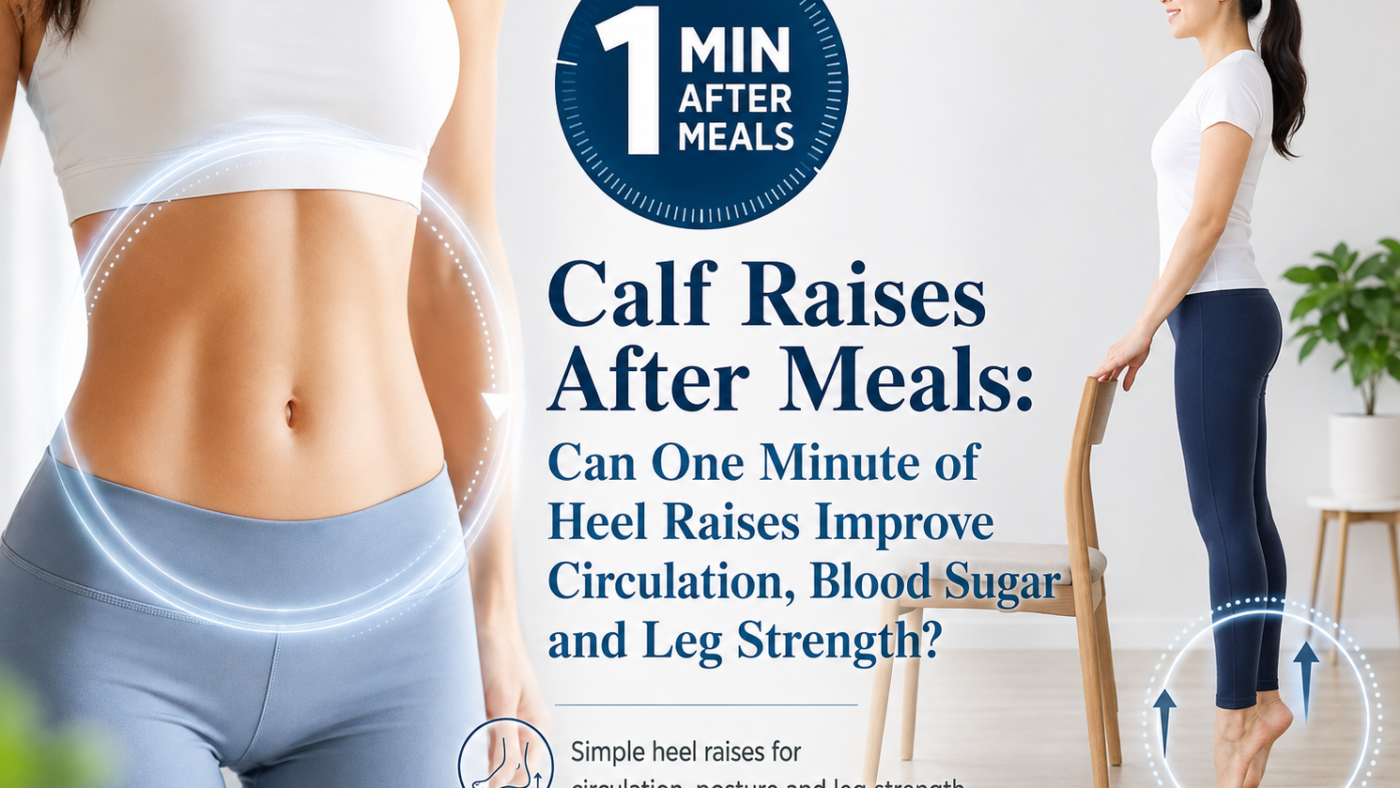
A simple heel raise may look almost too easy to matter. You stand upright, lift your heels until you are balanced on the balls of your feet, lower them again, and repeat. It requires no gym membership, almost no space, and can be performed while holding a chair, countertop, or wall for support.
That simplicity has helped calf raises become popular in short exercise videos, where they are sometimes promoted as a way to “burn fat in one minute,” dramatically improve circulation, stabilize blood pressure, prevent blood sugar spikes, relieve varicose veins, and even stimulate beneficial bone hormones.
There is some real physiology behind several of these ideas—but the dramatic claims go much further than the evidence.
Calf raises can strengthen the muscles of the lower legs, activate the calf muscle pump that assists venous blood return, add useful movement after long periods of sitting, and contribute to an overall physically active lifestyle. Performing light physical activity after meals may also support post-meal glucose management.
What calf raises cannot realistically do is produce major weight loss by themselves. One minute of heel raises does not burn enough energy to explain claims of losing 10 kilograms, and the exercise should not be considered a treatment for diabetes, high blood pressure, varicose veins, or other medical conditions.
Used for the right reasons, however, this remarkably simple movement can be a useful addition to your daily routine.
What Is a Calf Raise?
A calf raise—sometimes called a heel raise—is a basic strengthening exercise that primarily works the gastrocnemius and soleus muscles in the calf.
To perform one:
- Stand upright with your feet approximately hip-width apart.
- Hold a stable chair, countertop, railing, or wall if you need support.
- Slowly raise both heels away from the floor.
- Rise onto the balls of your feet without rolling your ankles outward.
- Pause briefly at the top.
- Lower your heels slowly and under control.
- Repeat.
Although the movement is small, the calf muscles have important roles in walking, climbing stairs, maintaining ankle stability, producing forward propulsion, and helping move venous blood from the legs toward the heart.
Are the Calves Really the “Second Heart”?
You may have heard the calf muscles described as the body’s “second heart.”
This is a useful metaphor, but it is not a literal anatomical description.
Blood traveling through the arteries is pumped outward by the heart. Returning blood from the lower legs is more challenging because it must travel upward against gravity.
When the calf muscles contract during walking, ankle movement, or calf raises, they compress veins running through the lower leg. One-way venous valves help direct blood upward rather than allowing it to fall backward.
This mechanism is commonly known as the calf muscle pump.
That is why prolonged immobility can sometimes make the legs feel heavy or swollen, while walking and ankle movement often feel refreshing after sitting for a long time.
Calf raises activate this muscular pumping action, although walking involves a broader combination of ankle, foot, leg, and whole-body movement.
Benefit 1: Calf Raises Strengthen an Often-Neglected Muscle Group
The clearest benefit of calf raises is also the least sensational: they strengthen your calves.
Strong calf muscles contribute to everyday activities including:
- Walking
- Climbing stairs
- Standing on your toes
- Maintaining ankle control
- Hiking
- Running
- Changing direction
- Maintaining balance during movement
Calf strength becomes especially relevant as we age because muscle strength and power naturally tend to decline over time.
A few calf raises will not reverse age-related muscle loss, but progressively challenging the calves as part of a broader resistance-training program can help preserve lower-body function.
For beginners, body-weight calf raises may be enough. As they become easier, progression can include more repetitions, slower lowering, single-leg calf raises, or appropriate external resistance.
Benefit 2: They Activate the Calf Muscle Pump
Every calf contraction squeezes veins within and around the working muscles.
This helps support venous return from the lower extremities.
Research involving people with chronic venous insufficiency has found that structured calf-strengthening exercise can improve calf muscle pump function and calf strength. That does not mean calf raises cure venous disease, but it supports the idea that calf muscle conditioning is relevant to lower-leg circulation.
For healthy people who spend many hours sitting, simple calf raises can therefore be viewed as one way of interrupting prolonged inactivity.
They are not a substitute for regular walking or general exercise, but they can be especially convenient when you cannot easily leave your desk or room.
Can Calf Raises Reduce Leg Swelling?
Movement can sometimes help with mild lower-leg heaviness associated with prolonged sitting or standing because muscle contractions assist venous return.
Walking, ankle pumps, and calf raises may all help keep the lower legs moving.
However, swelling has many possible causes.
Persistent, unexplained, painful, severe, or one-sided swelling should not simply be treated with an exercise challenge. It can require medical assessment, particularly when accompanied by redness, warmth, chest pain, or shortness of breath.
Can Calf Raises Help Varicose Veins?
This claim needs careful wording.
Exercise does not remove damaged varicose veins. Calf-muscle activity may nevertheless help venous circulation and can be part of conservative lifestyle management for some people with venous symptoms.
Walking is particularly useful because repeated contraction and relaxation of the calf muscles activates the calf pump.
Calf strengthening may support the same physiological mechanism.
But saying that heel raises “get rid of varicose veins” would be inaccurate.
Established varicose veins can involve structural problems with venous valves and sometimes require compression therapy, medical evaluation, or procedures depending on their severity and symptoms.
Benefit 3: Calf Raises Break Up Sedentary Time
One underrated advantage of this exercise is convenience.
Modern life involves enormous amounts of sitting: working at a computer, driving, watching television, traveling, and using phones.
Calf raises can be performed almost anywhere.
You might do a short set:
- After getting out of a chair
- While waiting for coffee
- During a work break
- After a meal
- While brushing your teeth
- Before taking a walk
- After sitting during a long journey
The greatest benefit may not come from the calories burned during that individual minute. Instead, the habit can become a cue to move more frequently throughout the day.
Small movement habits become more meaningful when they accumulate.
What About Doing Calf Raises After Meals?
This is one of the more interesting ideas in the original exercise challenge.
Muscle contractions require energy. During physical activity, skeletal muscle can increase its uptake and utilization of glucose.
Research on post-meal physical activity has found that moving after eating—particularly activities such as walking—can improve postprandial glucose responses compared with remaining inactive.
That makes the general idea of moving after meals scientifically reasonable.
However, most evidence should not be interpreted as proving that exactly one minute of calf raises prevents a blood sugar spike.
The effect can depend on:
- Exercise duration
- Intensity
- Meal composition
- Fitness level
- Muscle mass involved
- Individual insulin sensitivity
- Diabetes status
- Medications
A short calf-raise session is best viewed as a convenient piece of post-meal movement rather than a medical glucose-control technique.
Whenever practical, combining it with a short walk may provide a more complete form of activity.
Do Calf Raises “Burn Fat”?
Technically, every physical activity requires energy.
But this needs perspective.
One minute of body-weight calf raises uses only a modest amount of energy. It cannot reasonably explain dramatic fat loss by itself.
Meaningful weight loss normally develops from sustained changes that influence overall energy balance over weeks and months, including nutrition, regular physical activity, sleep, and other lifestyle factors.
The Centers for Disease Control and Prevention recommends adults generally accumulate at least 150 minutes of moderate-intensity aerobic activity each week, together with muscle-strengthening activity on at least two days.
Calf raises can contribute to an active lifestyle, but they should not be marketed as a stand-alone fat-loss shortcut.
A Better Way to Think About the One-Minute Habit
Instead of:
“Do this for one minute and lose weight.”
Think:
“Use one minute to establish a movement habit that can gradually lead to more daily activity.”
That distinction is important.
A one-minute habit is valuable because it is easy to start—not because one minute has magical metabolic properties.
What About Osteocalcin?
Some videos make a much more specific claim: repeatedly dropping the heels against the floor supposedly stimulates the bones, releases osteocalcin, and therefore prevents blood sugar spikes.
There is an interesting scientific idea buried inside this claim.
Osteocalcin is a protein produced by bone-forming cells and is widely used as a marker related to bone formation. Experimental research has also raised the possibility that some forms of osteocalcin participate in communication between bone, muscle, and energy metabolism.
Exercise can influence bone metabolism, and research has examined changes in circulating osteocalcin following physical activity.
However, translating this into the statement:
“Heel drops release osteocalcin and stop blood sugar spikes”
goes beyond established human evidence.
The relationship between osteocalcin and human glucose metabolism remains an active research field. Human studies have not established a simple therapeutic pathway in which repeatedly striking the heels on the floor produces predictable glucose control.
So osteocalcin is scientifically fascinating—but it should not be used to promise metabolic benefits from a one-minute exercise.
Do Calf Raises Stabilize Blood Pressure?
Regular physical activity is strongly associated with cardiovascular health, and exercise can contribute to healthier blood pressure over time.
That does not mean a set of calf raises should be advertised as a treatment that “stabilizes blood pressure.”
Blood pressure is influenced by many factors, including cardiovascular fitness, genetics, body weight, diet, sodium intake, alcohol consumption, sleep, stress, medications, kidney function, and underlying health conditions.
Calf raises may form part of a healthy exercise routine, but anyone with hypertension should continue following their clinician’s treatment recommendations.
Why Lowering Slowly Matters
Many people focus entirely on lifting upward.
The lowering phase matters too.
After reaching the top of a calf raise, lower your heels gradually instead of simply dropping your body weight onto the floor.
Controlled lowering keeps the calf muscles working through the eccentric phase of the movement and reduces unnecessary impact.
There is generally no need to slam the heels forcefully into the ground to obtain the benefits of calf exercise.
If your objective is lower-leg strength and mobility, controlled movement is usually the better priority.
How to Do Calf Raises Correctly
Start beside a stable support.
Stand tall and gently engage your abdominal muscles. Keep your shoulders relaxed and look forward.
Place your feet approximately hip-width apart.
Slowly lift both heels.
Your weight should move toward the balls of your feet while the toes remain in contact with the floor.
Avoid allowing the ankles to roll dramatically outward.
Pause briefly.
Then lower your heels slowly until they return to the floor.
Keep breathing normally.
Do not hold your breath and strain.
Beginner Routine
Try:
8–12 repetitions
Rest briefly.
Repeat for:
1–3 sets
If this feels challenging, perform fewer repetitions.
If it feels extremely easy, build gradually rather than turning the exercise into uncontrolled bouncing.
A Simple One-Minute Version
For someone who wants the convenience of the original challenge, a one-minute routine can still be useful.
0–15 Seconds
Perform slow calf raises.
Focus on posture and control.
15–30 Seconds
Continue at a comfortable rhythm.
Keep the knees relaxed rather than aggressively locked.
30–45 Seconds
If comfortable, slightly increase the pace while maintaining control.
45–60 Seconds
Finish with controlled repetitions.
Then walk around briefly and relax your calves.
The goal is not to perform as many repetitions as physically possible.
Quality matters more than speed.
A Better Seven-Day Calf-Raise Challenge
Instead of promising dramatic fat loss in seven days, use the week to develop consistency.
Day 1
Learn correct technique and perform one comfortable set.
Day 2
Repeat the exercise after one meal.
Day 3
Perform two short sets at different times of day.
Day 4
Add a short walk after one meal if practical.
Day 5
Slow down the lowering portion of every repetition.
Day 6
Try slightly more repetitions if your calves feel comfortable.
Day 7
Review how your balance, coordination, calf endurance, and consistency have changed.
Seven days is unlikely to transform your body composition.
It can, however, establish a movement habit that you can continue for months.
And that is far more useful than a seven-day miracle promise.
Should You Do Calf Raises After Every Meal?
You do not need to perform them after every meal.
If you enjoy the routine, attaching a short movement session to meals can simply serve as a useful behavioral cue.
For example:
Finish lunch → stand up → perform calf raises → walk for several minutes.
This transforms the exercise from an isolated fitness trick into part of a larger habit.
For metabolic health, the broader principle is more important:
Spend less time completely inactive and move regularly throughout the day.
How to Make the Exercise Harder
Once ordinary two-leg calf raises become easy, progression is important if your goal is strength.
Possible options include:
Slower Repetitions
Take approximately two or three seconds to rise and another two or three seconds to lower.
Pause at the Top
Hold the highest comfortable position for one or two seconds.
Single-Leg Calf Raises
Use one leg while holding a stable support.
This dramatically increases the load placed on each calf.
Increased Range of Motion
More experienced exercisers sometimes perform calf raises with the forefoot supported on a secure step so the heel can lower through a greater range of motion.
This requires more balance and should be approached carefully.
Added Resistance
Weights or exercise machines can provide additional resistance when body weight is no longer challenging.
Calf Raises Versus Walking After Meals
You do not necessarily need to choose one.
Calf raises are exceptionally convenient and directly challenge the calf muscles.
Walking activates far more muscle mass and provides a broader cardiovascular stimulus.
A practical combination could be:
10–20 controlled calf raises followed by a short comfortable walk.
This is more realistic than expecting one isolated movement to provide every cardiovascular and metabolic benefit associated with exercise.
Who Should Be Careful?
Calf raises are generally simple, but no exercise is appropriate for every person in every situation.
Use caution or seek professional guidance if you have:
- A recent foot, ankle, Achilles tendon, knee, or calf injury
- Recent lower-limb surgery
- Severe balance problems
- Significant peripheral neuropathy
- Unexplained leg pain or swelling
- Known vascular disease
- Severe osteoporosis or a high fracture risk
- A condition that limits safe standing exercise
People who become dizzy while exercising should stop and sit or lie down safely.
Sudden calf swelling, warmth, redness, tenderness, chest pain, or unexplained shortness of breath requires medical attention rather than an exercise routine.
The Bottom Line
Calf raises deserve attention—but not because they are a secret one-minute weight-loss technique.
Their real advantages are more practical.
They strengthen important lower-leg muscles, activate the calf muscle pump, provide an easy way to interrupt sitting, and can be incorporated into short bouts of movement throughout the day.
Doing them after meals may be a convenient way to encourage post-meal activity, although stronger evidence exists for the broader concept of physical activity—especially walking—after eating rather than for a precise one-minute heel-raise protocol.
Claims that calf raises alone can produce massive weight loss, cure varicose veins, stabilize blood pressure, or prevent glucose spikes through osteocalcin should be treated cautiously.
The best reason to try them is much simpler:
They are accessible, quick, scalable, and easy to repeat.
One minute will not transform your body.
But one minute can be the beginning of a habit—and habits repeated consistently can become meaningful parts of long-term health.
FAQ
Are calf raises good for circulation?
Calf contractions activate the calf muscle pump, which assists venous blood return from the lower legs. Regular walking and lower-leg movement are generally more important than relying on one isolated exercise.
Can calf raises burn belly fat?
Calf raises use energy but cannot selectively burn abdominal fat. Body-fat reduction depends on overall energy balance and sustained lifestyle habits.
Can one minute of calf raises help you lose weight?
One minute of calf raises alone is unlikely to produce meaningful weight loss. Its main value is as an easy movement habit that can encourage greater daily activity.
Are calf raises good after eating?
Light movement after meals can support post-meal glucose management. Calf raises may be one convenient form of movement, although walking has broader supporting evidence and activates substantially more muscle.
How many calf raises should beginners do?
A reasonable starting point for many healthy adults is approximately 8–12 controlled repetitions for one to three sets. Individual ability varies, so stop before technique deteriorates.
Do calf raises lower blood pressure?
Regular physical activity can support healthy blood pressure, but calf raises alone should not be considered a treatment for hypertension.
Can calf raises remove varicose veins?
No. Exercise may support calf-pump function and sometimes help symptoms related to venous circulation, but it does not remove structurally damaged varicose veins.
Do heel drops release osteocalcin?
Exercise and mechanical loading can influence bone metabolism, including markers such as osteocalcin. However, there is not strong clinical evidence that performing heel drops produces a predictable osteocalcin response that prevents blood sugar spikes.
Medical Disclaimer
This article is for educational and informational purposes only and is not intended to diagnose, treat, cure, or prevent any disease. It is not a substitute for individualized medical advice, diagnosis, or treatment. People with cardiovascular disease, diabetes, vascular disease, balance problems, significant osteoporosis, recent surgery, persistent leg swelling, or other medical conditions should consult an appropriate healthcare professional before beginning a new exercise program.
References
Centers for Disease Control and Prevention. Physical Activity and Your Weight and Health. National Center for Chronic Disease Prevention and Health Promotion.
Centers for Disease Control and Prevention. Health Benefits of Physical Activity for Adults.
Guy’s and St Thomas’ NHS Foundation Trust. Varicose Veins: Improving Your Symptoms.
Padberg FT Jr, Johnston MV, Sisto SA. Structured Exercise Improves Calf Muscle Pump Function in Chronic Venous Insufficiency: A Randomized Trial. Journal of Vascular Surgery.
Solomon TPJ, Tarry E, Hudson CO, Fitt AI, Laye M. Post-Breakfast Physical Activity Is Most Optimal for Improving Postprandial Glycemic Control in Healthy Adults. Diabetes.
Research reviews examining osteocalcin, exercise, bone signaling, and human glucose metabolism, including recent evidence emphasizing that the clinical metabolic role of osteocalcin in humans remains incompletely established.
This article is for general education and does not replace individualized care from a qualified health professional. Seek appropriate advice for persistent, severe, or concerning symptoms.
Read the full medical disclaimer