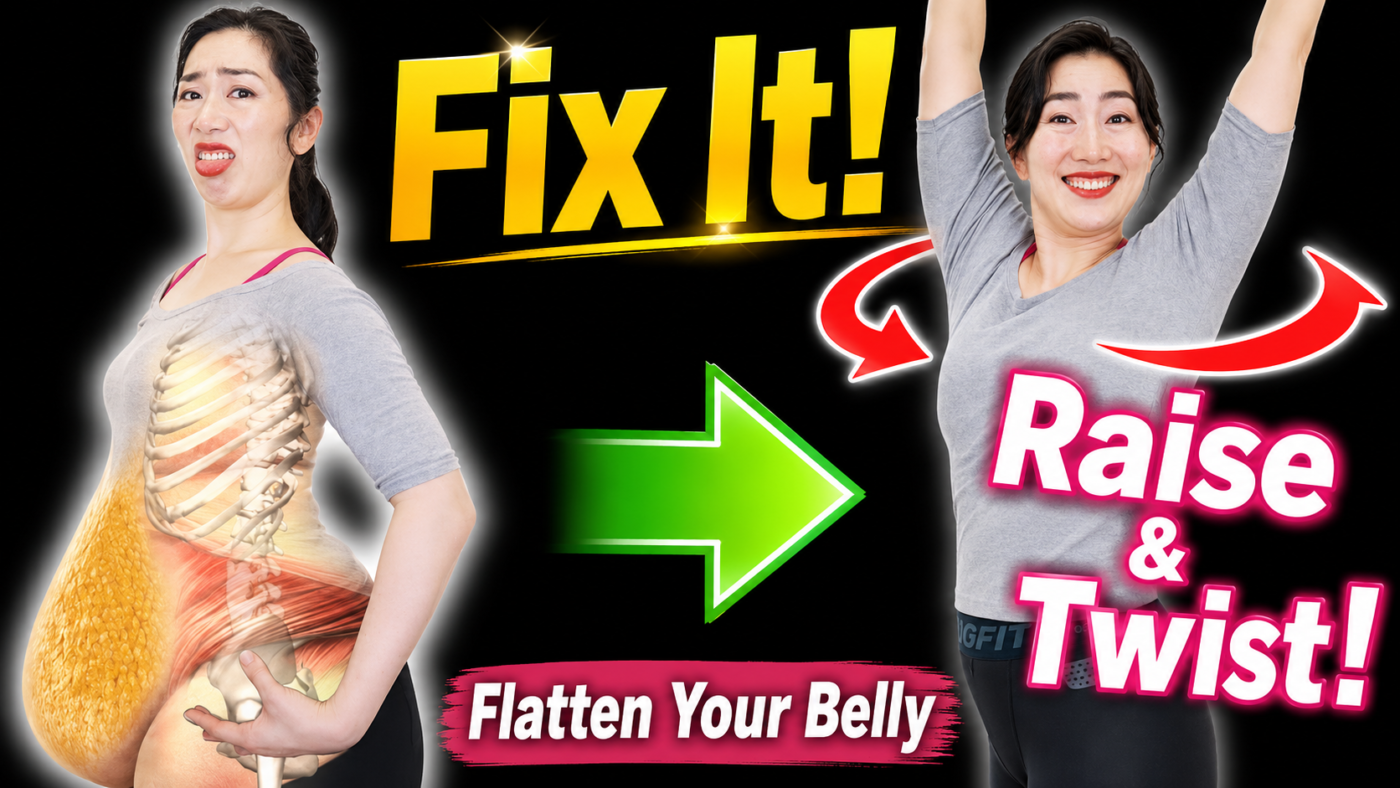
Overhead stretch for flatter belly after 40 can help your torso feel longer, improve posture awareness, and make your abdominal muscles feel more engaged. Raising your arms and gently twisting may temporarily change how your waist looks, although this does not mean belly fat has suddenly disappeared.
That is why a very simple movement—raising the arms overhead and gently twisting—can sometimes make the stomach look different within minutes.
But there is an important distinction.
This visual change does not mean belly fat has suddenly disappeared.
Raising your arms cannot permanently lift your internal organs.
And a few twists cannot turn your body into a fat-burning machine while you sleep.
What these movements can do is help improve posture awareness, rib-cage mobility, spinal movement, breathing mechanics, and gentle core engagement.
For adults over 40, those are worthwhile benefits on their own.
Why Your Belly Can Look Different Without Losing Fat
An overhead stretch for flatter belly after 40 works mainly through posture, mobility and temporary core engagement rather than localized fat loss.
The appearance of the abdomen is influenced by much more than body fat.
It can change depending on:
- Posture
- Pelvic position
- Rib-cage position
- Abdominal muscle activity
- Bloating
- Breathing
- Spinal alignment
- How relaxed the abdominal wall is
If you spend much of the day sitting with the shoulders rounded and the trunk compressed, standing tall and reaching overhead may immediately change the shape of your torso.
You have not lost fat.
You have changed your position.
Can Raising Your Arms Make the Belly Look Flatter?
Temporarily, yes.
When you lift your arms overhead, several things may happen.
The rib cage moves.
The spine lengthens.
The trunk muscles become active.
You may naturally stand taller.
The abdominal wall may become more engaged.
All of this can make the stomach appear slightly more controlled.
But that is a postural effect, not localized fat loss.
Does Arm Weight Compress Your Internal Organs?
No.
Human arms do have weight, but simply allowing them to hang naturally at your sides does not compress the abdominal organs enough to create a protruding belly.
The body is anatomically designed to support the upper limbs through the shoulder girdle, muscles, connective tissues, and skeleton.
A protruding abdomen is much more likely to reflect factors such as:
- Body fat
- Posture
- Abdominal muscle tone
- Bloating
- Pelvic position
- Pregnancy history
- Genetics
The idea that hanging arms physically push the organs downward is not supported by normal anatomy.
Can Raising the Arms Lift Internal Organs?
Not permanently.
Reaching overhead can alter trunk position and intra-abdominal pressure.
You may feel the abdomen lengthen.
But the liver, intestines, stomach, and other organs are not mechanically lifted into a permanently higher position by stretching.
They are supported by complex anatomical structures, including:
- Ligaments
- Fascia
- Mesenteries
- Abdominal walls
- Pelvic floor
- Surrounding tissues
An overhead stretch cannot rearrange them.
What Happens to the Core When You Reach Overhead?
The core helps stabilize the trunk while the arms move.
Muscles that may contribute include:
- Transversus abdominis
- Internal obliques
- External obliques
- Rectus abdominis
- Multifidus
- Erector spinae
The degree of activation depends on how you perform the movement.
If you gently brace the abdomen while reaching, the exercise becomes more of a trunk-control drill.
That can be useful.
Why Twisting Changes How the Waist Feels
Torso rotation involves the obliques and spinal rotators.
A controlled twist may help:
- Improve rotational mobility
- Increase awareness of the rib cage
- Activate the obliques
- Reduce the feeling of stiffness
- Make standing movement feel easier
But twisting does not selectively burn side fat or love handles.
The obliques can become stronger.
The fat above them is controlled by overall body composition.
Can This Exercise Strengthen Respiratory Muscles?
Breathing and posture are closely connected.
Your main respiratory muscle is the diaphragm.
Other muscles can assist breathing, especially during deeper or more demanding respiration.
Overhead arm positions can change the mechanics of the rib cage and chest wall.
However, saying that raising the arms “reactivates respiratory muscles that work 24 hours a day and dramatically boosts metabolism” exaggerates the effect.
Breathing muscles already work continuously.
They do not need to be “switched back on.”
Do Weak Respiratory Muscles Slow Metabolism?
Not in the way social-media videos often suggest.
Resting metabolism is primarily influenced by factors such as:
- Body size
- Lean body mass
- Age
- Genetics
- Hormones
Weak breathing muscles are not a common hidden cause of ordinary weight gain.
Regular exercise improves fitness and increases energy expenditure.
That is a much more meaningful pathway.
Can Better Breathing Help Exercise?
Yes.
Learning to coordinate breathing with movement can improve comfort during exercise.
For example:
Inhale while preparing.
Exhale while engaging the core or moving through the more demanding part of the exercise.
This can improve movement control.
Does Raising Your Arms Increase Serotonin?
Exercise in general can influence mood-related neurochemistry.
But a few overhead reaches should not be presented as a reliable method for significantly raising serotonin levels.
The mood benefits of regular physical activity are much better established than claims about one specific movement.
Can This Exercise Prevent Back Pain?
No exercise can guarantee that.
But gentle spinal movement, shoulder mobility, and core control may help some people feel less stiff.
Back pain is multifactorial.
Possible contributors include:
- Disc problems
- Joint irritation
- Muscle strain
- Nerve irritation
- Sleep
- Stress
- Work demands
- Previous injury
If pain is persistent or severe, stretching alone is not enough.
Can Twisting Hurt the Back?
It can if performed aggressively.
People with sensitive backs should avoid forceful end-range rotation.
The movement should be controlled.
Rotate only as far as feels comfortable.
Do not use momentum.
An 8-Step Overhead Stretch and Twist Routine
This overhead stretch for flatter belly after 40 routine combines gentle reaching, twisting and pelvic control.The original routine contains several useful mobility movements.
Here is a safer version focused on posture, core control, and comfort.
1. Shoulder Shrugs
Stand with feet about hip-width apart.
Lift the shoulders gently toward the ears.
Lower them slowly.
Repeat 8–10 times.
Do not force the movement.
2. Overhead Reach
Place your palms together or keep the hands shoulder-width apart.
Reach upward.
Keep the ribs controlled rather than dramatically flaring them forward.
Breathe normally.
Hold for 5–10 seconds.
Relax.
Repeat 3 times.
3. Overhead Side Twist
Raise the arms overhead.
Gently rotate the torso to one side.
Keep the pelvis mostly facing forward.
Return to center.
Rotate the other way.
Repeat 5–8 times per side.
Avoid forcing your neck to look far behind you.
4. Shoulder-Blade Circles
Lower the arms.
Move the shoulders in slow circles.
Let the shoulder blades glide naturally.
Perform 8 circles.
Reverse.
5. Hip Circles
Place the hands on the hips.
Circle the pelvis slowly.
Keep the knees relaxed.
Repeat 5–8 times.
Reverse direction.
6. Pelvic Tilt
Stand comfortably.
Gently tilt the pelvis forward.
Then backward.
Avoid strong abdominal gripping.
Repeat 8–12 times.
This helps you recognize different pelvic positions.
7. Overhead Reach With Gentle Core Activation
Raise both arms.
Exhale slowly.
Gently tighten the abdominal wall as though fastening a comfortable belt.
Reach upward without holding the breath.
Hold 2–3 seconds.
Relax.
Repeat 5 times.
8. Relaxed Arm Swing
Lower the arms.
Swing them gently beside the body.
Let the shoulders relax.
Breathe slowly for 30–60 seconds.
What Should You Feel?
You may notice:
- A taller posture
- Gentle abdominal tension
- More rib movement
- Looser shoulders
- Mild warmth
- Easier spinal rotation
You should not feel:
- Sharp back pain
- Dizziness
- Numbness
- Chest pain
- Strong pelvic pressure
Stop if these occur.
Why the Belly May Look Flatter Immediately
After the routine, you may naturally:
- Stand taller
- Engage the abdomen more
- Reduce excessive rib flaring
- Change pelvic position
- Hold the torso differently
All of these can change your silhouette.
That is why before-and-after images can appear dramatic even when body fat is unchanged.
Can Doing This Five Times a Day Permanently Flatten the Belly?
Not by itself.
Repeating a mobility drill several times per day may improve movement awareness.
But lasting abdominal fat reduction requires a broader strategy.
That typically includes:
- Regular physical activity
- Strength training
- Nutrition
- Appropriate energy intake
- Sleep
- Long-term consistency
Can Core Activation Help?
Yes.
A stronger, better-controlled core can improve trunk stability.
Useful exercises include:
- Dead bugs
- Bird dogs
- Side planks
- Modified planks
- Pallof presses
- Carries
- Glute bridges
These provide more progressive resistance than stretching alone.
Why Strength Training Matters After 40
Muscle mass tends to decline with age if it is not actively maintained.
Resistance training helps preserve:
- Strength
- Muscle
- Bone
- Balance
- Function
If your goal is a firmer-looking midsection, whole-body strength training is much more important than repeatedly stretching the waist.
Can You Spot-Reduce Belly Fat?
No.
Twisting the waist does not force the body to burn fat from the stomach.
Abdominal fat reduction occurs as part of overall body-fat loss.
Genetics and hormones influence where fat comes off first.
What Actually Helps Reduce Belly Fat After 40?
A realistic plan includes several elements.
Regular Walking
Walking increases daily energy expenditure.
Resistance Training
Strength training preserves muscle.
Protein
Adequate protein supports muscle maintenance and satiety.
Appropriate Calories
Long-term fat loss requires an energy deficit.
Sleep
Sleep quality affects appetite and recovery.
Stress Management
Stress can influence eating, sleep, and activity patterns.
Is This Better Than One Hour at the Gym?
No.
A short overhead mobility drill and a one-hour gym session serve different purposes.
A gym workout may provide:
- Much greater muscular loading
- Higher energy expenditure
- Cardiovascular training
- Progressive resistance
A short stretch can still be valuable because it is easy to repeat.
It should complement exercise, not replace it.
Can Stretching Increase Basal Metabolism?
Not meaningfully.
Basal metabolic rate is not substantially increased by a few stretches.
Building and maintaining lean mass has a much greater long-term relationship with resting energy expenditure.
What About a “Fat-Burning Body While You Sleep”?
Your body always uses energy while sleeping.
But overhead stretching does not dramatically increase overnight fat burning.
The phrase is better understood as marketing language rather than physiology.
Posture Still Matters
Even though posture does not directly burn fat, it can strongly influence appearance.
Compare:
slouched torso + relaxed abdominal wall
with:
upright torso + controlled ribs + gentle core activation
The second position may look significantly leaner.
That visual change is real.
It just should not be confused with weight loss.
A Better Goal Than “Flatten My Belly Instantly”
Instead of asking:
“How do I shrink my belly today?”
ask:
“How do I improve my posture, core strength, and body composition over the next few months?”
That creates a much more effective strategy.
The Bottom Line
An overhead stretch for a flatter belly after 40 can help you feel taller, more mobile, and more aware of your abdominal muscles.
Raising the arms and gently twisting may temporarily change the way your waist looks.
But the exercise does not:
- Melt belly fat
- Lift internal organs permanently
- Dramatically increase basal metabolism
- Turn you into a fat-burning machine while sleeping
Its real value is more practical:
mobility + posture awareness + core coordination + movement
Use it as a short movement break.
Then combine it with walking, resistance training, and appropriate nutrition for lasting changes.
A flatter-looking belly can begin with posture.
A genuinely healthier body requires the whole picture.An overhead stretch for flatter belly after 40 can be a useful daily mobility habit, but it should complement—not replace—walking, strength training and appropriate nutrition.
Frequently Asked Questions
Can raising your arms make your belly look flatter?
Temporarily, yes. Better posture and abdominal engagement can change your silhouette.
Does overhead stretching burn belly fat?
No. It cannot selectively remove abdominal fat.
Can twisting slim your waist?
Twisting strengthens and mobilizes the trunk but does not spot-reduce waist fat.
Can raising the arms lift internal organs?
No. It may change posture but cannot permanently reposition internal organs.
Do hanging arms make the belly protrude?
There is no evidence that normal arm weight compresses abdominal organs enough to create a bulging belly.
Can breathing exercises boost metabolism?
They use some energy but do not dramatically increase basal metabolism.
Can overhead stretching help back stiffness?
It may help some people feel more mobile, but it cannot guarantee prevention or treatment of back pain.
Should I twist as far as possible?
No. Stay in a comfortable, controlled range.
How often can I do this routine?
Gentle mobility can often be practiced daily if it feels comfortable.
What actually reduces belly fat?
Overall fat loss supported by appropriate nutrition, physical activity, resistance training, sleep, and consistency.
Medical Disclaimer:
This article is for educational and informational purposes only and is not medical advice. Stop any exercise that causes sharp back pain, dizziness, numbness, chest discomfort, or significant pelvic pressure. People with recent abdominal or spinal surgery, significant back disorders, hernias, pregnancy, or cardiovascular concerns should consult a qualified healthcare professional before starting a new exercise routine.
This article is for general education and does not replace individualized care from a qualified health professional. Seek appropriate advice for persistent, severe, or concerning symptoms.
Read the full medical disclaimer