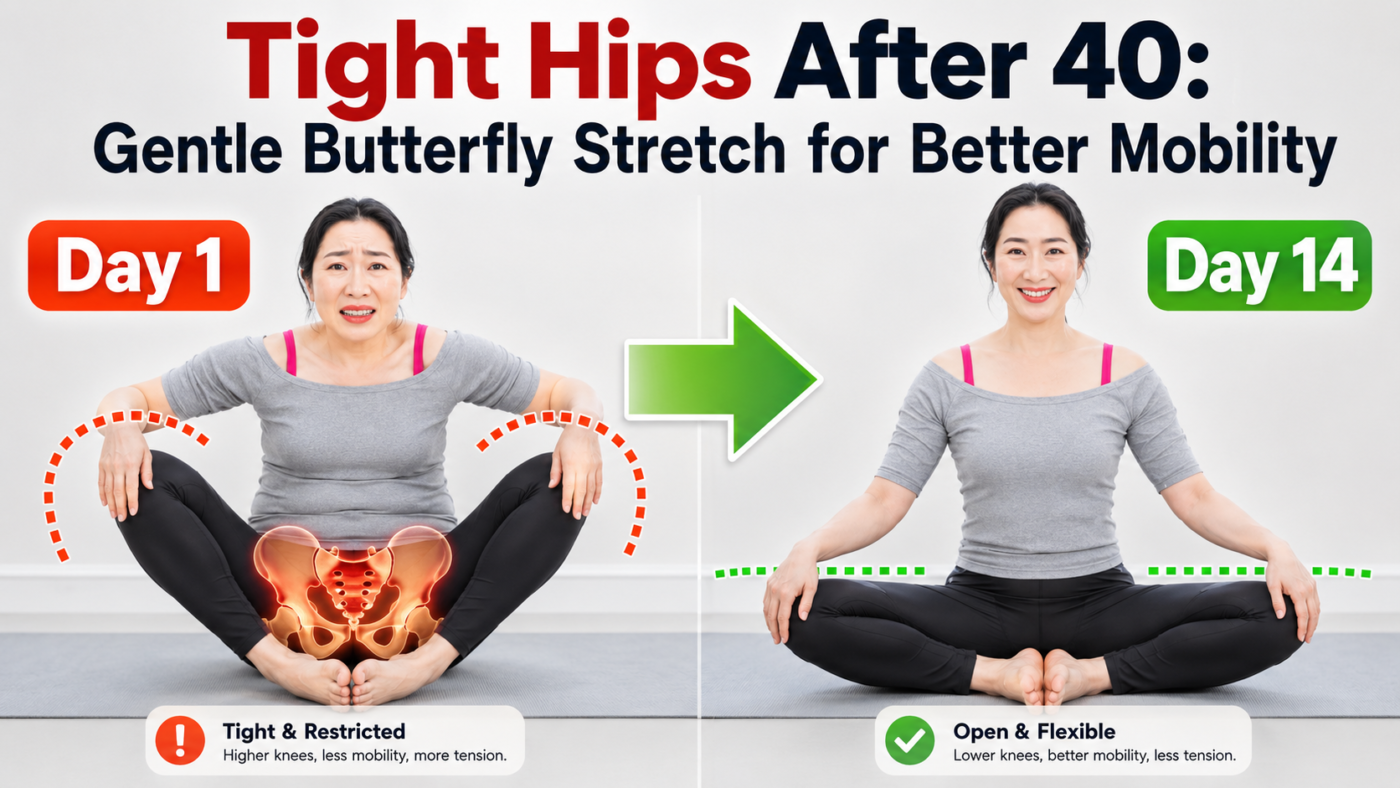
Tight hips after 40 can make ordinary movements feel surprisingly difficult.
You may notice stiffness when standing after sitting for a long time, bending down to pick something up, getting out of a chair, climbing stairs, or sitting on the floor.
For some people, even a simple butterfly stretch feels nearly impossible.
This has led to a popular claim online:
“Open your hips and your body will start slimming down.”
That sounds appealing, but hip flexibility does not directly control fat loss.
Improving hip mobility can make movement more comfortable and may help you stay more physically active. That can support weight management over time.
But stretching itself does not melt body fat.
The real value of hip mobility is better movement, greater comfort, improved flexibility, and maintaining physical independence as you age.
Why Tight Hips After 40 Are So Common
The hips are designed to move in many directions.
They help with:
- Walking
- Running
- Squatting
- Sitting
- Climbing stairs
- Rotating the body
- Getting up from the floor
However, modern life often involves long periods of sitting.
When certain movement ranges are rarely used, they can begin to feel stiff or unfamiliar.
Other contributors may include:
- Reduced physical activity
- Previous injury
- Osteoarthritis
- Muscle weakness
- Limited hamstring flexibility
- Tight quadriceps
- Hip flexor stiffness
- Lower-back discomfort
- Individual anatomy
Not everyone experiences hip stiffness for the same reason.
Do Tight Hips Prevent Weight Loss?
No.
Tight hip muscles do not block your body’s ability to lose fat.
Weight loss primarily depends on long-term energy balance.
That means overall calorie intake, activity level, muscle mass, sleep, and other lifestyle factors matter much more.
However, hip stiffness can still matter indirectly.
If walking, squatting, cycling, dancing, or strength training feels uncomfortable, you may naturally move less.
Better mobility can make those activities easier.
So the realistic relationship is:
Better hip mobility → easier movement → more physical activity → better support for weight management
Not:
Open hips → automatic fat loss
Can Hip Stiffness Cause Knee or Back Pain?
Sometimes it can contribute.
The hips, knees, spine, and ankles all work together.
If hip motion is limited, another region may compensate during certain movements.
That can affect how some people experience exercise or daily tasks.
But saying hip stiffness is “often the cause” of all knee or back pain is too broad.
Knee pain can come from:
- Osteoarthritis
- Tendon problems
- Meniscus injuries
- Ligament injuries
- Muscle weakness
- Previous trauma
Back pain can involve many factors too.
Hip mobility is one piece of the puzzle, not the entire explanation.
Why the Butterfly Stretch Is Useful
The butterfly stretch is a simple seated position that mainly targets the inner thighs and hip region.
It involves:
- Sitting down
- Bringing the soles of the feet together
- Allowing the knees to move outward
- Staying within a comfortable range
The goal is not pushing the knees to the floor.
The goal is gradually improving tolerance to hip abduction and external rotation.
You Do Not Need Extreme Flexibility
Many people assume a good butterfly stretch means both knees must lie completely flat.
That is not true.
Hip anatomy differs from person to person.
The shape and orientation of your pelvis and femur can influence how far your hips comfortably open.
A smaller range of motion does not automatically mean your hips are unhealthy.
Comfortable functional movement matters more than achieving an impressive stretch.
Can One Session Make You More Flexible?
Yes, temporarily.
After a warm-up and gentle stretching, your range of motion may improve during the same session.
This can happen because of:
- Increased tissue temperature
- Reduced muscle guarding
- Increased stretch tolerance
- Greater familiarity with the movement
That is why your second butterfly stretch may feel easier than your first.
But one session does not permanently change your body.
Long-term improvement requires repetition.
What About Massage Before Stretching?
Gentle massage may help you feel more relaxed before mobility work.
It may:
- Reduce perceived stiffness
- Increase local warmth
- Improve body awareness
- Make stretching feel more comfortable
But massage does not physically “unlock” the hip joint.
Nor does pain during massage prove that tissue is blocked.
Use comfortable pressure.
A 7-Step Beginner Hip Mobility Routine
This routine adapts the useful movements from the original video while removing exaggerated claims.
The goal is gentle progression.
1. Check Your Butterfly Position
Sit comfortably on the floor.
Bring the soles of your feet together.
Allow your knees to move outward naturally.
Do not press them down.
Notice:
- How high your knees remain
- Whether your back rounds
- Whether one side feels tighter
- Whether you feel discomfort
This is your starting point.
2. Massage the Front of the Thighs
Extend or relax one leg.
Use your hands to gently massage the front of the thigh.
Work through the quadriceps with comfortable pressure.
Continue for around 30–60 seconds.
Repeat on the other side.
This is a warm-up, not a fat-loss technique.
3. Massage the Back of the Thighs
Sit in a comfortable position.
Use both hands to gently massage the hamstrings.
Avoid strong pressure directly behind the knee.
Breathe slowly.
Repeat for around 30–60 seconds per side.
4. Gentle Knee Rocking
Sit with your knees bent.
Move them slowly from side to side.
Keep the range small.
You should feel movement through the hips.
Do not force the knees toward the floor.
Repeat 8–12 times.
5. Figure-Four Hip Stretch
Lie on your back or sit comfortably.
Place one ankle over the opposite thigh.
If lying down, gently bring the supporting leg toward you.
You may feel a stretch in the buttock or outer hip.
Hold for 20–30 seconds.
Repeat on the other side.
6. Seated Hip Rotation Stretch
Sit with one leg positioned comfortably in front and the other behind or to the side.
Use cushions if needed.
Keep the stretch mild.
Turn your torso slightly toward the front leg.
Hold for 20–30 seconds.
Repeat on the other side.
This position should never cause sharp hip pain.
7. Prone Quadriceps and Hip Stretch
Lie on your stomach.
Bend one knee.
If comfortable, bring the heel slightly toward the buttock.
You may use a towel or strap if reaching the ankle is difficult.
Keep the pelvis relaxed.
Hold for 20–30 seconds.
Repeat on the other side.
This primarily stretches the quadriceps and can also involve the front of the hip.
Recheck Your Butterfly Stretch
Return to the original butterfly position.
You may notice:
- Knees resting slightly lower
- Less pulling
- Easier forward leaning
- Less tension
- No major difference
Any of these is acceptable.
Improvement should be gradual.
Should You Push the Knees Down?
No.
Using force to press the knees toward the floor can place unnecessary stress on the hips, knees, and inner thighs.
Let gravity do most of the work.
If you want more support, place cushions beneath the knees.
What If You Cannot Sit Upright?
Put a folded blanket or cushion underneath your hips.
This raises the pelvis and often makes the butterfly stretch much easier.
This is especially useful if your lower back rounds strongly.
How Long Should You Hold a Hip Stretch?
A practical starting point is:
20–30 seconds
Repeat once or twice.
There is no need to hold a painful stretch for several minutes.
How Often Should You Work on Hip Mobility?
Three to five short sessions per week can be effective for many adults.
Gentle mobility work may also be performed daily if it feels comfortable.
Consistency matters more than intensity.
Stretching Is Only Half the Solution
Flexible hips also need strength.
After mobility work, consider adding:
Glute Bridges
10–15 repetitions
Sit-to-Stand
8–12 repetitions
Side-Lying Leg Raises
10–15 repetitions per side
Clamshells
10–15 repetitions per side
Supported Squats
8–12 repetitions
Strength helps you control the new range of motion you develop.
Why Hip Strength Matters After 40
Hip muscles are important for:
- Balance
- Walking
- Stair climbing
- Standing from a chair
- Controlling the knees
- Maintaining independence
With age, muscle mass tends to decline unless it is actively maintained.
This is why resistance training becomes increasingly valuable.
Do Tight Hamstrings Affect Hip Mobility?
They can.
The hamstrings cross the hip joint.
When the knees are straight, limited hamstring flexibility can restrict forward bending.
However, butterfly stretching primarily involves different movement patterns.
That is why a complete mobility routine should include:
- Hamstrings
- Adductors
- Hip flexors
- Glutes
- Quadriceps
What About the Iliopsoas?
The iliopsoas is a major hip flexor.
It helps lift the thigh and contributes to trunk and hip movement.
Some people experience a sensation of tightness around the front of the hip after prolonged sitting.
Gentle hip-extension movements and appropriate strengthening may help.
But the iliopsoas should not automatically be blamed for every hip or back problem.
Can Hip Stretching Improve Circulation?
Movement can temporarily increase local blood flow.
That can make muscles feel warmer and more comfortable.
But this does not directly reduce fat.
Circulation and fat loss are different physiological processes.
Does Hip Stretching Improve Lymphatic Flow?
Regular movement helps normal fluid circulation in the body.
But stretching is not a specialized treatment for lymphatic problems.
And increased lymph movement does not selectively remove hip or thigh fat.
Does Flexibility Reflect “Body Age”?
Not by itself.
Flexibility is one component of physical function.
A very flexible person can still have poor strength or cardiovascular fitness.
A less flexible person may still be extremely healthy and functional.
Healthy aging involves a combination of:
- Strength
- Aerobic fitness
- Balance
- Mobility
- Coordination
- Nutrition
- Sleep
There is no single flexibility test that tells you your true “body age.”
Hip Mobility and Weight Management
Mobility should be viewed as a supporting tool.
If better hip motion allows you to:
- Walk longer
- Exercise more comfortably
- Squat safely
- Cycle
- Hike
- Strength train
then it can indirectly support weight management.
But the stretching itself is not the primary calorie-burning activity.
Can Butterfly Stretching Make Your Legs Slimmer?
No specific stretch can selectively slim the thighs.
Leg appearance depends on:
- Body fat
- Muscle mass
- Genetics
- Skin
- Bone structure
Stretching may change how the muscles feel and how you hold your body.
It cannot selectively remove thigh fat.
What If You Feel Hip Pain?
Do not push through sharp pain.
Stop if you feel:
- Pinching deep in the groin
- Sharp pain
- Clicking with pain
- Numbness
- Tingling
- Sudden weakness
Persistent hip pain deserves medical evaluation.
When You Should Seek Professional Advice
Consider seeing a healthcare professional if you have:
- Persistent hip pain
- Pain at night
- Significant loss of motion
- Recent trauma
- Difficulty bearing weight
- Increasing weakness
- Unexplained swelling
- Previous hip surgery
Stretching is not a substitute for diagnosis.
The Best Goal After 40
Instead of aiming for:
“Perfect butterfly flexibility.”
Aim for:
“Hips that let me move comfortably through everyday life.”
That can mean being able to:
- Stand up easily
- Walk comfortably
- Sit on the floor
- Get into a car
- Bend safely
- Exercise confidently
These outcomes matter much more than how low your knees reach.
The Bottom Line
Tight hips after 40 are common.
Gentle hip mobility, massage, and stretching can improve comfort and flexibility.
But hip stiffness does not stop fat loss.
Opening your hips does not automatically make your body slimmer.
And hip tightness is not the single cause of every knee or back problem.
The most useful approach is:
Mobility + strength + regular activity
Stretch gently.
Strengthen the hips.
Walk regularly.
Stay active.
And focus on function rather than extreme flexibility.
Frequently Asked Questions
Can tight hips stop weight loss?
No. Tight hips do not directly stop fat loss, although discomfort may reduce activity.
Does butterfly stretching burn thigh fat?
No. Stretching cannot selectively burn fat from the thighs.
Can hip flexibility improve after one session?
Yes, temporarily. Long-term improvements require repeated practice.
Should my knees touch the floor in butterfly stretch?
No. Hip anatomy varies, and the knees do not need to reach the floor.
Is massage useful before hip stretching?
Gentle massage may help reduce perceived stiffness, but it does not unlock fat loss or fix the hip joint.
Can tight hips cause knee pain?
Limited hip mobility may contribute in some cases, but knee pain has many possible causes.
Can tight hips cause back pain?
They may influence movement patterns in some people, but back pain is multifactorial.
How often should I stretch my hips?
Three to five short sessions per week is a reasonable starting point.
Should hip stretches hurt?
No. Mild tension is acceptable; sharp or pinching pain is not.
Do I need extreme hip flexibility after 40?
No. Functional mobility and strength are much more important.
Medical Disclaimer:
This article is for educational and informational purposes only and is not medical advice. Stop any stretch or massage that causes sharp pain, pinching, numbness, tingling or significant discomfort. People with persistent hip pain, arthritis, recent injury or previous hip surgery should consult a qualified healthcare professional before beginning a new mobility routine.
This article is for general education and does not replace individualized care from a qualified health professional. Seek appropriate advice for persistent, severe, or concerning symptoms.
Read the full medical disclaimer